Sunday, August 11, 2013

Quality or quantity? The Debate Rages on Lynn Swann’s Hall of Fame Credentials

Reprinted from Pro Football Weekly online

******************************

Pro Football Weekly

Quality or quantity? The debate rages on over Swann’s Hall of Fame credentials

By:    John Turney

Monday, Jan. 22, 2001 

Every year for the last 13 years, the day before the Super Bowl, a great debate begins. It entails the pros and cons of former Pittsburgh Steelers WR Lynn Swann and his worthiness of being inducted to the Pro Football Hall of Fame. Swann has been the most debated player in the history of the Hall of Fame, having been on the list of final 15 candidates a record 14 times, including the upcoming list for 2001. No player has been a finalist that many times without being voted in. Swann has been on that list every year since he became eligible in 1988. 

This debate has, at times, been very contentious. Myron Cope, the Steelers' radio broadcaster and inventor of the "Terrible Towel," resigned from the selection committee because he felt he was getting too emotional and might be hurting Swann's chances of induction. Some of the voters even dread going over the same territory every year. 

The debate goes something like this: The cons are articulated by people like Sports Illustrated's Peter King, who is one of the fairest and thoughtful voters on the Hall of Fame committee. The naysayers point to the fact that Swann averaged less than three catches per game for his career and say that is simply not a Hall of Fame number. The pro argument, as voiced by the likes of Paul Zimmerman, also at Sports Illustrated, goes something like this, "What do you want, quality or quantity? Swann's catches were mostly made downfield, his catches meant something and he played his best when the stakes were the highest." 

Both sides seem to have merit, which is why there has been a stalemate on that committee for 14 years. There are enough of the voters on the "con" side to block those on the "pro" side but still enough of the pros to keep Swann's name on the list for more than a dozen seasons. 

Swann's nine-year career was indeed short by usual Hall of Fame standards, but it should be noted that Swann had problems with concussions early in his career. He was knocked cold in 1975, a week before he played possibly the best game by a wide receiver in the history of the Super Bowl. The following year George Atkinson gave Swann his second major concussion in two seasons, inciting the debate of whether there was a "criminal element" in the game of football. However, it was not the concussion that cut Swann's career short. 

It was always Swann's plan to play in the NFL for 10 years, but after his ninth, he was offered a television deal that dwarfed what he would have earned in the NFL. In 1982 the players were not pulling in the kind of dollars they are today, so financial stability was a factor. "I weighed the decision of playing another year to getting a foothold into my next career, and I think I made the right choice. I am still in broadcasting." 

Swann has often jabbed at former Steeler head coach Chuck Noll, saying that his type of offense has kept Swann out of the Hall of Fame. Noll was a run-first coach. From 1974 to ’82, the Steelers ran the ball 58.9 percent of the time, among the highest percentages in the NFL for that period. Even in 1978, when the NFL loosened the rules to enhance the passing game, Noll wasn't having any, at least on a regular basis. The Steelers still threw the ball 100 to 150 fewer times than teams like San Francisco, San Diego, Cleveland, Seattle, Minnesota and a few others whose receivers put up big numbers, and therefore gained the attention of the Hall of Fame voters. 

Still, when the Steelers threw, their passes were down the field. During that same period of 1974-82, the Steelers averaged 14.1 yards per completion, the second-highest average in the NFL. While the Raiders talked of the vertical game, it was the Steelers who practiced it most effectively. The Steelers’ offensive game plan was simple: pound the ball with Franco Harris and Rocky Bleier and when a shot was available down the field, take it. Terry Bradshaw's credo, "Throw deep," wasn't just idle talk for the Steelers; it was a reality. 

No one has ever questioned Swann's talent, just his career numbers. However, when looked at in context, his numbers look excellent. Swann averaged 46 catches per 16 games for 753 yards and seven touchdowns. Hall of Famer Charlie Joiner was called by Bill Walsh "the smartest, most calculating receiver the game has ever known." Which may be true, but his career average was not much more than Swann's. Over his 18-year career, Joiner averaged 50 catches and 813 yards and 4.4 touchdowns per 16 games. That is roughly one extra 15-yard curl, a pattern that Joiner was the master of, every four games. Of course, compared to Joiner, Swann averaged an additional touchdown every six games. Joiner retired as the leading pass catcher in NFL history, thanks to some degree to being part of a forward-thinking head coach who put the ball in the air 55 percent of the time. Had Swann played for those Chargers teams, many think he would have put up great numbers in a "Air Coryell" offense. 

The case is similar to Art Monk, who is eligible for the Hall this year. Monk averaged 67 catches for 909 yards and five touchdowns per 16 games. Compared to Swann, Monk averaged about one 1.3 more catches for almost 10 extra yards every game. With Monk, however, you would have to give back a touchdown every seven games. So what do you want, more catches or more touchdowns? The Steelers’ coaches chose an offense that would get them championships. Damn the statistics, full trap ahead. 

The reasonable point here is that eras changed during Swann's career. Great players like Monk and Joiner were on the leading edge of a passing revolution in the NFL that began in 1978. Receptions were easier to get, due to rule changes in pass defense and pass blocking. The numbers that receivers post are more staggering every season, culminating with the St. Louis Rams’ passing offense that broke so many records the past two seasons. 

Of course, the Hall of Fame should never be decided on speculation, but if Swann could play in the Rams’ offense of today, a reasonable observer would have to concede that he would put up huge numbers. Seeing Isaac Bruce — the clean cuts, the body control, the acceleration — reminds some experts of Swann, but with the talent edge going to Swann. The same holds true for Marvin Harrison, who dons Swann's number and slight build, but Swann's athleticism had a certain grace and beauty to it. Swann could have made a living winning those old, made-for-TV "Super Stars" competitions that Swann just dominated. Regardless of what Swannie did, he did it well and with style. 

Swann reflects back to the days when they would watch the Chargers on film and be amazed at the number of balls that were available. "We were lucky to throw 15 to 20 passes a game. In our offense you had to be happy to get three or four in a game; now they get that many in a quarter." Today it would be a different story. "I know with that same group of guys and running a big-time offense like the 1999-2000 Rams, John (teammate WR John Stallworth) and I would do what they are doing today in terms of catches, yards, whatever. Theo Bell, Jim Smith and Bennie Cunningham were all excellent players who could play today. I'll say this: It would be fun." 

The strongest case to be made for Swann is that he played best when it counted most, in the playoffs. Swann did come up huge in 16 postseason games. He caught 47 passes for 906 yards for an 18.9-yard average and nine touchdowns — against playoff competition in a run-first era. In those 16 games the Steelers came out victorious 13 times, including four times in the Super Bowl. Swann made a couple of big catches in the AFC championship game that propelled the Steelers into Super Bowl IX against the Vikings. 

Swann was the MVP in Super Bowl X with perhaps the best "big" game any receiver has ever played. He made four catches, three of the circus variety, for 161 yards, including the game-winning grab. "Terry Bradshaw only threw five passes to me that day." What Swann won't tell you but knows in his heart is that a normal wide receiver could not have made three of those catches. They were too difficult, too unique to his set of skills — in a word, too much Swann. 

He caught the go-ahead pass in Super Bowl XIII that put Dallas in a hole. On that one, Swann called the play in the huddle because he saw the Dallas cornerbacks coming up. He knew they were biting on the three-step drop. So Swann waited for Bradshaw to pump-fake, and that was his signal to blow by the corner. He did, and that touchdown, for all intents and purposes, sealed the Cowboys’ fate that day. 
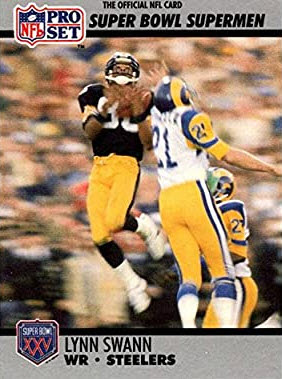
The following year there was Super Bowl XIV, in which he made a spectacular, leaping 47-yard touchdown reception that gave the Steelers the lead. On that catch, Swann outleaped the Rams’ two best defensive backs, Pat Thomas and Nolan Cromwell. Cromwell was so close to knocking it down that, to this day, it nearly kills Ram fans to see that highlight. A few plays later, Swann was knocked out of the game with yet another concussion, and it became Stallworth's turn to catch the game-winning touchdown pass. 

When Swann decided to retire after nine seasons, he felt he had gotten all he could out of football — All-Pro, Super Bowl MVP, Pro Bowls, Super Bowl rings. All that is left is the Hall of Fame. His choice of health and a new career in the media has definitely affected his chances. Had he played a few more years, his regular-season numbers might look better. But would they make him a greater player? Absolutely not. 

Jerry Rice, the king of all wide receivers, paid Swann the best compliment ever. It was done in a subtle way, the way jocks talk to each other, simple, direct and sincere, "He walked up to me," Swann remembers, "and said, ‘Swannie, you were "the Guy," to everybody.’ "Swann knew what that meant. Swann knew he had made an impact. 

Swann knows that he had an impact. He is secure with the fact he has Super Bowl rings. He is secure in the knowledge that he did his job, he made the touch catches, he went across the middle, he played great in big games, he brought skill and grace to the WR position and also brought intelligence and knowledge of the game. He remembers making an impact his rookie year as a punt returner. He knows the answer to the question: "Was he good enough to be in the Hall of Fame?" The question he can’t answer is whether the selection committee voters know it too. 

The debate will rage once again on Super Bowl Saturday, and the committee will let us know whether quantity or quality. But time may be running out for Swann, who has this year and next to be voted in. Unless that is, Swann becomes the subject of a regular debate at the Hall of Fame Seniors Committee meetings each August. 

Let's hope the air conditioning is in working order for those sessions—if they occur. 

John Turney is the researcher/historian for the Dick Butkus Football Network and a member of the Pro Football Researchers Association. 

Monday, July 15, 2013

Combined All-Decade Teams—1930s

By John Turney

Aside from the Pro Football Hall of Fame Official All-Decade team (HOF) there were more 1930s All-Decade selections. They were Pro Football Digest (PFD), Pro Football Chronicles (PFC), Sunday Mayhem (SM) along with Sports Illustrated (SI)  and Sporting News (SN).

Note: The HOF teams are not officially separated as First- and Second-teams, however, in the early 2000s on the Pro Football Hall of Fame website they were separated as such and we considered that semi-official and also those divisions followed with who was considered the top players and thus made sense, as you will see below.

Here are the selections:


Sunday, May 12, 2013

Jaguars Show Off New Uniforms

LOOKING AHEAD
By John Turney

A few weeks ago the Jacksonville Jaguars redesigned their uniforms allowing Nike to design the duds. According to reports on the Internet the new unis are "meant to create a new look and new attitude" for Florida’s youngest NFL franchise. This was a coloration between Nike and the NFL, with Scott Faries as part of the mix. 

Nike Elite 51 is the type of uniform they will wear. According to Nike "The design renaissance developed by the Jacksonville Jaguars, the NFL, and Nike, centers around the concept of the American dream and realizing success through hard work, ingenuity, and leadership".

Again, according to Nike's press release, "The uniform is a head-to-toe integrated system of dress with an aggressive, modern design that honors the team’s military fan base and positions the team for the future." 

More from Nike, "The new black uniform features teal and gold accents, making a bold statement from top to bottom. Black represents the true characteristics of a jaguar – a feared predator who hunts with stealth precision. Jaguar claw marks across the shoulders, around the neckline and within the stripe pattern on the pant are placed in an aggressive forward-facing position."

The new uniforms feature a new helmet that are black in the front and fade to gold—symbolizing a jaguar coming out of the shadows.
Correct us if we are wrong, but if the jaguar is coming out of the shadows shouldn't the back of the helmet be black and the front gold?

We think the gradient helmet is iffy, and the number font is terrible. The uniforms are just not good.  Obviously, these things will never be up to us, all we can do is be critics, but if the fans like them, fine. But can these types of things last?

Jaguars owner Shahid Khan called the new design "A piece of art. We're young, we're contemporary and it looks to the future".

Well, he's right. It is the future. For now.

We'll check in around 2019 or so to see if they are still wearing them. You see, a team has to wear a uniform for five years before they can change them.

So, by then we'll see if there is a "new" future and a new "piece of art".

Saturday, May 11, 2013

Vikings Unveil New Uniforms for 2013 Season

LOOKING AHEAD
By John Turney
Source: Vikings Website
The new Vikings uniforms actually look good. We got a glimpse a while back when Nike showed all the uniforms in a mass release but we got a closer look late in April.

The Vikings and Nike, in a team release, made this statement, "The Vikings new uniform is a modern twist on the team's classic look. Reflecting on a culture of toughness, simplicity, and detailed craftsmanship, these unique characteristics give the Vikings uniform a renewed distinction."

Yes, it's a load on B.S. but it seems like this is happening a lot with new Nike uniform releases. Maybe they just like to hear themselves talk. But this time as we mentioned, they did pretty well.

There is a hint of the "new" and the "old" if you will. The numbers, those in the 'left-hand" column have the design of the "bow" of a Viking ship. The numbers on the right-hand side are normal. Our only gripe is that single-digit numbers should have the "bow" effect as well. We called the Vikings and asked what that was and they just said, "that's just not our font".
Source: Vikings Website
Says who? Nike. Oh well, it's not that big a deal.

The helmet has a matte finish and the mask is black. We'd have preferred a purple mask, but again, that's a small detail.
Source: Vikings Website
Here are the Nike "talking points" released by the Vikings PR staff last month.

“There’s a harshness to the environment in Minnesota and it really creates a strength within those who live here,” said Vikings linebacker Chad Greenway. "The new uniforms are simple and powerful, and this design truly feels like us. I couldn’t be more proud to wear it this season.”

Another quote from the release, "The Nike Elite 51 uniform gives us a highly innovative, performance-led canvas to really tell the Viking story,” said Todd Van Horne, Nike’s Global VP and Creative Director for Nike Football. “This new design is a modern representation of the Viking culture and makes a simple, yet powerful statement.”

“I’ve worked closely with Nike designers for years to provide input on the way this uniform should be built,” said Minnesota Vikings running back Adrian Peterson. "The way a uniform fits really does matter when you’re out there on the field. I think fans will love the new design – it’s the way a Viking is supposed to look.”

The Vikings last changed uniforms in 2006 though it does not seem that long ago to us. This is an upgrade and think it will be around a while.

Friday, May 3, 2013

Dolphins Officially Show New Uniforms

LOOKING AHEAD
By John Turney
CBS Miami
Above are the new Dolphins uniform that was leaked last month and then officially announced a couple of days later (April 23, 2013). Apparently, this uniform was a collaboration between Nike and Scott  Faries, a designer who worked for the NFL in some design capacity.

The color of aqua is said to be "brighter" as is the orange that captures the "city’s modern, cutting-edge characteristics".  Further, according to Nike, "Miami’s sun and South Florida waters serve as the foundation for the Dolphins uniform aesthetic. The updated hues reflect the blues in the water, as well as the orange in the sun and glow of the city".

The uniform will be the Nike Elite 51 uniform design and according to Todd Van Horne, Global VP and Creative Director for Nike Football it "is a true reflection of their culture – modern, refined and bold. This highly innovative uniform system allows for zero distractions on the field and provides a fresh updated look to take the team into the 2013 season."

Zero distractions? That has to be a good thing, right?

The release goes on, "The new helmet sheen features a sparkled finish to reflect the sand, as well as a refined stripe pattern with a pop of orange, to highlight the horizon. The same stripe pattern is carried throughout the uniform into the new number and font design and through the stripe in the pant."

“As an athlete, you don’t want to worry about your uniform out on the field. It’s good that Nike thinks about the details so we don’t have to,” said Miami Dolphins wide receiver Mike Wallace. "Look good, feel good, play good — that’s what it’s all about.”

The Dolphins Hall of Fame QB alumni were certainly on board—"It’s fine. It's about looking forward and a new vision for the Dolphins" said, Dan Marino. “But the bottom line, and we all know it, it's about winning football games. It don’t matter what the logo is if you’re winning.”

Bob Griese added "I never was a big fan of a dolphin with a helmet on it," said Griese, preferring the new "realistic" figure on the helmet. “I think it looks confident, it looked stronger, it looks ready to battle.”
The "realistic" new Dolphin
Dolphins CEO  said "The old logo was kind of the dolphin dancing on top of the water at the dolphin show. This logo was more about the dolphin swimming in the wild and being at its maximum force."

Get it? MAXIMUM FORCE. Wasn't that a video game? But, we digress.

According to ESPN, "One of the early complaints from Miami fans is the eyes of the dolphin are smaller and appear to be nearly closed."

Of the power of the Dolphin, Armando Salguero of the Miami Herald wrote—
’The logo is interesting to me because it is the most controversial change of the team’s new look. It’s also less cartoonish now. It’s no longer wearing the helmet with its signature “M.”
Some people say it looks like a squeezed wedge of Aquafresh toothpaste. Others mock that it looks like a whale. Others say the old logo made the dolphin seem strong and this one makes the animal seem weak. 
Well, the truth is the Dolphins actually called marine biologists and asked at what point a dolphin is at its strongest. And the answer, the club tells me, is not after the mammal has breached the water’s surface, which is what the old logo depicts. Indeed, this is when the animal is most vulnerable. 
The answer is the dolphin is strongest in nature just prior to the animal’s breach of the water when all its muscles are flexed. And that’s what the new logo is said to depict. I cannot account for that. I’m just passing it along."
We don't know about all that. Our view is this uniform is okay, we'd give it a passing grade. Call it a "C".

We'd give this one an "A"—

Wednesday, February 20, 2013

Bruce Smith, 200 or 201?

LOOKING AT ERRORS IN THE OFFICIAL SACK ERA
by John Turney

In Week 11 of the 1985 season the Buffalo Bills traveled to Cleveland to play the Browns, which was not considered a historical game by any means. What makes it interesting is a statistical anomaly that occurred in the NFL Game Summary (play-by-play or PBP).

In reviewing it one can see that late in the first half rookie Bruce Smith was credited with two sacks on back-to-back plays, one for four yards and the next for six yards. However, as is sometimes the case with the PBPs the tackle chart at the end of the game summary showed conflicting information. But, to make this a rarity, the conflicting information is corrected in the tackle chart to make it consistent with the text. However, that information never seemed to be forwarded to Elias Sports Bureau, the NFL’s official statisticians.

The tackle chart and the end of the PBP showed one sack for Bruce Smith for four yards, but shows Don Smith, a defensive tackle who entered games in likely passing situations, getting the other sack for six yards. In NFL sack research Nick Webster and I often go with the text of the PBP as opposed to the tackle chart if there is a conflict, the logic being that the more senior member of the statistical crew would be typing the text. But in the case, the tackle chart was corrected in pencil giving both sacks to Bruce Smith, which made it consistent with the text.

Why mention it now? Only to show that in football there are often anomalies in these documents that have to be addressed by researchers who examine them. What makes this anomaly different is that if the text and the tackle chart agree (which they do after a Bills official corrected the tackle chart) then Bruce Smith had 7.5 sacks in 1985 rather than 6.5. If it bears out, then Bruce Smith has 201 sacks rather than 200.


It’s not a major difference, but does show that prior to 1987 when Elias Sports Bureau insisted on reviewing sacks there were small discrepancies and it shows that even though sacks were official beginning in 1982 that sacks are a tough statistic to score and on occasion it’s a matter of opinion.The best evidence would be the game film or television copy of the game, but those may not still exist. So, using the best evidence at this point, it is that Smith has 201 career sacks.

Art credit: John Turney
On a related note, in 2014 when the St. Louis Rams traveled to Kansas City there was another type of scoring anomaly that shorted Robert Quinn of a rightly earned sack.

Early in that game Quinn tacked down Chief quarterback Alex Smith and stripped the ball from him behind the line of scrimmage and the ball traveled forward a few yards where it went out of bounds. The Chiefs’s official scorers ruled it a running play likely because the officiating crew marked the ball improperly.

For weeks, to no avail, the Rams challenged the scoring. Team officials were told that Elias was having trouble accounting for the yardage since miscellaneous yards were no longer a category for odd plays like this. Rams coach Jeff Fisher said, "Yeah, it's one of those unusual things that happens once every few years". Quinn was disappointed, but also shrugged it off, "No need to sit there and lose sleep about it, right?" he said.

One aspect that would make it significant is that if properly scored Quinn would have had three sacks in the game, which would give him six three-sack games in his career in four seasons. The official leaders in that category are Lawrence Taylor and Reggie White, who had 12 each. Both those players did it 13 and 15 seasons, respectively.

The moral of the story is errors happen in football statistics, it’s such a fast and dynamic game that often split decisions are made to who made a tackle or sack or who forces a fumble or tips a pass. Pro Football Journal likes to report on these types of statistics, but is not under any illusion that the stats are always concrete or set in stone. And don’t even bring up a 2000 sacks credited to Le’Roi Glover that likely should have been credited to defensive end Joe Johnson. Johnson knocked a ball loose a split second before Glover tackled the quarterback who had no ball in his hand. That would have given Glover 16 for the season and Johnson 14, but it would have cost Glover the sack title as Warren Sapp had 16.5.

When this was pointed out to Seymour Siwoff he was a bit put out in that he replied “I wish you would have contacted us, we want to get it right”. His staff was informed by me, but in a busy season it was either not reviewed or it was and the film was not conclusive enough to make the change.

So no one is at fault, all involved try to get it right, but in football, “right” is a bit more nebulous than in say, baseball.

Monday, February 18, 2013

A LOOK BACK: 1979 AFC Pro Bowl selections: DE

1979 NOT A PRO BOWL-TYPE SEASON FOR ELVIN BETHEA
by John Turney


Often at Pro Football Journal we like to review the post-season honors players received and with perfect 20/20 hindsight make suggestions as to possible oversights and omissions.

One example is the 1979 Pro Bowl selections for defensive end in the AFC. The players voted to the game were Fred Dean, LC Greenwood, and Elvin Bethea. Dean and Bethea are Hall of Famers and Greenwood is a many-time finalist. Sacks did not become official until 1982 but in 1979 they were kept by game statisticians and most teams tallied them in their weekly press releases, along with tackles, forced fumbles, and other individual defensive statistics.

In the NFC the choices were fairly easy. Lee Roy Selmon was the NFL Defensive Player of the Year and Jack Youngblood and Bubba Baker were two of the top sackers in the NFL. Selmon was injured in the 1979 NFC Championship game and was replaced by Harvey Martin. Carl Hairston of the Eagles had 15 sacks and was thought to be a top alternate.

However, the AFC players didn't have the gaudy statistics of their NFL counterparts. Dean had nine sacks and Greenwood had seven. Bethea had one. Yes, one. Research has yielded some interesting details about that season and can perhaps offer a couple of choices that may have been better than Bethea and even Greenwood. Clearly, sacks are not the only measure of a defensive end, playing the run and being aware of run action passes like screens and on occasion taking the second back out of the backfield in coverage. But, from the Deacon Jones era to the present, sacks are a representation of the major job a defensive end has. To paraphrase Hall of Fame coach George Allen, "If a defensive lineman cannot rush the passer, he's stealing".

Starting in the late-1960s the designated pass rusher was starting to show up in NFL games, a player who played primarily on likely passing situations. However, none had ever received post-season honors such and being named All-Pro or voted to the Pro Bowl until 1981, when Fred Dean was so honored with both and more. Bethea was a worthy Hall of Famer, but 1979 was not one of his better seasons.

Rookie designated pass rusher Jesse Baker got the lion's share of sacks and led the AFC with 15½, about the number of Dean and Greenwood combined. However, being a rookie and not being an every-down player (he did spell Bethea some at right defensive end in the base defense) he was not voted for any post-season honors other than being voted to various All-Rookie teams so it's understandable how he was overlooked. 

Also overlooked, for likely the same reasons, was Tony "Mac the Sack" McGee, who totaled 11½ sacks The same is likely true for Tony "Mack the Sack" McGee, who, from 1974 through 1983 was a consistent nickel rusher for the Patriots and Redskins. The same goes for Willie Jones, the Raiders replacement in the DPR role previously held by Pat Toomey, with his ten sacks.

As for the players who were starters the best candidates for the Pro Bowl who were overlooked were Art Still and Vern Den Herder. Den Herder a nine-year vet had nine sacks as the Dolphins surged after a few down years. Still was chosen by Sports Illustrated's Paul Zimmerman for his All-Pro team, citing consistent pressure and great ability to stop the run. Still, he had 8
½ sacks but really began to show his ability the following year, 1980, when he totaled 14½ sacks and continued in his run-stopping dominance.

Bethea was hampered by some injuries, but played through them and on occasion played defensive tackle while Baker played right defensive end in the Oiler pass-rush set.

So, in this looking back installment, the best choices for 1979 AFC defensive ends would be Dean, who played very well on a very good Chargers defense, Still, an up-and-comer, and then a pick 'em: Den Herder or Greenwood. Both veterans with good moves, but coming to the end of their careers. 

Career stats: