Showing posts with label Chris Willis. Show all posts

Wednesday, November 26, 2025

OTD: 100th Anniversary Red Grange Pro Debut

 LOOKING BACK
By Chris Willis, NFL Films
Game Program for Red Grange's Pro Debut on Nov. 26, 1925

     On this day - November 26th - back in 1925 Harold "Red" Grange made his professional debut at Cubs Park in Chicago. Just four days earlier he left the University of Illinois to play pro football with the Chicago Bears. On Thanksgiving Day he played against the Chicago Cardinals and begin a barnstorming Tour that would change pro football and the NFL forever. 


     Over the next month or so PFJ will take a look back at one of the NFL's greatest events with articles on the famous Red Grange-Chicago Bears barnstorming tour. First will look at Red's pro debut. 

    Red Grange played his last collegiate game in Columbus, Ohio against Ohio State. After the game he took a train overnight to Chicago to sign with the Chicago Bears and play pro football. 

    On Sunday morning (Nov. 22nd) Red would make his way to the Morrison Hotel. Located downtown in the Loop, the Morrison was a high-rise hotel at the corner of Madison and Clark. The recent expansion of the hotel was just completed in 1925 to give the hotel a 46-story high-rise and nearly 2,000 rooms. It was just the stylish hotel that made the perfect headquarters for C. C. Pyle. In rooms 1739-1941 “Cash and Carry” was ready for the morning show. Red, wearing a light-colored suit and vest, a striped tie, white collard dress shirt, and his auburn hair slicked back and parted down the middle, knocked on the door of room 1739. Red entered the suite and greeted Halas and Sternaman for the first time. Red was quickly impressed by George Halas. 

    “I was impressed with him because he did everything himself. George was a one-man gang. He was his own press agent, his own coach, he played right end, he ran the ball park, looked out for security, he signed the players, he did his own scouting, he did everything there was to do around the football team.”

    After a few pleasantries Pyle got the circus going. The eager promoter brought in the press and photographers. The moment everybody was waiting for, had arrived. In the suite the four men sat down at a round glass table. The contracts and several pens were sitting there ready to make history. Red, sitting in the middle, had Pyle to his left and Halas to his right, with Sternaman sitting next to Halas. The foursome posed as Red held pen in hand ready to sign his first pro contract. Through a haze of smoke, following a broadside of flashlight powder from photographer’s cameras, Red signed his name. With the press surrounding him, Red said a few words:

    “Why I can’t see that there is any difference between the game as it is played on college gridirons or on the fields used by men who turn their attention to the sport for financial rewards. I am at a loss to comprehend all the fuss that has been made in my case simply because I propose to capitalize on such success as I have attained while playing at the University of Illinois.

    There are scores of baseball players who were mighty good men on college diamonds who upon leaving their universities have entered professional baseball and are now earning comfortable livelihoods through their skill at pitching, fielding or batting. No one ever criticized those fellows for signing pro baseball contracts.

    I have always loved football and when I play the game I want to play with and against the best teams possible. The closer the battle and better I like it. There isn’t any particular thrill in taking part in a one-sided contest. I have associated with the best men in the Western Conference for three years and learned much about football. In the professional circuit I expect to be pitted against seasonal players- the best men the various clubs offer. Here the competition should be of a keen order.”
Red Grange signs pro contract with Bears. L-to-R, Dutch Sternaman, George Halas,
Grange, and Pyle.
 
    Red then released a more complete statement (dated Nov. 22nd, Chicago, Illinois) to the press on why he choose to play pro football:

    “Yesterday I played my last college football game. Today, I am looking forward to my future. I alone must determine my career of tomorrow. No longer can I turn my eyes to those sterling American gentlemen and sportsmen, Huff and Zuppke, for the assistance they contributed so wholeheartedly in my development as a football player. My teammates who stood by me in the thick of conflict are now separated. No longer can they join with me with their splendid cooperation in the execution of the play as they did when we held aloft the colors of our beloved University of Illinois. No more will the liberal and generous press feature my deeds as a college football player. The plaudits of the student body and the public can no longer acclaim me for exploits upon the campus. 

    No one will gainsay I did my best on the football field. I put forth every ounce of energy into my playing and I feel as though I have now discharged a part of my obligation to the University of Illinois, to the student body, and to the traditions of that splendid institution. I say I have discharged in part my obligations. It will never be possible for me to repay in full measure all my obligations to that institution and its students.

    There remains uncharged my obligation to my father. Possessed of a scant supply of this world’s goods, he has given me an opportunity for an education at a great sacrifice. Then there is still imposed upon him the burden of my brother’s education.

    In what manner can I best perform my duty to my father and my brother? This is the question I have been turning over in my mind and seeking for an answer in my conscience for many days.
Trained and developed in the game of football and achieving some success as a player, there is where my best talent has been revealed.

    I have received many alluring offers to enter fields of enterprise in which I have had no training or experience. But I believe the public will be better satisfied with my honesty and good motive, if I turn my efforts to that field in which I have been most useful, in order to reap the reward which will keep the homes fires burning.

    There are countless thousands interested in football who seldom have an opportunity to see a college game. These devotees of the sport cannot take Saturday off and make a long trip to Champaign or some other point, in order to witness a college game. Many are excluded from college games, too, because of the limited number of tickets available to the public. These people in order to satisfy their desires must perforce attend professional football games which are held on Sundays, when and where it is convenient for them to go.

    Therefore, I have resolved that I will play professional football. I will play with the Bears because they are a Chicago team, many Zuppke trained at Illinois University- some of them predecessors as captains of the team.

     I signed a contract today to play with the Bears on Thanksgiving and other days. This is the first contract I have ever signed to play professional football. I preserved my amateur standing spotless until my college career as a football player ended.

    Mr. Pyle has acted within the recent few weeks as my good friend and adviser. Today he is my manager. Owing to the need of sufficient time in which to catch up with my studies, I am leaving college, temporarily, but will return later.

    To Messers. Huff and Zuppke and my teammates, to the student body and alumni, to the public and to the press I give my thanks out of the depths of a grateful heart for the splendid support and encouragement extended to me throughout my college football career.”

    Simultaneously with the Grange’s statement Manager Pyle issued a few words of his own:  

    “Considerable speculation and misinformation have been going the rounds during the past several days as to my relations with Harold Grange. As his friend, I undertook to act for him as an advisor and emissary.

    With all the numerous offers being made to Mr. Grange, it was necessary to reduce them to a sensible selection. Recognizing this need, I visited the managers of professional football teams in Florida advised with promoters and schemers, as well as bona fide producers of motion pictures, interviewing them by scores, ascertained their offers and ability to make good and in every way I attempted to ferret out the good prospects from the worthless ones.

    I traveled a great deal, spent much time and defrayed all my own expenses, in order to make this investigation. After considerable work and examination, I came to certain conclusions as to what Harold Grange’s future course should be. I laid my conclusions before him and he is now making his decision in respect to them.

    He has appointed me his manager. Today we have entered into several contracts for professional football to be played in Chicago and other cities.

    Mr. Grange has at no time sullied his pure amateur standing by any act of professionalism. He waited until his last game was played and today the contracts for his future services were drafted and entered into. I believe Harold Grange has made a wise decision in following up his splendid spectacular college career by engaging in professional football while his popularity is at its zenith.

    There is a large body of the public clamoring for an opportunity to see him play, who never had a chance during his college days.

    Joining the Chicago Bears, Mr. Grange will be continuing to play under the same teaching he received at the University of Illinois. He will give the lovers of the professional football game the same sterling efforts he gave to the followers of the college game. He is destined to be great as a success in his newly chosen field as he was in the one just brought to a very successful conclusion.”

    Both Red’s and Pyle’s full statements would be used by newspapers all across the country.

    The photo of Red sitting next to Pyle (with Halas and Sternaman) at the Morrison Hotel signing his pro contract was featured in newspapers across the country, usually with a bold headline announcing the big news. The Chicago Herald-Examiner headline read “Red Grange Signs Fat ‘Pro’ Contract.”

     But there wasn’t much they could do about Red’s decision. He recalled:  

  “You see, all the college coaches and athletic directors, they were 100 percent against professional football. They thought anybody connected with it was going to hell, you might say. When I joined the Chicago Bears, as far as the University of Illinois was concerned, I would have been more popular if I had joined the (Al) Capone mob.”

    Red heard all the criticism about his decision to turn pro. Sensitive to the talk he knew deep down he made the best decision for himself, as he had to live with his choice. The only person he had to answer too, was his best friend- his father. Lyle Grange trusted his son to make a good decision and was relieved his son had finally accepted one of the lucrative offers made to him. But he wasn’t happy with the choice of a business manager that he chose to help guide him. Speaking to the Chicago Herald-Examiner, Lyle was quoted as saying:

    “I’d rather that my boy had turned to something that would have allowed him to stay in school, if that was possible…I want to say here and now, though, that I want my boy to have nothing to do with that Pyle, and you can go as strong as you like about that.”
Right before playing his pro debut Red spent time with his father Lyle, 
in Wheaton. 
     Eventually Lyle Grange would come around. The day (Nov. 23rd) after Red signed his pro contract he woke up early for his first practice with the Bears. Accorded to his contract Red was to practice in the morning then be allowed to travel to Champaign to attend the football banquet at Illinois. Around 11:00 a.m. Red walked into Cubs Park as a pro football player. He greeted his teammates, as well as a host of newspaper men, photographers and newsreel cameramen. Halas placed Red at left halfback on offense. Red was joined on the field by no less than seven former Illini players- Halas, Dutch and Joey Sternaman, Jim McMillian, Oscar Knop, Vern Mullen and Laurie Walquist. He was in familiar surroundings.

Grange at first Bears practice at Cubs Park. L-to-R; Verne Mullen, Grange, Duke Hanny
    The Bears made sure a number 77 jersey was ready for him to wear. “Seventy-seven was awfully good to me in college and I do not wish to change my luck at this time,” said Red to the press. Harold Johnson attended the practice for the Chicago American, reporting that “Red was usually frisky and consumed with learning and mastering all the plays and formations.” Halas was pleased with how quickly Red was picking up everything. “Gee, he is a wonder at mastering plays,” said Halas to Johnson after Red grabbed a pass from Joey Sternaman. “Let me explain this to you in detail,” suggested Halas to Red during one play from scrimmage. “That’s all right George, I got it the first time,” responded Red. After running the play again, Red swept through the play in perfect fashion.

    All of the major Chicago daily newspapers covered Red’s first practice. In the afternoon edition of the Chicago Daily News the paper recapped practice, as well as publishing three photos: Red in full football uniform (no helmet); Red posing with the whole Bears offense; and a posed shot of Red in a huddle with Halas and Sternaman. The Chicago American ran an exclusive photo of Red as a ball carrier behind lead blocking by Dutch Sternaman and Laurie Walquist, with Joey Sternaman calling the signals, and George Trafton who had just snapped the ball to Red, while the Chicago Evening Post wrote:

    “Red absorbed some of the Bears signals and plays today and went thru a snappy workout. In passing the ball around the players, there were plenty of comments on the heaving of Grange…Grange went at his new job as if he meant business.” 

    Ever since Red announced he was signing with the Chicago Bears, tickets to his debut game against the Chicago Cardinals on Thanksgiving Day were a hot commodity. Tickets were sold at Cubs Park and A. G. Spalding’s & Company sporting goods store at South State and Adams Streets. The Bears owners decided not to raise ticket prices, which turned out to be a smart move. From the start they sold like hot cakes. Prices were $1.75 for a reserved seat and $2.00 for a box seat. Standing room seats started to sell too.
Game Ticket, Cardinals at Bears, Nov. 26, 1925
   That Monday fans lined up for blocks to get their ticket to see the Galloping Ghost. As the Daily Illini wrote, “Nobody wanted a ticket because it was the Bears or Cardinals playing- they all wanted tickets for ‘the Grange game’.”  Fifteen police officers were called in to calm “the riot” as reported by the Chicago Herald & Examiner. Jimmy Corcoran of the American wrote: “The panic is on! Pandemonium has broken loose. The town has gone NUTS in Harold Redhead Grange, the flaming phantom of the greensward. Everybody wants tickets, tickets, TICKETS!” The Herald-Examiner ran on the front page of the paper (not just the sports section) the big bold headline: “RIOT FOR GRANGE GAME SEATS: Ticket Line Fights Keep Police Busy.” Within the first three hours all 20,000 tickets were sold. Halas got busy printing more tickets.

    Red turned his focus to prepare for his first pro game. He had the support of his Bears teammates. “We want the redhead to go, and you can bet every last one of us will see that he gets every chance.” declared Bears tackle Ed Healey to the Chicago Daily Journal. As game day approached scalpers were having a field day. News reports came out that the $1.75 grandstands seats were fetching up to twenty dollars. The crowd at Cubs Park was looking to be a record-breaking crowd for a pro football game. The city assigned nearly 300 police officer and 100 private detectives to help with the massive turnout. Automobiles were parked for ten blocks in every direction of Cubs Park.

    On the day of the game Irving Vaughn of the Chicago Tribune wrote that “Grange is the man who has stood the town on its beam end as no other athlete ever had done and he’s the man those 35,000, most of whom have never cast eye on him, want to watch.” The Tribune also wrote:

    “No previous sporting event in the history of the Midwest has stirred up a city as Chicago has been stirred since the roaming red head broadcast word that he had hung up his hat alongside those of other stars who had deemed it fitting to turn their varsity fame and ability to the making of an honest dollar…No event here ever caused a ticket turmoil such as broke loose when Red was formally received into the ranks of those who draw pay for their play.”
    The whole city of Chicago, and the sold-out crowd at Cubs Park, was now ready to see Red Grange. The gates opened at 9:00 a.m., with kickoff at 11:00 a.m. Fans filled the park by the thousands, while outside programs, featuring Red smiling in his Bears uniform on the cover, were sold for ten cents. In the press box was all the big Chicago sportswriters, including Irving Vaughn (Tribune), Harry MacNamara (Herald & Examiner), W. V. Morgenstern (Herald & Examiner), Robert McBroom (Evening Post), Harold Johnson and Jimmy Corcoran (American). Newspaper accounts reported a crowd of 36,000 to 40,000.

    Wearing his famous number “77” jersey Red Grange jogged out onto the field at Cubs Park as a member of the Chicago Bears for the first time. He would be starting at left halfback with Laurie Walquist at right halfback, Dutch Sternaman at fullback and Joey Sternaman at quarterback. On the line would be Frank Hanny (LE), Ed Healey (LT), Bill Fleckenstein (LG), All-Pro George Trafton (C), Jim McMillian (RG), Don Murry (RT) and George Halas (RE).
Red Grange sits on bench of his pro debut vs Cardinals. From R-to-L; CC Pyle, Grange, Murry, George Halas. 
    Lost in the excitement of Red’s pro debut was their opponent. The Chicago Cardinals, led by All-Pro halfback Paddy Driscoll, were 8-1 and at the top of the NFL standings. They were fighting for a championship, but on this day, they were taking a backseat to the greatest football player on the planet.

    As for the game, it was nothing to write home about, but tons of sportswriters tried their best in describing the action. The five major Chicago daily newspapers- American, Daily Journal, Daily News, Herald-Examiner and Tribune- wrote plenty of Red’s daily actions to their nearly two million readers in 1925. The game quickly became a defensive battle, with neither team giving an inch. Red was able to have a few good kick returns, three of them going for more than twenty yards, but that was all of his highlights for the game. Throughout the contest when Red retired to the bench, he took a seat next to Pyle who was trying to stay warm bundled up in his overcoat and fedora. You could see, several times, Red and Pyle chatting away. In the Chicago Tribune the next day a photo was published in the sports page of the two talking below the caption “Were They Counting The Crowd?” Maybe for Pyle, but not Grange. He was focused on the game.

    In the third quarter the usually reliable Paddy Driscoll missed two field goals from 43 and 50 yards. Red continues to plug along with few chances to succeed. This day he wouldn’t give the fans a big reason to cheer. He did have an interception in the red zone to help stop a Cardinals drive. The game ended in a 0-0 tie. While leaving the field Red was surrounded by a huge rush of fans. “He was almost carried off his feet by the rush after the final whistle, and it took a flying wedge of bluecoats (police) to get him off the field.”
Red Grange, ball carrier, against the Cardinals in pro debut. To the left on 
the ground is George Hala
s. 
   Red finally arrived at the Bears locker room, only to be greeted by newspapermen. Sporting a large red bump under his left eye Red was exhausted as he talked to the press: “They are two great teams, the Bears and Cardinals. They are better than any college team I ever played against…this was the hardest game that I was ever in, but it was clean. It was much cleaner than most college games. I got this bump when I ran into a player. Red was then asked about the interference he was giving by his teammates:

“The best I ever got. The Bears did all they could for me today, but it’s different blocking out these players than it is in college. It is a lot harder to do. I knew what this game was when I went into it, and it was just about as I expected. But I like it, as I expected to like it, and I intend to keep on going.”

    The main storyline in most game recaps was Driscoll’s decision to punt away from Red. The future Hall of Famer became the villain. Jimmy Corcoran of the Chicago American wrote, “Paddy Kicks’ Em O.K. but Not Towards Red- Head; Paddy Driscoll- shame on you!” Fans might’ve been disappointed in the play of Grange and Driscoll in the scoreless tie, but none of that mattered to one spectator at Cubs Park- C. C. Pyle. He was overjoyed with seeing a sold-out crowd. “Charlie Pyle, after a while, saw a fella coming through the gate with the gate around his neck, and he said, ‘I knew we’d sold out. They broke the gates to get in’,” recalled Red in a 1978 interview. 

    As for the Chicago Bears, Dutch Sternaman was in charge of supplying the Red-Pyle group the exact box office statements. He would provide the figures to them on typed-up stationery, whether it was in Chicago or on the road. These statements- as well as the game contracts- Sternaman kept his entire life. The documents were eventually donated by the Sternaman family to the Pro Football Hall of Fame in 2011.

    Although Red might not have been a success on the field, he sure was a winner at the gate. Pyle, Red, Coolley, and Moore received a typed-up letter on Chicago National League Ball Club stationery with the gate numbers for Red’s pro debut against the Cardinals. The numbers were staggering:

 Cardinals at Bears
(Tickets)                              (Gate Receipts)                       (War Tax)
9,237   @ 1.61                    16,718.97                                 1,755.03
13,503 @ 1.59                    21,469.77                                 2,160.46
8,440   @ 1.36                    11,478.40                                  1,181.60
Ex   5   @  .45                             2.25                                          .25
=         31,180                      49,669.39                                 5,097.36
          Cubs 20%                      9,933.88
                                               39,735.51
Bears expense sheet from Red's pro debut, from Dutch Sternaman Collection
(Pro Football Hall of Fame) 
   Based on the gate receipts the actual paying crowd was 31,180- a record for a pro game. Free passes and gate crashers probably pushed the crowd to over 36,000 which was reported in the newspapers. The total gate amounted to $49,669.39, which $9,933.88 was paid to the Cubs for use of the ballpark and expenses. Based on the contract he negotiated with Halas-Sternaman two weeks earlier, the Red-Pyle group received $9,007.43 for the game (getting 15 percent of the first $10,000 and 20 percent of everything after). Halas-Sternaman paid the duo with two checks (check numbers #3029 and #3030). The Bears also paid the guarantee for each club (total of $14,000); the 3 game officials (total of $120.00) and tickets to be printed (total of $114.44). Based on the contract written up between them, the total split of $9,000 for Red’s first pro game would’ve been:

Red ($4,500)
Pyle ($2,250)
Coolley ($1,125)
Moore ($1,125) 

   Halas was also ecstatic. “There had never been such evidence of public interest since our professional league began in 1920. I knew then and there that pro football was destined to be a big-time sport,” Halas recalled. The attendance figure was a record for a pro football game. The record wouldn’t last very long. The only person who was a loser in the money department after the game was Cardinals owner Chris O’Brien. Not expecting the massive crowd O’Brien decided to take the ($1,200 guarantee) instead of a piece of the gate. A move that backfired big time.

    Shortly after the game Red sat down with Harold Johnson of the Chicago American to give him an exclusive interview on his opinion of his first pro game.

    “Collegiate football is one thing, but I have just discovered that the sport as played by the Bears and Cardinals is something else together.

    The Bears certainly are swell fellows and tried all through the game to help me along. I thought I had mastered most of the play they had taught me during the limited time I had to practice with them, but believe I will be able to give the boys a better performance in the next game.

    There wasn’t a single bit of unnecessary roughness on either side, despite the traditional rivalry between these two teams. Of course I felt a bit strange in there during the first quarter, but soon shook off that nervousness and was just as much at home as if I were playing with my old mates at Illinois.

    I am sorry some of the rooters criticized Paddy Driscoll as they did because of his kicking. It was the first time I had the pleasure of playing against him and he impressed me as one of the greatest men I ever saw on the gridiron.

    It was the hardest, toughest game in which I have played in my career…It was a clean game from start to finish, and this beautiful bump under my eye is just one of the tokens of battle. There wasn’t any rough stuff and no attempt was shown to get me.”

On this day (Nov. 26th) Red Grange made his professional debut and pro football was never the same. 

NEXT: Red Grange and the Chicago Bears Embark on Football's Greatest Barnstorming Tour

Dec. 2nd - Bears at St. Louis All-Stars 

Monday, January 6, 2025

2024 Pro Football Journal All-Rookie Team

 By Chris Willis, NFL Films
Jaylen Daniels (left) and Jared Verse (right)
Once again, we present our annual All-Rookie team, selected by Chris Willis, the Head of the NFL Films Producer, the Head of the Research Library, and the resident historian there as well.

OROY – Jayden Daniels, QB, Washington Commanders
DROY – Jared Verse, EDGE, Los Angeles Rams

Monday, January 8, 2024

2023 PFJ All-Rookie Team

 By Chris Willis, NFL Films

For the tenth season in a row, we once again present our annual All-Rookie team selected by Chris Willis, the Head of the NFL Films Research Library and the resident historian there as well.

Offensive Rookie of the Year—C.J. Stroud, Texans

Defensive Rookie of the Year—Kobie Turner, Rams


Wednesday, May 4, 2022

Remembering Ralph Kercheval: NFL & Horses

LOOKING BACK
By Chris Willis, NFL Films

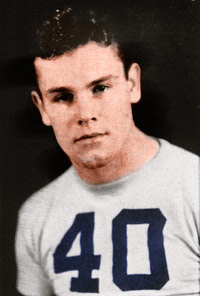
Ralph Kercheval, halfback, Kentucky

Today PFJ looks back at one of the more unique stories of one of the NFL’s best two-way players who had a better career in another sport. With this being Kentucky Derby weekend we take a look back at the career of Ralph Kercheval.

Kercheval was born on December 1, 1911, in Salt Lick, Kentucky (Bath Co.), a town about fifty miles east of Lexington. All of his life Kercheval never strayed too far from his bluegrass roots. He had a passion for sports and horses. He would make one passion help the other achieve his life’s work.

In 2001 (July 12th) I was fortunate enough to interview Kercheval at his home in Lexington. He talked about growing up playing football, especially his special skill of kicking. “I must have kicked the ball a million times as a kid,” recalled Kercheval. “I practiced in all my spare time. Sometimes we’d play football all day. I did more kicking when I was between the ages of 10 and 15 than any other time.”

After making a name for himself on the gridiron in high school, Kercheval went to play football at the University of Kentucky. In Lexington Kercheval was a triple threat star, gaining a reputation of being one of the best kickers/punters in the country. It was also there that he met a Wildcat legend in John “Shipwreck” Kelly. The two would reunite in the NFL.

Ralph Kercheval, punting, Univ. of Kentucky

After playing one year with the New York Giants, “Shipwreck” Kelly joined the Brooklyn Dodgers in 1933. The following year Kelly reached out to Kercheval to see if he was interested in playing pro football. This was before the NFL Draft was founded, so Kelly had the inside track to sign Kercheval. The fellow Kentucky star agreed to come to Brooklyn and play for the Dodgers.

NFL CAREER:

The 6-1, 190-pounder Kercheval played 7 seasons (74 games) with the Brooklyn Dodgers. His biggest problem was his team’s lack of success, as the Dodgers went just 29-41-7 during his time there with only one winning season in 1940 (8-3-1). He scored 10 total TDs (4 rush., 5 rec., 1 INT ret.) and scored 186 career points.

He made only one First-team All-Pro selection and that was by the Boston Post in 1935. He was named Second-team All-Pro in 1935 by Green Bay Press-Gazette and New York Journal, and in 1936 by Collyers Eye. He was also named Honorable Mention by the NFL in 1935-1936.

In the end, Kercheval's NFL career was mostly known for his kicking prowess.

Ralph Kercheval (#1), ball carrier, Brooklyn Dodgers, 1939

KICKING:

During his time in the NFL Kercheval gained a reputation as one of the league’s best kickers. He was just a notch below his contemporaries Ward Cuff (Giants), Jack Manders (Bears), and Glenn Presnell (Spartans-Lions). He converted 31 career FGs and 33 XPs, making 86% of his extra-point attempts….6 times he finished in Top 5 in FGs made, including leading the league in 1938 with five.

     “I got Ralph Kercheval to come to Brooklyn. He was a halfback, but his real greatness was in kicking the football. He could punt, he could placekick. He was the best kicker ever to play the game. Hell, he could fart the football farther than these guys can kick it today,” said “Shipwreck” Kelly to author Richard Whittingham for his book What a Game They Played.

Ralph Kercheval, kicking, Dodgers, 1939
(Courtesy, Time magazine)

Kercheval seemed to thrive under pressure kicking, since he’d practiced so much growing up. “You’re not exactly fresh after playing both ways for 50 minutes,” recalled Kercheval. “One advantage I had over some punters was the fact pressure situation never bothered me. You see punters who are terrific in practice but experience trouble in games.”


In 1939 Kercheval was a part of NFL history.
October 22, 1939
First Televised NFL Game
Eagles at Dodgers, Ebbets Field

One of the major moments in the career of Ralph Kercheval, although he might not have known it then, was playing in the first ever televised game in NFL history.

13,000 fans inside Ebbets Field took notice of some of the bulky TV cameras. Roughly 1,000 TV sets in New York City would’ve had the opportunity to tune into the game. Allen Walz, a former Golden Gloves champ and NYU football star, did the play-by-play that day for W2XBS.

 “We were told about it,” said Kercheval. “Just said, ‘boys forget it. You are going to be on camera…we saw some people all before the game to set up in various places. At the end of the grandstand, where one of the field goals happened to be, they had a camera all set up. So we were aware of it.”

After a 7-7 halftime tie, Kercheval became the star of the game, kicking 3 field goals in the second half, from 44, 38, and 45-yards, to help the Dodgers to a 23-14 victory.

HORSE TRAINER: 

But playing in the NFL wasn’t Kercheval’s ultimate dream. He used the money he made playing pro football to finance his true passion- being a horse trainer. “After seven years that was enough for me, because football was primarily so I could be in the horse business,” said Kercheval. He bought a farm in Louisville and began training horses. Over the next four decades Kercheval trained horses including a stint at the famous Vanderbilt ranch. He would train several top racing horses but one stood out among the rest.  

NATIVE DANCER:

Kercheval would go on to train a once-in-a-lifetime horse. His name was Native Dancer. “He was such an outstanding horse,” recalled Kercheval. “I don’t think there’s ever been another horse quite like him. There’ve been an awful lot of wonderful horses but he was just an outstanding horse.”

Native Dancer ran in 22 races and won 21 of them. His only lost was in the 1953 Kentucky Derby in an upset. Native Dancer got so upset that he went out and won the Preakness and Belmont to narrowly miss out on the Triple Crown. 

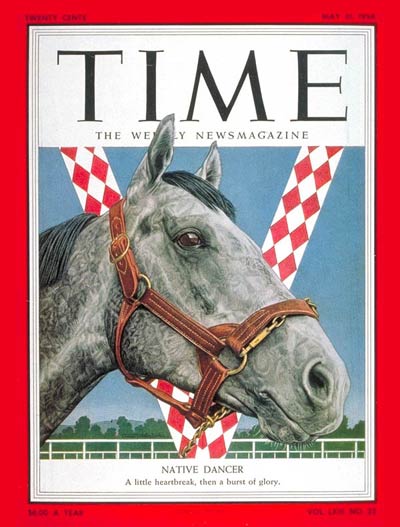
Native Dancer

In 1954 the horse graced the cover of TIME magazine and made him even more popular with his races on television. The horse would go down as one of the greatest racehorses of all time. 

Native Dancer
(Courtesy: Time

During my visit with Ralph in 2001 his wife of fifty years, Blanche, joined us. She was very charming as she took care of her dear husband. They were a perfect match. After he got back to Jersey after the interview, Blanche sent me a sweet thank you note. 

Ralph Kercheval, 2001 NFL Films interview

Ralph Kercheval and his wife Blanche

 Although Kercheval was a decent NFL player during the two-way era he will be more know for his career with the ponies. During our interview, he reflected on his time in the NFL. “It was a lot of fun,” said Kercheval. “I wouldn’t have played if it hadn’t been fun. But I played pro football because I loved to play the game.” 

As the Kentucky Derby goes off this Saturday, I'll choose to remember Ralph Kercheval and Native Dancer. 

Monday, March 7, 2022

Remembering Ward Cuff, New York Giants All-Around Two-Way Star

LOOKING BACK
By Chris Willis, NFL Films

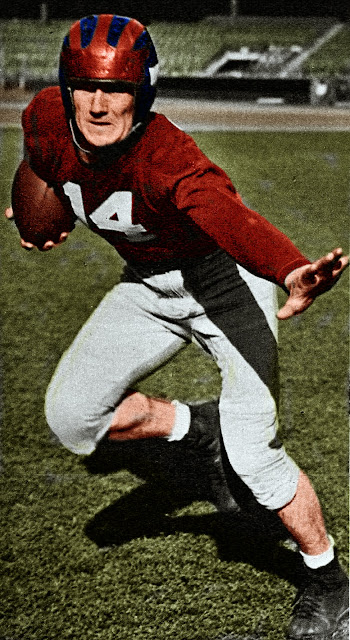
Ward Cuff, New York Giants, Wingback

     Today PFJ looks back at the career of one of the more underrated players of the two-way era. He was one of the more versatile and dynamic backs of that time, who could do almost everything. His name was Ward Cuff.

     After graduating from Marquette, Cuff was drafted in the 4th round of the 1937 NFL Draft (34th overall) by the New York Giants. Cuff was personally scouted by Giants head coach Steve Owen. Although Marquette was led by their All-American halfback Ray Buivid (finished 3rd in the Heisman ahead of Sammy Baugh) and brothers Art and Al Guepe, Owen’s eyes became fixated on Marquette’s blocking back. He was the man doing all the dirty work, making all the tackles and lead blocking for the star backs. Owen knew he wanted Cuff.    

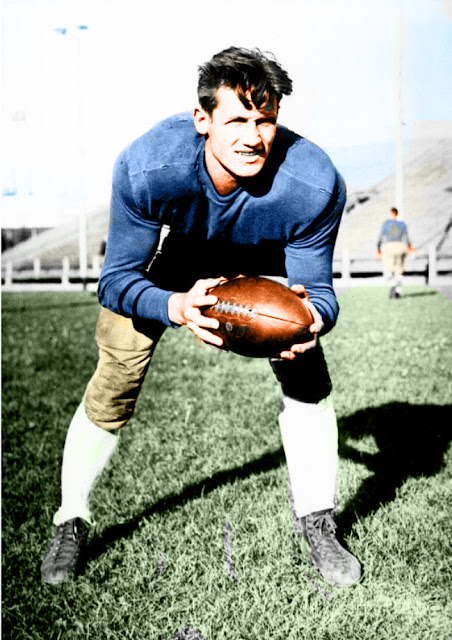
Ward Cuff, Marquette, circa 1936

      That first training camp coach Owen made it a priority to use Cuff in any way possible. At Marquette Cuff never kicked, but Owen saw something in his prized recruit. So, every day for three weeks Owen drilled Cuff for a half hour in the art of place kicking. He liked what he saw. Owen recalled that first training camp in an article he wrote for Colliers magazine in 1942:

     “Cuff had tremendous leg drive and an excellent sense of balance. I was not too certain about the third necessary qualification but that was speedily discovered when we scrimmaged. Mr. Cuff has nothing but ice water in his veins. Nothing rattles him. He looked like a perfect prospect.”

     The 6-1, 192-pound Cuff played 11 years (110 games) for three teams (Cardinals, Packers) but mainly played his entire career with the New York Giants (9 years). A very durable player that would play through any aliment. “Ward was outstanding as a runner, a receiver, and a defensive halfback. Above all, he was an Iron Man who could play with so many injuries that he often seemed to be taped from head to toe before he put on his uniform,” wrote Steve Owen in his book My Kind of Football (1952).

     On offense, Owen had developed a new offensive system he called the “A” formation. He had the perfect center, Mel Hein, to snap the ball, he had plenty of halfbacks and quarterbacks like Tuffy Leemans, Ed Danowski, Hank Soar, but what he was missing was the wing-back. The man who would go in motion at times to be a decoy, a ball carrier every so often, run pass routes, but mainly his role would be as a lead blocker. Cuff was the man for the job. “Our motto was to keep knocking men down until the whistle blew ending the play,” once said Cuff to the Milwaukee News in 1938. What Owen didn’t know was that Cuff, almost from the start in 1937, was his best receiver, blocker and defensive back.

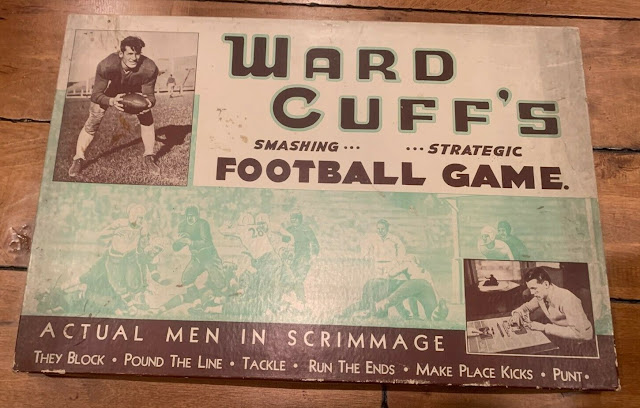
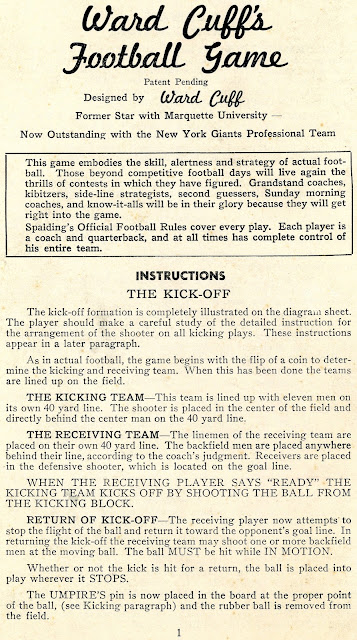
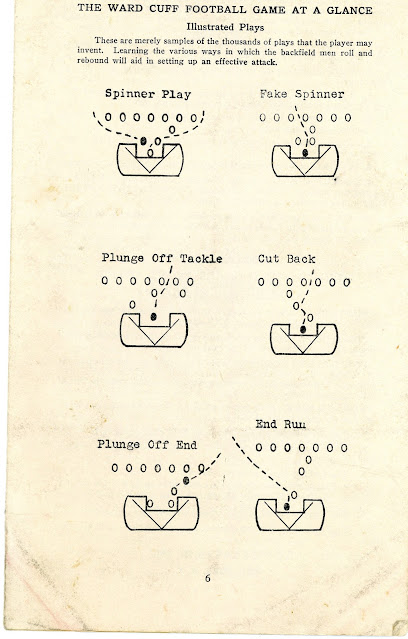
     Cuff was also very creative off the field. After his rookie year Cuff developed a football board game titled, Ward Cuff’s Football Game. Inside the game was a patent pending booklet, designed by Cuff himself. The game looked to be more detailed and “strategic” then most football board games of the time. A few of the board games have survived today, despite not being mass produced. It was obvious that Cuff loved the game of football.


1938 NFL CHAMPIONSHIP:

     In his second season Cuff helped the Giants win the Eastern Division. He led the team in scoring with 45 points, while helping the defense only surrender a league low 79 points- including only ten points in their final five games.

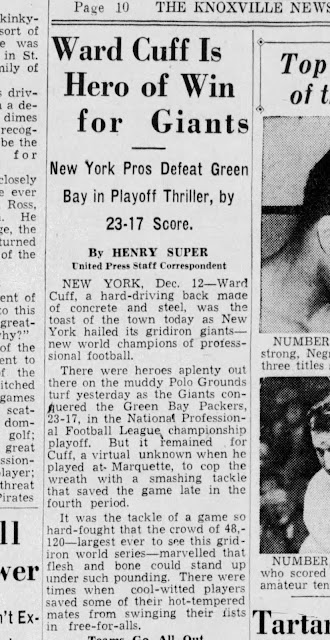
     In the NFL Championship Game they faced off against the Green Bay Packers (Western champs) at the Polo Grounds. In the first quarter Cuff booted a 14-yard field goal to give the Giants an early 3-0 lead. Then the Packers and Giants started to trade touchdowns as New York took a 16-14 lead into halftime.

     Early in the third quarter the Pack took the lead for the first time, 17-16. Then Ed Danowski hit Hank Soar with a 23-yard scoring strike to give the Giants the lead back at 23-17. In the fourth quarter the Packers had the ball four times, but came close scoring only one time. In the redzone Packers quarterback Arnie Herber connected with Wayland Becker, but Cuff nailed Becker forcing a fumble that was recovered by the Giants Kayo Lunday who returned the ball to their own 22-yard line. The Packers never got closer.

    Cuff was a world champion. Although he was just doing his job, Cuff’s name made plenty of newspaper headlines as the “hero of game.”


ALL-AROUND PLAYER:

    Ward Cuff’s passion for the game always came out in the way he played on the field. Going hundred miles an hour to help his team win. He didn’t care if he carried the ball or made the block. On film Cuff was always around the ball and consistently made plays- on both offense and defense. He showed excellent ball skills and was very durable, playing in over 100 games. He finished his career with 3,410 yards from scrimmage (1,851 rush., 1,559 rec.), averaging a robust 5.4 yards per carry.

     Never the top dog in the Giants rushing game, he was mostly overshadowed by Hall of Fame halfback-fullback Tuffy Leemans- his teammate with the Giants for seven seasons (1937-1943). But twice Cuff led the NFL in rushing average per carry, in 1943 (80 carries) with a 6.5 avg. and in 1944 with a 5.6 avg. (tied with Steve Van Buren). His 80 rushing attempts in 1943 was a career high. Rarely did he get to carry the football. But he might’ve been the most important piece in the backfield.

     Another strength was catching the ball (from Tuffy Leemans/Ed Danowski). From 1937-1943 he caught 78 passes for 1,170 yards- averaged a gaudy 16.7 yards per catch - and 10 TDs.

Ward Cuff, Giants, wingback, 1945

     Watching game footage of Cuff on the defensive side of the ball, he consistently showed great range and timing as a defensive halfback with 13 career INTs for 263 return yards. He always seemed to be around the ball, breaking up many passes and never being out of position. In the championship season of 1938 he had a 96-yard INT return for a TD against the Redskins (won game 36-0) to help clinch the Eastern Division title and set a Giants team record that lasted twenty years when Erich Barnes broke it in 1961 (102-yards). In 1941 he led the NFL in interception return yards with 152. In a 1985 NFL Films interview Washington Hall of Fame coach Ray Flaherty remembers the 1938 Cuff interception:

     We took the ball down to the Giants one yard line. It was first down and a yard to go for a touchdown. I was just sitting there relaxing, waiting for them to go across the goal line. Frank Filchock lined up in the tailback position and threw a pass into the right side of our offense against the best, probably the best defensive back in the league, Ward Cuff. He picked it off and went 96-yards for a touchdown.”

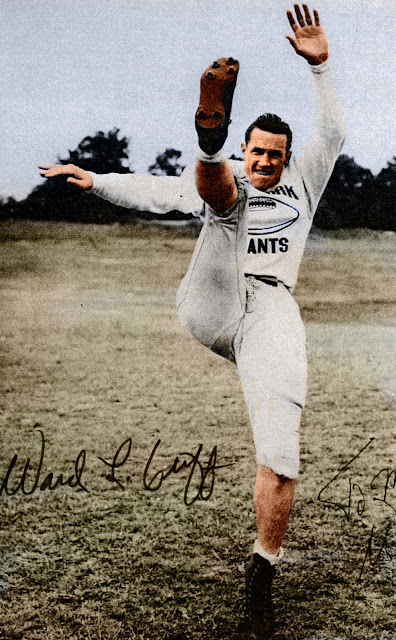
     Cuff was the premiere kicker of his time- among the likes of Ken Strong, Ralph Kercheval, and Jack Manders. He converted 43 FGs and was an impressive 155 of 162 on extra points, a clip of 96%. He led the NFL in FGs made 4 times, 1938-1939, 1943, and 1947 – at the age of 35 - and finished in Top 5 of FGs made 8 times. Also was in Top 10 in scoring 8 times…Helped the Giants win 4 divisional titles and the 1938 NFL Championship- where he kicked 2 XPs and 1 FG against the Packers, a 23-17 victory…Scored 21 career TDs (13 rec., 7 rush., 1 INT return).

Cuff still ranks second all-time with Most Seasons Leading League, Field Goals Made, only Lou Groza had more seasons. 

1st- Lou Groza, 5 times (1950, 1952-1954, 1957)

2nd- Jack Manders, 4 times (1933-1934, 1936-1937)

2nd- Ward Cuff, 4 times (1938-1939, 1943, 1947)

2nd- Mark Moseley, 4 times (1976-1977, 1979, 1982)

3rd – 3 times by, Bob Waterfield, Gino Cappelleti, Fred Cox, Jan Stenerud, Stephen Gostkowski

Ward Cuff, Giants place-kicker, circa 1939

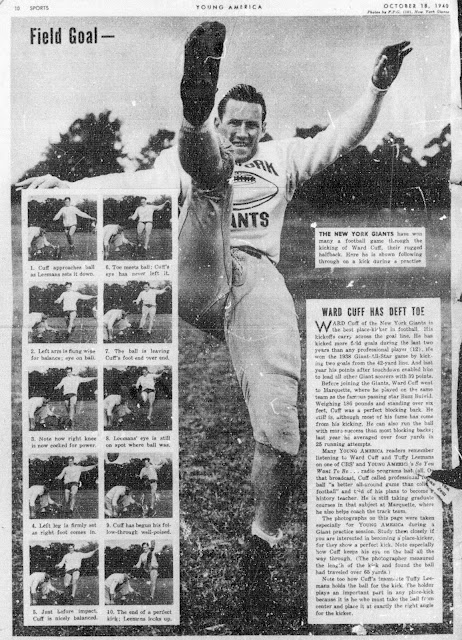
     In 1938 Cuff explained his kicking process:

     “There’s no trick to it. The mechanics of the thing are simple, and the only thing I take credit for are the hours I devote to practice. Practice is essential; it develops the right timing.

     First and foremost, the kicker must keep his eye on the ball. That’s why so many kickers miss. Rushing linemen distract them, and involuntarily they take their eyes off the ball. That’s fatal.

I start off with my right foot, take one step with the left and let go.”

     In 1946, at the age of 34, Cuff was traded by the Giants to the Chicago Cardinals, so he could be closer to his family’s Milwaukee home. Despite losing one of his best players Wellington Mara agreed to the trade. That season he finished 3rd in the NFL in scoring with 55 points (behind Packers Ted Fritsch 100 points, and Bob Waterfield 61 points). Cuff played his final season in the NFL with the Green Bay Packers in 1947. When he retired Cuff finished with 411 career points (had 305 points with the Giants).

     In 2000 I interviewed Hank Soar, one of Cuff’s teammates with the Giants. He praised Cuff for his all-around play. “Ward could punt a ball. He would kickoff too, his ball would always be right there at the goal line. He was strong kicker. Ward was a great defensive player. He could run. He could just play football and he was a great defensive man. He’d intercept passes like nobody in football could do.”

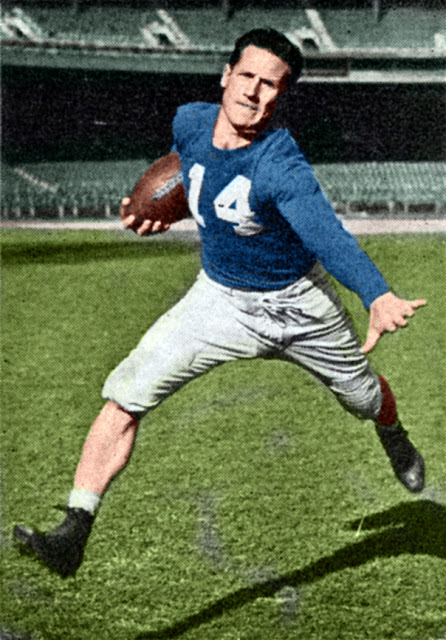
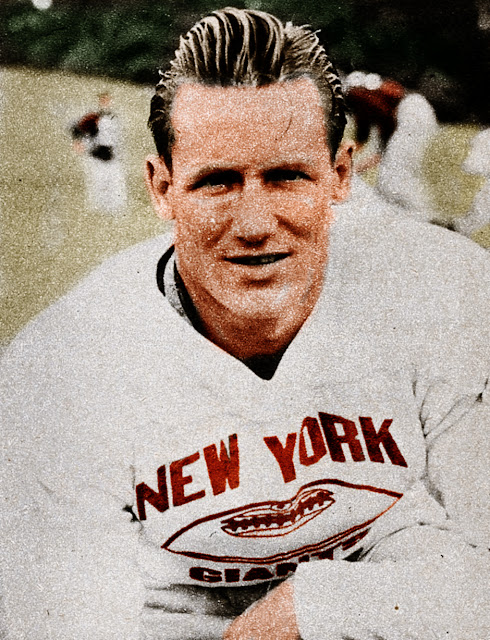
Ward Cuff, N.Y. Giants, 1942

HONORS:

     Cuff only endured one losing seasons in his career (1945, 3-6-1), helping his teams to an overall record of 71-38-10. He made 3 Pro Bowls, 1938-1939, 1941 and three times named First-team All-Pro by UP in 1941, 1943-1944 and once by Pro Football Illustrated in 1944…Named Second-team in 1938 by I.N.S.; in 1939 by Football Writers and I.N.S., and in 1943 by New York Daily News…Honorable Mention by NFL 4 times, 1937-1939, 1941 and once by the Football Writers in 1938.

     Because he was never the focal point of the offense his overall stats come up short with other Hall of Fame backs from the two-way era, especially his contemporaries like George McAfee, Bill Dudley, Tony Canadeo or his teammate Tuffy Leemans. But nobody might’ve been more important for their team’s success than Ward Cuff for the Giants. Offense, defense and special teams – premiere kicker of his era – Cuff was simply an outstanding two-way player. Footage shows us that too. Once speaking in 1943 Steve Owen told Arthur Daley of the New York Times,If I had to choose up sides, Ward would be the first man I pick. He does everything and does it remarkably well.”

Giants Jersey Number 14 Retired (1946):

     Despite his lack of recognition Ward Cuff was honored with one of the greatest achievements any player can have. His jersey retired.

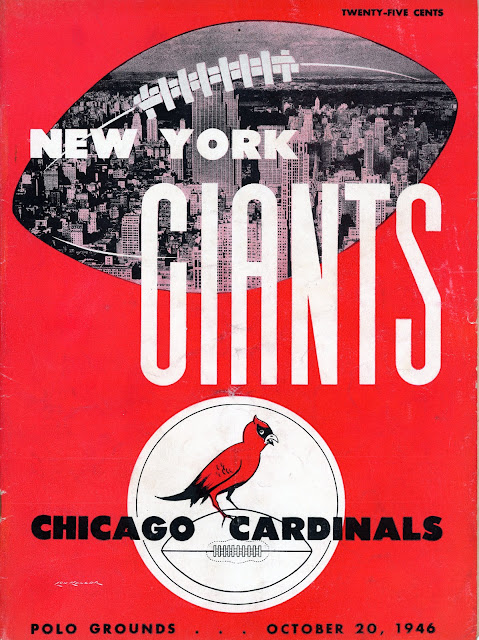
     The Giants retired his no. 14 jersey in 1946- the year he was traded to the Cardinals. That fall Cuff returned to his old stomping grounds wearing a different uniform but a familiar jersey number. On October 20, 1946 Cuff jogged out in front of over 50,000 fans at the Polo Grounds wearing his Cardinals number fourteen jersey. The fans gave him an ovation.

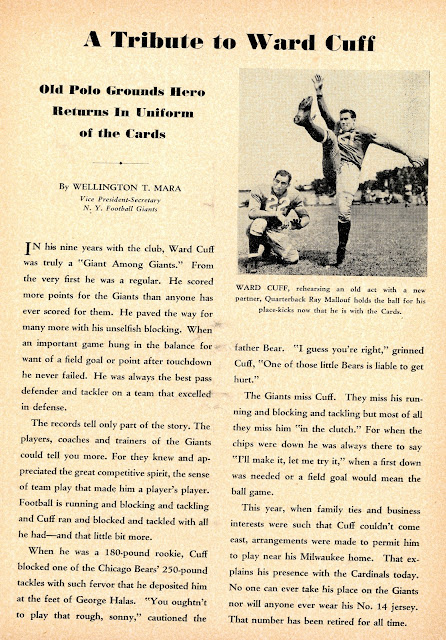
     In the game program that day Giants Vice-President-Secretary Wellington Mara wrote a one-page tribute to Ward Cuff, praising the former Giants hero. He wrote:

     “In his nine years with the club, Ward Cuff was truly a ‘Giants Among Giants.’ From the very first he was a regular. He scored more points for the Giants than anyone has ever scored for them. He paved the way for many more with his unselfish blocking. When an important game hung in the balance for want of a field goal or point after touchdown he never failed. He was always the best pass defender and tackler on the team that excelled in defense…

     The Giants miss Cuff. They miss his running and blocking and tackling but most of all they him ‘in the clutch.’ For when the chips were down he was always there to say ‘I’ll make it, let me try,’ when a first down was needed or a field goal would mean the ball game.

     This year, when family ties and business interests were such that Cuff couldn’t come east, arrangements were made to permit him to play near his Milwaukee home. That explains his presence with the Cardinals today. No one can ever take his place on the Giants nor will anyone ever wear his No. 14 jersey. That number has been retired for all-time.”

     That day Cuff played his heart out trying to beat his former team. He accounted for 12 points on a touchdown run, one field goal (42-yards) and three extra points. But it wasn’t enough as the Giants pulled out a tough 28-24 victory.

     Cuff’s jersey wasn’t retired quite yet. In 1961 when the Giants traded for Y.A Tittle they brought out jersey number 14 for him. But since 1965 no New York Giants player has worn the number fourteen.

     After doing some high school coaching and working for Boeing, Ward Cuff passed away on December 24, 2002 at the age of 90. “We were contemporaries,” Giants owner Wellington Mara said to the Associated Press. “He came to camp in 1937 as a rookie, and we roomed together from then on in camp and on the road. I have a lot of fond memoires of him. He was a terrific competitor.”

     Not too many players get their jersey retired. A Special honor, for a special player. We remember Ward Cuff.


Ward Cuff article, Young America, Oct. 1940