Saturday, February 21, 2015

Dutch Clark's Missing 1937 MVP Award

LOOKING BACK
by John Turney

Dutch Clark, colorization by John Turney
On December 27, 1937 the following story ran across the Associated Press wire:


It reports that Dutch Clark was voted the first annual Gruen Award, which was for the outstanding player who also displayed sportsmanship. So, it seems that it was an award with more than one component. In 1938 Mel Hein won the Gruen award, but no article yet found explains if there was a sportsmanship component to Hein's award as was the case with the prior year's award. What is certain is that it was not yet named the Joe F. Carr Trophy at that time. 

Columnist Frank Moran wrote, on June 24, 1939, "a resolution introduced by George Halas of the Chicago Bears, calling for (the) designation of the league's most valuable player award as the Joe F. Carr Memorial Trophy, will be adopted at the summer meeting of the National Professional Football League moguls!" So from that point through 1946 the award, voted on the Pro Football Writer's Association of America was known as the Joe F. Carr Most Valuable Player, still, to this day, the only MVP Award the NFL has officially sanctioned.

According to author and historian and Pro Football Journal contributor/writer and Pro Football Researchers Association Executive Director Chris Willis, Hein's 1938 Award was an official award, appearing in the minutes of the NFL meetings. Clark's 1937 Gruen Award was not.

What appears to have happened is that Hein's Gruen Award was re-designated a Joe F. Carr Trophy but Clark's was not. The Gruen Watch Company was the sponsor of both the 1937 and 1938 Award, but no mention of it appears after Hein's 1938 award.

Based on the facts gathered it seems reasonable to believe that the 1937 Gruen Award and the 1938 Gruen Award were similar enough to be considered the same award and as such it seems reasonable to retroactively crown Dutch Clark as the 1937 NFL Outstanding Player.


T.J. Troup, Coach, Football Scholar, Author

Happy Birthday, Coach.

T.J. Troup is the author of The Birth of Football's Modern 4-3 Defense and This Day in Pro Football as well as being a JC Football coach in Southern California and a writer/contributor to Pro Football Journal. Today he is sporting Slingin' Sammy Baugh's throwback uni.

Baugh Colorization by John Turney, photo courtesy of the Troup family.

Things You Can Never Lay Your Hands On-Sacks

SACKS OVER THREE-YEAR INTERVALS
by John Turney

Again, as part of Pro Football Journal's ongoing series of "Things You Can Never Lay Your Hands On" (whose title is an homage to the great book Pro Football Chronicles) we have put together an inclusive list of information that began appearing in the NFL Record and Fact Book in the late-1980s. In those volumes the editors of that book would compile leaders in various categories over 3-, 5- and 10-year intervals which was very helpful to the reader. However, to get complete lists one had to have all the volumes and in that era and it took time to piece it together so to help that we've taken the concept to the beginning and have complied it into one place. The following is a list of teams who had the most sacks in the three-year periods since sacks became an official team statistic in 1963 with commentary.

The Lions and Patriots led in the first interval, 1963-65. Neither team has a Hall of Famer, though Alex Karras should be considered with his four-time First-team All-Pro, five-time Second-team All-Pro and over 100 sack career. Roger Brown got to the QB as often, if not more, than Karras and later contributed to the Ram Fearsome Foursome.  The Patriots of that era had their own foursome of fearsome pass rushers: tackles Houston Antwine and Jim "Earthquake Hunt" and end Larry Eisenhauer and Bob Dee, all of whom received AFL post-season honors in their careers.

Mid-season 1963 is when Tom Landry moved Hall of Famer Bob Lilly to right defensive tackle from left defensive end and that moved ignited the effectiveness of Landry's Flex Defense. The Cowboys out-paced the Rams Fearsome Foursome in sacks while that Dallas defense became known as "Doomsday". Lilly, George Andre, and others led the charge as they led pro football in sacks for three consecutive three-year periods.

The 1967 Raiders set a then-record of 67 sacks, and the foursome of Ike Lassiter, Ben Davidson, Tom Keating and Dan Birdwell continued to get after the quarterback in 1968 and 1969 as well.

The Fearsome Foursome of Deacon Jones, Merlin Olsen, Lamar Lundy and Roger Brown with some help from Coy Bacon took the crown through 1971. The Rich Jackson, Paul Smith and Lyle Alzado-led the Broncos surge from 1970-72.

The Rams were the leader through the 1975 interval, with Jack Youngblood, Fred Dryer, Larry Brooks and Fearsome Foursome holdover Merlin Olsen. The 1971-73 Redskins tied the Rams with Diron Talbert (former Ram), (former Jet) Verlon Biggs, (former Bill) Ron McDole and designated rushers Jimmie Jones and Bill Brundige. In an oddity one sack the Rams had in 1971 of Roger Staubach was mis-scored as a run. If properly scored the Rams would have led from 1971-73 by one, but as it stands officially, the George Allen-Redskins tied the team he formerly coached.

The 1974-76 Raiders may come as a surprise, beating out the Rams, Vikings, and even the Steel Curtain Steelers. With less-than-household names the Raiders put a lot of heat on enemy quarterbacks with Tony Cline, Horace Jones, Otis Sistrunk, Art Thoms. The final year, 1976, the Raiders switched to a 3-4  defense with injuries to their ends and with Ted Hendricks and John Matuszak they still got to the quarterback often enough to lead for that interval.

The Colts Sack Pack led next with John Dutton, Fred Cook, Mike Barnes and Joe Ehrmann. In 1975 Dutton had 17 sacks, Cook had 16-½, Ehrmann nine and Barnes 7-½.

Doomsday II with Harvey Martin, Randy White, Ed "Too Tall" Jones and Jethro Pugh took the next two titles followed by the 1978-80 San Diego Chargers. Hall of Famer Fred Dean handled the outside with LeRoy "Too Much" Jones while Gary "Big Hands" Johnson pushed inside, with Louis Kelcher 9who had bigger hands than Johnson).

Next up were the Los Angeles Rams once more and, again, was led by Hall of Famer Jack Youngblood, Dryer, Brooks, this time with Mike Fanning and Cody "Hold Your Bones" Jones filling Merlin Olsen's left tackle position.

The Raiders ran a 3-4 scheme in the 1980s, but on passing downs went to a 4-man line. Cedrick Hardman led the Raiders in sacks in 1980 after being acquired from the 49ers where he had put in a decade of work, then they traded for Lyle Alzado in 1982 who was a grizzled vet ready for a comeback. Along with draftees like Howie Long, Greg Townsend, Bill Pickell the Raiders the Raiders nickel-set was the best in the NFL.

Buddy Ryan's famed 46 defense took charge and was the best in the NFL in the mid-1980s. Hall of Famers Richard Dent and Dan Hampton were a great inside-out tandem who got plenty of help with lots of blitzing by Otis Wilson and good rush ability from tackle Steve McMichael.

The Buddy Ryan-led Eagles wrestled this crown from the Bears for a season, but lost it to the Vikings who had their own magnificent foursome of Hall of Famer Chris Doleman, All-Pro Keith Millard, solid Henry Thomas and Al Noga. However the Eagles regained the lead in this category with monsters like Reggie White, Clyde Simmons, Jerome Brown.

Hall of Famer Rickey Jackson and All-Pro Pat Swilling led the Saints in the early 1990s. And the Steelers followed with their first appearance on this particular list with the original Blitzburgh Defense. In 1993 the Steelers signed free agent Kevin Greene and matched him with Greg Lloyd and Chad Brown to pace the league in sacks.


Joe Johnson and Wayne Martin were the leading sackers on the now-4-3 scheme of the Saints. In 1998 they added L'Roi Glover and then Darren Howard as this group quietly mounted the NFL's most consistent rush over a six-year period. Only the 1996-1998 49ers (who added Chris Doleman and Kevin Greene to their rush) and the 1998-00 Rams broke up their string. The Rams underrated defense had All-pro Kevin Carter at left end, D'Marco Farr as the three-technique and Grant Wistrom as the blind-side rusher that tied the Saints in sacks for those three seasons.

Joey Porter and Jason Gilder were the leading sackers for the 2001-03 Steelers. Jim Johnson's Eagles defense, without a lot of stars blitzed from all over and took the 2002-2004 crown. Jason Taylor was the main man for the 2003-05 Dolphins. Rex Ryan's group, paced by Terrell Suggs and Adalius Thomas, led next.

The two "Seans" Merriman and Phillips (spelled Shawne and Shaun respectively) led Wade Phillips' Charger pass rush from 2005-2007. Phillips went on to be defensive coordinator in Dallas and with DeMarcus Ware as the kingpin with help from Greg Ellis and others became the crown bearer through 2009.

James Harrison (36.5 sacks) and LaMarr Woodley (35 sacks) were the sack masters of the 2008-10 version of the Steelers "Blitzburgh" defense. Trent Cole was the mainstay of the 2009-11 Eagles with a big year from Jason Babin (18 sacks) in 2011.

Next up were the Rams with Chris Long, Robert Quinn, with nickel rushers William Hayes and Eugene Sims leading the way in sacks. The 2012-2014 Bills edged the Rams, but with Mario Williams, Kyle Williams, Marcell Dareus and Jerry Hughes the Bills earned the leadership as the most consistent rush over the past three seasons.

Friday, February 20, 2015

Charles Woodson - The NFL's first 50 INT and 20 sack man?

A LOOK BACK
by John Turney

Charles Woodson is a tremendous player and among his achievements in 2014 was recording his 20th career sack which, coupled with his over 50 interceptions, makes him the only official 50/20 man.

However, since the official sack era began in 1982 it is interesting to look back and celebrate the first man to amass those totals, albeit unofficially.

While it's probable that Larry Wilson was not the first safety to blitz and tackle a quarterback for a loss while attempting to pass (a sack) he's often cited as the one who popularized it.  Wilson has certainly seen his teammate Jerry Norton take after the quarterback in 1960 when Wilson was a rookie.

Officially, Wilson has 52 interceptions, but no sacks. However, by reviewing the St. Louis Cardinals Game Summaries (Play-by-plays or PBP) we find that Wilson was very successful in getting to the quarterback, which he did at least 21 times in his career with a career-high of five in 1962.

There are some sacks in the PBPs which do not record a specific tackler of the quarterback, and film (if it exists) would have to be reviewed to fill in some gaps, so it is possible, even likely that Wilson has a few, or even a handful, more during his career. Nonetheless, Woodson had it may be a bit tougher, spending most of his career as a cornerback rather than safety and he deserves much praise for his accomplishment. But, so too, does Wilson. For what it is worth, Woodson has 60 interceptions, so he's the only 60/20 man in NFL history.

The sack research has not uncovered any other defensive back that would qualify. So, Wilson and Woodson, the W&W of picks and sacks, the only two 50/20 men in NFL history.

A Look Back - Photo Colorizations

SHOUT OUT FROM TALES FROM THE AFL
by John Turney

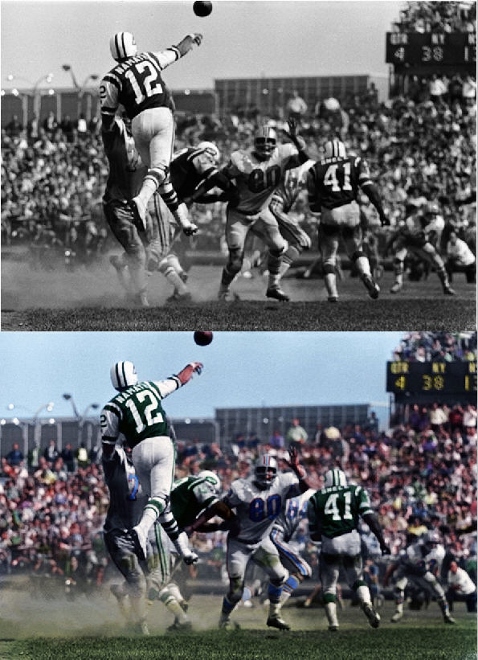
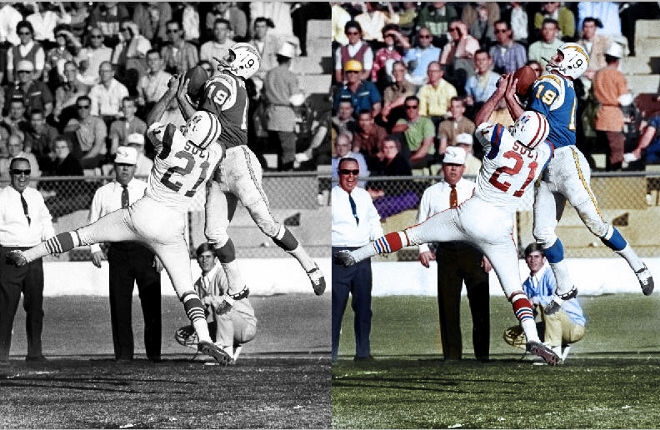
As a hobby, I have been colorizing old football photos to bring them to life, but mostly for my own enjoyment. These colorizations have been featured on various websites on the Internet. One in particular was very kind in their reviews.

Todd Tobias runs the website Tales From the American Football League -which is fantastic in its coverage of the AFL. He featured some of my work for his readers. Click here to take a peak.

Here is one:
colorization by John Turney

And another:
colorization by John Turney

In 2012, my father suffered a serious stroke and, as a result, had a lengthy hospital stay. During this time, as a coping mechanism, I could really only do a couple of things: play computer chess and colorize photos. It took my mind off the serious nature of his illness. As a result, I became proficient in doing these colorizations. After consulting with an expert in copyright laws, I understood that it was fine for me to do these and publish them as "derivative art" with my own copyrightAfter having done a lot of research, counting sacks, forced fumbles and other things, this became a right-brain balance that I likely needed. Hope you enjoy looking at them as much as I did in making them.

MVP Shares

A LOOK AT J.J. WATT'S DOMINANCE
by Nick Webster
JJ WATT
Art credit: John Turney
With the Super Bowl just over lots of people will want to talk about what transpired on that fateful Sunday night. I believe, however, the Saturday night prior was just as interesting (we’ll leave aside the NFL’s desire to monopolize media during this entire week and thus leaving award announcements till a month later than when they were historically handed out).
Saturday J.J. Watt, to much publicity, was the first unanimous choice as the Associated Press Defensive Player of the Year.  But what about other DPOY’s?  Who else was close?  Well, interestingly, the closest to a unanimous DPOY ever was. . . J.J. Watt, who garnered 98% of the vote (49 of 50) in his 2012 DPOY year. 
Currently, Watt has now tallied the two most dominant DPOY vote victories ever.  After Watt’s 2014 and 2012, who’s the next most dominant selection?  Try Lawrence Taylor, with 88% of the vote in his MVP season, of course, in the modern NFL the MVP has to be an offensive player.  But think about this: J.J. isn’t the NFL MVP, but was viewed more dominant defensively that the last defensive player to win overall NFL MVP, such a shame.
In baseball researchers contemplate MVP Career Shares – basically adding up the percentage of the votes a player received for MVP across a number of seasons, so a player who never wins one, could rank highly, or players with one great season surrounded by few others might score poorly.   What if we look at Defensive Player of the Year in the same manner?  By that measure J.J. Watt is already the most dominant defender since the award was re-introduced by the Associated Press in 1972.  Watt’s Share of DPOY is 2.03, followed closely by Bruce Smith with 1.93 and LT with 1.92.  In fact, a list of players with two Defensive Player of the Year Awards reads like the Mt. Rushmore of defensive greats with LT, Smith, Joe Greene, Mike Singletary and Ray Lewis being the only members (and first ballot HOF’ers all of them -unless voters hold Atlanta against Lewis).   Finally, maybe most impressive, if you aggregate all players by team, over the nearly 45 year history of the award, only five teams have more DPOY shares than Watt, led by the Steelers with almost two-and-a-half times Watt at 5.26.  
Time and consistency will tell, but while everyone enjoys arguing about Seattle and their potentially all-time defense, we’re looking at a truly once-in-a-generation player in J.J. Watt.

Tuesday, February 17, 2015

The Eleven Most Dominant Pass Rushing Teams in NFL History.

A LOOK BACK AT LEN FORD AND DOUG ATKINS
by T.J. Troup

Len Ford, colorization by John Turney
In honor of Len Ford's birthday, the 18th of February, listed below are the 11 best pass rushing teams in league history using the following criteria: Yards lost attempting to pass divided by opponent pass attempts.

Since this is a territorial game; yards sure do count. When a team sacks the quarterback for big losses in yardage, and your opponent does not attempt that many passes you have gained an unquestioned advantage in field position.

Ranking 11th is the '51 Browns (1.30) led by the first great pass rusher Len Ford (recorded over 20 sacks in a 12 game season). The '77 Patriots rank 10th (1.32), while the '65 'Skins (1.32) hold down the ninth spot. While much has been written about the '85 Bears defense, the pass rush in '84 comes in 8th (1.34).

Returning to the championship game for the third consecutive season; the New York Giants set records for passing, yet their pass rush led by left end Jim Katcavage earns 7th place in the rankings (1.35). The '52 Eagles fill the 6th spot (1.37) on this list. The rule changes in '78 did not impact Detroit as Al "Bubba" Baker and his "Silver Rush" cohorts pillaged the pass pocket to rank 5th (1.37). Clark Shaughnessy had a myriad of "red dogs" and in '60 the Bears continued to attack the pass pocket as they rank 4th(1.44).

We all can debate just how angry the 11 defenders of the Oakland Raiders were in '67, yet no doubt AFL passers came under siege as the Silver & Black finished 3rd in our rankings (1.45). For the first half of the '76 season the 49ers "Gold Rush" had the look of destiny, and though they could not sustain their dominance; finishing second on this list is quite an achievement (1.53).

More myth than man? Not if you have seen him come off the edge from his right defensive end position. Doug Atkins finally began to fulfill his promise in '57, and as such the Bears rank #1 as they recorded 479 yards in sacks, while opponents attempted only 306 passes(1.56) for first place on this list.

Doug Atkins, colorization by John Turney