Tuesday, April 14, 2015

The NFL's First All-Time Team (1942)

LOOKING BACK
By John Turney

In December of 1942, the Sporting News polled some of the NFL's All-Time greats in order to compose an All-Time team, which was purported to be the NFL's first (of many) sich teams.

Here is the team and the (votes) each received:
Ends—Don Hutson, Green Bay (7), and Bill Hewitt, Chicago Bears & Eagles (6).
Tackles—Cal Hubbard, Green Bay & New York (6), and Turk Edwards, Boston and Washington (3).
Guards—Danny Fortmann, Bears (5), and Mike Michalske, Green Bay (5).
Center—Mel Hein, New York (6).
Quarterback—Earl (Dutch) Clark, Detroit & Portsmouth (3).
Halfbacks—Sammy Baugh, Washington (6), and Cliff Battles, Boston and Washington (4).
Fullback—Bronko Nagurski, Bears (6).

At the time Baugh was as much known for his single-wing work as his T-formation quarterbacking and he was chosen as a halfback. Clark was a single-wing player who ran, passed and kicked. He was chosen as the quarterback.

Mel Hein declined to vote for himself, thus preventing him from being a unanimous selection.

Wednesday, April 8, 2015

"The Little General"

LOOKING BACK
By T.J. Troup

Eddie LeBaron began his NFL career in 1952 after a productive career in college, and serving our country with honor in Korea. LeBaron attempted a couple of passes opening day in 1952 against the Cardinals as he patiently watched the master; Sammy Baugh, lead Washington to victory.
Baugh and LeBaron. Colorization by John Turney
The Steelers led the Redskins 24-21 in the 4th quarter the fourth week of the season until Eddie threw his first game-winning touchdown (43 yards to Bones Taylor). LeBaron threw 9 touchdown passes the last three weeks of the year to finish a strong rookie campaign. He shared the quarterback position with Jack Scarbath in 1953 before heading north to Canada for one year.

Head Coach Joe Kuharich believed in a power running game, and with the defense now entrenched in the 4-3 the Redskins became contenders for the Eastern Division crown in 1955. LeBaron's ball handling skills and his ability to pass after precision fakes led to an upset opening day in 1955 against the defending league champion Browns. His 13-yard scoring canter after traversing the entire field was the final score in the upset. Eddie kept defenses off balance with his roll outs, fakes, and thew continued use of Kuharich's unbalanced offensive alignments for the next three seasons. Though Washington was capable of beating anyone, wins just did not come often enough for Kuharich to keep his job. LeBaron had a highly efficient season passing in 1958 as he completed 37 of 64 for 686 yards with 9 going for touchdowns, and only 3 interceptions in the four Washington wins. The season highlight came on November 9th when the "Little General" threw 5 touchdown passes in the victory over the Chicago Cardinals. A double run fake; a beautiful touch pass down the right sideline to halfback Jim Podoley for 66 yards set up his 5 yard pitch to Joe Walton. Second quarter and Eddie flips over the middle to Podoley for 20 yards and a score. A mix-up in the backfield would have stymied many a signal caller, but LeBaron had the wherewithal to roll left and find Podoley open for a 10 yard scoring toss. Before the half, Eddie throws to Walton in the right flat for 18 yards and his fourth touchdown after a sterling play action fake reminiscent of Frankie Albert.

LeBaron has the Redskins in an unbalanced left formation, with right end Joe Walton running a seam streak down the middle of field. Eddie is on the money again (38 yards)and his fifth and final touchdown toss of the game. The close of the 1959 season under new coach Mike Nixon has LeBaron hanging up his cleats. He earned three Pro Bowl berths in his time in Washington as he completed 221 of 435 passes for 3,549 yards (16 yards a completion) with 36 going for touchdowns and 36 interceptions in the games the Redkins won. His 71.5 passer rating is an indicator of his value to the team (47.3 in games the 'Skins lost or tied). 
LeBaron and Lipscomb. Colorization by John Turney
Expansion in Texas and head coach Tom Landry wants a veteran signal caller to take the reins in Dallas in '60. Though the maiden voyage of the Cowboys is a winless struggle; there is a player heading to Los Angeles for the pro bowl. End Jim Doran latched on to enough of LeBaron's accurate passes to earn that distinction. Talented Don Meredith has a fine future in football as he shares the position with Eddie during an improved 1961 season. 

October 14, 1962, stands out in passing annuals as LeBaron achieves a PERFECT passer rating of 158.3 (completes 7 of 7 for 128 yards and a touchdown) in the win over Philadelphia. Next up; a strong hard-bitten gang of Steelers are destroyed by "The Little General's" passing acumen 42-27. First quarter and LeBaron fires to Howton for 16 yards and a score. In the second quarter and speedy Frank Clarke (caught more LeBaron touchdown passes than any other player) grabs a pass and strides 45 yards to score. Third quarter; and Clarke catches two touchdown passes from Eddie (3 and 13 yards) as Dallas takes command of the game. His fifth and final is a 26 yard toss to Lee Folkins. Many fine passers have played for multiple teams, but how many have thrown 5 touchdown passes for two teams in their career? Six weeks into the campaign and LeBaron leads the league in passing as he has completed 60 of 92 for a whopping 945 yards with 11 scores and just 4 intercepted and Dallas has a winning record (3-2-1). Though the Cowboys fell from contention; LeBaron was honored with another Pro Bowl selection. Landry many times during the year rotated quarterbacks with the play. Eddie comes back for one final season in 1963 as Meredith's back-up. The Dallas Cowboys won 11 games during LeBaron's time in Texas. His passing was the key element as his passer rating was 107.7! May the "Little General" rest in peace.

Monday, April 6, 2015

Charlie Sumner: His Place in the Rise of the 3-4 Defense in the NFL

LOOKING BACK
by John Turney


Credit: Topps Chewing Gum Company
In the NFL, even with much film available to re-check the written words of the historical record it is hard to know, for sure, who is responsible for any given scheme or player package or other nuanced changes in the game. Often, a new idea will spread in a matter of weeks after years of maybe
being used once-in-a-while, as a change-up.

One such scheme is the 3-4 or often called "Okie" defense in the early 1970s. In the late-1950s the Bears and Colts and other teams used it on rare occasions, maybe in long-yardage or late in a game as a prevent. In the mid-1960s, in the AFL, Joel Collier used is as at least a part-time base defense with the Buffalo Bills. Bum Phillips liked it and used it some with the 1969 and 1970 San Diego Chargers.

Miami's famed "53 defense", which was a 3-4 defense that was very prevalent in their Dolphins Championship runs in 1972 and 1973, oddly, though, for the Dolphins it wasn't their base defense, it was more of a hybrid nickel, one in which Bob Matheson could either cover or rush. Don Shula often commented that Matheson could cover a short zone as well as many defensive backs and could rush as well as many defensive ends. So, though it was a 3-4, Bill Arnsparger always spoke of it as their "change up nickle" rather than a defense they'd employ versus another teams tight end and two running backs set.

The year the 3-4 scheme, as a base defense broke out, was 1974 and often it is Bum Phillips' Oilers that were given much of the credit, especially after they traded John Matuszak to the Kansas City Chiefs for defensive tackle Curly Culp, who fit Phillip's ideal middle guard role perfectly.

Prior to the trade, however, the Oilers were not a pure 3-4 team, using both a 4-man and 3-man lines against opposing teams' base offense. Once Culp arrived, though, the Oilers did little else but an Okie front. Other teams used it, the Saints, for one used it quite a lot so as to almost qualify it as their base.

In 1973, however, New England Patriots team highlights and films show that defensive coach (coordinator) Charlie Sumner was already using the 3-man scheme under freshman NFL coach Chuck Fairbanks. Nineteen seventy-two and 1973 may be the worst back-to-back run defenses in the history of the NFL with the Patriots giving up about 200 yards a game at an average of just over five yards a carry. Clearly, Fairbanks and Sumner had to do something.

They had wanted to switch to the 3-4 in 1973, but were unable to secure a key player they thought they needed to play the defense. Rich "Tombstone" Jackson had just finished an injury-riddled 1972 season with the Cleveland Browns and wanted to get into coaches as he was getting older and had been late (27 years old) in entering the NFL. Fairbanks wanted Jackson to play nose tackle in the 3-4, even though he had spent his career as a defensive end. The thinking was playing inside would not require as much quickness to be effective and that Jackson's off-the-charts strength would make him dominate as a nose tackle. Fairbanks also thought that Julius Adams could play one two-gap (304) end and a youngster out of Oklahoma Ray "Sugar Bear" Hamilton could handle the other. Jackson was agreeable to play the position, but he had a condition–he wanted to coach.

Credit: Topps Chewing Gum Co.
Jackson's collegiate background was in teaching and coaching and was willing to put his body on the line for another season if he got a year of seasoning as the Patriots defensive line coach. Fairbanks turned him down and the Patriots played 1973 in the 4-3 once again, but at times showed a 3-4, especially against the Bills and Dolphins, teams that ram the ball more often than they passed.

In 1974 Sumner and Fairbanks made the change to a 3-4 base defense in time for week one of the 1974 season. They had picked up George Webster to play outside linebacker. Webster had been a three-time All-AFL selection before his knees were hurt, but still had athleticism left and hunger in well for two seasons before injuries finally ended his career after the 1976 season.

In the 1974 NFL Draft, the Pats selected Steve Nelson and Sam Hunt, who ideally filled the inside linebacker positions in the new scheme. Hunt, a thumper against the run, as was Nelson, but Nelson could also cover from his inside position as well. Sumner installed stout Mel Lunsford at left defensive end with rock-steady Julius Adams at right defensive end. Additionally, they sent 3rd and 8th-round picks to the Chicago Bears for defensive end Tony "Mac the Sack" McGee. McGee would fill the role as a designated pass rusher on third down when opponents went to three wide receivers and the Patriots responded with four defensive linemen and five defensive backs. And fill it he did, averaging around 10 sacks per season from 1974-80.
Credit: Topps Chewing Card Co.
The Pats responded well that first season, both defensively and offensively and on special teams as they were 6-1 at mid-season with big wins over the Dolphins, Rams, and Vikings. They had a narrow loss to the Bills and later gave the Steelers all they could handle in a late-season game but finished the season 7-7. The Oilers did the opposite, starting the year 1-5 and finishing strong with a 6-2 mark to end the season - the same as the Patriots. But the table was set, both had proven the 3-4 was a viable, every down defense in the NFL and for each of the following several years, teams kept switching to the 3-4, until it hit critical mass in 1985 when 25 of 28 teams were using it (Bears, Cowboys, Redskins were the only three teams that did not make the switch in that era).

In 1979, Sumner moved to the Raiders as the defensive coordinator, though the Raiders didn't use that title and where he employed a very similar scheme with the Raiders. Though the Raiders had started their 3-4 in 1976 when injuries along the defensive line caused their switch to the 3-4. And in 1977 they added a new wrinkle as they'd bring in the designated sacker (Pat Toomay) to play the Tony McGee role and Toomay responded with 14-½ sacks.

Upon Sumner's passing today, the story of Sumner coaching linebacker Jack Squirek to step in for Matt Millen and cover Redskins back Joe Washington in Super Bowl XVIII which resulted in a quick pick-six for the Raiders has been making the rounds. But really, it was a fairly typical deployment for that Raider defense at that time, to move pieces around and use them in various places.

For example, in 1983 the starting defensive line was Howie Long at left defensive end, Reggie Kinlaw at nose tackle, at right end Lyle Alzado, with Ted Hendricks at left outside linebacker, Matt Millen, usually a strong and Jeff Nelson at weak inside linebacker and Rod Martin at right outside linebacker.

However, in Sumner's "Pirate" defense, James Davis would play nickel as both inside linebackers would come off, and Greg Townsend would play left defensive end, Bill Pickell would play left defensive tackle and Howie Long would play right defensive tackle (usually a 3 technique) in this extremely effective set. When Alzado would get nicked or needed some air, Long would play right defensive end and Townsend or Pickell would play left defensive end. And to isolate Howie Long on the center, as the Bears Buddy Ryan would do with Dan Hampton, Long would play nose tackle in a 5-man line. In the 'Desparado" defense, it was the four best pass rushers and seven defensive backs on the field for the Raiders. ("Renegade was the dime or six-man secondary).

The popularization of the 3-4 defense in the NFL from the early 1970s through the present likely falls on several coaches' resumes, as it rightly should, but here is one who hopefully will get his fair share of credit for that fascinating era of transitionCharlie Sumner.


Saturday, April 4, 2015

The Major MVP Awards—As Found in Total Football: The Official Encyclpedia of the NFL

By John Turney

Note: Joe Carr Trophy, is the only official NFL MVP.  Neither the Associated Press, PFWA, nor any others are official awards. Also, awards given after the release of Total Football:  The Official Encyclopedia of the NFL are included. And the 1937 Guren Award has been added as the predecessor to the Joe Carr Trophy. 

1937

• Dutch Clark, Detroit Lions, Quarterback-Halfback (Guren Award)

1938

• Mel Hein, C - NY Giants (Joe Carr Trophy)

• Ace Parker, QB – Brooklyn (United Press International)

1939

• Parker Hall, HB – Cleveland (Joe Carr Trophy)

1940

• Ace Parker, QB – Brooklyn (Joe Carr Trophy, INS)

1941

• Don Hutson, E - Green Bay (Joe Carr Trophy)

1942

• Don Hutson, E - Green Bay (Joe Carr Trophy)

1943

• Sid Luckman, QB - Chicago Bears (Joe Carr Trophy)

1944

• Frank Sinkwich, HB – Detroit (Joe Carr Trophy)

1945

• Bob Waterfield, QB – Cleveland (Joe Carr Trophy)

1946

• (NFL) Bill Dudley, HB – Pittsburgh (Joe Carr Trophy)

• (AAFC) Glenn Dobbs, HB – Brooklyn (Official Award)

1947

• (AAFC) Otto Graham, QB – Cleveland  (Official Award)

1948

• (NFL) Pat Harder, RB - Chicago Cardinals (United Press)

• (AAFC) Otto Graham, QB - Cleveland/Frankie Albert, quarterback - San Francisco (tie) (Official Award)

1949

1950

1951

• Otto Graham, QB - Cleveland (United Press)

1952

1953

• Otto Graham, QB - Cleveland (United Press)

1954

• Joe Perry, FB - San Francisco (United Press)

• Lou Groza, OT - Cleveland (Sporting News)

1955

• Otto Graham, QB - Cleveland (United Press, Sporting News)

• Harlon Hill, E - Chicago Bears (Newspaper Enterprise Association)

1956

• Frank Gifford, HB - NY Giants (United Press, Newspaper Enterprise Association, Sporting News)

1957

• Y.A. Tittle, QB - San Francisco (United Press)

• Jim Brown, FB - Cleveland (Associated Press, Sporting News)

• John Unitas, QB - Baltimore (Newspaper Enterprise Association)

1958

• Jim Brown, FB - Cleveland (United Press International, Associated Press, Newspaper Enterprise Association, Sporting News,)

1959

• John Unitas, QB - Baltimore (Associated Press, United  Press International, Sporting News)

• Charley Conerly, quarterback - NY Giants (Newspaper Enterprise Association)

1960

(NFL)

• Norm Van Brocklin, QB - Philadelphia (United Press International-tie, Newspaper Enterprise Association, Sporting News)

• Joe Schmidt, LB - Detroit (United Press International- tie)

(AFL)

• Abner Haynes, HB - Dallas Texans (United Press International, Sporting News)

1961

(NFL)

• Paul Hornung, HB - Green Bay (United Press International, Associated Press, Sporting News)

• Y.A. Tittle, QB - NY Giants (Newspaper Enterprise Association)

(AFL)

• George Blanda, QB - Houston (United Press International, Associated Press, Sporting News)

1962

(NFL)

• Y.A. Tittle, QB - NY Giants (United Press International, Sporting News)

• Jim Taylor, FB - Green Bay (Associated Press, Newspaper Enterprise Association)

(AFL)

• Cookie Gilchrist, FB - Buffalo (United Press International, Associated Press)

• Len Dawson, QB - Dallas Texans (Sporting News)

1963

(NFL)

• Jim Brown, FB - Cleveland (United Press International, Newspaper Enterprise Association (tie))

• Y.A. Tittle, QB - NY Giants (Associated Press, Newspaper Enterprise Association (tie), Sporting News)

(AFL)

• Lance Alworth, WR - San Diego (United Press International)

• Clem Daniels, HB - Oakland (Sporting News)

• Tobin Rote, QB- San Diego Chargers (Associated Press)

1964

(NFL)

• Johnny Unitas, QB - Baltimore (United Press International, Associated Press, Sporting News)

• Lenny Moore, HB - Baltimore (Newspaper Enterprise Association)

(AFL)

• Gino Cappelletti, WR - Boston (United Press International, Associated Press, Sporting News)

1965

(NFL)

• Jim Brown, FB - Cleveland (United Press International, Associated Press, Sporting News, Newspaper Enterprise Association)

(AFL)

• Jack Kemp, QB - Buffalo (United Press International, Associated Press)

• Paul Lowe, HB - San Diego (Sporting News)

1966

(NFL)

• Bart Starr, QB - Green Bay (United Press International, Associated Press, Newspaper Enterprise Association, Sporting News)

• Don Meredith, QB - Dallas (Maxwell Club of Philadelphia)

(AFL)

• Jim Nance, FB - Boston (United Press International, Associated Press, Sporting News)

1967

(NFL)

• Johnny Unitas, QB - Baltimore (United Press International, Associated Press, Newspaper Enterprise Association, Sporting News)

(AFL)

• Daryle Lamonica, QB - Oakland (United Press International, Associated Press, Sporting News,

1968

(NFL)

• Earl Morrall, QB - Baltimore (United Press International, Associated Press, Newspaper Enterprise Association, Sporting News)

 (AFL)

• Joe Namath, QB - NY Jets (United Press  International, Associated Press, Sporting News)

1969

(NFL)

• Roman Gabriel, QB - LA Rams (United Press International, Associated Press, Newspaper Enterprise Association)

(AFL)

• Joe Kapp, QB - Minnesota (PFWA—NY Chapter)

• Daryle Lamonica, QB - Oakland (United Press International, Sporting News)

• Joe Namath, QB - NY Jets (Associated Press)

1970

• John Brodie, QB - San Francisco (Associated Press, Newspaper Enterprise Association)

1971

• Alan Page, DT - Minnesota (Associated Press)

• Bob Griese, QB - Miami (Newspaper Enterprise Association)

1972

• Larry Brown, RB - Washington (Associated Press, Newspaper Enterprise Association)

1973

• O.J. Simpson, RB - Buffalo (Associated Press, Newspaper Enterprise Association)

1974

• Ken Stabler, QB - Oakland (Associated Press, Newspaper Enterprise Association)

1975

• Fran Tarkenton, QB - Minnesota (Pro Football Writers of America, Associated Press, Newspaper Enterprise Association)

 1976

• Bert Jones, QB - Baltimore (Pro Football Writers of America, Associated Press, Newspaper Enterprise Association)

1977

• Walter Payton, RB -  Chicago (Pro Football Writers of America, Associated Press, Newspaper Enterprise Association)

1978

• Earl Campbell, RB - Houston (Pro Football Writers of America, Newspaper Enterprise Association)

• Terry Bradshaw, QB - Pittsburgh (Associated Press)

1979

• Earl Campbell, RB - Houston (Pro Football Writers of America, Associated Press, Newspaper Enterprise Association)

1980

• Brian Sipe, QB - Cleveland (Pro Football Writers of America, Associated Press, Sporting News)

• Earl Campbell, RB - Houston (Newspaper Enterprise Association)

1981

• Ken Anderson, QB - Cincinnati (Pro Football Writers of America, Associated Press, Newspaper Enterprise Association, Sporting News)

1982

• Dan Fouts, QB - San Diego (Pro Football Writers of America, Newspaper Enterprise Association)

• Mark Moseley, K - Washington (Associated Press, Sporting News)

1983

• Joe Theismann, QB - Washington (Pro Football Writers Association of America, Associated Press, Newspaper Enterprise Association)

• Eric Dickerson, RB - LA Rams (Sporting News)

1984

• Dan Marino, QB - Miami (Pro Football Writers Association of America, Associated Press, Newspaper Enterprise Association, Sporting News)

1985

• Marcus Allen, RB - LA Raiders (Pro Football Writers Association of America, Associated Press, Sporting News)

• Walter Payton, RB - Chicago Bears (Newspaper Enterprise Association)

1986

• Lawrence Taylor, LB - NY Giants (Pro Football Writers Association of America, Associated Press, Sporting News)

• Phil Simms, QB - NY Giants (Newspaper Enterprise Association)

1987

• Jerry Rice, WR - San Francisco (Pro Football Writers Association of America, Newspaper Enterprise Association, Sporting News)

• John Elway, QB - Denver (Associated Press)

1988

• Boomer Esiason, QB - Cincinnati (Pro Football Writers Association of America, Associated Press, Sporting News)

• Roger Craig, RB - San Francisco (Newspaper Enterprise Association)

1989

• Joe Montana, QB - San Francisco (Pro Football Writers Association of America, Associated Press, Newspaper Enterprise Association, Sporting News)

1990

• Randall Cunningham, QB - Philadelphia (Pro Football Writers Association of America)

• Joe Montana, QB - San Francisco (Associated Press)

• Warren Moon, QB, Houston Oilers (Newspaper Enterprise Association)

• Jerry Rice, WR - San Francisco (Sporting News)

1991

• Thurman Thomas, RB - Buffalo (Pro Football Writers Association of America, Associated Press, Newspaper Enterprise Association, Sporting News)

1992

• Steve Young, QB - San Francisco (Pro Football Writers Association of America, Associated Press, Sporting News)

• Emmitt Smith, RB - Dallas (Newspaper Enterprise Association)

1993

• Emmitt Smith, RB - Dallas (Pro Football Writers Association of America, Associated Press, Newspaper Enterprise Association, Sporting News)

1994

• Steve Young, QB - San Francisco (Pro Football Writers Association of America, Associated Press, Newspaper Enterprise Association, Sporting News)

1995

• Brett Favre, QB - Green Bay (Pro Football Writers Association of America, Associated Press, Newspaper Enterprise Association, Sporting News)

1996

• Brett Favre, QB - Green Bay (Pro Football Writers Association of America, Associated Press, Newspaper Enterprise Association, Sporting News)

1997

• Barry Sanders, RB - Detroit (Pro Football Writers Association of America, Associated Press (tie), Newspaper Enterprise Association, Sporting News)

• Brett Favre, QB - Green Bay (Associated Press - tie)

1998

• Terrell Davis, RB - Denver (Pro Football Writers Association of America, Associated Press, Sporting News)

• Randall Cunningham, QB - Minnesota (Newspaper Enterprise Association)

1999

• Kurt Warner, QB - St. Louis Rams (Associated Press, Pro Football Writers Association of America, Newspaper Enterprise Association, Sporting News)

2000

• Marshall Faulk, RB - St. Louis Rams (Associated Press, Pro Football Writers Association of America, Newspaper Enterprise Association, Sporting News)

2001

• Kurt Warner, QB - St. Louis Rams (Associated Press, Newspaper Enterprise Association )

• Marshall Faulk, RB - St. Louis Rams (Pro Football Writers Association of America Sporting News)

2002

• Rich Gannon, QB - Oakland Raiders (Associated Press, Pro Football Writers Association of America, Newspaper Enterprise Association)

2003

• Peyton Manning, QB - Indianapolis Colts (Associated Press – tie, Newspaper Enterprise Association, Sporting News)

• Steve McNair, QB - Tennessee Titans (Associated Press - tie)

• Jamaal Lewis, RB, Baltimore Ravens (Pro Football Writers Association of America)

2004

• Peyton Manning, QB - Indianapolis Colts (Associated Press, Pro Football Writers Association of America, Newspaper Enterprise Association, Sporting News)

2005

• Shaun Alexander, RB - Seattle Seahawks (Associated Press, Pro Football Writers Association of America, Newspaper Enterprise Association, Sporting News)

2006

• LaDainian Tomlinson, RB - San Diego Chargers (Associated Press, Pro Football Writers Association of America, Newspaper Enterprise Association, Sporting News)

2007

• Tom Brady, QB - New England Patriots (Associated Press, Pro Football Writers Association of America, Newspaper Enterprise Association, Sporting News)

2008

• Peyton Manning, QB - Indianapolis Colts (Associated Press, Pro Football Writers Association of America, Sporting News)

• Kurt Warner, QB – Arizona Cardinals (Newspaper Enterprise Association)

2009

• Peyton Manning, QB - Indianapolis Colts (Associated Press, Pro Football Writers Association of America, Sporting News)

2010

• Tom Brady, QB - New England Patriots (Associated Press, Pro Football Writers Association of America, Sporting News)

2011

• Aaron Rodgers, QB - Green Bay Packers (Associated Press, Pro Football Writers Association of America, Sporting News)

2012

• Adrian Peterson, RB- Minnesota Vikings (Associated Press, Pro Football Writers Association of America, Sporting News*)

2013

• Peyton Manning, QB - Denver Broncos (Associated Press, Pro Football Writers Association of America, Sporting News*)

2014

• Aaron Rodgers, QB - Green Bay Packers (Associated Press, Pro Football Writers Association of America, Sporting News*)

Note: Total Football's errors not corrected ... the very few there are. 

Friday, April 3, 2015

AP NFL Lineman of the Year: And Second Shall Be First

LOOKING BACK
by Nick Webster

Who Were Really the Defensive Players of the Year in the late 1950’s?

In the Late 195os the Associated Press had a short-lived award called the NFL Lineman of the Year award.  This award was fascinating for a handful of reasons, 1.) It was only awarded after the season for the 1956 to the 1959 seasons – very short lived indeed, 2.) The definition of “Lineman” lineman was quite vague, with offensive lineman, defensive linemen, linebackers and wide receivers all receiving votes, 3.) The award itself explicitly carved out running backs and quarterbacks, who were then – as they are now - typical MVP or Player of the Year Award Winners, and finally, 4.) For the last three of the four years the award was issued – the previous season’s runner up won the award.

AP Lineman of the Year Winners. Graphic by PFJ
More interesting yet; given that a true defensive player of the year award wouldn’t be awarded for almost another decade and a half, this gives one an opportunity to understand who might have been viewed as each season’s best defensive player.  Let’s look season by season.  First, we remove the Offensive players from the mix, second, we consider whether any non-front seven players may have been considered, finally we name our own revised Defensive Players of the Year.

The best front-seven players, as directly voted on were:
1956: Joe Schmidt
1957: Joe Schmidt
1958: Gino Marchetti
1959: Sam Huff

In order to determine which Defensive backs should be considered in the mix we go again to the voting, but this time the vote tallies for the AP All-Pro teams, did any defensive backs approach the vote counts that the Defensive Lineman of the Year Winner did on the All-Pro Team?  Note that since the AP officially began issuing a Defensive Player of the Year Award, the quartet representing the typical defensive backfield – 36% OR 4 OF 11 Defensive players – have only won 23% of Defensive MVP’s, and half of those winners lead their team to a Super Bowl in that season.

More over the next few days and weeks as we’ll drill into the 1956 – 1959 award picture to arrive at our Pro Football Journal Defensive Players of the Year.

Best Teams Over a 52-game Span. Part Two

LOOKING BACK
by T.J. Troup

This is the second of a three part series on the best teams over a 52-game span to not win a play-off game.
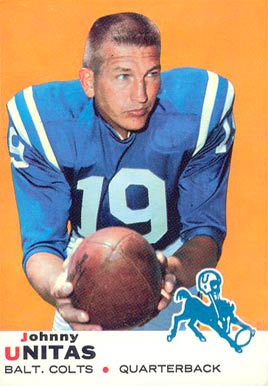
Johnny Unitas. Credit: Topps
October 4th, 1964, through December 10th, 1967, the Don Shula-led Baltimore Colts won 40 games, lost just 9, and tied 3 games. Defensively, this group of gang tacklers allowed just 97 yards a game rushing in the 40 victories, while allowing 152 a game rushing in the 12 games they did not win.

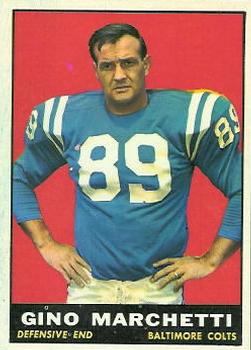
Though none of the linebackers on this team earned a Pro Bowl berth, Hall of famer Gino Marchetti (his 10th and final), Ordelle Braase, and Fred Miller each earned trips to Los Angeles. When Rick Volk was selected as a rookie in 1967 he became the fourth member of the secondary to earn post season honors, as Lenny Lyles, Jerry Logan, and Bobby Boyd (30 interceptions) had been chosen previously.

Though the Colts did play some man coverage, since they would blitz regularly, they were one of the best zone teams in the league. Their defensive passer rating for the 40 wins was 56.9 as opponent passers just could not solve the rotating coverages devised by Shula, defensive coaches Bill Arnsparger, and Chuck Noll. In the 12 games Baltimore did not win, they were riddled as the pass efficiency rose to 85.2!

The main ingredient though in the land of crab cakes was the man in the hightop black cleats, one Mr. John Unitas. Though he, no doubt, received game plans from Shula; he orchestrated a balanced offense, though none of the runners stood out production-wise. Baltimore averaged 128 yards a game rushing in the 40 victories, and just 97 yards a game in the 12 losses. However, Johnny Hightops would probe, and set-up defenses for the big throw down the field, and the stats bear this out. Colt passers were an efficient 96.6 in victory.The yards per pass was an outstanding 8.87, with just 38 interceptions thrown in the 40 wins, while Colt receivers found the end zone 81 times.
Gino Marchetti. Credit: Topps
Willie Richardson, Jimmy Orr, John Mackey, and Raymond Berry all earned Pro Bowl berths during this time period. On the days when the Baltimore passing game was not efficient (48.4) they could not taste the fruits of victory. A strong offensive line included left tackle Bob Vogel, and in honor of his birthday today guard Jim Parker. They both played in the Pro Bowl and earned All-Pro recognition.

Wednesday, April 1, 2015

1933 NFL MVP RACE Retroactive

LOOKING BACK
By Chris Willis
(Part two of an on-going series)

At the end of the 1932 NFL season two teams tied at the top of the league standings. Because the league title was decided by win-loss record, the Chicago Bears and the Portsmouth Spartans agreed to play a playoff game in Chicago to decide who would win the championship. What ensued was the famous "Indoor Game" between the two clubs as a brutal snowstorm blanked the Windy City. Joe F. Carr, NFL President, agreed to let the two teams play the game indoors at Chicago Stadium. Because of the confined field (the field was just 80 yards long) the NFL adopted several new rule changes that would affect the NFL forever- and especially the 1933 season.

Rules that came out of the Indoor Game included:  Hashmarks for the first time; Passing was legal from anywhere behind the line of scrimmage (before you had to be at least five yards back); the field goal posts were brought up to the front of the endzone to encourage more field goals and in-turn more scoring. Two of the big complaints concerning the NFL in 1932 were that the game was not wide-open enough and that there were too many tie games. In 1933 the NFL saw more points on the scoreboard (16.4 points per game in 1932 compared to 19.0 in 1933), as well as half the number of tie games.

Scoring/Tie Games Comparison
Season       Total Points Scored*           Touchdown Passes     Field Goals     Tie Games
1932                  788   (48 games)               42 TD passes          6 FG made        10 ties
1933                 1,105 (58 games)               61 TD passes          39 FG made        5  ties 
*stats include postseason

The other most important item to come out of the Indoor Game was the publicity and attention that the play-off contest received nationally. Because of the media coverage and sold-out crowd, the NFL Owners agreed to split the NFL up into two divisions and have the winners meet in a NFL Championship Game. The NFL now had its World Series. In 1933 the newly established setup worked perfectly. The two best teams met for the Championship. 

Although the title game would feature the two best teams, the league as a whole featured the haves and the have-nots. Only four teams finished the season with winning records. The best teams had several retroactive MVP candidates fighting it outThe only problem when evaluating candidates (especially stats) for the 1933 MVP, was considering the number of games played since every team in 1933 didn't play the same number of games (teams played between 9 and 14 games).

1933 NFL Standings
Eastern Division,  Overall Record, Points Scored, Points Against
New York Giants              11-3-0     244 (17.4),      101 (7.2)
Brooklyn Dodgers             5-4-1        93  (9.3),        54 (5.4)
Boston Redskins                5-5-2       103 (8.5),        97  (8.1)
Philadelphia Eagles           3-5-1         77 (8.6),       158 (17.6)
Pittsburgh Steelers             3-6-2         67 (6.1),       208 (18.9)

Western Division,   Overall Record, Points Scored, Points Against
Chicago Bears                  10-2-1        133 (10.2),     82 (6.3)
Portsmouth Spartans         6-5-0         128 (11.6),     87 (7.9)
Green Bay Packers            5-7-1         170 (13.1),    107 (8.2)
Cincinnati Reds                 3-6-1          38  (3.8),      110 (11.0)
Chicago Cardinals             1-9-1          52  (4.7),      101 (9.2)

The new rules helped open up the game just slightly in 1933. Yes tie games were less common, but the running game still towered over the passing game. NFL teams rushed the ball 4,118 times for 13,792 yards (3.3 average) and 69 touchdowns, while NFL passers tossed the ball 1,631 times and completed just 576 (35 percent) for 57 touchdowns. They also threw a whopping 249 interceptions!

As for the passers Giants rookie quarterback-tailback Harry Newman made an immediate impact. Leading the league in all passing categories: completions (53), attempts (136), yards (973) and touchdown passes (11). Newman helped the Eastern Division champion Giants to the scoring title too, by putting up 244 points (17.4 per game), which was heads and shoulders above second-place Green Bay with 170 points. Newman also contributed in the running game by gaining 437 yards on 130 carries and scoring three touchdowns. His all-around play showed up in the passing game with 136 receiving yards, one touchdown and played great defense. As a rookie, Newman tossed his hat in the MVP race.

The only other passer in contention would be Portsmouth Spartans tailback Glenn Presnell. In his third year with the Spartans Presnell caught a lucky break when Spartans superstar back Dutch Clark retired from pro football to go into coaching full-time. He didn't waste his opportunity to finish second in the league in passing.


Harry Newman. Colorization by John Turney
 Just like Newman, Presnell was much more than a passer. The former Nebraska All-American also contributed in the ground game, rushing for 522 yards on just 118 carries, placing him fourth in the NFL in rushing. He scored six rushing touchdowns, tops in the NFL, and his average of 4.4 was third best. His leadership while replacing the great Dutch Clark led the Spartans to a 6-5 record. Just ahead of Presnell among the rushing leaders was the NFL's best power runner- Bronko Nagurski. The game's most feared runner finished the season third in rushing with 533 yards (4.2 average was 4th best) but only scored one touchdown all season, which hurts his MVP resume. Although head coach George Halas used him a lot as a decoy near the goalline (Nagurski completed 14 of 27 passes, but none for scores) the lack of scoring knocks Bronko down a notch. In the end, he was one of the league's best defensive players (part of a Bears defense that gave up only 8 total touchdowns all season) and helped the Bears capture the Western Division title.

Looking at the top of the rushing stats one sees two players from the Boston Redskins. Both Jim Musick (173 carries, 809 yards, 4.7, 5 TDs) and Cliff Battles (136 carries, 737 yards, 5.4, 3 TDs) had very productive years. The Redskins as a team led the NFL with 2,260 yards rushing but that production didn't amount to wins on the field as Boston finished with a record of 5-5-2. Although they both piled up some great stats, Newman, Nagurski and Presnell also helped their teams win more.

Bronko Nagurski. Colorization by John Turney
 As for the receivers, their numbers always seem to pale to the rushing stats. Brooklyn back John "Shipwreck" Kelly led in receptions (22) and touchdowns (3), plus he scored in other ways with two rushing, one punt return and one on defensive giving him seven total scores which were half his team's total of thirteen.


John Shipwreck Kelly. Colorization by John Turney
Kelly scored 43 points placing him 4th in the NFL in scoring. The Giants' Kink Richards scored seven touchdowns too, but most of his scores came in mop-up duty or when the Giants were well ahead. Boston's Jim Musick finished 3rd in scoring with 45 points. Besides passing and running the Spartans' Glenn Presnell also helped his squad by being one of the game's best kickers. His five field goals and 13 extra points, along with his six touchdowns, gave him 64 total points, tied for tops in the NFL in 1933.


Glenn Presnell, vs. College All-Stars. Colorization by JT
Presnell was tied with one of the NFL's best all-around players who had maybe his best year as a pro in 1933. Ken Strong was playing in his fifth year in the NFL when he scored 64 points for the Giants in 1933. All year long he showed off his versatility by rushing for 272 yards (on 96 carries) and three touchdowns; catching 10 passes for 146 yards and two touchdowns; kicked 5 field goals and 13 extra points; threw two touchdown passes, and had one interception return for a touchdown on defense.

Strong was never better than in a November 5th game against fellow MVP candidate Glenn Presnell and the Portsmouth Spartans.  Heading into the game the Western Division Spartans were 5-1 and one game back of the undefeated Bears (6-0), while the Giants were struggling in the Eastern Division at 4-3. At the Polo Grounds Presnell started fast with an 80-yard touchdown run and a 20-yard field goal to give the Spartans a 10-0 lead heading into the 4th quarter. Then Strong took over the game, as he caught a 12-yard scoring pass from Harry Newman, and capped the comeback off with a short 2-yard scoring plunge to give the Giants a 13-10 victory.

Led by Ken Strong the New York Giants would not lose another game the rest of the regular season- winning six straight and capturing the Eastern Division title.

Two weeks (Nov. 19th) after the Spartans win Strong once again showed why he was the best player in the NFL. In front of 22,000 fans at the Polo Grounds Strong's 21-yard field goal was the difference as the Giants defeated the Chicago Bears 3-0 in a hard-fought battle of the NFL's two best teams.

 Although the Chicago Bears would get their revenge in the league's first NFL Championship Game (beating the Giants 23-21) Ken Strong was the best player in the NFL during the 1933 season edging out Glenn Presnell and Bronko Nagurski.

1933 NFL MVP
Top Five

1) Ken Strong, New York Giants, Fullback
2) Glenn Presnell, Portsmouth Spartans, Tailback
3) Bronko Nagurski, Chicago Bears, Fullback
4) Harry Newman, New York Giants, Tailback
5) John "Shipwreck" Kelly, Brooklyn Dodgers, Wingback

Ken Strong, 1933 Pro Football Journal Retroactive MVP. Colorization by John Turney