Tuesday, February 16, 2016

The Ephemeral with the Everlasting: The Art of Steve D. Sabol

REMEMBERING
By T.J. Troup
The enjoyable and often fascinating discussions with Steve Sabol concerning his background in art is the subject of today's post. The years of rumination on various and sundry topics came to life in his art. The French impressionistic painter Paul Cezanne has one of the quotes Steve and myself have used over the years: "All art is selected details".

When one absorbs the details in Steve's art you see what he was about. Each painting tells us about the culture captured with football as the centerpiece. So many tell a tale, yet for me "SPACE FLYER" is my favorite. The location of each of the characters in the painting and the subject matter strikes the strongest of chords.


Enjoy:
"Space Flyer" Artwork: Steve Sabol

"Have You Ever Been Lonely?"  Art by Steve Sabol
The clever use of "Van Brocklin, Van Gogh, and Van Buren"
"Dutch Matters' By Steve Sabol


Sunday, February 14, 2016

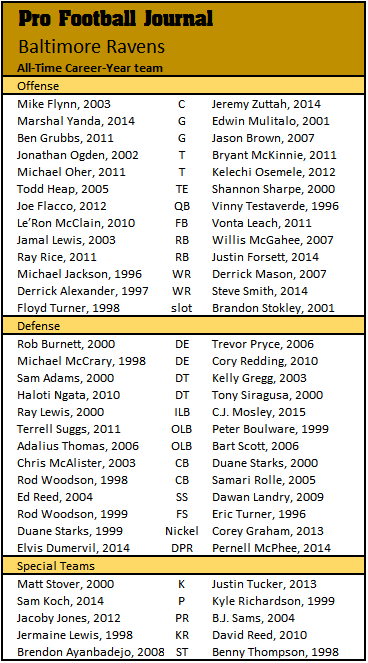
Baltimore Ravens All Career-Year Team

OPINION
By John Turney
We at Pro Football Journal are trying to pick the best individual seasons in the history of each franchise, which we will continue today with the Baltimore Ravens. By "Career-year" we mean the best performances at each position, with the following rule: Only one season per player per position. For example, here, we cannot pick Ray Lewis's best two seasons and use all linebacker slots. 

First-team on the left, Second-team on the right: 
Finding a tackle opposite Jonathan Ogden was not easy, they have had solid players, but no one that really stood out and several that disappointed. We looked at several things and came up with the order in the chart, but will be looking deeper to see if there may be a hidden season or two by someone. For Ogden, we went with 2002 when he allowed only two sacks and was not flagged for a single penalty all season.
First-team guards were easy, as were the Second-team guards. Mike Flynn was a heady player who was part of the monster season by Jamal Lewis in 2003.

Jamal Lewis was chalk at one spot. Ray Rice had to get the other season. The backups presented some tough choices but those who we listed seemed like the next-best to Lewis and Rice.

Todd Heap had a few seasons that qualified, we went with 2005 over 2006 when he was voted the NFL's top TE by NFL Alumni. In 2005 he had more yards and touchdowns. His 2002 was also a great year with good numbers but his blocking always set him apart.

Backing him up is Shannon Sharpe from the 2000 Championship team. McClain was a fullback who could carry the ball, and Leach is one of the modern, guard-in-the-backfield types, though he could catch well. 

Michael Jackson and Derrick Alexander were holdovers from the Cleveland Browns and still have the best statistical seasons by any Ravens receivers. Floyd Turner had better numbers and he gets the nod over Stokely. 

We went with Flacco's Super Bowl-winning season over a couple of slightly better statistical seasons. Vinny put up big numbers in 1996 and deserves recognition for it.

Ayanbadejo was one of the best special teams players in past decade-and-a-half and 2008 was his best season. Bennie Thompson was an All-Pro special teamer in 1998. The returners were prioritized by returns for touchdowns and then post-season honors. The First-team selections are particularly strong. Gary Stills and his 2006 season (24 tackles on special teams) gets an honorable mention

Kickers and punters are prioritized by honors then net punting and FG accuracy. All four are strong for the Ravens and could be juggled a bit. Sam Koch's 2014 stands as his best with a 43.3 net average and a 26-4 inside-the-20 to touchback ratio, though in 2015 he made the Pro Bowl however 2014 was a slightly better year.

The defense was fun to choose, with three Defensive Player of the Year winners and other strong seasons by one of the best defenses, year-in, and year-out since they became a team in 1996

We went with honors and stats for the CB positions in general. Rod Woodson is qualified for two spots—safety and corner. As a corner in 1998 he picked off six passes and took two to the house. The rest of CBs here are very solid, but not superstars. We were tempted to put Deion Sanders's lone season as a nickel here, but we though the two listed made more plays so Deion gets honorable mention as a nickel as does Corey Ivy for 2008 when he had 52 tackles and 2.5 sacks. Ivy was excellent as the "Cat" blitz, amassing 9.5 sacks from 2005-08 with Ravens and Rams.
Okay, for purists, they will see Ed Reed listed as a strong safety. Well, he was listed there by Ravens in 2004. Will Demps was listed as the free safety from 2002-05. 

However, we are fully aware that in Ravens defensive scheme the safeties really were pretty much interchangeable and both safeties will play strong and free depending on the formation and situation and defensive call. But in his early years, Ed Reed did often play close to the line of scrimmage and made lots of plays there. In his first four seasons when he did line up more to the TE side (2002-2005) he had 17.5 run stuffs. In the seven Raven seasons when he lined up more to the open side (2006-2012) he had 7.5 run stuffs. 

Regardless he was the NFL Defensive Player of the Year as had one of the best-ever seasons by any safety in any season, ever.

In 1999-2000, sometimes against base personnel (21) the Ravens would use a Buddy Ryan-type 46 front, but would play cover-3 deep and have OLBer Jamie Sharper player the tight end man-to-man. They would also blitz Peter Boulware from the "Otis Wilson" spot and two defenders would then have to cover the short zones, all five of them. 

We don't know what they called it, but in verbiage, I am familiar with, it would be Bear Cover-3 latch. The "latch" means a LBer takes the TE on all routes, everyone else in zone. But it would not be as complex as what Marvin Lewis was doing. According to PFJ's Coach T.J. Troup they could get away with this because the two defenders assigned to the underneath zones could run and tackle. Their names? Rod Woodson and Ray Lewis.

Lewis had two DPOY seasons to choose from and it was a tough call, but we went with 1999 rather than 2000 or 2003. He had 16.5 tackles for loss, picked off three passes a career-high in tackles. His runner-up season is 2003 with his six picks. 

Had we chosen a 3-4 ILBer it would have been Mosely and we'd find two Second-team inside 'backers. Daryl Smith is an honorable mention for his 2013 season when he had three picks, five sacks and 123 tackles. He'd be the Second-team MLBer had he gone with a 4-3 scheme.

Outside linebacker for Ravens scheme is a hybrid and has been, really, since the Ravens inception. Suggs is half linebacker/half defensive end. Thomas was part linebacker, part end, sometimes even lining up outside. Boulware was a linebacker versus base offenses, and when they went sub (3-wide or 4-wide) he was the left defensive end. Bart Scott would play inside, then outside, in 2006 he had 9.5 sacks. Had to leave him off the First-team for that year, but Suggs and Thomas had the best years, though we could put Scott as an ILB because he did play there in the 3-4. Jarrett Johnson would be honorable mention as would Jamie Sharper's fabulous 2001 season.

There is some beef in the Ravens defensive line choices. Only Michael McCrary is a speedster-type. Why do we at Pro Football Journal insist that AP All-Pro teams not "The" All-Pro team? In addition to THIS: here is an anecdotal example. In 1998 only Sporting News recognized McCrary as First-team All-Pro with it's player vote. Why is that important? McCrary not only had the then single-season record of 14.5 sacks he had 12 run stuffs, for 26.5 plays behind the line of scrimmage. 

The AP All-Pro DEs were Reggie White (also DPOY) and Michael Strahan. White had 16 sacks and 3 stuffs for 19 sacks+stuffs. Strahan had 15 sacks and 8 stuffs for 23. The Second-team All-Pros were Smith and Michael Sinclair, whose totals were 10+4=14 and 16.5+3.5 = 20, respectively. It was a year where three of the four were the top sackers and possibly the run stuffs were not looked at as part of the equation or just ignored.

Burnett is a personal favorite. He'd line up as an end in base and in nickel, he'd reduce to a 3-technique (and also play 3-technique in the 46). In 2000 he had 10.5 sacks, 6 stuffs, 5 fumbles recovered, 3 forced fumbles and a pick on the NFL's best defense. Trevor Pryce and Redding were both Rob Burnett-types, ends on run downs, tackles in nickel, with Pryce getting 13.0 sacks in 2006.

Haloti Ngata was consistent and had a few seasons that fit 2010 he was the best in the business. He was listed as a 3-4 end but he's a defensive interior guy. Sam Adams is the other choice. The three quickest defensive tackles off the ball we've seen are 1. Sam Adams, 2. Alan Page, 3. Aaron Donald. Goose and Gregg back the tackles and are shade-technique types. In 2003 Gregg had  80 tackles 6.5 stuffs and 3 sacks. Siragusa may be only defensive lineman who has a season chosen where he didn't have a sack. We went with a Super Bowl-winning season but could have just as easily gone with 1999 when he had 3.5 sacks.

Dumervil had tons of sacks and two starts in 2014 and McPhee had a good year, too, often as an inside rusher. Paul Kruger gets an honorable mention.

Agree, disagree? Did we make a mistake? Let us know.

Saturday, February 13, 2016

Colorization of the Day: Hit Heard 'Round the World, Bills Mike Stratton

LOOKING BACK
By John Turney

“The Hit Heard ‘Round the World,” is one of the greatest defensive plays in Buffalo Bills history.

Bills photographer Robert Smith took this B&W shot on December 26, 1964 during the Bills AFL Championship Game versus the San Diego Chargers. I have colorized it.

Mike Stratton was an outside linebacker for the Buffalo Bills, an All-AFL selection as was Charger running back Keith Lincoln.

Enjoy:
Colorzation by John Turney

Colorization of the Day: Daryle Lamonica 1963 Buffalo Bills

REMEMBERING
By John Turney

Daryle Lamonica had a couple good seasons, even coming in for Jack Kemp and pulling out some wins for the Billls in his years before he was sent to Oakland.

Note #75 Jess Richardson, no face mask, one of the last two to do that, other: Tommy McDonald.
Colorization by John Turney

Friday, February 12, 2016

Colorization of the Day: Ward Cuff, New York Giants versus Brooklyn Dodgers

LOOKING BACK
By John Turney

Yes, New York Giants versus Brooklyn Dodgers. Dodgers are in blue and Giants in red with the blue helmet, Ward Cuff is ball carrier. Enjoy if you are into classic NFL.

Giants versus Dodgers. Colorization by John Turney

Thursday, February 11, 2016

Again, Hall of Fame Snubs and Insults

OPINION
By John Turney

Yesterday, NBC's Mike Florio suggested Lynn Swann should "tread lightly" when speaking about Hall of Fame qualifications. Florio makes the case that Swann's Gold Jacket is because of "(T)wo reasons: team accomplishments and his performance in Super Bowl X."

I am not sure how Florio knows that, perhaps he has spoken to the Hall of Fame voters who debated his case 14 times, but it may be for more than the two reasons Florio mentions. Other reasonable folks have different views. Bob Labrolia wrote, "Quality over quantity might be the simplest way to characterize Swann’s career. His 907 receiving yards in 16 playoff games is more than he ever amassed over a whole regular season, and he also averaged 18.9 yards per catch in the postseason to go along with nine touchdowns". That is also the mantra Paul Zimmerman used many times when writing about Swann, "big plays in the biggest games" Dr. Z. would say.

It was a contentious debate, however, Myron Cope, the Steelers' radio broadcaster and inventor of the "Terrible Towel," resigned from the selection committee because he felt he was getting too emotional and might be hurting Swann's chances of induction.

Other points were that not only has the game changed to allow for far more passing attempts, even after the change Chuck Noll was a run-first coach. From 1974 to ’82, the Steelers ran the ball 58.9 percent of the time, among the highest percentages in the NFL for that period. Still, when the Steelers did throw, their passes were down the field. During that same period of 1974-82, the Steelers averaged 14.1 yards per completion, the second-highest average in the NFL. While the Raiders talked of the "vertical game", it was the Steelers who practiced it more effectively. Florio states that the change in the game was a "knee-jerk" response. But, it could be said a cursory look at "numbers" could also be a "knee jerk" response, correct?


The strongest case to be made for Swann is that he played best when it counted most, in the playoffs. Swann did come up huge in 16 postseason games. He caught 47 passes for 906 yards for an 18.9-yard average and nine touchdowns — against playoff competition in a run-first era. In those 16 games the Steelers came out victorious 13 times, including four times in the Super Bowl. Swann made a couple of big catches in the AFC championship game that propelled the Steelers into Super Bowl IX against the Vikings.

Swann was the MVP in Super Bowl X with perhaps the best "big" game any receiver has ever played. He made four catches, three of the circus variety, for 161 yards, including the game-winning grab. "Terry Bradshaw only threw five passes to me that day." What Swann won't tell you, but knows in his heart is that a normal wide receiver could not have made three of those catches. They were too difficult, too unique to his set of skills — in a word, too much Swann.

He caught the go-ahead pass in Super Bowl XIII that put Dallas in a hole. On that one, Swann called the play in the huddle because he saw the Dallas cornerbacks playing "up". He knew they were biting on the three-step drop, so Swann waited for Bradshaw to pump-fake, and that was his signal to blow by the corner. He did, and that touchdown, for all intents and purposes, sealed the Cowboys’ fate that day.

The following year there was Super Bowl XIV, in which he made a spectacular, leaping 47-yard touchdown reception that gave the Steelers the lead. On that catch, Swann out leaped the Rams’ two best defensive backs, Pat Thomas and Nolan Cromwell. Cromwell was so close to knocking it down that, to this day, upsets Ram fans to see that highlight. A few plays later, Swann was knocked out of the game with yet another concussion, and it became Stallworth's turn to catch the game-winning touchdown pass.
Credit: Merv Corning
Swann was a First-team All-Pro three times and maybe had his most satisfying compliment when Jerry Rice, the king of all wide receivers, paid Swann the best compliment ever. It was done in a subtle way, the way jocks talk to each other, simple, direct and sincere, "He walked up to me," Swann remembers, "and said, ‘Swannie, you were "the Guy," to everybody.’ " Swann knew what that meant. Swann knew he had made an impact.

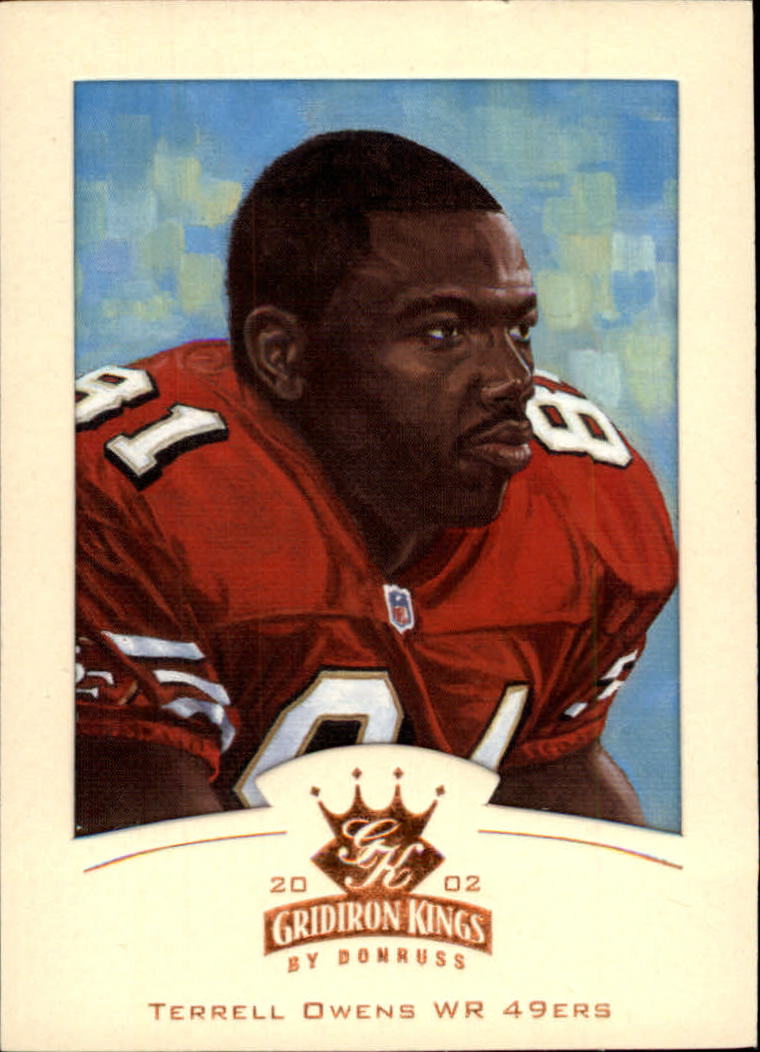
Maybe that is not enough for some. Reasonable people can disagree and Florio and others do. However, what is a bit more problematic is how this relates to the Terrell Owens mini-controvery that has buzzed since last Saturday.


Earlier today Florio wrote that "Hall of Fame voters definitely blocked T.O. for being “so disruptive" and opined that if a player has such issues that if those issues are great enough to keep him out on his first try then "(They) should keep him out forever." Florio then attempts to refute the criticism that T.O. was disruptive and that "The notion that “five teams couldn’t wait to get rid of” Owens simply isn’t true". Well, maybe it is overstated, but it is a fact that he did change teams often in his prime and they often surrounded the disruptive incidents.

Additionally, the so-call disruptive factor was part of the criticisms of Owens, but not the only one. It is my understanding that his leading the NFL in drops and near the top other seasons was brought up in the meeting as well as poor route-running and other esoteric things.

So, if the shoe is on the other foot, maybe the T.O. supporters can state why he IS a first-ballot WR. I don't have a dog in the fight. Had he gotten in over, say, Tony Dungy, I would not have been critical of the committee. I really don't think folks can make a huge case that Owens deserved to get in on his first try more than Harrison deserved to be in on his third try.

My view is that none of the recent WRs, other than Jerry Rice had careers such that they were first-ballot WRs. Again, this is just me, but Jim Brown, Johnny Unitas, Joe Montana, that is first-ballot. My view is there are a couple players that got in right away that were not quite up to the Brown-Unitas-Montana standard, but that is what happens when votes are taken.

Another point Florio makes is this, "Why not just say only five modern candidates can get in each year, and with two of the best receivers in NFL history up at the same time, we decided to give the spot to the guy who had been waiting the longest? It’s far closer to the truth, and it can be stated without requiring voters to take shots at a guy who, regardless of his real, embellished, and/or imagined behavior, merits at least some degree of respect for what he accomplished on the field.".

I agree with the first part is because there is limited room and so many qualified candidates, only a few can jump to the head of the line and be elected right away, Brett Favre fit that bill last week. Owens really didn't. However, the problem I do have is the part where he talks about writers taking "shots" at Owens.

Well, that is why the meeting is private, so that the honest views of writers and the fruits of their research can be discussed openly. In this case Florio only knows about the "shots" is someone spoke about it. Well, that is fine, but it hardly means voters were taking unnecessary shots.  Also, Owens made the semi-finalist list and the final 15 lists. That seems to be giving Owens "some degree of respect", no? Is taking shots what Lynn Swann  "accomplished on the field" showing "some degree of respect" even if you don't agree with the selection?

Did Owens himself show Chris Carter due respect when he said, "Chris Carter begged his way into the Hall of Fame? Carter was another of the great receiver who had to wait due to am imperfect career, albeit great.

Florio's job is to report on all aspects of the NFL, so his articles about the Hall of Fame are fair game. Also, here and here. But if memory serves Florio may not have been so pure about showing respect what players did "on the field" all the time in the past. His turd watch was a staple of Pro Football Talk, as was his reporting on the "Love Boat" and the "Original Whizzinator", all off-the-field affairs.

Perhaps all of us, me included, should tread lightly when commenting on the Hall of Fame process and criticisms of what is said in those meetings. What they say in private, many in the media are posting on publicly and that could be construed as not showing respect for what those players did on the field. Maybe Florio and Jason Whitlock are more familiar with the process than I am or know the voters better since they are mainstream sports journalists, but for Whitlock's complaints about the HOF Class of 2011 there is another reasonable explanation other than the system being broken, which is what he, and Florio are insisting in their writings.

This will hit critical mass when Darren Sharper is up for the Hall of Fame. When you look at his numbers and All-Pro honors his 63 interceptions are remarkable when adjusted for era. When Paul Krause intercepted his 81 passes  (1964-79) when the interception rate in the NFL was 5.3%. Sharper's 63 picks in an era (1997-2010)  where the interception rates is 3.1% . However, Sharper will never get in, in my view, due to awful off-the-field behavior.

The Hall of Fame selection committee does good work. Do I always agree? No. But they do their due diligence and in my view do a better job that the voters that preceded them as their access to information has expanded. More football on television, more media outlets, more researchers all leads to more information. It is a tough job to sort through it all and then pick the best five of 15 qualified candidates. That's my take.

Owens will get in, and when he does, it will be because of his excellent career, which has more positives than negatives (but the negatives are real). In fact, one data point is our receiving stat in which Owens ranks highly. But it is not a "snub" or any type of "injustice" that Owens will have to wait. His career, while very impressive, is not in the Hutson-Alworth-Rice category, and that's just one man's opinion. In fact, it can be argued that Owens getting in on the first ballot could have been a real injustice.
"Haunted Hero" Art credit: Steve Sabol


Wednesday, February 10, 2016

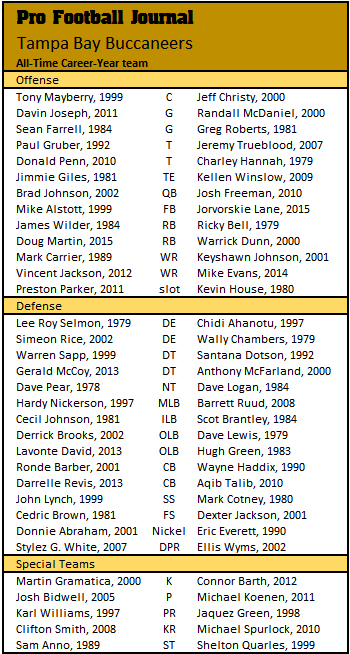
Tampa Bay Buccaneers All Career-Year Team

OPINION
By John Turney
We at Pro Football Journal are trying to pick the best individual seasons in the history of each franchise, which we will continue today with the Tampa Bay Buccaneers. By "Career-year" we mean the best performances at each position, with the following rule: Only one season per player per position. For example, here, we cannot pick Derrick Brooks's best two seasons and use both OLBer slots.

Here are the selections, First-team left, Second-team right:
The offensive linemen were picked based on the All-Pro selections or Pro Bowl selections, however, there have not been many such honored players in Buc history. Paul Gruber was a stalwart who had several good seasons that would fit here. Farrell was a First-team All-Pro by Sporting News in 1984. Charley Hannah was very good in 1979, when the Buccaneers, in their fourth season, advanced to the NFC Championship game. Greg Roberts never lived up to his draft status but was good in 1981. Peter King named Trueblood to the Sports Illustrated All-Pro team in 2007.

Jameis Winston should move into one of the two slots very soon. It was hard to leave out Doug Williams, but in his run with the Bucs it was joked that he was the only one (circa 1979-1980) who could overthrow the Ayatollah Khomeini. Even for his era, he was not an accurate quarterback.

The running backs are interchangeable with the exception of Alstott. We ordered them this way, but reasonable people could argue that they could be ordered in another way.
Wide receivers have not garnered many post-season honors, but these are the ones that we felt stood out in that they were at least mentioned by some outlets for honorable mention All-Pro. Jimmie Giles was a consistent tight end who could block. Winslow was a good receiver who wasn't a great blocker.

The Buccaneer tradition is defense and they are stacked on this side of the ball. Selmon could have several years picked, but we went with the obvious, 1979. That season he was the Defensive Player of the Year, had 11 sacks, 61 solo tackles, 27 assists, (88 total tackles)  and 8.5 stuffs. He also had three forced fumbles, blocked three kicks, two fumbles recovered, one of which was a scoop and score. He also knocked down four passes and was credited with 60 pressures.

Simeon Rice had a great season in 2002. Wally Chambers had a good season in 1979, his second as a 3-4 defensive end after really earning his bone fides as a defensive tackle for the Bears in the mid-1970s. Chambers had 46 solo tackles, 20 assisted tackles for a total of 66. He had 5½ sacks and 43 pressures and forced seven fumbles. Chidi Ahanotu was very effective in 1997.

The premier position for the Bucs may be three-technique. Lee Roy Selmon played that spot in 1976, but got hurt. Sapp's 2000 season, which PFJ contends Sapp led the NFL in sacks could have been his best, but again, we go with his 1999 season when he was the Defensive Player of the Year. McCoy and Dotson had fine seasons in the years mentioned. McFarland is the only one here who was not a three-technique. He was the shade/1-technique and was a big help to Sapp.
Lee Roy Selmon
The Buccaneers player a 3-4 defense from 1977 to 1990 so we listed a nose tackle as well. Dave Pear had 9 sacks in 1978 and was as good a nose tackle as there was that season. Dave Logan had 9 sacks in 1981, 9.5 in 1983, but in 1984 he was a Sporting News All-Pro that season when he had 5.5 sacks. We give Pat Toomay an honorable mention for 1976, he was voted the team Defensive MVP in their inaugural season.
Hardy Nickerson was steady and solid, but 1997 stood out. Ruud was good in 2008. At 3-4 inside linebacker we went with Cecil Johnson. Johnson was an outside linebacker for the Bucs but was asked to move. He did it and had a good season as the Buccaneers advanced to the playoffs. However, that does not mean Johnson liked it. He likened it to going into a lion's den "wearing a three-piece pork chop suit".

Johnson edged Richard "Batman" Wood who gets a Second-team spot. Wood had 2 picks, 2 fumbles recovered and had 17 tackles for loss. Scot Brantley was a worker, good run stuffer, but was usually not on the field in likely passing downs and he gets an honorable mention for his 1984 season.

Outside linebacker is the other premier position for the Tampa Bay franchise. All four of these seasons were special. Derrick Brooks was the Defensive Player of the Year. He had 87 solo tackles, 30 assists for a total of 117 tackles. He picked off five passes and returned three for touchdowns. He deflected 11 passes and recovered a fumble, which he returned for a touchdown. Six of his tackles were stuffs, he forced a fumble and had one sack.
Lavonte David has been almost as impressive in his career and several seasons fit on this chart, but we are going with 2013. He had 107 tackles and 38 assists for a total of 145 tackles, seven sacks, five interceptions, 10 passes defenses. And an amazing 17.5 of his tackles were stuffs for losses to go with the two forced fumbles and his lone recovery

Hugh Green was another player who had three stellar seasons. We went with 1983, though the 1982 strike season may have been a hair better. In 1983 Green had 104 solo tackles and 20 assists for 124 total, 3.5 sacks, 7 stuffs, three forced fumbles, two interceptions that were both pick 6s.
Dave Lewis
The other Second-team OLBer is Dave Lewis in 1979. One almost had to see it because it was a great all-around season.  Lewis had 89 tackles, 8 passes defensed, 5½ sacks, four forced fumbles and two interceptions one of the NFL's best defenses. It was hard to regulate him to the Second-team. Lewis had a big year in 1980 as well—68 tackles and 16 run stuffs and a Pro Bowl.

Broderick Thomas was the Buc's only pure 3-4 rush backer they had in the 3-4 scheme and he only started one year (1990) in it. However, he transitioned well in 1991 in the Bucs first season in a 4-3 since 1976. He ended the season with a career-high of 11 sacks and 15.0 stuffs and 7 forced fumbles to go with his 124 tackles and he gets an honorable mention for really, a great season few folks remember. Again, on most teams having 26 sacks plus stuffs would land you on the First-team but with Brooks, David, Green, and Lewis it's a tough room. Another honorable mention is Richard Wood who moved to inside linebacker

Ronde Barber and John Lynch could have multiple seasons here, but we went with 2001 and 1999, respectively. Reavis was just too good a corner to leave off, even though he was there only a season. Talib was the NFL Alumni Defensive Back of the year in 2011. Haddix picked off a lot off passes and scored with them. It was hard leaving off Ricky Reynold's 1991 season (and others) but he was a guy who covered well, didn't get challenged much, and didn't get tons of post-season honors but he was a quality corner. He, too, gets an honorable mention.

Mark Cotney was a Paul Zimmerman favorite, better against the run than the pass, he was an old-time hitter, not unlike Lynch.

The special teams were picked on the basis of mostly stats as were the nickel backs and designated rushers. If folks have better seasons, feel free to post your disagreements.