Saturday, April 27, 2019

Buffalo’s Brushes with the Hall of Fame During the Roaring Twenties

By Jeffrey Miller 

Unfortunately, they all played for the other guys …


The Buffalo All-Americans of the early 1920s were a great team, finishing within one game of the title in each of the league’s first two seasons (1920 and ’21). But despite an overall record of 18 wins and just 2 losses, the All-Americans, perhaps the most talented team ever assembled that did NOT win a championship, boast no Hall of Famers. In fact, there is no one from the team’s entire nine-year existence even sleeping on the hallowed hall’s front lawn.

Former Buffalo Bison fullback Pete Calac was nominated, but more for his connection to the great Canton Bulldog teams of the late 1910s and his association with Jim Thorpe than for his brief tenure in the Nickel City. And though Calac himself didn’t make it in as a player, he did get to stand outside the hall and deliver Jim Thorpe’s presentation speech when the former Olympian was inducted in 1964.

Frank McNeil, the founder and first owner of the All-Americans/Bisons, despite being declared a “pioneer” who “did so much to develop football” by George Halas upon Papa Bear’s 1963 induction, never got closer to the hall than Halas’ enshrinement speech.

Despite the fact that the All-Americans/Bisons are not represented in Canton, the rosters of the teams against which they played boasted many football immortals. Grid giants bearing such names as Red Grange, Link Lyman, Fats Henry, Fritz Pollard, Paddy Driscoll, and Jim Thorpe traversed the opposite side of the field against the great Buffalo teams of the Roaring ‘20s. Below is a listing of all the Hall-of-Famers who visited Queen City between 1920 and 1929, with dates of games and a brief description of the player’s performance:

 F Harold “Red” Grange 

Tuesday, October 12, 1927--The Galloping Ghost of Illinois fame made his first appearance against the Buffalo Bisons a memorable one, scoring on a short touchdown run in leading his New York Yankees to an easy 19-8 victory at Bison Stadium.  Grange only played the first quarter.

Sunday, October 13, 1929--Grange returned to Buffalo as a member of the Chicago Bears, throwing a touchdown pass in leading the Bears to a 16 to 0 win at Bison Stadium.

F Joe Guyon
Sunday, November 21, 1920—Guyon, the Chippewa Indian and former teammate of Jim Thorpe at Carlisle Institute, made his first trip to Buffalo as a member of Thorpe’s Canton Bulldogs. Playing before 15,000 fans at Buffalo Baseball Park, the Bulldogs defeated the formerly unbeaten All-Americans 3-0.

Sunday, November 6, 1921—Guyon, by this time a member of the Cleveland Tigers, picked off a pass and raced 75 yards for a touchdown before 7,000 fans at Buffalo’s Canisius Villa.  It was not enough, however, as the All-Americans held on to win, 10-6.

Sunday, November 26, 1922—Having joined the Oorang Indians along with Jim Thorpe, Guyon snagged a 30-yard touchdown pass, along with a pass for an extra point (both from Thorpe), as the Indians rolled to an easy 19-7 victory before 3,000 at Buffalo Baseball Park.

F Guy Chamberlin
Sunday, November 11, 1923—The Hall-of-Famer who faced Buffalo teams more than anyone else (7 games altogether) in the decade came to Buffalo for the first time as a member of the Canton Bulldogs. Despite boasting two other HOFers on their roster (Fats Henry and Link Lyman), the Bulldogs left Buffalo Baseball Park with only a 3-3 tie for their efforts.

Sunday, November 1, 1926, at Buffalo Stadium with the Frankford Yellow Jackets.  Jackets win, 12-3.   

F John “Paddy” Driscoll
Sunday, October 13, 1929—In the only Buffalo appearance of his career, an aging Driscoll manages a mere extra point as the Bears cruise to a 16-0 victory at Bison Stadium.

F Wilbur “Fats” Henry
Sunday, November 21, 1920--The three-time All-American from William & Jefferson makes his first appearance in Buffalo at the Baseball Park in helping Canton to a 3-0 triumph before 15,000.

Sunday, November 20, 1921, at Canisius Villa with the Bulldogs.  A 7-7 tie.   

Sunday, November 11, 1923—Before 10,000 at Buffalo Baseball Park, Henry dropkicks a 20-yard field in the last minute to secure a 3-3 tie for his Bulldogs.

F George Trafton
Sunday, October 13, 1929, at Buffalo’s Bison Stadium with the Chicago Bears in a 16-0 rout.

F Morris “Red” Badgro
Wednesday, October 12, 1927, at Bison Stadium with New York Yankees in a 19-8 win.

F Mike Michalske
 Wednesday, October 12, 1927, at Bison Stadium with New York Yankees in a 19-8 win.

 F Walt Kiesling
Sunday, September 29, 1929, at Bison Stadium with Chicago Cardinals in a 9-3 victory.

 F William Roy “Link” Lyman
Sunday, November 11, 1923, at Buffalo Baseball Park with the Canton Bulldogs in a 3-3 tie.

F Jimmy Conzelman
Sunday, November 23, 1924, at Bison Stadium with the Milwaukee Badgers in a 23-0 drubbing.

F Jim Thorpe
Sunday, November 21, 1920—The most celebrated athlete of his day made his first appearance in Buffalo. Thorpe played just one quarter in Canton’s 3-0 victory before 15,000 at Buffalo Baseball Park.

Sunday, November 26, 1922—In perhaps the greatest exhibition of talent displayed by any visiting player during the 1920s, Thorpe tallied two touchdowns on scampers of 7 and 20 yards, threw for another and capped his performance by tossing a pass for an extra point as his Oorang Indians pounded the All-Americans, 19-7 before 3,000 fans at Buffalo Baseball Park.

Sunday, October 21, 1923—Thorpe’s last appearance in Buffalo as a player proved to be an embarrassment, as the All-Americans skunked the hapless Oorang squad, 57-0 in front of 12,000. Thorpe, in a vain effort to help his team, played the entire game—a rare occurrence for the famed Olympian.

 F FRITZ POLLARD 


Sunday, December 5, 1920—Pollard is the Hall-of-Famer who visited Buffalo most often (5 times).  In his first appearance in Western New York, Pollard brought the undefeated Akron Pros onto the field at the Buffalo Baseball Park for a game played in a veritable quagmire.  The fleet-footed Pollard, usually a terror with the ball, actually might have cost his team the game when he fumbled a fourth-quarter punt away to the All-Americans.  But the AAs failed to capitalize and the contest ended in a 0-0 deadlock.  The tie was enough to secure the very first league championship for the Pros and the proud city of Akron. 

Sunday, November 13, 1921—Pollard was again a non-factor in this 0-0 tie at Canisius Villa.

Saturday, December 3, 1921—In a return engagement at Canisius Villa, the Akronites fell 14-0 to the undefeated All-Americans.

Sunday, October 11, 1925—Before 3,500 diehards in an unrelenting downpour at Bison Stadium, the Bisons and Pros battled to yet another 0-0 tie.

Sunday, September 26, 1926—With only 2,500 present as witnesses, the Buffalo Rangers (as they were called this one season) defeated the Pollards Akron Indians, 7-0.  It was Buffalo’s fifth-straight home shutout of a Pollard-led team (which might be a record?).

F BENNY FRIEDMAN 
Tuesday, November 5, 1929—at Bison Stadium in Buffalo, Friedman led the Giants to a 45-6 thrashing of the lowly Bisons, throwing two touchdown passes (30 yards to Ray Flaherty and 70 yards to Len Sedbrook) and kicking three extra points.

 F Ray Flaherty 
Tuesday, November 5, 1929—Though perhaps better known for his coaching career with the Washington Redskins, with whom he won two league titles, Flaherty proved he was a fine end as well in catching two touchdown passes as his New York Giants demolished the Bisons 45-6 at Bison Stadium.


F Steve Owen
Tuesday, November 5, 1929, at Bison Stadium with New York Giants.  A 45-6 win.

 There ya have it … a total of sixteen Hall of Famers who graced Buffalo’s pro football fields during the league’s first decade. As of this writing, there are no members of Buffalo’s original NFL team enshrined in the Hall, but who knows?  Perhaps one day All-Americans’ perennial all-pro guard Swede Youngstrom will take his rightful place alongside the greats against whom he competed during those turbulent years. 
***
Historical notes on the Buffalo venues mentioned in this article … the All-Americans' home field for the first two seasons was Canisius Villa, which was located on the grounds of Canisius College at Jefferson and Hughes streets in the city of Buffalo, which had a seating capacity of 12,000.  As bigger crowds were anticipated for certain games, the AAs used Buffalo Baseball Park (located at the block created by East Ferry Street and Masten, Woodlawn and Michigan avenues) three times in 1920.  

In 1922 and '23, the team called the Baseball Park home, though playing one game in '23 at Canisius Villa.   Buffalo Baseball Park was demolished and replaced by a new venue on the same site called Bison Stadium in time for the 1924 season, where the newly-named Buffalo Bisons would play their home games for the remainder of the decade.  Bison Stadium would be renamed Offermann Stadium in 1936 and remained home to the minor league baseball Buffalo Bisons until 1960    

Wednesday, April 24, 2019

Chris Willis's List of the Top Ends of the 1920s and 1930s

LOOKING BACK
By John Turney
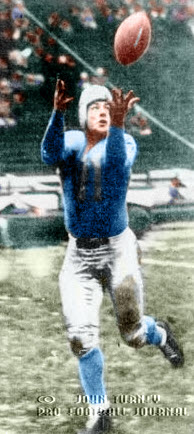
As the 100th Anniversary approaches, we continue to list players who were tops at their position and who made a significant impact on the league. This post reviews the two-way ends of the 1920s and 1930s.

NFL Films Producer Chris Willis has been kind enough to give us his list of the top ends of the first two decades of the NFL. Willis is the author of a half-dozen books from this era and a leading expert of the early years of the NFL.

1920s Ends
1. Guy Chamberlin—Part of five NFL championship teams, NFL 1920s All-Decade team; HOFer. 1922 had career-high seven TDs; could score rushing and receiving. If there had been a "Player of the Decade" for the 1920s Chamberlain would be the choice.

2. Lavvie Dilweg—Part of three NFL Championship teams; NFL 1920s All-Decade. Many researchers and historians think Dilweg belongs in the Hall of Fame.

3. George Halas—Won on NFL Championship as a player; NFL 1920s All-Decade team; HOFer.

4. Tillie Voss—Very productive; best year in 1924 with Packers, caught 5 TDs (all thrown by Curly Lambeau), All-Pro several times from different newspapers.

5. Charlie Berry—Only played two seasons, but All-Pro both years; scored nine career TDs with six TD catches; became a MLB umpire.

6. Paul Robeson—Only two seasons, but HOF talent; in 1922 game vs Oorang Indians scored 2 TDs including a 50-yard TD catch.

7. Tom Nash—Won three NFL championships with Packers, 1929-31; four career TD catches.

8. Joe Rooney—Caught seven career TDs; best year in 1927 with three TD catches; while with Duluth on October 31, 1927, caught the game-winning 25-yard TD pass from Ernie Nevers to defeat Milwaukee, 7-6.

9. Luke Urban —First-team All-NFL by Halas in 1922; only played three seasons.

10. Eddie Anderson—Solid end with best years playing for Chicago Cardinals.

1930s Ends
1. Don Hutson—Clearly the best end in the first fifty years of the NFL's history. Hall of Famer, member of the NFL 75th Anniversary Team and 50th Anniversary Team

2. Bill Hewitt—Better on defense than offense, but still very productive in passing game; great at blocking kicks, too. He was a Hall of Famer and a 1930s All-Decade selection.

3. Ray Flaherty—A four-time All-Pro and led NFL in receptions, yards, yards per catch and touchdown receptions in 1932 and part of the Championship won by the Giants in 1934. A Hall of Famer

4. Luke Johnsos—A TD machine; 20 TD catches.

5. Red Badgro—A three-time All-Pro and led NFL in receptions in 1934 and won NFL championship that same season. A Hall of Famer.

6. Wayne Millner—A Hall of Famer and a 1930s All-Decade pick. He caught touchdown passes of 55 and 78 yards from Sammy Baugh in the 1937 title game win over the Bears.

7. Gaynell Tinsley—All-Pro in 1937 and 1938 and led NFL in receiving yards and yards per catch in 1937.

8. Jim Poole—Had 65 catches for 895 yards; 13 career TD catches; three Pro Bowls; won one NFL Championship.

9. Bill Karr—Caught the game-winning touchdown lateral (from Bill Hewitt) in 1933 NFL Championship Game; good receiver, averaged over 18 yards a catch, 21 TD catches; Twice led NFL in receiving TDs.

10. Harry Ebding—Once led NFL in receiving yards (in 1934) averaged over 17 yards per catch. He was All-Pro in 1933 and a major cog in the 1935 Lions NFL Championship team.

Wednesday, April 17, 2019

Top Holders and Long Snappers In NFL History

OPINION
By John Turney
Well, in this exercise "NFL history" begins in the 1950s but we will be guilty of 'recentism' because there is more data these days to go by than in the 1950s and 1960s. But we do hope to share some names you have not heard in a while or maybe never heard of.

Do enjoy, and correct us if you think we missed someone...we likely have. All we are trying to do is celebrate some of the great specialists in the history of the game so we welcome comments -- it is not an exhaustive list on either holers or longsnappers.

Holders

Credit: LA Times
1. Nolan Cromwell—He's number one on Rick Gosselin's list as well. The reason we have him number one is that he's one holder that could win or seal a game with a fake. We've seen him do it quite a few times, more than anyone else. He was a tremendous athlete with great speed and good hands. He was also a college quarterback so he could throw as well.

There may be a holder or two with slightly better hands, but no one had his legs and impact on a game. Cromwell was a true weapon.

It should also be noted that he was a good special team player on the punt block team (six career blocks) as well. And was often the safety on the kick coverage teams because he was a good tackler and had excellent speed, so using him as the last line of defense was a good idea.
2. David Humm—Said by Bob Chandler to have the best hands ever.
3. Brad Maynard—Ranked second by Gosselin, we will go with that.
4. Paul Krause—Ranked third by Gosselin. Note that Krause is old school in that he has his front leg forward. You don't see that anymore but it used to be the norm.

Now players are coached not to do that is because it's dangerous for the holder to have his front leg sticking out because somebody could land on it. Although Krause does have it tucked as opposed to Whitsell (below) so the leg is not as vulnerable.

Also, when a holder kneels on his front knee he can use the back leg as a backstop since that where where he's catching the ball and placing it so the spot and setting the ball down becomes much more consistent and less prone to error.

5. Dave Whitsell—Excellent holder and the best edge place kick blocker ever. There may be a couple inside rushers with better numbers but no one from the edge. As mentioned, Whitsell has his front leg stretched out like Krause and is kneeling on his back knee. In this position, an edge rusher could lay out and land on the outstretched leg and possibly cause an injury.

6. Sam Koch—These days the snappers and holders are so good that it's hard to critique them. Koch represents the near perfection of today's holders, almost all of who are punters. What we know is on his watch the kickers have been great.

7. Bill Troup—Always ranked high by pro scouting firm in the 1970s.

8. Bob Chandler—Held for the Bills and then the Raiders. 

9. Hunter Smith—Called by one of his special teams coaches, "The best ever".

10. Eddie Meador—Like Cromwell, also a Ram and also wore #21, he could execute a fake as well as anyone outside of Cromwell. He rushed for 59 yards on six fakes and one touchdown and also threw a touchdown on a fake.

11. Joe Theismann—Quick out of his 'holder kneel' could roll and throw. We do know he wasn't loved by Deacon Jones. In 1974, in the final game of the season, the Redskins were blowing out the Chicago Bears. Jones talked George Allen into letting him kick an extra point if the Redskins scored a touchdown, which they did. However, Theismann refused to hold for Jones until the Deacon had a word with him, "I had the threaten the little prick to get him to hold for me".

Also not Theismann is kneeling on his back knee, perhaps one of the last to do it that way. But as we know, Theismann's leg was not injured when he was holding for a kick.

12. Jeff Feagles—Like Maynard held hell for a long time.

13. John Hadl—Held when he was with the Chargers then with the Oilers but not for the Rams in 1973-74.

14. Steve Dils—Like Humm, great hands.

15. Koy Detmer—Stayed in the league largely because he could hold. One of the last of the quarterback-as-holder era.

16. Brian Baschnagel—Another high ranker in the eyes of one pro scouting firm.

17. Roger Wehrli—Scored a touchdown on a fake in his first and last NFL season.

18. Larry Wilson

19. John Sciarra—Interesting player. A college quarterback converted to safety but would sometimes play quarterback in goal line situations for the Eagles.

20. Johnny Hekker—Anyone who can hold and point out to the referee that there are 12 men on the defensive side of the ball at the same time deserves a spot here. He also can throw on fake kicks like he does on punts.

21. Jeff Rutledge

22. Jason Baker

23. Charlie Waters

24. Brian Moorman—Did it playing in cold, windy Buffalo.

25t. Danny White—A Gil Brandt entry

25t. Sane Lechler

25t. Pete Holohan—Terrific hands. One of the few tight ends to hold.

25t. Elroy Hirsch—A HOF receiver with excellent hands.

25t. Joe Scarpati—Longtime holder for Eagles, held for Tom Dempsey's 63-yard field goal in 1970 for the Saints.

Sure, we could list many more names, but we just can only assume guys like Sonny Jurgensen, John Brodie, or Len Dawson or all the punters now did a good job our someone else would do it. George Allen, in his 1985 book on special teams mentioned Richie Petitbon and Bobby Boyd of the Colts as well.

As we've mentioned would love some anecdotal evidence from kickers, snappers in the NFL and the retired guys to hear some stories as to why their guy, their holder was the best.

Long Snappers
We've sorted them by games played but that is not how we rank them. We really cannot rank them because there is not a way we know of to do that, short of tracking each snap's accuracy and velocity.

We do, however, talk to people we trust and get input about that. One person said the most important things are #1 Accuracy #2 Not having a "hitch" prior to the snap #3 Velocity.

The names on the list that played 105 games or less (aside from Anno) are recommendations from George Allen in his book on special teams.

Recently, Hall of Fame voter Rick Gosselin ranked the long snappers with Steve DeOssie first, Patrick Mannelly second, and Don Muhlbach, third.

That order sounds fine to us.

After that, we'd go with Junkin, Hellastrae, Dorenbos, Mike Morris, Zak DeOssie (probably the best at getting downfield and making tackles since Rich Saul), Mike McDonald (maybe had the best accuracy and velocity and no "hitch"), Dan Turk.

Bush and Maples were starting centers a good portion of his career, Tingelhoff was a starter his whole career and handled all snaps. Bobby Bell and D.D. Lewis were starting linebackers.

Who was the first? No one knows. Could it be Joe Reid of the 1951 Rams? We've seen films of that team and the only time we saw #52 was long snapping but not enough to know how many games he did it. He didn't begin the season doing it (he was a tookie) but did, at some point, take over the job. So, the question remains. 

Tom Catlin snapped for the Browns in 1958 and was not the starting center (1957, too, but missed four games) and George Allen named him as one of the best he'd ever seen. He certainly was a pioneer of an exclusive snapper for kicks. Jackie Burkett played the role, even as a starting linebacker with the Colts and Saints as did Karl Rubke for the 49ers and others. But they were longsnappers only in just a few seasons, using starting at least some games. So, they may be considered other than classic lonsnappers as it is meant today. You be the judge.

George Burman was the Rams long-snapper from 1967-70, according to George Allen in his special teams book released in the late 1980s but we've never confirmed the specifics. However, he missed 1968 with an injury and often didn't snap for placekicks—only punts through 1970. That year he was the long snapper for both placements and punts. He went on to do the same for Washington for the next couple of seasons. 

Another player of note was Bob Whitlow who snapped for placements and punts in 1968 for the Browns. Cannot confirm if he did that earlier than that, though. The question was if he did it long enough. This is certainly a subject that more research is needed, but there is not a lot written about it. Believe me, we've tried to find more answers.

So, if we've omitted anyone, please let us know. We are sure that guys like Jim Otto did a credible job, but we'd love to hear the stories. Todd Christensen and Wesley Walls were a pair of tight ends who were excellent long snappers. Jeff Robinson was a defense end— and then a tight end—but was a long snapper his entire career.

With some of the field and game conditions back in the day, sometimes just getting a kick or punt off was likely a feat. So if there is more to this, we are all ears; we would love to learn more about the esoteric aspects of special teams play.
Junkin
Some notables, though not a complete list of snappers who spent all or part of their careers long-snapping—
NameYearsGames
Trey Junkin19832002281
David Binn19942010256
Blair Bush19781994246
Patrick Mannelly19982013245
Mick Tingelhoff19621978240
Ethan Albright19952010236
Kendall Gammon19922006234
Don Muhlbach20042018228
John Denny20052018224
L.P. Ladouceur
Dave Moore
Dan Turk
2005
1992
1985


2018
2006
1999
221
220
218
Brian Jennings20002012208
Dale Hellastrae19852001205
Adam Schreiber19841999202
Jeff Robinson
Jon Dorenbos
1993
2003

2009
2016
202
201
Adam Lingner19831995200
Guy Bingham19801993199
Brian Kinchen19882003193
Lonie Paxton20002011189
Ed Brady19841995188
Mike Morris19811999188
Zak DeOssie20072018188
D.D. Lewis19681981186
Bobby Maples19651978184
Rob Davis19962007183
Greg Warren20052016180
Rich Saul19701981176
Steve DeOssie19841995175
Cullen Loeffler20042014171
Mike Bartrum19932006171
Bobby Bell19631974168
Mark Rodenhauser19871999168
Garrison Sanborn20092018160
J.J. Jansen20092018160
Kevin Houser20002010159
Mike Schneck19992009159
Randy Kirk19871999157
Trevor Matich19851996148
Brad St. Louis20002009144
Chris Massey20022011141
Jim Pietrzak19741987140
Morgan Cox20102018134
Jon Weeks20102018134
Nick Sundberg20102018120
Tom Goode19621970113
Ed Perry
Josh Harris
1997
2012

2005
2018
109
107
Charlie Ane19751981105
Mike McDonald19831992104
Dan Ryczek19731979102
Sam Anno19871993102
Ted Fritsch19721979102
Bob Whitlow19601968100
Kyle Nelson2012201893
Pail Crane1966197288
George Burman
Vic Lindskog
1964
1944

1972
1951
85
78
John Rapacz1948195476
Larry Strickland1954195962
Tom Catlin1953195951
List has been updated.