Tuesday, January 18, 2022

Terry Bradshaw, err, Matthew Stafford, Leads Rams to Playoff Win Over Cardinals

 By John Turney 
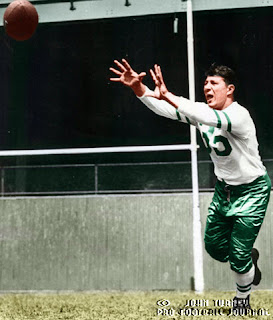
Terry Bradshaw

Someone kidnapped Sean McVay and replaced him with Chuck Noll. His gunslinger quarterback threw just 17 passes, completing 13 of them for 202 yards and a pair of touchdowns in a 31-11 win over the Cardinals.

This from a coach who has been fairly criticized for abandoning the run, going "pass-happy" and not doing the "4th down thing" right. 

Last night he stayed committed to the run. He let Johnny Hekker pin the Cardinals inside the twenty-yard line, let his defense do some work. He let his quarterback throw darts on the plays he does well. But didn't overdo it. 

It was 1970s Steelers football when Noll would run Franco Harris and Rocky Bleier and often limit Bradshaw's throws and let his defense dominate. 

Four times in the 1970s Bradshaw, in playoff games, threw20 or fewer passes and gained 200 or more yards. He won all four. And his offense scored an average of 32 points per game. 

No one else has more than one. Stafford now has joined that group.
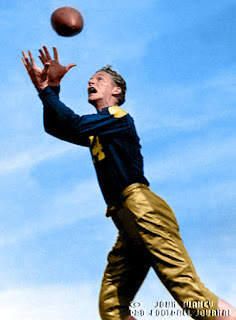
Matthew Stafford
Stafford played extremely well. He was accurate, threw passes with authority and with touch. Didn't make any "Harry High School" plays, as Steve Young called them in ESPN's pregame show referring to Stafford's pick-sixes and other plays inside his own 15 plays that gave opponents easy scores. In fact, it was Kyler Murray who did that last night.

Last night's strategy may not work against Tampa Bay but last night it was great to see some 1970s-style football by the Rams—38 rushes. 18 passes (one a gimmick) for a 67% run-to-pass ratio, 5 punts all inside the 20, no missed field goals or PATs, 183 total yards allowed, allowing 61 yards rushing, a 40.9 defensive passer rating, two picks including a pick-six, a great pass rush all night, keeping the Cardinals 0-9 on third downs.

Yes, Chuck Noll (and Don Shula, Vince Lombardi) are likely all smiling in football heaven. McVay performed as though he were one of them last night. 

Friday, January 14, 2022

The MVP Case for Cooper Kupp

 By John Turney 
Cooper Kupp
We have posted this background information before so we will repeat some of it verbatim. 

"AP Only" Line of Thinking Is Errant
We hear from the analytics crowd quite often that the NFL MVP has to be a quarterback because that position has the most "value". As if they invented that concept.

Though it may have been written before Buddy Parker wrote that in his book in 1955 We Play To Win!. He did use the work valuable he said "important'. However, the gist is the same.

That said, over the years plenty of running backs have been voted the MVP or Player of the Year (the nomenclature United Press (later United Press International) chose, though the award was the same). Remember the Associated Press (AP) started with "outstanding Player" then changed to "Player of the Year" then in 1961 Changed to Most Valuable Player (MVP), then changed back to "Player of the Year: in 1962 before permanently going with MVP from 1963 to the present. Understand this: The award was the same regardless of what they called it. The Newspaper Enterprise Association called it 'MVP' two years before the AP started giving out an award. 

The NEA, UPI, and AP were the big three that were recognized by the Offical NFL Record and Fact Book which is the official yearly record book published by NFL. 

Later the Pro Football Writers of America (PFWA) began choosing an MVP and along with the Sporting News, those are the major awards accepted by the NFLPA and also by Total Football: The Official Encyclopedia of the NFL. Note the word "official" in the title.  

With that background, the first MVP award will be the PFWA in mid-January but the most publicized is the AP MVP award with the hoopla of the NFL Awards show. Sp, mainly we are speaking of that, though try as it might, it is not an official award. It is just the one that is picked up by the most media outlets and gets the most discussion and the votes are released, unlike the PFWA. It should be noted that since 2004 the AP and PFWA have been sympatico in their selections. 

"QB Only" Line of Thinking is Errant
The last wide receiver to win a major award was Jerry Rice in 1990 when he was the Sporting News Player of the Year. But if you don't like that one he was the PFWA and NEA MVP in 1987. John Elway was the AP winner garnering 36 votes, Rice had 30. 

Jerry Rice the 1987 consensus MVP winning two of the accepted MVP awards that year no matter what the "AP only" crowd thinks.  Rice was the MVP. 
Jerry Rice
There had been some winners before but they were far and few between. Harlon Hill (NEA-1955), Lance Alworth (AFL UPI-1963), Gino Cappelletti, (AP/UPI 1964). Cappelletti doubled as a kicker and led the AFL in scoring that season. The NFL's Official MVP went to Don Hutson in 1941 and 1942 so there is that as well.
Mark Moseley
There are other breaks however, one was in 1982 when kicker Mark Moseley was the AP MVP. But to be fair,. Dan Fouts was the MVP in 1982, winning the PFWA and NEA awards, same as Rice did in 1987 making him the condenses MVP, not Mosely, just as Elway was not the MVP in 1987. Rice was.

So, we have established that a wide receiver can be an MVP, though it is rare. Analytics statheads try to turn football into baseball with WAR that shows a QBs value is higher than other positions. Duh.

As we mentioned Buddy Parker wrote that 65 years ago. We don't need some skewed formula that claims to be math when it is Math™ to tell us that. 

The "valuable" in MVP was not set in stone and people are simply injecting stats into the "V" and interpreting that as the "value",. Stop it. Football did not start in 2006. Or when the Internet began.

Again, the AP MVP had two names before it was "MVP"—Most outstanding player and Player of the Year. Then back-and-forth to POY and MVP. 

Don't be so sacrosanct as if the meaning of value is brought down from high by cultlike characters with new scripture (analytics), false prophets (proponents of them who preach and convert gullible young people), and any disobedience or even partial acceptance is not good enough. If you don't follow the "go for it/don't go for it chart" exactly you are a heretic to this cult. Think it's sometimes? Then still, it's heresy and one gets mocks and scorned. 

The Point? It's easy the AP MVP does not have to be a quarterback. It just does not. To think that is foolish. When someone says on Twitter or wherever that a wide receiver cannot or should not be an MVP we just want to ask, "Who told you that"? 

The definition of the word valuable and how it applies to the MVP is just out of proportion. It's like the old theological debate of "How many angels can stand on the head of a pin"? People should even get dragged into such a debate. If they think the wider receiver had the better year than the quarterback, vote for the wide receiver. If they think the quarterback had the better season, vote for him. Easy.

There is no need for AP voters to just be part of a Borg, "You will comply, resistance is futile" and vote for a quarterback every year from now on, now that the analytics have educated us that the quarterback position is the most valuable and their Math™ proves it. We took Buddy Parker's word for that in the 1970s when we read his book in the school library. It still does not mean a WR is positionally prevented from being the MVP. Jerry Rice and the others prove that.

Cooper Kupp
Kupps achieved the triple crown but not only that he flited with an NFL record. But even MORE than that he was the guy who made the Rams offense go. If you didn't see him play you may not get it. 

he saved the Rams offense's rear end countless times by getting open when it didn't look like he could then hauling in a long pass to continue a drive. He was amazingly clutch. He just looked uncoverable at times. 

He also is a complete player—this post is not all about the "numbers" it's about the player who put up the numbers. He is a tremendous blocker and on short passes few were better at gaining yards after the reception, he just hustled until tackled and even got yards after contact like no one else.

Without him, the Rams would be second-division. He's that good.

So, what about the quarterbacks? Sure in most cases quarterbacks are the top players. we do happen to agree that in general, they are the most valuable but we are not strict or pious about it. There can be years that are exceptions. Usually, that involves a running back and in the history of the NFL there have been many running backs that merited the MVP Award but the majority were signal-callers.

So, the favorite of the mainstream press is Aaron Rodgers. And he is the best quarterback in the NFL this year in our view. But did he have an MVP season—the kind that we are used to seeing in this era? The kind of seasons when you know who the MVP is by week 12 or so? MVPs like Cam newton who got 48 of 50 votes in 2015? Or Lamar Jackson's 50 out of 40 MVP in 2019?

Years like 2018 when Patrick Mahomes there 50 touchdown passes? Or 207 when Tom Brady threw 50? Or when Peyton Manning threw 55? Or last year when Aaron Rodgers threw 48 matched with just  5 picks? Is his 2021 the same level as that? I mean, if we going to go by numbers with feed into the computer and spit out the analytic scripture we're supposed to follow.

Answer? No. And in our view, the same for Tom Brady.

Rodgers and Brady's seasons are not rare for QBs these days (unless you account for Brady's age). They are excellent seasons, worthy of All-Pro but given the standards set by quarterbacks, these are not MVP-type seasons like we saw in the recent past. Sure, they dwarf the 1960s, 70s, 80s, 90s, and even early 00s. But not the last ten or so years. The 2021 seasons of TB and AR are behind what very recent MVP quarterbacks do.
Aaron Rodgers

That leaves Cooper Kupp. 

The only thing that will prevent him from being the MVP is anti-WR bias or pro-QB bias. Neither is founded in reason. Neither is fair. 

Kupp had the most unique and rare season—you know the numbers 145 receptions for 1947 yards and 16 touchdowns and 89 of those catches went for first downs plus one more first down rushing. he returned punts (mostly for safety, he didn't fumble all season). He was as valuable to his team as Rodgers was to his. 

And let's be honest that's a judgment call that cannot be measured and is unknowable—meaning if someone say "What happens to the Packers if you take Rodgers away and what happens if you take Kupp away from the Rams". What they want you to say is the Packers suffer worse because quarterbacks have more value. And in truth, it's just words. Both teams would be screwed, I mean, if you watched the games.

Kupp was uncanny. He was a cut above. And we don't even say he's the "best" wide receiver in terms of skill sets. Davante Adams has been at a super-high level. If we had to pick a player for our team we'd take Adams. But the MVP is not a player personnel award. It is for the best player that year. Not who was better before, not the best quarterback, not all those things. 

Kupp had the best season. Give him his fair reward—the MVP.

2021 Pro Football Journal Awards

 Chosen by Vote of Staff Writers


MVP—Aaron Rodgers
OPOY—Cooper  Kupp
DPOY—T.J. Watt
Coach—Bill Belichick
OROY—Ja'Marr Chase
DROY—Micah Parsons
Comeback—Nick Bosa
Improved—Trevon Diggs
Assistant—Leslie Frazier
Executive—Brian Gutekunst

2022 Pro Football Journal Awards

 By John Turney 

MVP—Patrick Mahomes, QB, Kansas City
Offensive Player of the Year—Justin Jefferson, WR, Minnesota
Defensive Player of the Year—Nick Bosa, DE, San Francisco
Offensive Rookie of the Year—Garrett Wilson, WR, New York Jets
Defensive Rookie of the Year— Sauce Gardner, CB, New York Jets
Comeback Player of the Year—Christian McCaffrey, RB, Carolina-San Francisco
Coach of the Year—Brian Daboll, New York Giants
Most Improved Player of the Year—Geno Smith, QB, Seattle

These were our votes for the PFWA Awards

Thursday, January 13, 2022

The Very First NFL Wild Card Playoff Weekend

 By Joe Zagorski 

On December 24, 1978, the extension of the NFL’s very first 16-game regular season and two more playoff teams resulted in the league’s very first Wild Card Playoff Weekend. Two more teams would increase the total number of teams per conference to make the playoffs to five each. You would have your three division winners in both the AFC and the NFC in the playoffs, and then you would also have the two teams with the best overall record, but who didn’t win a division, meet each other in a conference wild-card game. Thus all three division winners in each conference got a much-needed and much-deserved bye week at the conclusion of the new 16-game regular season.

The four Wild Card teams would get no such luxury in 1978, however. But that did not matter. Prior to 1978, the Atlanta Falcons, Philadelphia Eagles, Houston Oilers, and Miami Dolphins would not have made the playoffs with their records.  n 1978, however, they did. They were now in the postseason tournament, and they were all very happy to be there. Eighteen other teams would be watching the playoffs at home on television. 

1978 Eagles-Falcons Wild Card Game

The first Wild Card game featured the Eagles at the Falcons. Both of those teams were quite similar in several factors. Atlanta was making its first-ever appearance in the NFL Playoffs, while Philadelphia was making their first trip back to the postseason in the past 12 years. Both of these teams benefitted from some pretty incredible and uniquely iconic pro football miracles. The Falcons seized upon a tipped pass deep downfield in the waning moments against the rival New Orleans Saints on November 12.  The play went down in posterity as Atlanta’s “Big Ben” play, and it gave them a critical 20-17 victory, which kept alive their hopes for a playoff spot.  

One week later, the Philadelphia Eagles collected an even more implausible 19-17 win over the New York Giants, when late in the game, a botched handoff between Joe Pisarcik and Larry Csonka led to a fumble recovery and a touchdown return by Philly cornerback Herman Edwards, in a moment that would live on forever as The Miracle in the Meadowlands. That key victory boosted the Eagles to one of the two Wild Card spots.

No one really knew what to expect when the Eagles took on the Falcons. Most predicted a defensive-oriented game, and they turned out to be correct. Philadelphia built a 13-0 lead going into the fourth quarter, but true to their 1978 nature, the Falcons staged a miraculous comeback during the final few minutes of the game. A 37-yard pass from Atlanta quarterback Steve Bartkowski to wide receiver Wallace Francis gave the Boys from Dixie a 14-13 lead. A 34-yard field goal attempt by Eagles placekicker Mike Michel drifted just wide of the uprights, however, and Atlanta prevailed to advance to the NFC Divisional playoffs the next week.

Oilers-Dolphins Wild Card Game

The first AFC Wild Card playoff game at Miami between the Dolphins and the Houston Oilers did not end as dramatically as the NFC Wildcard game, but nevertheless, it was still a tight game, where some key mistakes determined the winner and loser. The Oilers’ ace in the hole was their brand-new rookie running back supreme, Heisman Trophy winner Earl Campbell. He had the first of his many superstar seasons in 1978, and it was his 84-yard rushing effort in this game that kept several big drives alive for Houston, which aided their blueprint for victory. Indeed, it was Campbell’s 1-yard dive for a touchdown in the fourth quarter which led the Oilers to their 17-9 victory over the Dolphins. 

One unique trivia question and answer involved this game. Houston quarterback Dan Pastorini wore what is regarded as the very first modern flak jacket in this game, to protect his injured ribcage.  Pastorini had suffered from several bruised ribs several weeks prior to this game. An unknown inventor by the name of Byron Donzis put together the flak jacket and displayed it to Pastorini, who was instantly impressed. The flak jacket worked simply fine and has been worn by quarterbacks from high school to the pros ever since.

The Falcons remained true to their nature as they advanced to the divisional round of the NFC Playoffs.  They went to Dallas to take on the defending World Champion Cowboys. Atlanta barely lost in a valiant effort, 27-20.  Houston was more fortunate. They advanced to play the Patriots up in New England.  The Oilers were a distinct underdog in that game, yet they pulled off one of the biggest upsets of the year, as they defeated the Patriots, 31-14. Houston would end up losing in the AFC Championship Game the following week to the Pittsburgh Steelers.

So the very first Wild Card games in the NFL, way back in 1978, provided the fans with a good amount of excitement.  It also provided all the teams in the league a new opportunity. With these four new Wildcard teams every year, beginning in 1978, every team now had even more of a reason to play hard all year long.  Because now, in the case of many competitive teams, there was a new hope to make the NFL playoffs, even if those teams did not win enough games during the regular season to win a division championship. 

Joe Zagorski is a member of the Pro Football Writers of America (PFWA) and the Pro Football Researchers Association (PFRA).  He has written four books on pro football and is currently writing his fifth.


Tuesday, January 11, 2022

"When It's Too Cold for Them, It's Just Right for Us ..."


by Jeffrey J. Miller


It was with a combination of excitement and trepidation that Bills fans learned their team would be meeting the hated New England Patriots in the Wild Card round of the 2021 NFL playoffs this coming Saturday (January 15, 2021).  The excitement was due to this being the Bills’ second straight East Division title, thus securing home field advantage in the first round.  Additionally, the Bills had beaten the Patriots in three of the last four meetings, so prospects for a win leaned in their favor.  The trepidation is due to the fact that the Patriots and their head coach, Bill Belichick, pretty much owned the Bills for the two decades prior to the last four meetings between the clubs.  Then there is the fact that the Pats have been experiencing a bit of a revival this year after missing the playoffs in 2020, the first time since 2008.  Oh, and the fact that, well, it’s Belichick.  'Nuff said?

Boston quarterback Babe Parilli looking for an open 
man.  He found plenty on this day.


This bitter rivalry goes back to 1960 and the very first game ever played in the American Football League.  For the league’s inaugural game, the then-Boston Patriots came to Buffalo on July 30, 1960, for an exhibition encounter at old War memorial Stadium (Boston won, 28-7).  Amazingly, in all the years since, the Bills and Pats have faced each other in the post season a grand total of one time.  That meeting (December 28, 1963) occurred in a divisional playoff after the teams finished the regular season with identical 7-6-1 records.  Unfortunately for Bills loyalists, the Pats prevailed 26-8 in a biting 24-degree day on a snow-covered field. Boston quarterback Babe Parilli threw for 300 yards and two touchdowns, while Larry Garron caught four passes for 120 yards (and both of Parilli’s TD tosses).  Gino Cappelletti caught four passes for 109 yards, while kicking two extra points and four field goals.  (
Sadly, there is precious little film of this game, only a two minute and ten second snippet at the end of the Bills' 1963 highlight reel.  The Patriots did not produce a highlight film that year.)   

Buffalo's star running back Cookie Gilchrist is gang 
tackled by Boston defenders.

 
The Patriots went on to face the San Diego Chargers, winners of the AFL West, in the league championship game.  Bills fans took solace when they saw the Pats get steamrolled 51-10 by the high-flying boys in powder blue.  

Fifty-nine years later, the Bills and their bitter rivals will finally meet again in the post-season.  This time, instead of Jack Kemp, Cookie Gilchrist and Elbert Dubenion, the Bills will be led by Josh Allen, Devin Singletary and Stefon Diggs.  The Patriots of Parilli, Garron and Cappelletti are now being led by Mac Jones, Damien Harris and Jonnu Smith.  

Bills quarterback Josh Allen

 
So here we are.  Plenty of water under the bridge over the past six decades.  The current Bills possess the #1 defense in the league, along with the #5 offense.  New England boasts the fourth-best defense and the #15 offense.  The Pats have surprised observers with an outstanding season considering where they were last year (7-9) and having a rookie quarterback under center.  They beat the Bills in Orchard Park in December in a blinding windstorm, and the weather forecast for this week’s game is calling for more inclement weather.  Weatherfolks are forecasting as game time temperature of just 8 degrees!  But this is Bills country, and as Darryl Talley famously said, “When it’s too cold for them, it’s just right for us!”   The Bills are 4 ½ point favorites and should be able to beat that handily.  Their playoff experience (this will be their fourth post-season appearance in the last five seasons), smothering defense and fire power on offense will tip the scales in their favor.  

THE RECEIVING TRIPLE CROWN: The Elite Eight

By TJ Troup 
Tweet by ESPN
I saw on Twitter that ESPN (Eternally Stupid Putrid Network) has again failed to do complete research. Stating that only four men have led the league in the receiving triple crown is not only foolish, but the men omitted from the list rank with the greatest/best and of course most productive receivers of all time. I mean the NFL did start in 1920, right? That means "all-time" starts then? 

Just checking.
Pete Pihos
Who should be added to the list you ask? Dave Parks in 1965, Johnny Morris in 1964, Raymond Berry in 1959, Pete Pihos in 1953, Elroy Hirsch in 1951, and the Alabama Antelope who is the Babe Ruth of receivers—Don Hutson accomplished this four consecutive seasons 1941 through 1944 and five times overall. 

Additionally, Lance Alworth achieved this feat in the AFL in 1966 and reaching way back—Ray Flaherty was the first to do it in 1932. That was the first year the NFL had reliable statistics.

So, with these eight plus the four since the 1970 merger, the total of receiving triple crown winners is twelve with the feat being achieved sixteen times in NFL history. 
Don Hutson
Maybe ESPN should have given me a decent offer all those years ago when they wanted to hire me? Then we would not have to be subjected to this complete failure to tell the complete story.