By John Turney  |
| Dryer pressures Jim Plunkett |
When
Fred Dryer became established as an actor he demanded some changes be made in his hit series "Hunter" because he was not pleased with a couple of aspects. Among other things he refused to say the line "It works for me." It was a tagline that the character 'Rick Hunter' said every show, that is until Dryer said, "enough" and it ended. He made sure the character wore jeans, not suit pants because in Dryer's view that was the nature of the character he was playing.
Dryer did acting his way. That was a theme throughout Dryer's football career.
At Lawndale High School in Los Angeles, he was a star athlete, who actually preferred baseball to football, and was recruited by USC and other major schools, but for varying reasons, he began his collegiate career at El Camino Community College where he was voted a Junior College All-American in 1966.
Dryer chose to finish college at San Diego State, under famed head coach Don Coryell (recruited by defensive coach John Madden), and there he started on a team that won two national championships (1967-68)—in 1967 San Diego State went 10-1 and in 1968 the record was 9-0-1. Again Dryer was an All-American— and since at the time the school was 1-AA, this time he was a Little All-America his senior season, and in 1997 Dryer received his highest collegiate honor, being voted to the National Football Foundation Hall of Fame.
 |
| Dryer at San Diego State |
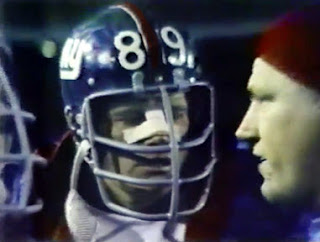
He had grown to 6-6, 225 pounds and ran a 4.8 forty, and showed potential as a top-flight defensive end. The New York Giants drafted him in 1969 in the first round and to prepare for the season he bulked up to 240 pounds in camp but felt he looked ridiculous and cut the weight and played around 25 pounds less than that. He told the media, "I was eating cans of tuna and drinking quarts of milk before going to bed . . . I had some unbelievable dreams."
 |
| Clean-cut Dryer |
He had a fresh haircut, a good defensively coach in Jim Katcavage, and away he went, finishing second on the team with 8½ sacks (behind Bob Lurtsema's 9).
 |
| ABC MNF still |
Prior to the 1970 season, when a strike loomed, Dryer went diving for coins off the coast of California before reporting to the Giants who became much-improved that year, going 9-5 and just missing the playoffs. Dryer was a star in that team, leading it in sacks and got votes for All-NFC. He was an alternate to the Pro Bowl and when one of the defensive ends begged out due to injury but Dryer couldn't play either due to a severely bruised hip. It was one of those anomalies that caused Dryer's boas to call him a "two-time Pro Bowler." According to today's accounting that is true, but there is no real information about it at the time, at least that we've been able to find.
He certainly impressed the Cowboys. He played well versus them in 1970 (3½ sacks in two games) and according to one report, Dallas offered Calvin Hill and Jethro Pugh to the Giants for Dryer which the Giants declined.
 |
| NOT clean-cut Dryer |
In the 1971 off-season Dryer went to South America on vacation. The Giants were not pleased when he came back with the effects of a virus that took even more weight off his frame and not a fresh haircut. But the experience was worth it, "I saw spiders the size of pies." He also took trips all over the United States and to New Zealand.
He did travel his way and played ball for the Giants with his hair his way.
The same was true of the much-worn-out story of "living in his Volkswagen van." It was common at the time to travel in a van when touring the country. Dryer would sleep in it, but stay at places, like Fran Tarkenton's and use the shower and so on, but rather than put people out, he'd just spend his time in the van.
The New York media and NFL media made a big deal out of it, essentially calling Dryer a California hippie but he went on using his vehicle to travel and to enjoy life. Dryer became weary of the questions and thought it was simply a way the media like to pigeonhole someone, put them in a box and move on to labeling someone else—such and such is the football cowboy or Joe Blow is the intellectual football player, and so on.
 |
| NFL Films still |
Dryer did his personal life his own way.
The 1971 season was a disaster and near the end of the season Dryer was a source for an article in one of the major New York papers that detailed the fiasco Dryer, and Tarkenton and others saw. The offense stalled and the team went 4-10 losing its last five and getting blown out in the final two games by a margin of 83 points allowed to 42 scored.
The pass rush, as a whole, was non-existent—on a team that had just 18 sacks, Dryer had 8½ of them. There was even talk of moving Dryer to a Ted Hendrick-type position as a linebacker. Hendricks in 1970 and 1971 had become a dominant player as an outside linebacker and was 6-8, 235 pounds or so. The change never occurred but it was among the first issues his less-than-230 pounds brought.
In the off-season, Tarkenton was shipped off to the Vikings and Dryer was traded to the Patriots (where he refused to report) so the Giants had rid themselves of their so-call malcontents and also their two best players. It wasn't any kind of punishment for either of them, they both wanted to be traded but with Dryer, the prospect of staying in the northeast for a struggling franchise was a kind of punishment or revenge of the Giants.
The Pats gave the Giants a first- (1972), second- (1973), and a sixth-round pick (1972) for Dryer, a hefty price. The number one pick came from Los Angeles in exchange for Phil Olsen the previous year and the New England head coach was excited to get Dryer to pair up with Julius Adams who was beginning to be a star.
The catch was Dryer had played out his option and didn't have a contract and didn't have to sign one with anyone if he didn't want to he was to become a free agent on May 1, 1972 (though there would be compensation for the Patriots, whatever Commissioner Pete Rozelle ruled—likely two first-round picks or a first- and a second-rounder based on other free-agent signees at the time). Finally, at an impasse, the Patriots send Dryer to the Rams so they could at least good value for him. The Pats got a #1 pick and defensive lineman Rick Cash and Dryer was a Ram.
Dryer was in awe at being a Ram, after all, he was an LA kid, grew up watching Deacon Jones and Merlin Olsen, played JC ball in LA, and college ball in San Diego. Dryer said "the Rams can win nine or ten games and go to the playoffs. The Giants will never win nine games."
The plan in Los Angeles was that Dryer would play right end. The previous right end (Coy Bacon) was moved to left end to replace the traded Deacon Jones. Nineteen seventy-one's first-round pick Jack Youngblood was to backup both but also compete for the right end position which was not his natural position.
Late in camp, Bacon complained about his position change since it was not coming easy to him and the Rams acquiesced and moved him to his familiar spot. Dryer and Youngblood were then moved to left end which angered Dryer telling the Rams that without playing left end in camp (he'd been a right end in NY) he was not prepared to play a full season at that position.
These days linemen move around, flop ends, for example, that it isn't a thing. Back then, due to blocking patterns and one's own skillset playing left and right was a thing. Youngblood, for example, hated playing right end. Dryer preferred the right end. Bacon struggle at left end. This was not uncommon in the NFL at the time but apparently, Prothro didn't get that.
Dryer opened the season as the starter at left end and was supposed to play versus passing teams. Youngblood was supposed to play versus running teams, or so head coach Tommy Prothro told the media. Apparently, Prothro knew which team was which.
After a few weeks Youngblood took over at left end and started 10 games that season. However, Dryer played in the Rams '57 defense' in which the right tackle Phil Olsen or rookie Larry Brooks (whoever was in the game at right tackle) were removed and moved right end Bacon to right tackle and Dryer would come into the game at right end to rush the edge.
In that role he totaled 4½ sacks and forced a pair of fumbles.
 |
| Dryer sacks Greg Landry from the 57 (three DE) package. NFL Films still |
As with the 1971 season with the Giants the 1972 Rams season was a failure. The team finished 6-7-1 (the Giants were 8-6) after being 5-2-1 through eight games. The wheels coming off caused Prothro's firing and the hiring of Chuck Knox.
Knox promptly made Youngblood the left defensive end and Dryer the right, but he rode Dryer quite often, telling Dryer, "You have to prove you can play at that weight" referring to Dryer's 223-pound physique. Dryer told Knox he'd proven it already but Knox, undeterred, said, "You have to prove it every day."
You see, Dryer decided that if he could not play football at his natural weight he would do something else. He knew he could do it and play well but ultimately he decided his so-called lack of weight was "their problem" not his.
In 1973 the Rams defense was tops in the NFL yards allowed and Dryer set a record for two safeties in a game which still is the record.
 |
| Dryer sacking Packer QBs for two safeties: NFL Films Stills |
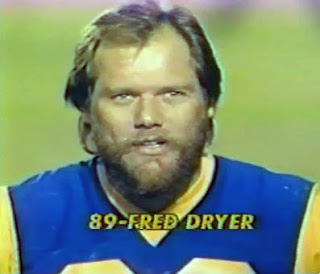
Then, in 1974 Dryer was All-Pro and now we know tied for the NFL lead in sacks. He'd proven he could play at just under 225 pounds and he did that the rest of his career. (Oddly, the Rams kept posting his weight at 240 from 1973-78. Then, in 1979, they dropped his official weight listing to 231—still too high but closer).
He had succeeded his way by playing at the weight he felt best. He did it the Dryer way.
 |
| ABC MNF still |
In 1975 he was a Second-team All-Pro and had double-digit sacks for the fourth time in his first seven years and totaled 70½ sacks in that 1969-75 span—tying Carl Eller for the third most. Only Elvin Bethea and Jack Gregory (who replaced Dryer in New York) had more.
Of course, none of this was known at the time, sacks were not official but were tracked by the teams and are now available on Pro Football Reference.com. But film study by the teams would have revealed the exact numbers but what was known is that Dryer was one of the best at what he did.
That same season Dryer was a free agent after playing out his option and could have signed with anyone and the Rams would have received compensation under the Rozelle rule. It was the compromise free agency the owners allowed in the early 1970s but few players changed teams because the compensation was considered too high. For Dryer, had he left, the Rams would have likely received two first-round draft picks.
Dryer fielded calls from other teams (reportedly one was Minnesota to replace Jim Marshall) but in July of 1976 the Rams and Dryer hammered out a five-year contract (that covered the 1977-81 seasons), one that included a no-cut clause for an average of about $200,000 a year (starting at $150,000 escalating $25,000 a year to $250,000 the final year of the contract), making him among the highest-paid defenders in the NFL. Dryer wanted to finish his career as a Rams and he wanted financial security in terms of not worrying about being waived and got one of the few guaranteed contracts in the league at the time (or since, really).
Fred got his security and money his way.
Changes were about to be realized, however. "In 1976 my effectiveness went down. The changes in the rules allowing linemen to hold did hurt my game. I had to adjust." Dryer went from averaging 10 sacks a season in his first seven years to 6½ per year his next five. However, despite his weight, he was still a very good run defender, something he rarely gets credit for.
 |
| CBS Sports still |
"Isiah and I used to dine out on our ability to play the 'under'. The Rams, in run situations, played a lot of odd-man fronts shifting either towards the tight end or away. The under is the "away" from the tight end and it put Dryer and All-Pro linebacker Isiah Robertson in a position where they had to respond to stop runs to the weak side of the offense and stop them they did.
The Rams from 1973-80 led the NFL in fewest rushing yards allowed—in that seven-year span the Rams went to the playoffs seven times, led the NFL in sacks, allowed the fewest total yards, and allowed the fewest points—close to a clean sweep.
Certainly, the Steelers defense was right there and with their four Super Bowl wins were the dominant defense of the era, but the Rams defense was excellent as well—
At that time "Scrapper" also became more fitness-oriented than ever, eating less meat, more whole grants and fruits, and lots of vegetables and cooking it in his training camp room. It caused a small dustup when Dryer didn't want to eat what was served at the Rams training table and wasn't showing up more meals. Chuck Knox didn't approve, ordering Dryer to at least show up in the cafeteria where all the other Rams went to eat.
Dryer instantly mocked that bureaucratic move by coming in, saying "hi" to everyone, grabbing maybe a paper, and then going up to cook some rolled oats or cracked wheat. "Horse food" is how Jack Youngblood described Dryer's cooked cereal, "what we feed the horses. Put a little honey in it and it's called sweet feed."
Dryer ate it anyway, doing his meals his way.
 |
| Ray Malavasi. NFL Films still |
Dryer graded out well in 1977 and the Rams defense was again one of the top few in the NFL but when the Rams lost to the Vikings Carrol Rosenbloom had seen enough and let Knox go and hired George Allen ostensively to get the Rams over the hump and to the Super Bowl. With him, he hired the Steelers defensive coordinator Bud Carson and moved Malavasi to the offensive coordinator position.
Carson's philosophy was to turn the Ram defense into a bit more of a blitzing team, something they didn't do under Ray Malavasi very much but since Carson had tremendous success as the Pittsburgh the Rams (though they had no choice) went along with it. However, according to Dryer, it used the defensive ends, all too often, as players who went wide just to open things up for the linebackers or safeties to run through essentially on those plays anyway, the ends were sacrificial lambs.
It was disappointing for him because in camp that year Allen called him and Jack Youngblood over for a meeting of the three. Allen, according to Dryer, said, "You guys are going to get 20 sacks each this year the way we will play this thing. We are not going to set things up for some safety to make a sack." Essentially Allen was telling them that they were returning to the Fearsome Foursome defense, the "Jet" scheme—get up the field and worry about the run on the way to the quarterback and that pleased the two rushmen.
It was in the same discussion that Allen told the two bookend defensive ends that he'd traded Isiah Robertson (who'd had thrown a tantrum in the previous couple of days in full view of the media) to the Packers.
After the conversation, Dryer asked Youngblood, "He can't do that, can he?" Youngblood responded, "I dunno, I don't think so."
Their suspicion that Allen acted above his pay grade was confirmed when the trade was stopped by Klosterman and Rosenbloom and Allen was fired for that and many other reasons.
"He's killing us", Carrol Rosenbloom said to Jack Youngblood in the training camp dorm room parking lot when the two had a chance meeting (Rosenbloom was using the bushes to, shall we say, "use the facilities." It was shortly after that, in a team meeting, held by Rosenbloom the Ram players were told that Allen had been let go and Ray Malavasi would be the head coach.
So, with Allen gone, the Allen playbook was gone. He'd brought his defense to the Rams in 1966 with its nomenclature and nuances and niceties and when he left after the 1970s the Rams kept a lot of the basic terminologies and kept them through the Malavasi era, but there were many differences in the more complex parts of the verbiage so that camp and preseason the Rams had to learn the new language.
So, on the fly, Carson reverted to the Malavasi playbook and that was a positive step for the Rams defenders. While the coverage or front was the same, what it was called was different and the Rams player thought Allen/Carson should apply what they wanted to do but use the same language since it was, they thought, easier for a few coaches to learn the new verbiage Rather than 20 something defenders. With Allen being fired that problem was solved.
And it worked, the 1978 Rams were first in fewest yards allowed and their coverage was top-flight, the best in the NFL with a 50.4 defensive passer rating and allowing 15 touchdown passes and picking off 28 and returning five of them for touchdowns.
Additionally, the defense was fourth in points allowed and third in run defense, fifth in sacks and fourth in sack percentage. However, about one-third of the sacks came from other than the defensive line and that was the difference Dryer was referencing.
The following year, though, there was an exception to the Carson plan of blitzing defensive backs and dogging linebackers. Both cornerbacks were hurt at times so the Rams didn't blitz quite as much since the back end of the defense was not as solid without either Rod Perry or Pat Thomas. So, the front four had to generate the pressure as it had from 1973-77 (and even before) and led the NFC in sacks with Dryer recording 10 sacks to reach double-digits for the first time since 1975 to wit the 'backers and defensive backs contributed about 16% of the sacks—about half the rate they did in 1978.
The Rams 52 sacks in 1979 came in two parts. The first eight games and the last eight. Merlin Olsen did the broadcast the week eight when the Rams got drubbed 40-16 by the Chargers. Olsen emphasized that the Rams had "only had 16 sacks" at midseason and he repeated it, almost harping on it, as the Rams went sackless in that game and Fouts carved up the secondary while facing little pressure.
The next week, against the Giants, Dryer, had a big-time game sacking Phil Simms five times. That took the team sack total to 21. The Rams ended up with 36 sacks in the last eight games, sparked by Dryer in week nine.
 |
| Rams front four in the 1979 Seattle game. CBS still. |
With the Carson philosophy changed somewhat due to injuries in the secondary certainly, there were exceptions. One of them was the Seahawk game in week ten with the Rams setting a still-standing NFL record for the fewest yards allowed in a game with -7.
In that game, the
Rams did use a lot of pressure and blitzes (even cover-0 blitzes), more like 1978, and it worked to perfection. Steve Largent was held to two catches and Jim Zorn was kept in the pocket all day. That was a task that was given to the ends—Dryer and Youngblood. Carson thought that anytime you kept Zorn inside the pocket and did not let him scramble around, buying time for the coverage to break down was to the Rams advantage. He was right. The Rams just buried the Seahawks 24-0.
Though the Rams went to the Super Bowl in 1979, losing to the Steelers, it was an off-year for the Rams going just 9-7. The injuries to their cornerbacks didn't help nor did the injuries on offense and even special teams but they did get hot in the playoffs and made their Super Bowl run, something they had failed to do from 1973-78.
Dryer, in 1980, suffered the first injury that caused him to miss any real playing time. He started at 16 games but was pulled early in the Dallas MNF game playing very few snaps the first game he just have significant snaps in his entire career. That is pretty remarkable given the mantra that he was too small. He was certainly physically sound—playing in 174 straight games in his first 12 seasons, with the exception of him trying to play in the second-to-last game of the 1980s season against the Cowboys.
In fact, Dryer once related a story that the team physician Robert Kerlan remarked to him that "You have very strong, sound bones." Dryer took that to mean he could play smaller than most because for one, he wasn't going to get hurt and in his view, he had excellent speed and technique that pulled him through and compensated for any lack of bulk and with no more a chance to get hurt than anyone playing the sport.
He's also said the criticism of being "too small" motivated him, making him more dedicated to the weights and other things to allow him to play on a high level on one of the top two defensive teams in his immediate era.
NFL Films clip
In 1981 Dryer went through quite the saga which became a national story. He was cut, resigned, then cut again, ending his NFL career. Malvasi was the head coach and Carson was still the coordinator and they decided to keep "seven defensive or eight" defensive linemen. When informed Dryer told the coach, "Let me guess I'm the eighth." He was right and he was quickly waived.
 |
| CBS still |
The problem with Dryer being cut is he had that no-cut contract mentioned earlier in this post which guaranteed his salary—they could waive him, but they still had to pay him his $250,000 salary. Once they were informed of that fact Rams management had Dryer come back to the squad. But he wasn't playing, Cody Jones was at the right end, and Dryer only played when Jones came out for a play or two
Dryer and defensive end Reggie Doss split time at right end in 1980 and Doss was a "hustle-type" but he wasn't fast enough to play 40-end so the Rams thought Jones (who'd entered the NFL as an end a decade earlier) could handle the position. He was okay, not bad, but nothing special.
Even after his career Dryer would pine that "I didn't care that much that they cut me, it's just that the Rams didn't replace me with someone great. They didn't do that for Merlin or, later on, For Jack (Youngblood). They didn't keep the tradition of a great defensive line going".
Dryer was right. They didn't have a Pro Bowl-type defensive lineman until the late 1990s in Sean Gilbert, and later Kevin Carter and D'Marco Farr. In the 2000s different sets of Rams brass drafted a ton of defensive linemen in the first round—Damione Lewis, Ryan Pickett (this after Grant Wistrom in 1998), plus Jimmy Kennedy, then Chris Long, Robert Quinn, Michael Brockers, and finally Aaron Donald.
To Dryer's way of thinking at least the team was trying to build a dominant line. In his era, only Mike Fanning was taken in the first round in 1975. They didn't take another until 1989 in Bill Hawkins, fourteen years later. That kind of thinking bugged Dryer.
With the second waving in 1981 Dryer entered the CBS broadcast booth and even did a couple of Rams games. The next year he began, in earnest, his acting career. Football was a thing of the past.
Dryer's position today would be as an edge rusher in the mold of a Jason Taylor or a Clay Matthews III, Ryan Kerrigan roles like that. However, even Dryer would admit he'd have to put on that weight he disdained, at least 25-30 pounds. His height and quickness would fit well in the NFL today. He had good strength for his size and with those 25-30 pounds, putting him at 250-55 he could handle today's game, as did Taylor.
Watching Dryer he had good shoulder slaps and great pursuit . . . he'd chase plays from the backside extremely well, just a tremendous worker. He was a higher-cut type of player, and used outside speed mostly but was very good on games and stunts with the tackle next to him.
Dryer's 103 sacks in 13 seasons put him in the Century-sack club and his nose for the ball resulted in 20 fumble recoveries making him one of the better rushers of his era and his work against the run using natural strength, leverage, and know-how make him FAR more of a complete end than his critics remember.
 |
| NFL Films still |
Perhaps the critics were aware of Knox's views or that Ray Malavasi every couple of years would tell some writer from the
Los Angeles Times, "We get hurt once in a while at right end because of Dryer's weight" and things like that. And we're sure that is accurate, but no more by a big man not playing his technique properly and losing a rep not because he's too small but not quick enough or play was in the wrong place. Even big men get blocked now and again.
But the fact was Dryer was not, say, Curtis McGriff or Ty Warren against the run, or Rich Jackson, but he held his own and teams didn't run weak side (or strongside) against the Rams. The Rams didn't suffer against the run with Dryer in the lineup, perhaps much to the chagrin of Knox and Malavasi. He just did his job, playing the run using great reads and "staying alive" in the run game, not letting tackles or guards get a square hit on him and on pass plays—getting after the quarterback to the tune of 8½ a year.
After all, it's simply true to say this: Dryer left his mark on the NFL and did it on his own terms—his way—like the Frank Sinatra song "My Way", Dryer did.