LOOKING BACK
By Chris Willis, NFL Films
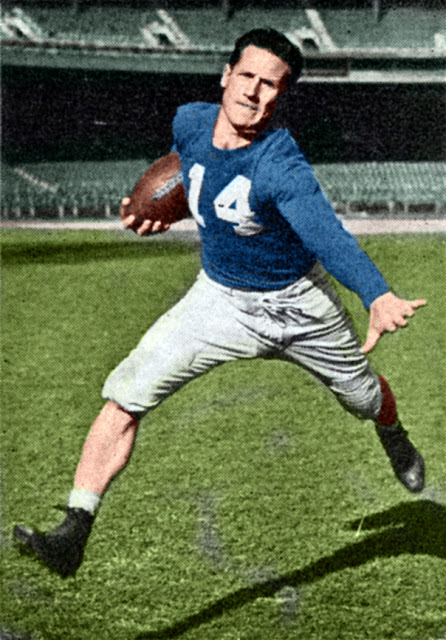 |
| Ward Cuff, New York Giants, Wingback |
Today PFJ looks back at the career of one
of the more underrated players of the two-way era. He was one of the more
versatile and dynamic backs of that time, who could do almost everything. His
name was Ward Cuff.
After graduating from Marquette, Cuff was
drafted in the 4th round of the 1937 NFL Draft (34th
overall) by the New York Giants. Cuff was personally scouted by Giants head
coach Steve Owen. Although Marquette was led by their All-American halfback Ray
Buivid (finished 3rd in the Heisman ahead of Sammy Baugh) and brothers
Art and Al Guepe, Owen’s eyes became fixated on Marquette’s blocking back. He
was the man doing all the dirty work, making all the tackles and lead blocking
for the star backs. Owen knew he wanted Cuff.
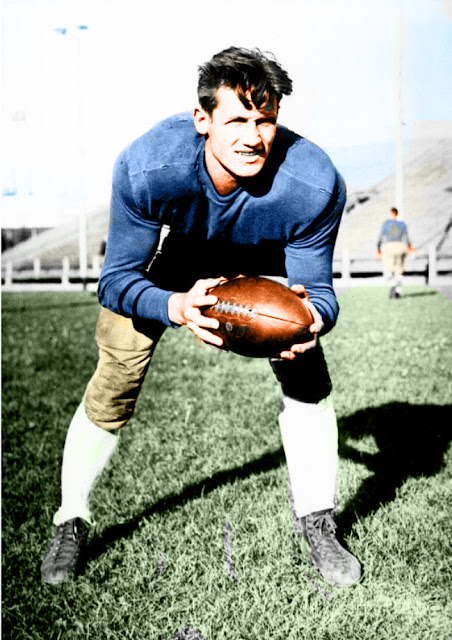 |
| Ward Cuff, Marquette, circa 1936 |
That
first training camp coach Owen made it a priority to use Cuff in any way
possible. At Marquette Cuff never kicked, but Owen saw something in his prized
recruit. So, every day for three weeks Owen drilled Cuff for a half hour in the
art of place kicking. He liked what he saw. Owen recalled that first training
camp in an article he wrote for Colliers magazine in 1942:
“Cuff had tremendous leg drive and an
excellent sense of balance. I was not too certain about the third necessary qualification
but that was speedily discovered when we scrimmaged. Mr. Cuff has nothing but
ice water in his veins. Nothing rattles him. He looked like a perfect prospect.”
The 6-1, 192-pound Cuff played 11 years
(110 games) for three teams (Cardinals, Packers) but mainly played his entire
career with the New York Giants (9 years). A very durable player that would
play through any aliment. “Ward was
outstanding as a runner, a receiver, and a defensive halfback. Above all, he
was an Iron Man who could play with so many injuries that he often seemed to be
taped from head to toe before he put on his uniform,” wrote Steve Owen in
his book My Kind of Football (1952).
On offense, Owen had developed a new
offensive system he called the “A” formation. He had the perfect center, Mel
Hein, to snap the ball, he had plenty of halfbacks and quarterbacks like Tuffy
Leemans, Ed Danowski, Hank Soar, but what he was missing was the wing-back. The
man who would go in motion at times to be a decoy, a ball carrier every so
often, run pass routes, but mainly his role would be as a lead blocker. Cuff
was the man for the job. “Our motto was to keep knocking men down until the
whistle blew ending the play,” once said Cuff to the Milwaukee News in
1938. What Owen didn’t know was that Cuff, almost from the start in 1937, was
his best receiver, blocker and defensive back.
Cuff was also very creative off the field.
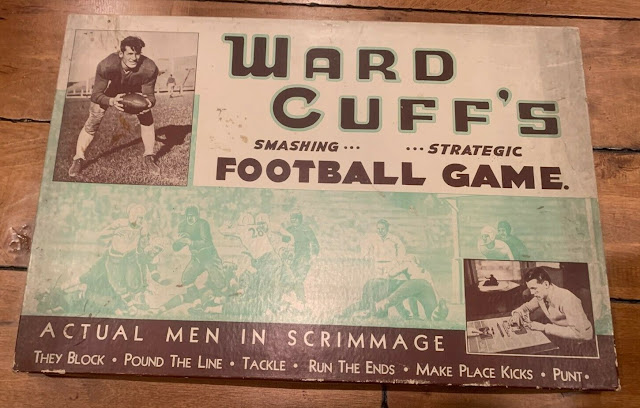
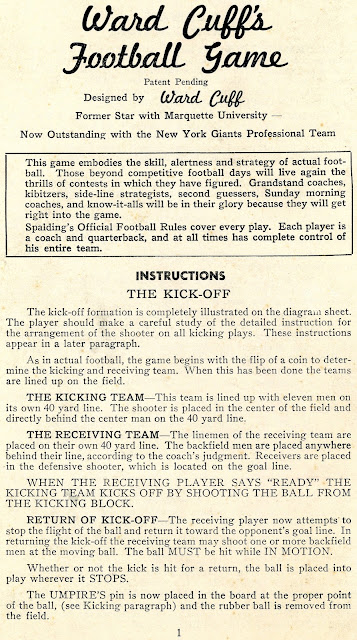
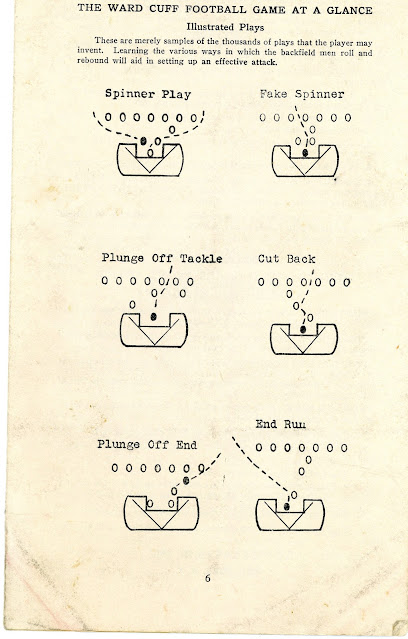
After his rookie year Cuff developed a football board game titled, Ward
Cuff’s Football Game. Inside the game was a patent pending booklet,
designed by Cuff himself. The game looked to be more detailed and “strategic”
then most football board games of the time. A few of the board games have
survived today, despite not being mass produced. It was obvious that Cuff loved
the game of football.
1938 NFL CHAMPIONSHIP:
In his second season Cuff helped the
Giants win the Eastern Division. He led the team in scoring with 45 points,
while helping the defense only surrender a league low 79 points- including only
ten points in their final five games.
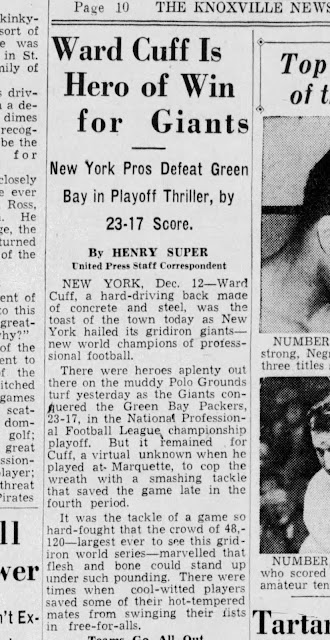
In the NFL Championship Game they faced
off against the Green Bay Packers (Western champs) at the Polo Grounds. In the
first quarter Cuff booted a 14-yard field goal to give the Giants an early 3-0
lead. Then the Packers and Giants started to trade touchdowns as New York took
a 16-14 lead into halftime.
Early in the third quarter the Pack took
the lead for the first time, 17-16. Then Ed Danowski hit Hank Soar with a 23-yard
scoring strike to give the Giants the lead back at 23-17. In the fourth quarter
the Packers had the ball four times, but came close scoring only one time. In
the redzone Packers quarterback Arnie Herber connected with Wayland Becker, but
Cuff nailed Becker forcing a fumble that was recovered by the Giants Kayo Lunday
who returned the ball to their own 22-yard line. The Packers never got closer.
Cuff was a world champion. Although he was
just doing his job, Cuff’s name made plenty of newspaper headlines as the “hero
of game.”
ALL-AROUND PLAYER:
Ward Cuff’s passion for the game always
came out in the way he played on the field. Going hundred miles an hour to help
his team win. He didn’t care if he carried the ball or made the block. On film Cuff
was always around the ball and consistently made plays- on both offense and
defense. He showed excellent ball skills and was very durable, playing in over
100 games. He finished his career with 3,410 yards from scrimmage (1,851 rush.,
1,559 rec.), averaging a robust 5.4 yards per carry.
Never the top dog in the Giants rushing
game, he was mostly overshadowed by Hall of Fame halfback-fullback Tuffy
Leemans- his teammate with the Giants for seven seasons (1937-1943). But twice Cuff
led the NFL in rushing average per carry, in 1943 (80 carries) with a 6.5 avg.
and in 1944 with a 5.6 avg. (tied with Steve Van Buren). His 80 rushing
attempts in 1943 was a career high. Rarely did he get to carry the football. But
he might’ve been the most important piece in the backfield.
Another strength was catching the ball (from
Tuffy Leemans/Ed Danowski). From 1937-1943 he caught 78 passes for 1,170 yards-
averaged a gaudy 16.7 yards per catch - and 10 TDs.
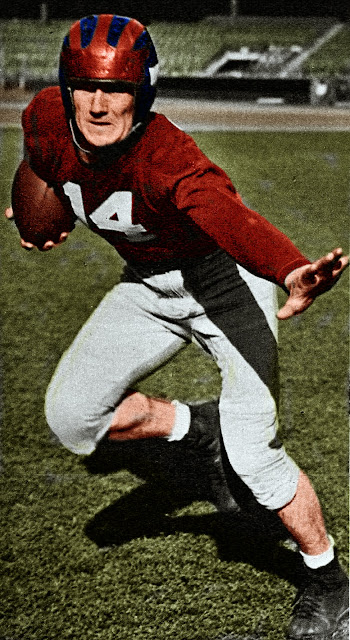 |
| Ward Cuff, Giants, wingback, 1945 |
Watching game footage of Cuff on the
defensive side of the ball, he consistently showed great range and timing as a
defensive halfback with 13 career INTs for 263 return yards. He always seemed
to be around the ball, breaking up many passes and never being out of position.
In the championship season of 1938 he had a 96-yard INT return for a TD against
the Redskins (won game 36-0) to help clinch the Eastern Division title and set a
Giants team record that lasted twenty years when Erich Barnes broke it in 1961
(102-yards). In 1941 he led the NFL in interception return yards with 152. In a
1985 NFL Films interview Washington Hall of Fame coach Ray Flaherty remembers
the 1938 Cuff interception:
“We took the ball down to the Giants one
yard line. It was first down and a yard to go for a touchdown. I was just
sitting there relaxing, waiting for them to go across the goal line. Frank
Filchock lined up in the tailback position and threw a pass into the right side
of our offense against the best, probably the best defensive back in the
league, Ward Cuff. He picked it off and went 96-yards for a touchdown.”
Cuff was the premiere kicker of his time-
among the likes of Ken Strong, Ralph Kercheval, and Jack Manders. He converted
43 FGs and was an impressive 155 of 162 on extra points, a clip of 96%. He led
the NFL in FGs made 4 times, 1938-1939, 1943, and 1947 – at the age of 35 - and
finished in Top 5 of FGs made 8 times. Also was in Top 10 in scoring 8 times…Helped
the Giants win 4 divisional titles and the 1938 NFL Championship- where he
kicked 2 XPs and 1 FG against the Packers, a 23-17 victory…Scored 21 career TDs
(13 rec., 7 rush., 1 INT return).
Cuff still ranks
second all-time with Most Seasons Leading League, Field Goals Made, only
Lou Groza had more seasons.
1st-
Lou Groza, 5 times (1950, 1952-1954, 1957)
2nd-
Jack Manders, 4 times (1933-1934, 1936-1937)
2nd-
Ward Cuff, 4 times (1938-1939, 1943, 1947)
2nd-
Mark Moseley, 4 times (1976-1977, 1979, 1982)
3rd – 3
times by, Bob Waterfield, Gino Cappelleti, Fred Cox, Jan Stenerud, Stephen
Gostkowski
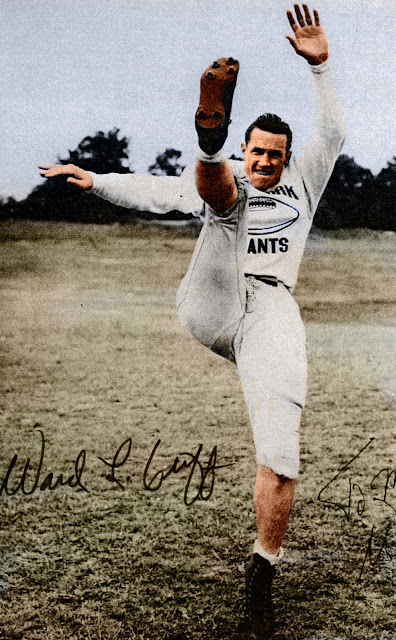 |
| Ward Cuff, Giants place-kicker, circa 1939 |
In 1938 Cuff explained his kicking
process:
“There’s no trick to it. The mechanics of
the thing are simple, and the only thing I take credit for are the hours I
devote to practice. Practice is essential; it develops the right timing.
First and foremost, the kicker must keep
his eye on the ball. That’s why so many kickers miss. Rushing linemen distract
them, and involuntarily they take their eyes off the ball. That’s fatal.
I start off with
my right foot, take one step with the left and let go.”
In 1946, at the age of 34, Cuff was traded
by the Giants to the Chicago Cardinals, so he could be closer to his family’s Milwaukee
home. Despite losing one of his best players Wellington Mara agreed to the
trade. That season he finished 3rd in the NFL in scoring with 55
points (behind Packers Ted Fritsch 100 points, and Bob Waterfield 61 points).
Cuff played his final season in the NFL with the Green Bay Packers in 1947. When
he retired Cuff finished with 411 career points (had 305 points with the Giants).
In 2000 I interviewed Hank Soar, one of
Cuff’s teammates with the Giants. He praised Cuff for his all-around play. “Ward
could punt a ball. He would kickoff too, his ball would always be right there
at the goal line. He was strong kicker. Ward was a great defensive player. He
could run. He could just play football and he was a great defensive man. He’d
intercept passes like nobody in football could do.”
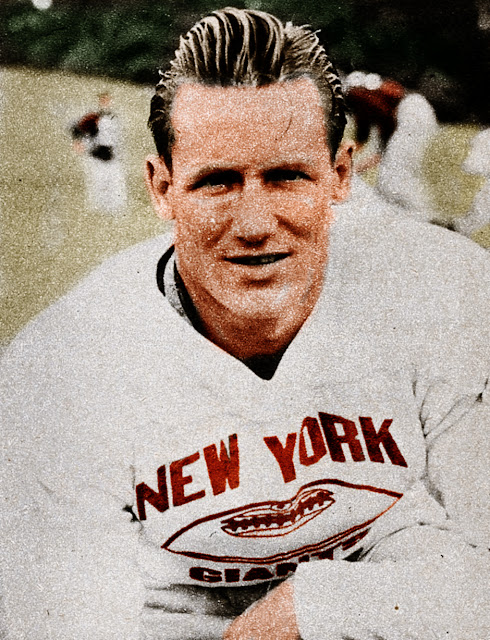 |
| Ward Cuff, N.Y. Giants, 1942 |
HONORS:
Cuff only endured one losing seasons in his
career (1945, 3-6-1), helping his teams to an overall record of 71-38-10. He made
3 Pro Bowls, 1938-1939, 1941 and three times named First-team All-Pro by
UP in 1941, 1943-1944 and once by Pro Football Illustrated in 1944…Named
Second-team in 1938 by I.N.S.; in 1939 by Football Writers and I.N.S., and in 1943 by New York Daily News…Honorable Mention by NFL 4 times,
1937-1939, 1941 and once by the Football Writers in 1938.
Because he was never the focal point of
the offense his overall stats come up short with other Hall of Fame backs from
the two-way era, especially his contemporaries like George McAfee, Bill Dudley,
Tony Canadeo or his teammate Tuffy Leemans. But nobody might’ve been more
important for their team’s success than Ward Cuff for the Giants. Offense,
defense and special teams – premiere kicker of his era – Cuff was simply an
outstanding two-way player. Footage shows us that too. Once speaking in 1943
Steve Owen told Arthur Daley of the New York Times, “If I had to
choose up sides, Ward would be the first man I pick. He does everything and
does it remarkably well.”
Giants Jersey Number
14 Retired (1946):
Despite his lack of recognition Ward Cuff
was honored with one of the greatest achievements any player can have. His
jersey retired.
The Giants retired his no. 14 jersey in
1946- the year he was traded to the Cardinals. That fall Cuff returned to his
old stomping grounds wearing a different uniform but a familiar jersey number. On
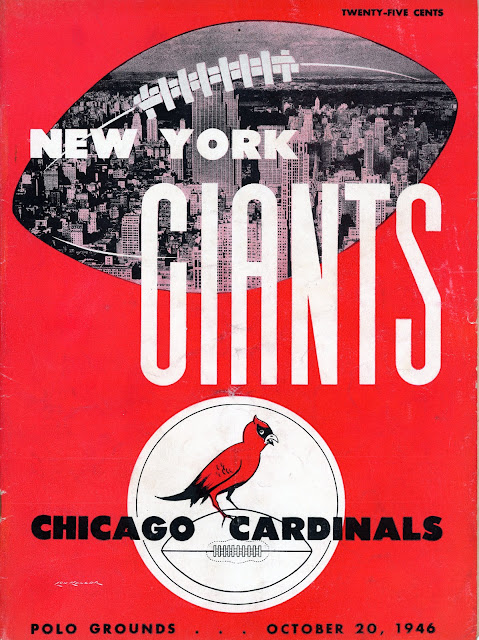
October 20, 1946 Cuff jogged out in front of over 50,000 fans at the Polo
Grounds wearing his Cardinals number fourteen jersey. The fans gave him an
ovation.
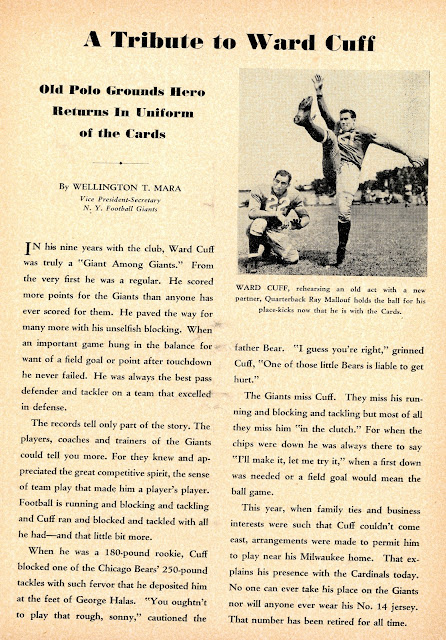
In the game program that day Giants Vice-President-Secretary
Wellington Mara wrote a one-page tribute to Ward Cuff, praising the former
Giants hero. He wrote:
“In his nine years with the club, Ward
Cuff was truly a ‘Giants Among Giants.’ From the very first he was a regular.
He scored more points for the Giants than anyone has ever scored for them. He
paved the way for many more with his unselfish blocking. When an important game
hung in the balance for want of a field goal or point after touchdown he never
failed. He was always the best pass defender and tackler on the team that
excelled in defense…
The Giants miss Cuff. They miss his
running and blocking and tackling but most of all they him ‘in the clutch.’ For
when the chips were down he was always there to say ‘I’ll make it, let me try,’
when a first down was needed or a field goal would mean the ball game.
This year, when family ties and business
interests were such that Cuff couldn’t come east, arrangements were made to
permit him to play near his Milwaukee home. That explains his presence with the
Cardinals today. No one can ever take his place on the Giants nor will anyone
ever wear his No. 14 jersey. That number has been retired for all-time.”
That day Cuff played his heart out trying
to beat his former team. He accounted for 12 points on a touchdown run, one
field goal (42-yards) and three extra points. But it wasn’t enough as the
Giants pulled out a tough 28-24 victory.
Cuff’s jersey wasn’t retired quite yet. In
1961 when the Giants traded for Y.A Tittle they brought out jersey number 14
for him. But since 1965 no New York Giants player has worn the number fourteen.
After doing some high school coaching and
working for Boeing, Ward Cuff passed away on December 24, 2002 at the age of 90.
“We were contemporaries,” Giants owner Wellington Mara said to the
Associated Press. “He came to camp in 1937 as a rookie, and we roomed
together from then on in camp and on the road. I have a lot of fond memoires of
him. He was a terrific competitor.”
Not too many players get their jersey
retired. A Special honor, for a special player. We remember Ward Cuff.
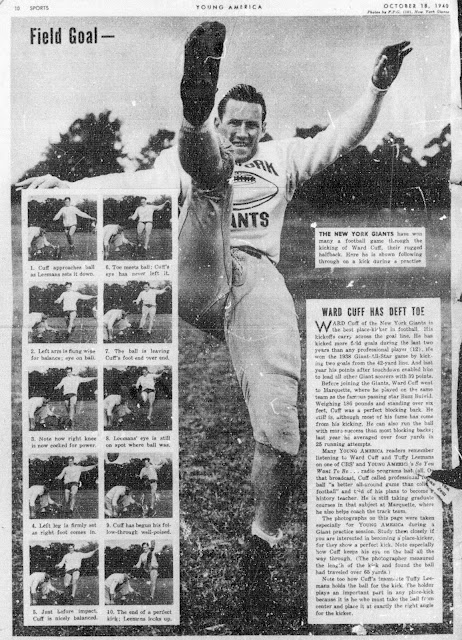 |
Ward Cuff article, Young America, Oct. 1940
|