Monday, August 15, 2022

Hall of Fame Snubs and Partisanship

 By John Turney 
Tomorrow social media will be full of complaints regarding the three senior candidates who will be chosen—no matter who the three turn out to be.

These are the players who are being considered—
Bengals fans want both their guys to get it. Jets fans are wanting Joe Klecko. Bronco partisans tout Randy Gradishar. And so it goes.

This is proper and to be expected. People want "their guys" to be in the Hall of Fame. However, Hall of Fame fans want the three best players of this group of twelve to be the nominees.

So, you will read "snub" a lot on Twitter and on media sites that cover specific teams. Some of it is venting some of it riles fan bases up. 

We're hoping for the best three.

Sure, there is partisanship on the committee of twelve that will do the cutdown votes and will be narrowed to the three nominees—A writer from city A will fight for "his guy" from city A. The same for a writer from city B—he will push for the player from city B. 

But lets hope that the committee will be fair, look at the credentials, weigh them and vote for the players with the best resume, not the guy they covered as a beat writer. The Hall of Fame is for the truly great, the best of the best and just because city C or D thinks they do not have enough players in the Hall of Fame should not carry any weight—partisans of city C or city D will disagree but they have to look at the full picture and carer about putting in the best first and put partisan interests away. 

Fans and even voters may bring those types of things up, it is only natural but the integrity of the Hall is a higher priority even if fans or voters think it may be unfair to a city to have, in their view, two few representatives in the Hall. 

What is fair is putting the best three of the twelve in—regardless of home fan views. The interests of the Hall outweigh the interest of partisans.

How are the best three to be chosen? There we have to trust the voters, who usually do a good job, to be conscientious in their voting. It does get tricky because each voter has varying criteria for what is a Hall of Famer and who is the best. But as long as they don't let their own biases creep too far in then the selections will be very good. And we think that will happen. We as fans then should weigh and measure those chosen through that lens and not with the lens of  "My guy from my favorite team got snubbed."

The Hall of Fame is not something that is meant to validate your team. It is for the best of the best and the Senior Committee was created to pick those who have fallen through the cracks not to create bragging rights by adding someone from city A, city B, city C, city D, and so on.

Thoughts On The Senior Category Final 12

 By John Turney 
Tomorrow the Seniors Committee of the Pro Football Hall of Fame will meet virtually to choose three candidates for the Hall of Fame. Those three will then be presented to the full committee prior to the 2023 Super Bowl in Glendale, Arizona.

The committee is composed of twelve voters and for the first time, all twelve will be included in the discussions and voting. In previous years a rotating group of five would meet and choose a candidate(s). 

Recently there has been only one senior player who would emerge from this process. In the recent past, there also was a period when two players would be selected. This year there will be three.

Here are our thoughts on the twelve players on the final list who will be considered—

Ken Anderson: Quarterback (1971-1986)
A four-time pro-bowler who started at quarterback for the Cincinnati Bengals from 1971-1986.
Anderson has been on the modern category Final 15 twice. He has four passing titles and an MVP season as well. The knock is he had a few seasons in the middle of his career that were subpar. This "donut hole" is in a sense like Kurt Warner's—who played great for three years with Rams and then the Cardinals he played well and in between he had several years of not-so-spectacular play. 

Maxie Baughan: Linebacker (1960-1970, 1974)
A nine-time Pro-Bowler, Baughan played linebacker for the Philadelphia Eagles (1960-65), the Los Angeles Rams (1966-1970) and the Washington Redskins (1974).
Went to a lot of Pro Bowls but also 1960s Pro Bowls were in a league with fewer teams. He was All-Pro in 1964, 1966, and 1967. He was the defensive signal caller with the George Allen-coached Rams. He had 24½ sacks and 18 picks. He also has a ring as a rookie starter for the 1960 Eagles.

Randy Gradishar: Linebacker (1974-1983)
Centerpiece of the “Orange Crush Defense,” Gradishar played all 10 seasons as linebacker for the Denver Broncos, seven of which were Pro Bowl years.
Gradishar stands out in that he was the NFL Defensive Player of the Year in 1978 and was third in the voting in 1977. He was All-Pro in 1977, 1978, 1979, 1980, and 1981 and Second-team All-Pro in 1983 and was also All-AFC in 1976 and never missed a game. He was also the first 3-4 inside linebacker to make an All-Pro team—breaking the 4-3 middle linebacker streak.

Historian TJ Troup said this, "(B)ased upon film study and what I learned from Billy Thompson Randy had pass defense responsibilities no other inside linebacker ever had before or since"

It is odd that there is no member of the Orange Crush honored in the Hall of Fame, from the mid-1970s through the early 1980s they were consistently among the NFL's best in defensive passer rating and in stopping the run.

Chuck Howley: Linebacker (1958-59, 1961-1973)
Being the only player on a losing team to win Super Bowl MVP (Super Bowl VI), Howley received six Pro Bowl selections and five first-team All-Pro selections while playing for the Chicago Bears (1958-59) and the Dallas Cowboys (1961-1973).
A Paul Zimmerman favorite who wrote that Howley was among the best weak-side linebackers ever. He was, like Baughan, able to rush the passer (26 sacks) and cover well (25 picks) and throw in 18 recovered fumbles. He has a ring and also a Super Bowl MVP trophy. 

Though Dr. Z touted Howley as a weak-side great, remember that he played the strong side (called Sara in Dallas terminology) more than "Wanda" (Cowboys term of weak-side or "Will" position).

Cecil Isbell: Tailback/Defensive Back/Halfback (1938-1942)
Of Isbell’s five playing years with the Green Bay Packers (1938-1942), he had four Pro Bowl appearances. 
Isbell was the thrower and Don Hutson was the record-setting pass catcher. He was All-Pro twice and Second-team All-Pro three times and led the Packers to one NFL Championship. 

Joe Klecko: Defensive End/Defensive Tackle/Nose Tackle (1977-1988)
A member of the famed “New York Sack Exchange,” this defensive powerhouse had four Pro Bowl selections and two first-team All-Pro honors in his 12-year NFL career, all spent with the New York Jets. 
Klecko is akin to Howie Long and Dan Hampton. He played multiple positions well. He led the NFL in sacks in 1981 with 20½ and in 1985 was the top NFL nose tackle—and was All-Pro both seasons. He was also a Pro Bowler as a 4-3 defensive tackle in 1983 and 1984. Earlier in his career he played 3-4 defensive end as well.

Bob Kuechenberg:  Guard/Tackle/Center (1970-1983)
A member of the Miami Dolphins Hall of Fame and a six-time Pro Bowler, Kuechenberg spent the entirety of his 14-year career as a member of the Dolphins.
A two-time First-team All-Pro and a Second-teamer once and also an eight-time modern-era finalist . He was the model offense guard according to John Hannah and Joe DeLamielleure. Some say he was the best offensive linemen on those great Dolphins teams. A master at the trap block and could lead sweeps and well and showed great balance in pass protection. If the Hall voters like textbook players, Keuch qualifies

Eddie Meador: Cornerback (1959-1970)
Meador played his entire career with the Los Angeles Rams, where he earned selection to two first-team All-Pro teams and six Pro Bowls. He is a member of the NFL’s All-Decade Team of the 1960s. He finished his career with 46 interceptions, which remains a Rams franchise record.
A three-time All-Pro (two consensus) Meador began his career as a cornerback and he moved to free safety in 1964. TJ Troup noted that Meador, "(H)is knack for a key takeaway, and his tackling ability place him above all the other candidates."

Meador was a great placekick holder who could run a fake into the end zone and is the Rams all-time leader in blocked kicks with 12.

Tommy Nobis: Linebacker (1966-1976)
Nobis was the first player the expansion Atlanta Falcons drafted and played his entire career in Atlanta. He won NFL Rookie of the Year, played in five Pro Bowls, selected first-team All-Pro (1967) and is a member of the NFL’s All-Decade Team of the 1960s.
Nobis was stuck on a lot of poor teams and still played well. However, he was First-team All-Pro just once and Second-team once. He also didn't pick off a lot of passes, recover a lot of fumbles, or total a lot of sacks. So, compared to the other linebackers his "stat" box is not checked.

Ken Riley: Cornerback (1969-1983)
Riley played his entire career with the Cincinnati Bengals and recorded 65 career interceptions, more than any other player not already in the Hall of Fame and the most by a player who saw action exclusively at cornerback. He was named first-team All-Pro in his final season.
His case is simple and divisive in some ways—If you go by his interception total and you think the Bengals are getting shorted by Hall voters you think he's a Hall of Fame. If you go by post-season honors (All-Pros and Pro Bowls) you don't think he belongs. In most cases, Hall of Famers check the "stat" box AND the "honors" box. Riley could be the exception.

Sterling Sharpe: Wide Receiver (1988-1994) 
Sharpe made five Pro Bowls and three first-team All-Pro teams during his seven-year career with the Green Bay Packers. His 18 touchdown receptions in his final season is still good for third best all-time.
He had a career like Terrell Davis and Dwight Stephenson in that he had a high peak but an injury ended his career early. Probably the second-best wide receiver behind Jerry Rice over the course of his career. He checks the stat box and the honors box but not the "longevity" box nor the "ring" box. It will be interesting to see how far he goes given that usually skill players often get the benefit of the doubt and the blockers and tackles have a tougher row to hoe.

Everson Walls: Cornerback (1981-1993) 
Playing most of his career with the Dallas Cowboys, Walls made three first-team All-Pro teams, four Pro Bowls and led the NFL in interceptions three times while in Dallas. He finished his career with the New York Giants and Cleveland Browns and helped New York to victory in Super Bowl XXV.
Walls had 57 interceptions, just eight fewer than Ken Riley, in an era where the league-wide interception percentages dropped from 5% (1969-83) to 3.9% (1981-93). He has a ring and was a three-time First-team All-Pro and had three interception titles. 

Walls played for three teams, after leaving Dallas he went to the Giants, playing for Bill Belichick's defense, and then was signed by Belichick to play corner for his Browns teams. Belichick must have liked something about Walls.

Sunday, August 14, 2022

The Story of Len Ford: Rectifying a Diminished Legacy—Part 4

By Nick Webster 

Len Ford and Otto Graham

Remaining at the Top

1952 was a great year for pass-rushers. The same season would see Norm Willey’s famous game in the Polo Grounds where he logged 15, er 13, er 11, er 8 sacks. Gino Marchetti (who would later join Ford on the first All-Time NFL Team) would jump onto the scene as a rookie for the ill-fated Dallas Texans and a young second-year Ram named Andy Robustelli would round into form.  But sack counts aside – the numbers aren’t sufficiently complete to determine who definitively led the league in sacks in 1952 – the end the league was most concerned about was Len Ford.

The Browns opened 1952 avenging the championship loss against Los Angeles at home. Lenny, now wearing #80 as the NFL changed its uniform number guidelines after the 1951 season, had a relatively quiet day on the pass rush. However, for the second time, Lenny was dismissed from a game, this one certainly better deserved than the 1950 booting, after a fourth-quarter fight with Bill Lange. Ford exclaimed, “He’d been annoying me all afternoon and I couldn’t take it any longer”. Sounding like a player who deserved to be tossed. Though one must consider that Lange’s collegiate career ended in 1950 when he was tossed from his Dayton game against Chattanooga on Thanksgiving Day for slugging an official; this wasn’t a matchup of two choir boys.  Controversy always swirled around these incidents of Ford’s. Lange later claimed that Ford was confused and that he’d only entered the game three plays earlier.

There is no film of the Rams tilt to open the year, but we do know that in the weeks following Lenny went on a tear notching sacks in seven consecutive games from Week 2 at Pittsburgh to Week 8 at home versus the Steelers. Ford topped out with 3.5 of the team’s seven sacks in the October 26 home matchup with the Redskins. Ford’s mercurial personality came out in that ‘Skins tilt, having bloodied little Redskin QB Eddie LeBaron’s nose Lenny was purported to have gently picked LeBaron off the ground and beg, “I’m awfully sorry, but I hope you understand that I’m just doing my job.” October 26 was also the day where the Eagles and Norm Willey tore into Giant QBs in the Polo Grounds and the traveling Dallas Texans, with rookie Gino Marchetti leading the charge, nailed 49er Y.A. Tittle for 95 yards lost and likely 10 sacks. Were records complete, it might have been the greatest pass rush weekend in NFL history. Ford followed the 3.5 sack Redskin game with a 2.5 sack road game against Bobby Layne and the Detroit Lions.    

Ford is still the ‘sprung-coil’, the Skins try to block him with the ‘flaring guard’ strategy here Gene Pepper

Ford had at least 14 sacks in the 12-game 1952 season as the Browns again won their division but disappointingly lost the Championship game to the team who would be their new nemesis, the Detroit Lions. The 14 sacks are the most any player is known to have had in 1952, though depending on what you believe about Norm Willey, Gino Marchetti, or Andy Robustelli he might have been eclipsed.  We do know that to that point in the season on October 26 Willey had been used sparingly at end and likely picked up his first sacks of the season in that Week 5 game. Robustelli had 10.5 known sacks in ’52 though if you assign the Rams’ 16 missing sacks pro-rata he’d land with 16 (the same approach for Ford and the Browns – with only five sacks missing – would land him on 15.5). Marchetti is a difficult case as so little exists on the nomadic Dallas Texans. He had three sacks in a spectacular debut at home against the Giants, could they block any quality pass rushers in 1952, and had 6.5 known sacks though the Texans had 30 missing sacks on the season including eight missing from that game at San Francisco where Gino had 1.5 of the two sacks accounted for. We may never know for certain who led the NFL in sacks in 1952, but we know for certain that Ford was among the leaders and most well regarded.
 
At season’s end Ford was again the only consensus First-team All-Pro end with Pete Pihos and Larry Brink sharing honors among AP, UPI, and New York Post. However, if it were voted on today, Night Train Lane and his historic 14 interceptions would win Defensive Player of the Year. But in that era players were required to establish themselves prior to receiving high honors and, in fact, Lane only received honorable mention as defensive halfback with five different players receiving some First-team honors, including Lane’s teammate Herb Rich. Given that only middle guard Stan West and defensive tackles Arnie Weinmeister and Thurman McGraw were also consensus first teamers you’d have to consider that Ford would receive votes and possibly win a 1952 Defensive Player of the Year.

The Browns would lose the 1952 Title to the Detroit Lions who would – over the course of the next few years – battle back and forth with the Browns for Team of the Decade Honors.
Doug Atkins (83)
In January 1953, again at the Bellevue-Stratford Hotel in Philadelphia, the Browns selected another future Hall of Fame defensive end, Doug Atkins of Tennessee. Atkins came out of Tennessee at 6’8” 240 pounds. with a pedigree as both a Football and Basketball star, perhaps Paul Brown thought he was getting Len Ford 2.0. Atkins was a 1952 All-American at defensive tackle and despite a very disappointing performance in the Vols Bowl Game against Texas, he was tabbed as a top end in the draft, in part because his height would disqualify him from eligibility from the Military Draft.  Offseason speculation would swirl around exactly what the Browns rotation would be at end, though the general expectation was that Ford would continue at right end with Atkins stepping in for George Young at left end.

Ford suffered nicks and bumps during the preseason and wasn’t 100% going into the ’53 season with nagging foot injuries. In the opener in Milwaukee County Stadium against the Packers, Ford and Atkins did start at right and left end, respectively, with a healthy dose of George Young spelling the ailing Vet and the Rookie. Lenny and Doug showed very little and didn’t post a sack against a Packer team whose pass protection was far from the best in the league. The following week, however, Ford showed he was still at the top of his game posting three sacks for 11, nine, and 10-yards. There is unfortunately little published about the Week 4 contest against the Eagles, a game in which Lenny and Don Colo are known to have split a 12-yard sack, which unfortunately leaves 51 yards of sacks (likely five sacks) unaccounted for by the Browns. This is an outing where accounts indicate Lenny had a great game, the Pittsburgh Courier saying he was “ranging all over the field, breaking up plays before they started, and bringing down ball carriers with vicious tackles. Ford participated in at least 60 percent of the Browns tackles during the contest”- certainly an exaggeration, but the point remains.  

Ford registered two, one, and one sacks in weeks 4 – 6 to complete a five-game stretch with at least 7.5 sacks, and likely more. However, Lenny would go sackless for the three games that followed and Atkins (who missed weeks 4 – 6 with injury) was slow to work his way up to expectations. The Browns defense performs well as a whole, however, first in points allowed leading them to an 11 – 1 record, though the line play is slightly off with Ford posting 10.5 known sacks (probably a couple more, particularly in the Eagle game) but with Atkins not playing up to George Young’s prior level, and with Bill Willis at 32 finally showing his age, posting just one sack after 11.5 and eight in each of the previous two seasons.

In 1954, both the league as a whole and the Browns were in the process of shifting to a four-man line.  While many squads accomplished this by dropping the conventional Nose guard into what would become the middle linebacker position Willis sometimes drops, but sometimes stays on the line in four-man fronts, typically as the right defensive tackle. In later years, Blanton Collier would say part of their motivation in going to the four-man line was to get Ford closer to the passer; this is likely apocryphal; the entire league was moving in the same direction and Lenny’s most devastating play was from a five-man line. But Ford was still the physical freak that scared teams in 1953, it would become lore decades later that his running-mate Atkins was a freak who hurdled blockers.  In fact, in 1953 it was Ford who could still leap tall buildings in a single bound and from whom Atkins was learning. Lenny still did things nobody else could. Not much is made of Ford grooming and bringing Atkins along, yet in 1953 Ford is primarily a stand-up DE, even when they go to a four-man line and Atkins – possibly a function of having been primarily a tackle in college – plays with his fist in the dirt.  
Nov first, 1953 Against Washington, Ford blows by the tackle trying to block him

Approaching the oncoming help from the RB, Ford leaps

Hurdling, landing and hitting the passer causing an errant throw

Doug Atkins, now with the Bears, shows what he learned from Lenny leaping over a blocker in this 1957 clip

Following the 1953 season, Ford is again the lone consensus All-Pro at defensive end with Robustelli and Norm Willey each splitting First-team slots in two of the four primary teams. Gene Brito probably doesn’t get the awards attention he deserved in his first year fully focusing on defense. At this point, it’s clearly Ford, Robustelli, Willey, and Brito who are at the top of the game. Film study shows, however, that while Brito is extraordinarily effective, he is a different “finesse style” defensive end, using speed and agility but rarely power, to make plays in the backfield, and he cannot hold the edge against the run like Lenny.  A Defensive Player of the Year probably goes to a defensive back with Jack Christensen of the Lions or Tom Keane (part of the same AAFC dispersal draft as Lenny) of the Colts would be likely leading the tally, though again, Lenny would be on the list.

In the post-season the Browns are again disappointed in the championship game by Christensen’s – really Bobby Layne’s – Detroit Lions, a second straight disappointment in a Title game, this time by a single point.
 
As the 1954 season approached, Ford began experiencing some minor injury problems typical of a defender accumulating wear and tear. Just as problematic, Atkins was not developing at the left end as Paul Brown would hope and the Brownies headed into their first season without Bill Willis, now retired, in the interior. As a team, however, the Browns’ D finished first in the league in points allowed for the third time in their five years in the NFL, finishing second in each of the other years; but they were doing it differently.

Through three weeks the Browns as a team totaled just two sacks, and Ford had no confirmed sacks, though one of the two sacks is unidentified. Following the third game at Pittsburgh Paul Brown replaced Doug Atkins with the diminutive end Carleton Massey, a rookie from Texas.  On the right side Ford was called out as performing, “below par.” According to the Plain Dealer he, “didn’t seem to have his customary zip during the practice schedule.  However, that was attributed to the fact that many of the experienced gridders use the exhibition for conditioning, so they’ll be ready when the bell rings.  The bell tolled a month ago and Lenny still isn’t operating at anything near his usual efficiency.” The change to Massey at left end jarred something as the Browns netted three sacks in the fourth game, more than in the season to date, with the Plain Dealer noting that the “line looked better than it has all season with ends Carlton Massey . . . and Len Ford giving Lamar McHan a bad afternoon.” By November Ford, along with Massey, was operating “as well as ever,” probably having shed some extra offseason weight. Against the Giants at the Polo Grounds, Ford notched two sacks and teamed with Walt Michaels to knock Charlie Conerly out of the game. Ford and Massey both constantly pressured the passer and Paul Brown praised the D-Line.

The following Week, the tenth of the regular season, Len Ford missed the Browns charter flight to D.C. on Saturday, the day before the game. Knowing what would come later in his career and life, one wonders if the offseason weight gain coupled with this transgression were the first cracks beginning to show as Lenny was perhaps starting to let his personal issues with alcohol and self-control affect his play. Ford did make it to D.C. and the Browns won the matchup clinching a share of the title, but the D-Line didn’t log a sack. However, Lenny was constantly double-teamed and drew an intentional grounding penalty with the papers noting that he turned in, “his usual strong game”.  

To the eye, Lenny is taking more plays off and not chasing plays away with the same vigor as in prior seasons. He’s not as solid in holding the edge against the run as in ’51 – ’53, but he constantly attracts double-teams and is still exceptionally effective when motivated. By season’s end, Lenny had regained his form after an admittedly slow start. Ford is named team MVP and is consensus First-team All-Pro for the fourth consecutive season alongside his first consensus running mate with Eagle end Norm Willey picking up those honors. Lenny is still considered a top – or top two – end in the league with Gene Brito off playing his trade in Canada for a season and Gino Marchetti in just his second season at DE after experimenting on the offensive Line in 1953.

The Browns end 1954 on a high note finally taking the Championship back from the Lions after losing in each of the previous two Title games to Bobby Layne’s team. The Browns trounce the Lions 56 – 16, and Lenny nabs two of the six Browns interceptions. In the Pro Bowl in early January, Lenny again shows up big, with the East defense powering the first two TDs.

Saturday, August 13, 2022

1952 GREEN BAY PACKERS: "And Sometimes In The Darkened Night, You See The Crossroad Sign"

By TJ Troup 
Babe Parilli
My friend and dedicated researcher Nick Webster has inspired me to write about another outstanding pass rushing team; the '52 Packers. Green Bay had fallen on hard times as they had won just eight of their past forty-three games entering the season. Since four teams fought down to the wire in 1951 no one viewed the Packers as contenders. 

Quoting noted historian Eric Goska in his must-read book "A MEASURE OF GREATNESS"..."swept along by a four-game winning streak, the Packers of 1952 ascended to first place in the National Conference with three weeks remaining". 

How did this happen? 

Well, folks follow along for the saga of this very interesting team. Forty-one men suited up for the Packers in 1952 with six men in their last year, and fourteen in their only year. Many times have hammered away in my stories about sources having incorrect data concerning who started, and how many times? Twenty-two positions, and twelve games, thus should add up to 264 total starts among players—yet Pro Football Reference has 274, and Pro Football Archives has 260. Oops! So who did start for Green Bay on offense, and how well did they play? 

Opening day at home against the rival Bears the Packers lose a hard-fought 24-14 decision. The starting left linebacker for the Bears misses two long field goals, a youngster that will go on to acclaim in league history; George Blanda. On the second attempt Ray Pelfrey in his only game with Green Bay in 1952 returns the ball 14 yards, and fumbles, recovered by a hustling Blanda. Bears take the lead on Whizzer White's 30-yard field goal. Green Bay takes the lead in the second quarter after left defensive end John Martinkovic blocks Curly Morrison's punt, and Bob Forte recovers on the Bear five. Three second-half touchdowns by the Bears pave the way for the Bear victory. 
The inconsistent Green Bay offense has an offensive line that began the year with Dave Hanner at left offensive tackle (he will be discussed when we talk about defense), yet by the third week of the season, Dick Afflis is the starter and remains so for most of the campaign. He is powerful, combative, and sure can drive block, yet he struggles in pass protection. 

Aligned next to the "Bruiser" is Steve Ruzich, and he takes most of the snaps, though Dave Stephenson also sees playing time there (he also plays right guard). Ruzich does a commendable job in all facets of offensive line play. The starting center is veteran Jay Rhodemyre, and he is quick, stays on his block, and has a fine campaign. Right guard is a revolving door with Dick Logan, Stephenson, and Wash Serini (he also plays some d-tackle) attempting to play the position. None of them stood out. Right tackle is rookie Steve Dowden in his only year. 

Obviously, the Packer coaching staff believed they could find someone better for '53, yet the youngster sure gave effort and did not embarrass himself. His strongest attribute was his ability to drive block. The Packers finished ninth in the league luggin' the leather and were running back by committee. Tony Canadeo has reached the end of the line, and though once a dynamic back he struggles breaking loose as he averages just 2.9 a carry (usually he is the left halfback). Floyd "Breezy" Reid, and Billy Grimes get plenty of playing time at halfback, but this is a fullback-oriented offense with Fred Cone, Bobby Jack Floyd, and Bill Reichardt getting the bulk of the carries. 

The team leader in rushing is quarterback Tobin Rote, though at times he is aligned at halfback with Parilli at quarterback. Rote has speed and evades tacklers in his attempts to spark the Packer offense. Both Parilli and Rote throw 13 touchdown passes during the season, and both men display the ability to throw deep and are accurate. 

The downside is both men force passes into coverage due to their belief in their arm. Since Rote is more consistent, and the better runner, sure looks like he is the future quarterback for the Packers. Bob Mann still has his moments as the starting left end, yet Carlton Elliott, and Jim Keane (also played right end as did Elliott) receive playing time. 

Film study shows Green Bay in max protection at times—but watching Bob Mann pass blocking is undeniably strange. Why would the Packers max protect? Simply because as the season wears on they have discovered a weapon who explodes on the scene with impressive game after impressive game. 
Bill Howton
Rookie Bill Howton at right end is not only the team offensive MVP, he is already one of the best in the league. Though he has excellent speed and long strides, it is his ability to run razor-sharp routes, and adjust to the ball in flight that sets him apart. He is the go-to guy and a year after Elroy Hirsch's great season...Howton gains 1,231 yards and scores 13 touchdowns. He may not be Hirsch, but boy oh boy can this redhead latch onto the pigskin when it is thrown his way. Talk about a bright future. Bill will sometimes align in tight, yet he is flanked or split many times to give him room to maneuver. 

Green Bay takes on the Redskins in Milwaukee and look strong in the 35-20 win before just 9,657 fans. The defending world champion Rams travel to Milwaukee to take on the Packers in what must be viewed as game of the week? Yes sir, the game is an all-time classic and since both teams are 1-1 the winner would be viewed as a title contender. The Rams have won seven straight against Green Bay and outscored them 273 to 66. 

Quoting Steve Bisheff in the Great Teams, Great Years series on the Rams "trying to pick the best game Bob Waterfield ever played is like trying to decide what Bob Waterfield did best on a football field". After three quarters the Packers lead 28 to 6. Norm Van Brocklin started for Los Angeles and is sacked by Martinkovic and Forte on the first series of the game. Third down and thirty-five and rookie Bobby Dan Dillon pilfers a Dutchman pass. Green Bay overcomes two sacks and a clipping penalty to dirve sixty-eight yards and score. Second quarter Van Brocklin is sacked again by Martinkovic, and left linebacker Bob Forte intercepts Norm. Howton scored on a pass from Rote, and all is well in Packer land 14-6 at the half. Green Bay takes the second-half kick-off and drives 69 yards on a twelve-play drive. Waterfield comes in to play quarterback yet he is sacked also, and Rams punt. The Packers drive 85 yards on nine plays to take what is believed to be a commanding 28-6 lead with 1:27 left in the third quarter. 

From that point on Waterfield completes just 5 of 10 for only 66 yards, yet each Los Angeles drive results in points, and an epic come-from-behind win. Quoting Waterfield "a rally like that can never happen of course, without the cooperation of the other team". "The biggest single reason for what happened was that Green Bay crawled into its shell and tried to protect its lead with safe football". Ok, Bob that is true, but with the Packers down 30-28 late in the game Rote broke loose for 30 yards but fumbled away the ball. If, and turnovers are always paramount...Rote does not fumble or a Packer grabs the loose ball; could Tobin have gotten the ball to Howton for a winning field goal attempt? Green Bay wins five of their next six and the key element was the defense. 

The '51 Packers finished dead last in the key defensive passer rating with a mark of 75.0. 1952 is a different story as they improved to eighth with a mark of 58.5 (league average was 57.7). So who aligned in the secondary during the year? Clarence Self was the nominal starter at left corner. He was more than adequate on pass defense, and was a willing run defender. Since Green Bay was aligned in a 5-2-4 the safety position was vitally important. Most of the year we see veteran Dan Sandifer at left safety, yet he also played right safety. 
Bobby Dillon
Rookie wunderkind Bobby Dan Dillon was the right safety, yet he also played on the left side, and corner in the red zone on goal line defense. His speed sure helped him as an open field tackler, yet he is most important attribute was his ability to play the deep pass, and always be around the ball. Ace Loomis played some safety but became the starter at right corner the second half of the year. A strong pass defender, he helped solidify the secondary. A bright future for this youngster. 

Dom Moselle began the year as the starting right corner, but late in the year, Marvin Johnson got some playing time there, and also at left corner. Rookie Deral Teteak was selected for the Pro Bowl for his performance in 1952. Though there were probably a couple linebackers that truly earned the honor of a pro bowl berth instead of Teteak he did display big play capability against both the run and the pass. Teteak was also utilized on the red dog. 

The starting left linebacker was veteran Bob Forte. He should have taken Teteak's place in Los Angeles for the Pro Bowl. Though historical data/stats is incomplete; it is very possible that Bob was the first left linebacker in league history to record three opponent fumble recoveries, four interceptions, and at least four sacks in a season. He always was a solid run defender on strong side sweeps, and film study shows him on the red dog rushing the passer many times, and he was effective. 

Hal Faverty had a strong rookie campaign at defensive end and linebacker. He hustled, hit, and had a nose for the ball. Faverty is listed as a starter for eleven games, and this is pure folly, but he earned plenty of playing time, and sure helped the improved defense. Ray Bray was born during World War I, and the 35-year-old veteran was a rock at middle guard. Strong, and resilient, he played the run very well, and could put pressure on the passer.

Line coaches Tarzan Taylor and Chuck Drulis rotated a handful of men at the two defensive tackle positions. Afflis began the year at left d-tackle, yet we know he play much more on offense. Rookie Dave Hanner played both d-tackle positions and had an excellent rookie year. His size, and ability to defend the run were a boon to the improved Packer defense. He also could put pressure on the passer. Tom Johnson is the first African-American d-tackle in Green Bay history and he played stalwart football the last eight games of '52. He played much more left d-tackle than right. 

Big Bob Dees received playing time at d-tackle after massive Howie Ruetz was injured. John Martinkovic was agile, mobile, and hostile at left defensive end. Excellent against the run, and very effective, and productive as a pass rusher, he also contributed on special teams. 

Blocking punts became a Martinkovic specialty. John was involved in one of those scoring plays during the campaign that had to be seen to be believed. Fourth quarter at Wrigley in November Reichardt has his field goal partially blocked...he pigskin bounces down the field to Whizzer White, and ricochet's off his arm towards the Bear end zone. A hustling Martinkovic outfights a couple of Bears to recover the ball for a Packer touchdown in a key victory. 

Not sure where Martinkovic would have ranked in the individual sack category, yet no doubt he would have been in the top ten. Lean, combative Abner Wimberly starts at right defensive end, and he is by far the Packers defensive MVP. He shed blocks well, and as such defended the weakside sweep with purpose. Having the play-by-plays of most of the Packer games for the season tells us the following tale; opening day against the Bears, and in the Packers first series on defense Ab takes down Bobby Williams of the Bears to record the first Green Bay "sack" of the season. This would not be the only time that Wimberly recorded a sack early in a game, and he was consistently putting the heat on opposing passers. 

Where did he rank in the league in the sack category you ask? Would venture that he finished in the top three right behind Ford, and Norm Willey. He would be the first Packer in history to record double-digit sacks for the season. This is not conjecture but based upon probability since the Packers set a new league standard with 443 yards in sacks. 

Take a moment and research how many teams after 1952 through 1969 had more than 443 yards in sacks. You will be impressed! 

Whoever was in charge of the Packer defensive scheme could have received the nomination for co-ordinator or line coach of the year. Wimberly truly earned his one and only trip to Los Angeles and the Pro Bowl. Returning to the season—after the blowout loss to Detroit, the Packers put together the four game win streak—their first since 1944. 

Green Bay outfought a tough Eagle team 12-10 even with Vic Sears tying the league record of three opponent fumble recoveries in a game. Then the impressive victory over the Bears at Wrigley, and continuing a strong road trip with a win over the contending Giants at the Polo Grounds. 

The Green Bay offensive line did not allow a sack in this game, while the Packer pass rush punished Conerly and the Giants to the tune of 52 yards lost while attempting to pass. Standing 6-3 and with destiny, in their fateful hands, the Packers fell apart. The powerful Lions and Rams dismantled them, and San Francisco at Kezar is always a challenge. 

Since Billy Grimes continued to be a fine punt return man, and consistent on kickoff returns, you would venture special teams was a Packer strength? Christiansen of Detroit continued to victimize Packers when they punted to him, and Green Bay allowed 25.7 yards on opponent kick-off returns. 

Babe Parilli was barely adequate as a punter, while Reichardt struggled with field goal accuracy making just 5 of 20. A breakeven season that gave hope for the future. So many youngsters contributed, thus coach Ronzani had be savoring the start of '53. 

Finally, the title of this saga comes from a classic Allman Brothers song "Seven Turns".

Friday, August 12, 2022

The Story of Len Ford: Rectifying a Diminished Legacy—Part 3

By Nick Webster 

The Heights – 1951 – The Season of All Seasons 

Prior to the start of training camp, Lenny indicated that he would wear a facemask for protection during the 1951 season, though not one as “cumbersome” as the one he wore in the 1950 Title game.  However, he got comfortable without it in early action and would play maskless throughout the year.  In 1953 after Otto Graham suffered a less severe jaw injury, he wore a plastic mask; this spurred Coach Brown to partner with Riddell on a more permanent solution. The result of this collaboration was the bar we’re all familiar with today, Brown would receive royalties for years as part of this collaboration.  As training camp kicked off, Ford started better than ever. In an opener against the College All-Stars Lenny had a sack-forced-fumble where he then tackled the recovering lineman for a safety and a blocked punt in a dominating win over the College All-Stars. The league was beginning to evolve and rapidly integrate, the Green Bay Press-Gazette proclaiming that the “Packers Pull a ‘Cleveland’ With Four Negros in Action.” Ford had half a season as a full-time defensive player and a more settled personal life, in 1951, he was 25-years old, on the best team in football and primed for success.

The reigning Champion Cleveland Browns opened their 1951 season on the road against the powerful San Francisco 49ers at Kezar Stadium with almost 53,000 of the 59,000-seat venue filled. Temperatures were mild with spotty showers that had fans running for shelter prior to a downpour before halftime.  The 49ers took it to the Browns in the opener, running the ball effectively and often with limited need for passing as they took the lead in the second quarter and stayed ahead throughout. The most effective running was by Verl Lillywhite who ran for 145 yards on 17 carries with Joe Perry effectively locked up with just four yards on 10 carries, despite scoring two touchdowns. The 49ers only dropped back 19 times, with 17 pass attempts and two sacks. Ford played almost entirely from a 3-point stance – something which will change over the course of the season – and only participated in 39 snaps (58% of the teams’ 67 total) as he was replaced by Jim Martin in Q4 with the Browns down on the scoreboard.  Later in the season, we see Ford’s snaps limited due to fourth-quarter blowouts. This was the only time it occurred with the Browns down on the scoreboard. Despite few drop-backs and limited participation, Ford was effective and had the only two sacks the team produced, for 30 yards in losses. It was a disappointing result on the scoreboard, but Ford’s play was exemplary, portending things to come.

Week 2 had the Browns traveling down the California coast to Los Angeles for a rematch of last year’s championship game, but this time in the Coliseum, the home of the Rams. Typical for the era, when travel was slow and difficult, the Browns stayed out on the West Coast between games rather than travel back home. The Browns stayed at the Green Hotel in Pasadena and practiced “in secret” at the public Brookside Park near the Rose Bowl. Paul Brown was either pessimistic or playing possum in stating, “It’s simply not the ball club it used to be” in referring to his team after the 49er loss. Despite beating the Rams in both prior meetings – each at home in Cleveland – the Browns were initially established as 3-point underdogs as visitors off the loss to San Francisco.

The Rams kicked off to the Browns on a beautiful sunny day in the Coliseum with long shadows cast from the participants. The Rams got off to a strong start, scoring the first 10-points of the game and holding a 10-7 lead at the half. But in the third quarter, the Browns came on scoring 21 unanswered points on their path to a 38-23 victory. Ford played nearly 90% of the defensive snaps and was in a 3-point stance for three-quarters of those snaps, fewer than in the first game, but still playing primarily with his fist in the dirt. The Browns would only sack the Rams once, with Bill Willis darting up the middle for an early third-quarter sack. Ford got excellent general pressure, collapsing the pocket and making life difficult but with frequent double-teams and a missed tackle on both a potential sack and stuff, his stat sheet was clean with zero sacks, zero stuffs and a single QB hit on the game.

Ford in a two-point stance at RDE, quickly penetrates, too quickly for the Wideout to execute his down-block

Ford makes contact and pushed the back further towards the goal-line, but misses the tackle

The play is cleaned up by the onrushing Safety for a 5-yard stuff, forced by, but not credited to Ford
Following their victory, the 1 – 1 Browns returned to Cleveland for a matchup against the 0 – 2 Washington Redskins. Two games in with a 2-sack game and a 0-sack game, this is where Ford would begin to dominate play. On the first Redskin series of the game, Ford nailed Redskin QB Harry Gilmer seven yards behind the line of scrimmage and, as the Associated Press put it, "The game really ended in the first two minutes when Cleveland's huge end, Len Ford hit Redskin QB Harry Gilmer as he attempted to pass and end George Young of the Browns plucked Gilmer's fumble out of the air and raced 60 yards for the opening touchdown." That gave the Browns a 7-0 lead that they’d never relinquish on their way to a dominating 45-0 victory over the still winless Redskins. Ford would be removed from the last couple series of this blowout, playing 69% or 47 of 68 snaps. Lenny was also a victim of friendly fire, being hit in the back of the head by a teammate, which may have precipitated his removal from the action. Lenny finished the game with two sacks for 13 yards and the critical early sack-forced-fumble that turned the game. Again, Lenny largely played with his fist in the dirt on over 80% of snaps.

The following week the 0–2–1 Steelers made the short trip to Cleveland to try and get off the schneid.  Lenny increased his experimenting with playing upright from a two-point stance with a 50/50 split of two versus three-point stance. The Steelers are still running their old single wing, so Ford is rarely asked to drop into coverage and is on alert for running plays going wide. Ford plays most of the game logging 63 of the team’s 73 snaps picking up a half-sack for seven yards (shared with George Young), a stuff for two yards and a QB hit causing an incomplete pass as the Browns pitch a second consecutive shutout.

The Steeler scheme has Fran Rogel attempting to take on Ford, he goes low, Ford gets by and hits the QB and the ball goes feebly into the ground

The Week 5 matchup against the Giants was a big game for the Browns, the Giants had the Browns’ number defeating them in both 1950 regular season games before losing the tight playoff matchup the prior December, allowing the Browns to move to the Championship. A tight contest played on a sloppy field saw the Brown take a one-point victory, 14-13, which, for the first time, required that Ford play every defensive snap. Lenny favored a three-point stance which he deploys on 84% of the 57 total snaps.  Quick on the trigger, Ford draws an offside penalty but also posts two sacks for 20 yards and a forced fumble. His five-yard sack, the first of the game, is a thing of beauty a leaping sack, the style of which few can match.

Lined up in a two-point stance Ford rushes off the edge and then dispenses with a chip from the releasing receiver

Ford is then engaged by G Bill Albright, who will be moved to defense in 1952

Lenny leaps and leaves his feet, while engaged with Albright

And grabs Conerly, still in the air and over G Bill Albright, before taking him down for the sack
Lenny’s second sack of the Giants game is a long 15-yarder.  Conerly rolls to his right, away from Ford, but as Young brings pressure he pivots back and gets swamped by Ford forcing Conerly to fumble from the force of the brutal hit, though the Giants are able to recover. The spectacular leaping sack of the QB and blocker, as well as the brutality of the sack/forced fumble would each be highlight plays in the modern age.

Riding a four-game winning streak, the Browns headed to Comiskey Park to take on the Cardinals, the first time Lenny himself has suited up against the South-siders since the Pat Harder incident in 1950.  Lenny is ready to play, despite the fact that Harder has been shipped off to the Lions, putting on his best performance of the season to date. Ford plays 90% of the teams’ 62-snaps in a nearly 50/50 mix of two and three-point stance. Lenny snags three sacks for 25-yards in losses (two solo and two shared – one each with Bill Willis and Derrell Palmer), two stuffs for 11.5-yards in losses (one solo and two of them shared), and a forced fumble, totaling seven tackles made in the backfield a number not matched by modern day greats J.J. Watt or Aaron Donald.

At the halfway mark of the short 12-game 1951 season Ford has logged 9.5 sacks, three stuffs, and three forced fumbles, but Lenny’s best work is yet to come.

In Week 7, the Browns return home for their first matchup of the season against the Eagles who suffered two humiliations against the Browns in 1950. Their second 1950 matchup, following the opening-game drubbing, was famous as well.  The Eagles had continued to describe the Browns in a derogatory fashion as a “finesse” team after the 1950 opening-game loss. This left Paul Brown upset about Eagle Coach Grease Neale, “shooting off his bazooka,” Brown and his team took to prove they weren’t finesse only, by famously throwing no passes in their rematch victory. Unfortunately, this famous story excludes two critical details. First, the Browns did dropback to pass twice in the game; one resulting in a holding penalty and one in an Eagle sack, meaning there were no official pass attempts, but also showing that Brown was not committed to never passing. Second, the game was played in some of the worst passing conditions imaginable, with temperatures just above freezing and constant rain causing an increasingly muddy field. The first 1951 matchup with the Eagles would be different, with dry conditions and temperatures around 50 degrees. The Eagles jumped out to a 10-0 halftime lead, but the talented Browns come back, aided by another Ford classic, to win 20-17 on a fourth-quarter field goal by Lou Groza. Ford participates in 90% of the 79 defensive snaps in a down-stance for nearly 80% of his snaps, the last time in 1951 he’ll spend more time with his fist in the dirt than in a two-point stance.  Lenny logs a single sack for seven yards, two stuffs for four yards and forced a fumble for the third-consecutive game, his fourth of the season.

Following the Eagle victory, the Browns traveled east to the Polo Grounds for an away rematch against the Giants and their vaunted defense. Following a shutout 10-0 victory, Cleveland’s third shutout of the season, Brown states incredulously, “Most everything the New York writers say about the Giants’ greatness on defense is true. What they overlook, or forget to say, is that we have gained more yards against them, scored more points and won more games than the Giants have against us . . . seems to me they should soon start to recognize and admit that our fellows are a pretty tough defensive outfit too.”  Though eight weeks, the Browns are giving up 11.75 points-per-game to the Giants 17+ PPG, and Ford is the star of the tough outfit. Against the football Giants, Lenny plays 88% of the teams’ 68 defensive snaps, just one-quarter of them in a 3-point stance; and this is the last time he’ll play any meaningful snaps with his hand in the dirt. Ford’s defensive gem includes 2.5 sacks (one solo, two shared with Willis and one shared with Kissell) for 19yards lost and 1.5 stuffs for eight yards lost for a total of six tackles for loss.

Returning home the following week against the Bears, the Browns wallop their visitors getting off to a 21-0 lead on the way to a 42-21 victory.  Ford is excellent, but Dub Jones is the MVP on this day going for six touchdowns (four rushing, two receiving) and doing so on just 12 touches (nine rushing attempts, four ending in the endzone and three receptions, two ending in the endzone). Years later, Gale Sayers will match Dub’s six touchdowns on 16 touches, nine runs, two receptions and five kickoff returns. The highlight reel defensive play of the game is turned in by the Bears’ Ed Sprinkle a sack + forced fumble + recovery with a touchdown return, though this is late in the fourth quarter of a blowout.  

Ford has fully transitioned to a 2-point stance playing all but one snap from a standing position. He logs two sacks for 19 yards (a 12-yard sack in the first half and a seven-yard sack-forced- fumble in the fourth quarter – the seven-yard sack was recovered for a loss of just three by the Bears, so the teams’ “Yards Lost tackled” only reflects the three-yard loss). Lenny’s first sack is a prime example of the inability of a guard to flare out wide and stop Ford, who also logged two stuffs for nine yards. His second sack and forced fumble saw the Bears blocking Lenny with a back cutting across the formation to take him on, but it was not good enough. An apparent blemish on his game was a roughing the passer penalty negating a long 95-yard interception return touchdown; closer inspection shows it was Ford’s pressure that caused the errant throw to begin with.  For a man with 14 sacks to this point in the season, however, it’s just Lenny’s second penalty to go with a mere five-yard offside penalty in the first Giant game.
Giants flare out a guard in protection against Ford, who plants his right foot in the dirt . . . 
 
                        . . .  and cuts back underneath the flaring guard, to bear down on the passer

And closed the deal with a sack

Ed Sprinke bears down on Otto Graham who’s focused downfield

Sprinkle leaps in the air his right arm extended in a Tomahawk chop which will become a popular fumble forcing move several decades later

He knocks both the ball and Otto’s helmet loose, causing the fumble

Which Sprinkle scoops up for a recovery and long TD return
The following week the Cardinals came to Cleveland for what would be the first of a three-game series of blowout victories, dominant Brown defensive performances, and early departures for Ford-all with the game well in hand. The Browns scored in the first minute-and-a-half of the game then, on the first play after the Cardinals took possession, Bill Willis swooped in for an eight-yard sac’s this is the way the whole game went for the slumping Cardinals. The Cardinals are not flaring guards out wide or using backs to block Lenny but are typically blocking him with a tackle, perhaps responding to tape of the prior week’s game against Chicago. Ford has only his second game of the season without a sack or a stuff, though he does recover a fumble following a botched handoff in the backfield. He is pulled at halftime of the blowout, replaced by Bob Oristaglio. Ford participated in just 47% of the 75 snaps, all from a 2-point stance. The Browns poured on the pass rush in the second half, the ends pinning their ears back, resulting in a seven-sack second half and a nine-sack game, George Young picking up four and Bob O. three.

In the second game of the spectacular three-game run, the Browns traveled to Pittsburgh and muddy Forbes Field. Despite it being December, Forbes still bore the sand (now mud) infield from a season of use for the Pittsburgh Pirates, with discernable lines at the edge of the old infield. Ford was spectacular, with a huge first-half to bury the Steelers. Standing up for all but two snaps, he finished with five sacks, 2.5 stuffs, a forced fumble, and a total of seven tackles for loss. He logs an eight-yard sack early, his second sack is a zero-yarder (this is a sack under the modern definition, in fact, TJ Watt had two zero-yard sacks in his 2021 modern record campaign and Michael Strahan had one zero-yard sack in his 2001 campaign which set the previous modern sack record).  
An early 8-yard sack sees Lenny come off the edge and around RB blocking to hammer the QB before George Young can get in

Ford notches a 0-yard sack as the QB cannot make a gain attempting to escape the pocket
On Lenny’s third sack the Steelers, inexplicably, leave Ford unblocked and he blasted through for the sack and his sixth forced fumble of the season, which Ford himself recovered on the eight-yard line.  
Lenny off right end unblocked blasts the QB and the ball comes out which Ford recovers deep in Steeler territory
Deep in Steeler territory, this essentially put the game away with a 21-0 lead after a short Graham TD pass.  At the end of the first half, Ford has three sacks, 1.5 stuffs and a forced fumble that he recovered deep in Steeler territory. Lenny’s fourth sack saw the Steelers try to block him with a back that Lenny nimbly sidesteps before pulling the QB down again. Lenny’s final sack is a ‘mop-up’ of the QB scrambling from pressure, dodging potential sackers Bill Willis and then George Young, before being ‘bear hugged’ by Lenny and held up till the whistle blows. Ford is pulled from the game in the early fourth quarter and replaced by Bob O, participating in just 71% of the defensive snaps. The Browns completed their fourth shutout of the regular season, a number only exceeded by the 1944 Giants and 1976 Steelers with five each.
Ford dodges a cut-block attempt by the Steeler RB

Lenny’s fourth sack results after an attempted cut-block from the back fails and he beat George Young in to make the play

Ford’s 5th sack of the Steeler game was a ‘mop-up’ sack, Willis getting early pressure and missing the diving sack, Young coming in but missing a tackle, with Lenny the beneficiary
Going into the final week of the season the Browns are carrying a 10-game winning streak after losing in Week 1 and are about to complete a historic three-game sack streak. They headed to Shibe Park in Philadelphia on a frigid day with snow piled up off the sides of the frozen turf and in the back end of the endzone. Temperatures were below 20 degrees F and wind speeds were approaching 20-MPH. For the first time in the 1951 regular season – and for the first regular season game since Week 4 of 1950 – the Browns did not wear their white jerseys, going with Brown as the home Eagles wore White.  

The entire line got excellent pressure throughout the game with nary a dropback that’s unmolested.  Ford picked up his first sack after George Young whiffed and his second as he and Young met at the quarterback, Young overrunning Burk so Ford takes him down alone. Bill Willis finished second on the team with an impressive 11.5 sacks for the season, likely the highest per-game total ever for a man playing over the center. Most of Willis’ sacks result from quickness with the small but agile Willis beating the blocker off the snap and getting in quickly. George Young, however, often got excellent pressure from his left end position but was beaten to the punch by Ford. Young’s impressive nine-sack season would likely have had four to five additional sacks were his running mate not arriving at the QB first.  
Ford as stand-up right end swoops in for the sack after George Young misses

Lenny logs his second sack of the Eagle game
Lenny’s third sack of the game was a devastating highlight-reel play. In the shadows of the Eagles own goal post Adrian Burk took the snap from his own 9-yard line. Ford was in a 2-point stance, as he was in all but a single snap in this game. Burk faked a pitchout to the right and dropped back, but Lenny was unblocked and slammed the quarterback back into his own goal post, only the frozen metal preventing a safety.  Ford and Burke slid down the goal post to the ground, with the referee slipping and falling at their feet as he’s contacted by the falling Burk on the slippery field.  
Lenny is unblocked and gets immediate pressure

Burke is hit and slammed against his own goal post

The Goal post is the only thing saving him from a Safety as Burke slides down for a sack at the one-yard line, resulting in a fourth-down punt from a snow pile in the back of the endzone
The ensuing punt was made off a snowbank piled in the back of the endzone following the sack back to the one-yard line. After one more series, Ford was pulled in the mid-third quarter for Bob O., who himself picks up 2.5 sacks after Ford’s departure. Lenny participated in just 58% of the 65 plays the Eagles run, playing entirely from a 2-point stance. The right end position combines for 5.5 sacks on the day and the team totals 11 for 92-yards lost.

The three-game run from December second at home against the Cardinals to the final game victory against the Eagles sees the Browns outscore their opponents 101 – 37 and pick up nine, nine, and 11 sacks, respectively, for 29 sacks over the three-game span. In the 70+ years since no team has recorded nine-or-more sacks in three-consecutive games with only the ’89 Vikings of Chris Doleman and Keith Millard logging three-consecutive eight-or more sack games. The 29-combined sacks in three weeks also exceeds the highest since, with the ‘Gold Rush’ of the 1976 San Francisco 49ers posting 10, seven and eight sacks to log 25 total over a three-week span. In the known NFL history, the 1951 Browns had the most sack-per-game in any NFL season at 4.92/per game.

Summarizing the Greatness
Len Ford completed the season with 23 sacks for 188 yards lost, 13 stuffs for 47yards lost, 6 forced fumbles, and 40 tackles for loss, all on just 638 of his team’s 818 defensive snaps in a 12-game season.  

Ties the Single Season Record:  Based on research we’ve completed at the Journal, this would tie Bubba Baker’s 1978 for the most sacks in a single season, albeit in just 12-games.

Second in a 16-game Span: Adding the last four regular season games that Lenny played in 1950, he compiled 27 sacks in a 16-game span.  His 12-game single-season sack streak stands alone above Reggie White’s 21 sacks in 12 non-replacement games in 1987, with the 16-game streak exceeded only by adding Reggie’s 10 sack streak to end 1986 to his 1987 total for 31 sacks in 16 games.  Bubba Baker’s stalwart 1978 had him garnering 22 sacks between Week 2 and Week 13, Lenny had 23, though Reggie White did (excluding scab games) have 24 sacks in 12 consecutive non-scab games from Week 13 of 1986 to Week 12 of 1987.

Tied for Most in Consecutive Games: Lenny’s two-game stretch to end the season with 5 and 3 sacks, respectively was also unique.  Players who put up those types of figures get game-planned for and shut down, typically, in consecutive weeks.  In the official sack era (1982-to-date), the most sacks in consecutive weeks is 7 ½ shared by Kevin Greene (across the final game of 1988 and the first of 1989), Aldon Smith in a November 2012 run, and of all people Johnnie Cooks of the Indianapolis Colts across a couple of November 1984 games.  Only prior to 1982 did any players match Lenny’s 8 sacks in two games, with Oakland’s Ike Lassiter accomplishing the feat across two October 1967 games and Cincinnati’s Mike Reid matching 8 in two games in October 1972.  Bill Stanfill in 1973 and Jim Katcavage in 1964 matched the 7.5 sack, consecutive game streak.

Ford's 1951 Season
Most Team’s sacks Per Game:  The Browns total of 59 sacks in 1951 recently would have led the NFL in every year since 2013 when the Carolina Panthers posted 60 sacks in 16 games. On a per-game basis the Browns’ 59 sacks rates as the top known season in NFL history over the likes of Teams with Nicknames, like the Monsters of the Midway, The Gold Rush or the Doomsday defense.
Unfortunately, after all this success, the following week’s Championship game would be a massive disappointment. The Browns would again face off against the Rams for the Championship this time in warm Los Angeles. However, unlike the 1950 tilt, the Browns would lose in a tight game with Norm Van Brocklin hitting Tom Fears for a long fourth-quarter touchdown to pull ahead 24-17. Ford wouldn’t log a sack in the game despite generally excellent play.
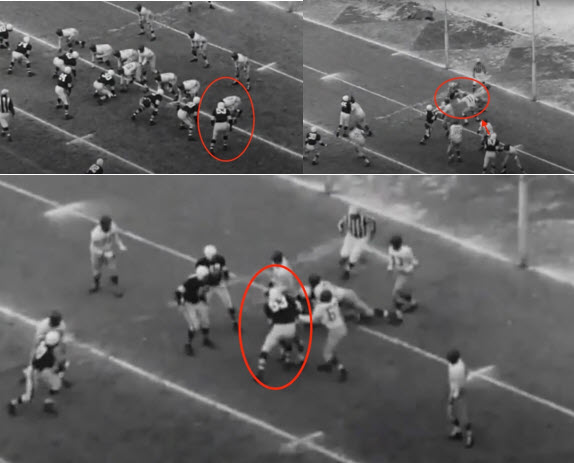
As the honors rolled in after the season, Lenny was the only consensus First-team All-Pro defensive end, with the Rams’ Larry Brink and Lions’ Leon Hart splitting votes as the AP and UPI couldn’t agree.  Along with Tank Younger and Emlen Tunnell, Ford was the first African American named to an All-Pro by either Associated Press or United Press. However, the likes of Duke Slater and Fritz Pollard made some newspaper teams prior to re-integration, and Bob Mann was certainly a snub in 1949. Evaluating performances, honors and verbatims there’s simply no doubt that were a Defensive Player of the Year issued in 1951, Ford would be the winner.