Tuesday, September 20, 2022

TUESDAY TIDBITS: On the Road With the Monkees

By TJ Troup
Photo credit: Wikipedia

This past Sunday the 18th is the ten-year anniversary of Mr. Steve Sabol's death. In Steve's office was a small sign that stated, "Did you make someone laugh today." Advice we can all learn from. 

Years ago Steve did a segment on Dickie Post, and we observe Post riding around on a boys bike and Steve watching. During one of my conversations with Steve asked him about any and all of his upcoming projects, and interjected if he had time he could go on the road with the Monkees—since he stated in the Dickie Post piece he "looked like a roadie for the Monkees". 

That classic Sabol laugh roared throughout the room. 

Last Thursday the Chiefs took on the Chargers, and the key play of the game was Watson's 99-yard interception return for a touchdown. Seven times the Chiefs have returned an errant Charger pass for a score. 

Willie Lanier recorded the first in 1968; Kansas City won and earned a playoff berth that season. Burruss pilfered two and tied a league record by scoring twice in 1986, again a Kansas City victory, and again they went to the playoffs. 

On September 6th, of '92, was at "The Murph" with one of my former players, and the key play of the game was Kevin Ross sprinting 99 yards with an interception for a touchdown, and yes—the Chiefs went to the playoffs that year. 
Mark McMillan did it in 1997, and bet you have figured out that Kansas City won that day and went to the playoffs. Marvcus Patton did it in 2000 but the Chiefs lost that day and DID NOT go to the playoffs. Thus when the Chiefs return an interception for a touchdown and beat the Chargers they advance to the postseason. It would be a shock if this year's Chiefs team did not go to the playoffs. 

 For the first time since 2016, the New York Giants are 2-0, and yes the G-men went to the playoffs that year. In four other seasons since 2000, the Giants have started 2-0, and that usually means post-season play. 

Still way to early to predict that kind of success for New York, yet the upcoming Monday night game at home against the hated Cowboys would sure inspire some confidence if they can come away with a win. 

 Since the Packers and Bears have played so many times and both teams have had outstanding runners in their history it should not come as a shock that there have been more 100-yard rushing performances in games between these two teams than any other rivalry. Thus, Sunday night both Montgomery and Jones went over the century mark to add to the record. 

 Every year you folks are bombarded with my favorite stat; the defensive passer rating, and with just two weeks in the books the teams that rank near the top could falter, and the teams at the bottom could certainly improve, yet....we have six teams playing outstanding team pass defense right now. In order, they are: Buffalo, Tampa Bay, Philadelphia, Pittsburgh, Jacksonville, and San Francisco. The three teams at the bottom are the Cardinals, Titans, and Dolphins. Since many folks believe the first big game of the year is next Sunday when division rivals the Bills and Dolphins square off, a key factor in the game just might be the Dolphin secondary demonstrating cohesive team pass defense since they face young Josh Allen. 


 The second half of 1965 the Dallas Cowboys for the first time began to play strong football and earned a trip to the playoff bowl. Landry had a team of young talent that had learned their lessons well, and during 1966 the Cowboys finally became a force to be reckoned with. On September 18th of '66, Dallas demolished the Giants 52-7. Meredith pitched the pigskin to Hayes and Reeves as they both gained over 100 receiving. Meredith's five touchdown tosses tied LeBaron's team record and left corner Cornell Green began to play like an All-Pro as he dashed 41 yards to score with an errant Giant pass.

Monday, September 19, 2022

Fewer Plays, Fewer Opportunities for Bears at Lambeau

 By Eric Goska

One way to beat the Packers has always been to keep the ball out of the hands of quarterback Aaron Rodgers.

In the opening two quarters of its home opener, Green Bay took the same approach with Chicago quarterback Justin Fields.

The Green and Gold shuttered the Bears’ offense for much of the first half Sunday night at Lambeau Field. In keeping Fields and Co. under wraps, the Packers parlayed a 17-point lead into a 27-10 win over their long-time nemesis.

Two factors conspired to make life difficult for Chicago in the first half. First, Rodgers and his mates possessed the ball as seldom before in this rivalry. Second, after giving up a touchdown early, Green Bay’s defense clamped down.

The Packers scored on four of their first five drives. The team reeled off 40 plays (25 on Chicago’s side of the field), posted 24 points and held the ball for 20 minutes, 22 seconds.

The Bears scored on their opening drive, then went nowhere on their next four possessions. The club mustered 17 offensive plays (3 in Packers’ territory) and the time it held the ball (3:56, 2:05, 1:39, 1:26 and 0:32) dwindled each time out.

By running 40 plays to Chicago’s 17, Green Bay recorded its greatest first-half differential (plus-23) in the series that dates to 1921 (numbers from 1941 are not available). Its previous best had been plus-20 on three occasions.

Such lopsidedness allowed the Packers to control the ball for better than 20 minutes in the first half against the Bears for only the fifth time in the last 50 years.

Jac Collinsworth and Rodney Harrison talk football
ahead of the Packers-Bears game at Lambeau Field.

Imposing limits like these has paid off for Green Bay in the past. Since 1954, the team is 17-3-1 (.833) when it holds the competition to fewer than 20 offensive plays in the first half. Further, it is 27-6-2 (.800) when it runs 20 or more first-half plays than its opponent.

Fewer plays yield fewer opportunities to rip off big yardage. Chicago had only three chunk plays in the first half: Fields passed to former Packer Equanimeous St. Brown for 30 yards and David Montgomery had carries of 13 and 12.

The Bears managed just 29 yards on their other 14 plays before the half.

The Packers got the better of Chicago after the break as well, but not by much. They ran 26 plays to the Bears’ 24 and out possessed them 16:53 to 13:07.

Add it up and Chicago ran just 41 plays from scrimmage. That’s the second-fewest by the Bears in 203 regular-season games against Green Bay, ahead of only the 39 they slogged through in a driving rainstorm in a 2-0 victory on Sept. 18, 1938, at City Stadium.

Ball Hogging the Bears
The four regular-season games in which the Packers reeled off 20 or more first-half offensive plays than the Bears. Numbers for the two games from 1941 are not available.

   +       GB-Bears        Date                              Result
  23          40-17            Sept. 18, 2022            GB won, 27-10
  20          42-22           Dec. 25, 2005              GB lost, 17-24
  20          38-18           Dec. 22, 2008              GB lost, 17-20
  20          41-21            Dec. 29, 2013              GB won, 33-28


Sunday, September 18, 2022

Cobie Durant Records a Sack and an Interception—The First Rams Rookie To Do So

 By John Turney

Rams rookie cornerback Cobie Durant joined elite company by intercepting a pass and also recording a sack in a Sunday's game against the Atlanta Falcons in SoFi Stadium in Los Angeles. Since 1982, when sacks became official, he became the first Rams rookie to record the duo of big plays.

In the second quarter of the game, he picked off a Marcus Mariota pass and returned it 51 yards. Mariota threw a short pass to running back Cordarrelle Patterson who deflected it and it fell into Durant's hands.
Durant's interception. Credit: Fox Sports
Later, in the third quarter, on a second and nine play, he sacked Mariota for a seven-yard loss on a corner blitz ending the Falcons drive.
Durant's sack. Credit: Fox Sports

Durant, a fourth-round draft pick out of South Carolina state with 4.38 speed, got his first significant playing time in the game, having played thirteen snaps, all on special teams, in the Rams opener ten days ago. In today's game, he was part of the Rams nickel and dime packages playing both outside and inside as a slot corner where he was positioned when he got to Mariota for the sack.

The last time any Ram pulled off the feat was Jack Youngblood in a 1975 playoff game against the St. Louis Cardinals, also in Los Angeles. That day the Rams beat the Cards 35-23 on the strength of two interceptions returned for touchdowns, one by Youngblood and the other by safety Bill Simpson

On the Cardinals second play from scrimmage, Youngblood tipped a Jim Hart swing pass intended for Jim Otis that popped up for a split second before landing in his hands and he proceeded to return it 47 yards for a touchdown. 

Late in the third quarter, Youngblood threw Hart for a ten-yard loss to complete the pair of notable plays. However, his sack is not recognized by the NFL since it occurred prior to 1982—leaving it lost to history. Still, the sack took place, official or not, so Durant gets to attach his name to a Rams legend. 

Well done, rook.  

Saturday, September 17, 2022

The Reach of David Boss

 By John Turney 
If you were a football fan anytime from the early 1960s to the end of the century you would have been touched by the influence of David Boss.

Boss worked for and then headed up NFL Properties for just over 30 years and that company was responsible for any product with an NFL or team logo on it. 

Everything. 

After being hired in 1960 he began to expand the fan experience by standardizing NFL game programs and filling them with articles by the top football journalists, amazing photography, and fine art as well. 

In the mid-1960s all the NFL teams had themed covers that were designed to be consistent from city to city. They became a national product. The covers would feature team-specific paintings or photographs and the features and other niceties were also the same in each program.

A fan in New York would have the same basic magazine as someone in Los Angeles except for the cover, team rosters, and some team-specific articles. 

The artwork stands the test of time. In 1966 the covers were paintings done by Boss himself.  A graduate of the Cleveland Institute of Arts, Boss was multi-talented in terms of fine art, photography, design and even journalism, having penned and edited NFL prose.
1966 NFL Game Program. Cover art: David Boss
In the 1970s the game programs Boss added a weekly feature that allowed the fans to see amazing portraits of NFL players by artists like Merv Corning, Chuck Ren, George Bartell, Cliff Spohn, and many others. These pieces are cherished to this day by fans, inspiring specific accounts on blogs and on Pinterest. 

Boss also personally designed all the Super Bowl game programs and Super Bowl posters from the beginning through Super Bowl XXV. These are still cherished and fetch a tidy sum on eBay and online auction sites as well. The early ones would cost someone between $400 up to the low four figures, depending on condition. 
He set up the licensing program that allowed companies to produce all the products fans could see in the Sears, JC Penny, or Mongomery-Wards catalogs. 

Those products were coveted by children, teens, and adults and to this day allow fans of that era evocative memories of a sweatshirt, sweater, letterman's jacket, pajamas, or bed sheets with their favorite team's logo on them. Or just looking through the Sears Wishbook and gazing at the seeming scores of products it offered. 

All of those things were licensed by NFL Properties. 
Throw in NFL-themed posters and books.

The Punt, Pass, and Kick series of books for younger fans are still sought by collectors. Boss also created some of the best coffee-table books of the day, the Pro Football Experience was a monumental oversized book that had photography that made players look like they could leap off the page.  It was 256 pages of cover-to-cover explosive content. 
He designed and produced The First Fifty Years: A Celebration of the National Football League in its Fiftieth Season which is still a great read. All the books that focused on specific positions were credited to him. One was Running Wild: A Pictorial Tribute to the NFL's Greatest Runners

He was the brainchild behind the 1973-74 series of books, Great Teams, Great Years. One of, in not, his last book was titled, From First Down to Touchdown which came out around the time of his retirement.

Moreover, Boss was instrumental in producing "Prolog" magazine and NFL Reports, and other publications that were direct productions of Properties. 

"Prolog" was an annual NFL preview magazine that also gave detailed coverage of the previous season. It was full of interviews and, again, great photography. 

The pocketbook-sized "NFL Reports" gave much of the same kinds of content but in a smaller format. It was sold, of course, at bookstores and dime stores but often was a giveaway at car dealerships or appliance stores that had a promotional deal with Properties. 
Boss redesigned the NFL logo, making it less busy and serves, by and large, to this day—with some minor tweaks along the way. 

Yes, if there was some NFL item you enjoyed as a kid, or even now as an adult, thank David Boss for it because he had a hand, directly or indirectly, in it. It really is mind-boggling to reflect how big his sphere of influence was and the amount of joy he helped create.

If you fell in love with the NFL, especially in the sixties and seventies, David Boss is a name you need to know.

Thursday, September 15, 2022

Michael Sinclair—Worth Remembering

 By John Turney 
We've seen many times when an injury can rob a player's production and it often, for all intents and purposes, ends a career.

Michael Sinclair didn't get injured, he got robbed by an illness—diabetes—that manifested at the peak of his NFL career and he was never the same after.

In 1991 the Seattle Seahawks drafted Sinclair in the 6th round of the draft. He'd been the best defensive lineman in the Lone Star Conference in 1990 playing for Eastern New Mexico University. He'd been All-LSC both as a junior and senior and ended his years as a Greyhound with 279 tackles and 30 sacks. 

Sinclair's hopes of playing pro ball rested on his ability to gain some weight. He was 238 pounds at ENMU and that was not going to cut in in the NFL so we went to work. Even though he had very good speed (4.58 in the forty) he was still a long shot to make the team.

Prior to his rookie season, he was able to gain twelve pounds to get up to 250 pounds and had a good camp and preseason—catching the coaches' eyes. He didn't quite make the club but was on the Seahawks practice squad and was activated and on the roster for the final four games but he never played in a game.

However, he'd shown enough promise that he was assigned to the NFL's new development league—the WLAF (that was renamed NFL Europe several years later)—and in the Spring of 1992, he played for the Sacramento Surge and was a major cog on a team that won the league championship.  

Sinclair caught a break there due to the fact one of the Surge front office executives was former Ram great Jack Youngblood who'd often attend practice and offer tips to young linemen. In fact another of those young linemen was Bill Goldberg, who was a defensive tackle on the club. 

It seems Goldberg would turn most reps into wrestling matches with offensive linemen and he would get off the block, just playing into the guard's hands. Youngblood once said, "Bill, I know you can whip him but what I want to see is if you can get off his block."

With the Surge Sinclair improved his craft and totaled ten sacks in ten games and was a league All-Star and was back with the Seahawks for the 1992 season.  

That year long-time veteran left defensive end Jacob Green had been released and right end Jeff Bryant was moved to left side. The plan was for him to play in the base defense with Sinclair coming in on passing downs but it didn't materialize until a month into the season due to a severely sprained ankle that slowed him. When he was healthy, though, Sinclair didn't impress. He was "Thinking too much" and that still on the light side, weighing 258 pounds despite two years of hitting the weights.

Things finally came together in 1993 with Sinclair excelling in his role as a nickel rusher. That off-season, he stayed a dedicated weight lifter and ate healthily and that paid off in a big way. He built himself up to 271 pounds and retained his quickness and get-off.  

He told the media, "This is the first year I will be able to play a full season."

There was talk among the coaches that he might be ready to be the starting left end but by the start of the season the 1992 plan was back:  Bryant on run downs and Sinclair would play in nickel defenses (with Michael McCrary on the opposite side). 

After eight games he was third in the AFC in sacks . . . then he broke his thumb and it kept him out the rest of the season. He had shown such promise and then boom, he was out and didn't make it through the full season as he'd hoped.

He didn't get that full season in 1994 either. He once again continued his weight program and weight gain, tipping the scales at around 290 pounds but he was slowed by a knee injury and then a groin injury and was never fully recovered until late November. Sinclair ended the season strong but again it was another disappointing year. 

Dennis Erickson brought change to the Pacific Northwest team in 1995. He brought in Greg McMackin to run the defense. McMackin had been a long-time college coach and in 1993-94 was the defensive coordinator for the Miami Hurricanes and brought with him a defensive scheme that called for a get-up-the-field philosophy for the defensive line.

While it did not fully manifest that first year the change was well suited for Sinclair and his to-be partner in crime McCrary. 

Erickson, on his arrival, told Sinclair to drop his weight telling him that 290 pounds was too much and also to not use his bull rush as much. He was to get up the field, putting his best asset, his quickness, to fuller use without trying to push a tackle back to the quarterback. 

Sinclair was finally a starter and played his first full season  Seattle improved from 6-10 to 8-8 and good things seemed like they were on the horizon for Sinclair. 

Indeed they were.

In 1996 the new scheme paid off, big time. With four dynamic players, the defensive line ranked among the best in the NFL. Sinclair (now down to 267 pounds) and McCrary were the ends with powerful Cortez Kennedy and super-quick Sam Adams inside at the tackle spots. They sacked opposing quarterbacks 48 times, the most since 1985. Sinclair and McCrary combined for 26.5 and countless pressures. 

Sinclair had arrived . . . he'd become the player he'd worked to be and was rewarded with being voted to his first Pro Bowl.

The Seahawks lost McCrary to free agency in 1997 but Sinclair rolled on recording 12 sacks and forcing 5 fumbles and was voted to his second consecutive Pro Bowl. 

Going into 1998 Sinclair was underpaid according to Seattle columnists and he considered holding out but decided against it. He told the media that honoring the contract he signed was more important and that the money would take care of itself in due time. 

Again, he had a stellar season. He led the NFL in sacks and forced fumbles, was Second-team All-Pro and made his third Pro Bowl.

He was on a hot streak. From 1996-98 no one, not Bruce Smith, not Reggie White, not Kevin Greene,  or any other dominant rusher had more sacks than Sinclair's 41.5 sacks and though it was not known at the time, through the magic of Pro Football Reference's Stathead now it is clear that no one forced more fumbles in that span either. 

Though not a household name, Sinclair was among the elites at his position and was doing things as well as the best of the best. His dedication paid off. 

And the money came. 

In August of 1999, Sinclair signed a seven-year $35 million contract that kept him signed through 2005. The Seahawks voided the last two years of a four-year deal he signed in 1996 so, in effect, it was a five-year extension and it made him one of the NFL's highest-paid defensive linemen.

Then the unexplained tiredness came. The inability to keep weight on. Seeking answers Sinclair was tested and found to have Type-II diabetes. He knew with treatment it could be controlled but still, he was in an industry where slowing by a half-step could take away his ability to compete.

With that and with Mike Holmgren's desire that his defensive ends focus more on stopping the run it seemed 2000 was going to be a challenge. Defensive coordinator Jim Lind brought his defensive ends "in". Rather than being split outside in a "wide 9" technique. Sinclair had to play tighter, on the outside shoulder of the tackle, at 5-technique. That cut the angles he had to take to the quarterback if the opposing offense decided to pass from a running formation or on a likely run down. 

Sinclair was third on the club in sacks with six and though he did force four fumbles it was clear that Sinclair was playing up to the level he had in the previous few seasons. 

He got a reprieve the next year with, once again, a new defensive coordinator, Steve Sidwell. Sinclair was allowed to spit out wide again, something he thought was better for his skill set. He proclaimed to the media, "The new scheme put me back to playing outside." He added that his diabetes was "stabilized". 

But all that didn't pan out. 

Sinclair's final two seasons in Seattle were dismal by his standards and that led to him being released early in 2002. He was looking for a job and to bolster his opportunities he got his weight up to 277, the most since 1994. He visited the Rams but signed with the Broncos for $750,000 but failed to make the club. A short time later, when injuries hit the Philadelphia Eagles defensive line, Sinclair was signed to provide some temporary depth. His stint there lasted just four games.

When diabetes manifested Sinclair was just 31 years old. He'd been among the best at his position for a few seasons. And though there was a hiccup in the 1999 defensive scheme that did not play to his strengths, it was the illness that sapped him of his elite ability and made him ordinary. He only got to play a short time under his big-money contract.

He's still the second-leading sacker in Seahawks history (behind only Jacob Green) and his 16.5 sacks in one season are still the franchise record. His three Pro Bowls as a defensive end are tied for the most in term annals—though Jacob Green, who had just two, likely deserved more. 

He went on to coaching. He had a stint in NFL Europa and then six years in the CFL and one season in the NFL, in 2013 with the Chicago Bears.

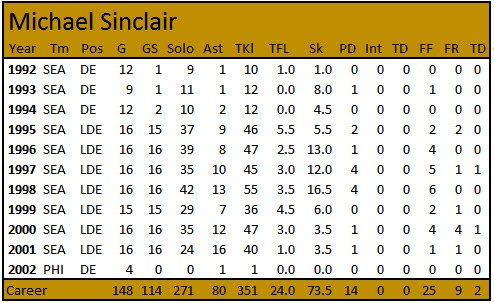
Career stats—

Wednesday, September 14, 2022

Justin Reid—Is He the Only One?

By John Turney

Yesterday CBS Sports Tweeted stating that Justin Reid "(I)s the only player in the last 30 years to do all of the following—score a touchdown, make an extra point, pick off multiple passes, force multiple fumbles, recover multiple fumbles, and record multiple sacks with the caveat that forced fumbles "first tracked in 1991."

And while that is accurate it is a little bit unfair to Jeff Heath who did all those things except that he had only one sack rather than two. 

Reid's accomplishment does raise this issue:  Did anyone do this prior to 1991? 

As CBS Sports mentioned the statistic of forced fumbles went back to 1991 but beginning in 1976 official gamebooks (also called play-by-plays) began listing forced fumbles and before that, the text of a gamebook often indicated if a forced fumble occurred and who caused it. 

We mention that because if play-by-plays are satisfactory evidence and if video evidence is as well then there are others who have done the same thing as Reid as long as the exact words used in the Tweet are adhered to. It is possible it means players who KICKED a PAT but it  reads, "make an extra point." 

Obviously one can score an extra point without kicking it, like on a botched snap like Dick Butkus did in 1971. After a dash for a botched snap holder, Bobby Douglasspicked up the free ball and found an open Butkus in the end zone and hit him for a game-winning PAT. 
Credit for still:  NFL Films
So if that counts, and it does, considering the verbiage CBS Sports used, then it opens up the list and includes Butkus because the Bears, in their 1972 Media Guide, credited him with three forced fumbles in 1971. If they had kept records before that who knows how many he would have, thirty? Fifty?

If the threshold were one sack, rather than two, Heath would qualify. And Hall of Famer Roger Werhri would, too. Another Hall of Famer, Packer safety, Willie Wood might as well but we've not seen film of him forcing fumbles but he had to have. Brig Owens also might qualify and possibly Wendell Harris as well. 

But the criteria is two or more sacks so we'll go with that.

Andy Russell, Steve Zabel, John Anderson, and Nolan Cromwell meet all the criteria. Play-by-plays are clear about them each forcing two or more fumbles in their career. Two of Russell's forced fumbles came in 1974, two years before they were officially part of the tackle charts included in the play-by-plays. Russell returned some kicks and blocked a punt in his career as well. 

Zabel and Anderson kicked the extra points (Zabel also kicked a field goal something Reid has yet to do) and Cromwell ran one in as a holder and Russell had the ball lateraled to him from the holder Dick Hoak who thought he couldn't get the ball placed in time. Baker's extra point was much like Butkus's, he caught a pass after a bad snap and the holder was able to get the throw off.

Then there are players who a matter of course likely qualify. They are players who played defense a long time and the odds are they forced at least a couple of fumbles in their careers. Lou Michaels, Wayne Walker, Jim Houston, Bob Gain, and Ralph Baker are in that group. 

Michaels and Walker were regular kickers so they would have kicked their PATs and given they had so many sacks, 47 and 38½ respectively. It would be highly unlikely they didn't force some fumbles. 
Lou Michaels
Bob Gain played most of his career in the 1950s when the sack data is incomplete but he had 14 in the 1960s and we'd surmise that he forced the ball out of a quarterback or running back's hands. Ralph Baker played eleven seasons so again, the odds are very high that he, too, caused some fumbles.

None of this takes anything from Reid—it just lets folks know that at least four others have done the same and five more almost certainly did. And if the sacks, rather than being arbitrarily set at two were set at one two more would make the cut and possibly three more after that.

None of this takes anything from Reid—it just lets football fans know that even with a rare feat, like Reid’s, it goes to show the wisdom of Ecclesiastes 1:9 is fair commentary, "There is nothing new under the sun." If it happens today it probably happened before if someone looks hard enough. 

Tuesday, September 13, 2022

TUESDAY TIDBITS: What Have We Learned?

By TJ Troup 
There were some hard-fought games this past Sunday, and a couple of them had numerous twists & turns (Bengals vs. Steelers tops the list). 
Did we learn anything after one week? 

As a former gambler.—there were ten road favorites, and only three covered the spread—it's just damn difficult to figure out how strong teams are early in the season. 

Josh Allen completed 26 of 31 against the Rams in the impressive Buffalo victory, yet there was a passer 84 years ago that had an even higher completion percentage than young Josh, his name you ask? Why none other than Samuel Adrian Baugh. 

Having demonstrated his ability to throw accurately as a rookie in leading the 'Skins to the title in 1937, "Slingin" Sam is in Municipal Stadium in Philadelphia to take on the Eagles. 

The Redskins were attempting to win for the fourth straight time in Philly, and just before the half Washington was down 16-7. Baugh is smashed to the turf in completing a pass to Max Krause. Max dashes 57 yards to score. 

Baugh finishes the game completing 12 of 13. Krause had the best game of his career as he scores his only three touchdowns of the season. Krause on a reverse in the third quarter ambles 71 yards to put the 'Skins ahead, but here come the Eagles to again score and take the lead. 

Rookie tailback Bill Hartman replaced Baugh and completes a pass to Bill Young on a tackle-eligible play out of a spread formation (we see those a lot these days), but with an unbalanced line. Young trundles 62 yards to score the winning touchdown! 

No, did not see these highlights on Sportscenter, or the NFL Network, but boy oh boy would sure relish watching this game on DVD. 
Another passer who was deadly accurate was Brian Sipe, and thirty-nine years ago against the Lions, the former San Diego Aztec found four different receivers for his scoring passes in a 31-26 victory. After the game, Sipe had thrown 135 touchdown passes in his career and had established a new team record (surpassing Frank Ryan).