Wednesday, July 31, 2024

What's Keeping Everson Walls Out of Canton?

By John Turney 

By his own admission, his Hall-of-Fame resume is an "all-in-one" package. So what don't voters like about it?

It took defensive back Everson Walls so long to have his case heard by the Pro Football Hall-of-Fame's board of selectors that, prior to the vote, he told one voter that he'd "fallen into the abyss." That was 2018 in the first ... and last ... year of Walls' modern-era eligibility.

So what happened? He fell into the abyss, that's what. He failed to advance past the first vote, where a list of 15 finalists is cut to 10, and moved from the modern-era list of Hall-of-Fame candidates to the seniors' category.

Or "the abyss."

It can be called that because the group is so deep with Hall-of-Fame caliber players that it's difficult to emerge. It took Jerry Kramer 45 years, for instance, before he was enshrined, and Johnny Robinson wasn't far behind. It took him 43.

According to Hall-of-Fame voter Rick Gosselin, over 50 all-decade players are waiting to have their cases debated, and Walls isn't one of them. He was not an all-decade choice. But he has a terrific case, worthy of the Pro Football Hall of Fame.

For openers, he's the only cornerback in NFL history to lead the league in interceptions three different years (1981, 1982 and 1985). As a rookie, he had 11, which at that time was tied for 14th most in a single season. And now, after 42 years, it's STILL tied for 14th. His ranking hasn't dropped a single spot. No one had more in a single season since. In 2021, Cowboys' cornerback Trevon Diggs tied the record, but no one has had more.

Walls did. He had more as a rookie ... and an undrafted rookie at that. 

Though he led the nation in interceptions as a senior at Grambling, no one drafted him in 1981, mostly because of Walls' 4.7-second 40 -- an acceptable time for, say, a defensive end but not a cornerback. Nevertheless, that didn't intimidate Cowboys' Hall-of-Fame executive Gil Brandt, who brought Walls to Dallas for a tryout.

He not only made the team but became a starter.

"You couldn't beat him deep," Brandt told Hall-of-Fame voter Alex Marvez, "even though he couldn't really run that fast. But more than anything, (there was) ability, Walls had the ability to make plays on the ball, which some guys don't have."

And make plays he did. In his 13-year, 186-game NFL career, he had 57 interceptions, tied for ninth all-time when he retired and 13th today ... and that's among all players. Ahead of him are only eight players who took significant snaps at corner, including three who spent chunks of their career at safety.

But among pure corners? He's tied for sixth-best. It's more than Hall-of-Famers Lem Barney, Aeneas Williams, Willie Brown, Darrell Green, Ty Law, Deion Sanders, Champ Bailey, Herb Adderley, Ronde Barber, Jimmy Johnson, Mike Haynes, Roger Wehrli and others.

Granted, interceptions are a thing. But they're not the only thing. There's more to his case than just the numbers. Walls was a three-time All-Pro, 1982 (PFWA), 1983 (AP) and 1985 (PFWA), and was All-NFC in 1982-1985. Plus, he received a second-team All-NFC nod in 1988.

Additionally, he went to the Pro Bowl in 1981-83 and 1985.

He probably deserved to go to another Pro Bowl in 1990 when he signed as a Plan B free agent with the New York Giants and helped them to a 20-19 victory in Super Bowl XXV by making a stop that his defensive coach,  Bill Belichick, called the play of the game.

"Wouldn’t have won," he said, "if (Walls) didn't make that tackle."

What Belichick was talking about was a Thurman Thomas run on third-and-inches where the Buffalo running back appeared to break away for a huge gain, perhaps even a touchdown. But Walls appeared out of nowhere, running across the field to take down Thomas after a 22-yard run with under two minutes to play.
But it wasn't that play that defined his season. He contributed all year long, returning one of his six interceptions to the house, defending 17 passes and forcing a fumble. 

"I wasn’t just one of those guys who was riding the bench," he said in an interview with the "Talk of Fame Network," just hoping to get a ring while I motivate other guys to do their job. I was instrumental. I was an integral part of that defense … the number-one defense in the NFL ... "

However, sometimes it's useful to look at what players did in the years they didn't make All-Pro or weren't chosen for the Pro Bowl, and one such means is literature -- specifically, the newspapers and magazines of that era. One such source was Pro Preview Magazine, which purported to "use the finest writers and scouts" for its content and a source I consider above the standard fare.

In its review of Walls' 1986 season, it said that "he continued to dumbfound quarterbacks with his ability to come off a receiver and get back in time to make the play despite the lack of flat-out foot speed. He's got an uncanny knack for being around the ball and uses his body and to direct receivers off the ball. Never allows a receiver to get inside of him and hardly ever drops an interception."

Sounds like a stellar year. 

In the next annual, the magazine had this to say about his 1987 season: "Walls remained one of the top cover men in the league. Walls is not the fastest player around, but his acceleration to the ball, uncanny instincts and good hands allow him to make plays when it looks like he's beaten."

Throughout his career, teams would study him on film and convince themselves that they could beat him because of the so-called lack of speed. They tried Walls again and again, and they usually lost ... again and again.

So, why the Hall's reluctance to award him a Gold Jacket?

One reason might be a nationally televised game where Walls played a major role in the game's biggest play. It was the 1981 NFC title game when San Francisco receiver Dwight Clark made "The Catch" on the game-winning touchdown.

Everson Walls was the defender.

But a player's career is much more than one play. The Hall of Fame is about a player's career. If too much emphasis has been given to that play it shouldn't. All cornerbacks have been beaten; it's the nature of the position. 

Not only that, but give the quarterback -- Joe Montana -- some credit. It was a perfect throw, placed where it usually would have fallen as an harmless incompletion out of the back of the end zone.

Except there's more to the story of that contest than Clark's game-winning catch. Walls had played a great game that afternoon. He intercepted two Montana passes and recovered a fumble. That's three takeaways, including two in the fourth quarter alone. In fact, four plays after Walls' fourth-quarter fumble recovery, the Cowboys scored a touchdown to take a 27-21 lead.

On the ensuing drive, Walls snagged his second pick, this one nearly 40 yards downfield. San Francisco coach Bill Walsh had his young quarterback test the rookie corner ... and he lost. In classic Walls' fashion, he forced the receiver outside and essentially ran the route for him. As was his habit, when he got his hands on the ball, he secured it.

Dallas could have all but ended the game at that point, but it didn't score and gave the ball back to the 49ers. You know the rest.

The long drive ended with Walls' picture on the cover of Sports Illustrated, right behind Clark. That image is out there and been written about so many times that it may be an obstacle to Walls' Hall-of-Fame quest. I said "may be." Voters are too smart to hang that loss on Walls. And they should be smart enough to bring Walls out of the seniors' committee in the near future.

The only question is: When?

"You can look at numbers all you want," Walls told the "Talk of Fame Network." " You can look at individual stories all you want. You can look at overcoming adversity all you want. You got me. That's me. All in one package."

Record-setting numbers. Honors. The ring. Marvelous scouting reviews. The package is indeed full for Everson Walls. 

Thursday, July 25, 2024

New York Jets To Wear Throwback Uniform in 2024

 By John Turney

Jets' throwback uniform that was announced this week

Starting in 1964 the New York Jets donned their green and white uniforms with the shoulder stripe and two sleeve stripes. The white version was worn in Super Bowl III when the Jets defeated the Colts 16-7.

They wore those through 1977. In 1978 they wore green helmets and jerseys with twin stripes. 

This year they will wear both. 


They will have the same design but the color is what they are calling "Legacy green" as opposed to the old Hunter green.

Here is a graphic from the change of uniforms from earlier this year—

This week the throwback or "Legacy" design was announced as an alternate uniform. Ironically the "Legacy" last year became the usual this year going forward.

So, it's the best of both worlds. And the good part is that the Nike-designed uniforms are gone— hopefully forever.

This jump back to the past is a further indictment of Nike's failed designs. A couple of teams -- the Bucs and Browns went back to nearly identical uniforms they wore before Nike hijacked their uniforms. Now the Jets join them.

Others like the Jaguars and Lions went to a more classic look, though not the same as before. Although the Jaguars announced a throwback earlier this month.

It will be interesting to see if the Rams and/or Falcons also revert when they can—which the Rams can next year. We are not hopeful on that front. We'll see.

Wednesday, July 24, 2024

Hall Voters Have Ignored Harold Jackson's Productivity

By John Turney 

"He may be small, but he can fly."

That's what Eagles' player-coach Irv Cross said in 1969 about Harold Jackson when then-Eagles' head coach Jerry Williams considered trading for the diminutive but fast wide receiver ... and Cross would have known. He was with the Rams the previous year and had to cover Jackson in practice. 

So, based largely on his evaluation, the Eagles pulled the trigger and traded for Jackson.

They weren't sorry.

The 5-foot-10, 175-pounder delivered for them -- big time. In fact, Jackson delivered big in nearly every stop of his 16-year NFL career. His production was often unmatched in a single season ... or over multiple seasons.

Yet, when it comes to the Pro Football Hall of Fame, that career has been ignored -- also, big time. He only reached the nomination phase, was never a finalist and appeared on the preliminary ballot just three times.

Harold Jackson deserves better, and I'll tell you why: When you examine his numbers, he was one of the top receivers of his era.

Consider that Jackson achieved the receiving triple crown, topping all others in receptions, receiving yards and touchdowns. That was a huge deal when the Rams' Cooper Kupp did it in 2021 because it's so uncommon to achieve. But Jackson didn't do it in a single season.

He did it for the entire decade of the 1970s. From 1970-79, no one caught more passes ... for more yards ... and more touchdowns than Harold Jackson.

But that's not all. 

Let's take it further. 

Expand the seasons from 1970-79 to 1969-81 -- the 13 years Jackson was a starter -- and you have the same results. Jackson was No. 1 in all three categories, and, yes, that's a big deal. Going back to when the NFL first kept statistics, only nine players in pro football history led all three categories for a 13-year span. 

The other eight? Try Don Hutson, Jerry Rice, Steve Largent, Larry Fitzgerald, Don Maynard and Marvin Harrison. Then add Fred Biletnikoff and Billy Howton, who each led in catches and yards but tied for the lead in TD receptions.

Randy Moss never did it. Nor did Terrell Owens. Throw in Hall-of-Famers Raymond Berry, Charlie Joiner, Art Monk, Andre Johnson, Isaac Bruce or anyone else with a Gold Jacket not listed above, and they didn't do it, either.

It's rarefied air. 

Now, consider that Jackson did it for two teams -- the 1973-77 Los Angeles Rams and 1978-81 New England Patriots -- and the accomplishment becomes even more remarkable. In Jackson's five years in L.A., "Ground Chuck" Knox was the most run-heavy coach in the NFL. Not Chuck Noll nor Don Shula. Chuck Knox. And when Jackson was in New England, only two teams had a higher run-pass ratio than the Patriots.

Imagine if he played longer in more balanced offenses. 

Actually, he did in the early 1970s with the Eagles, but their quarterbacks were names like Pete Liske, Rick Arrington and John Reeves. Not exactly Pro Bowl passers. Nevertheless, Jackson racked up the numbers, making him the king of receivers in the so-called "dead-ball" era of pro football. 

Yet, in light of all that, when Jackson was a modern-era candidate for the Pro Football Hall, he never had traction ... and that continues now that he's a senior candidate.

Why? Perhaps because he moved around so much he never had the support of his hometown presenters. Or maybe it's because he played on a lot of teams that never went to a Super Bowl. 

It's hard to know. But that should change. Granted, Jackson moved around a lot, but he was a player with value because -- as Cross put it -- "he could fly."

"HAROLD JACKSON STATE"

The Rams grabbed Jackson out of Jackson State, an HBCU in Mississippi where he dominated the competition so completely that one paper suggested it change its name to "Harold Jackson State." That was his junior season when Jackson scored three times in one game  -- once with a touchdown catch and two others by punt and kickoff returns. It was also the season he set a touchdown reception record that stood until 1998.

Small wonder, then, that Jackson's teammates called him "Ghost. He was so fast that you couldn't see him run by you. In fact, he ran by so many defenders that he was named all-conference twice and was chosen to the Black All-American team published by the Pittsburgh Courier.

Injured as a senior, he fell to the 12th round of the 1968 NFL draft where the Rams finally grabbed him and immediately discovered he was the fastest man on the team. But even though nobody could cover him in practice, he spent most of his rookie season on the taxi squad.

"Deacon Jones decided to cover me," Jackson said after defensive backs gave up. "He got right up over my head. So I came off the line of scrimmage and put a move on him, and he didn't put a hand on me. I went around him. He took off his headgear and threw it at me."

Jackson was set up to replace the retired Bernie Casey as the Rams' flanker in 1969, but that didn't happen. Legend has it that the second-fastest Ram, Wendell Tucker, edged Jackson in a head-to-head race where the winner would stay in L.A. and the loser goes on the market. Tucker was fast, but Jackson usually was faster.

But not on that day.

Tucker was also 10-15 pounds heavier and that made a difference to coach George Allen. When the Eagles' Williams asked Cross why the Rams would be willing to part with Jackson, Cross was direct.

"George Allen likes his receivers 6-3 and 215 pounds," he said. "But trust me, he can fly."

So, he was traded to Philadelphia where he started and where he excelled. 

In his time there, the team wasn't much good, but Jackson was. From 1969-72, only one NFL player caught more passes, and only two amassed more receiving yards. Jackson went to the 1969 and 1972 Pro Bowls and in 1972 was second-team All-Pro -- on an 2-11-1 team. He also led the NFL in receiving yards in 1969 and was first in receptions and receiving yards three years later.

Then he got a break. He was traded back to the Rams in 1973 for quarterback Roman Gabriel in one of the great robberies in NFL history.

The Eagles needed a quality quarterback. The Rams didn't. They'd just acquired John Hadl from the Chargers. But they wanted Jackson. In fact, they insisted he be included in any deal ... along with a quality fullback and draft picks ... and they got their way. The Eagles traded Jackson, running back Tony Baker, a first-round draft pick in the 1974 draft (John Cappelletti) and a first (Dennis Harrah) and third-rounder (Geoff Reece) in 1975 for Gabriel.

Result: In 1973, Jackson scored a league-leading and career-best 13 touchdowns, including four in an early game vs. Dallas, and was named first-team All-Pro. He also averaged 21.9 yards on his 40 receptions, which was second in the league.

"He had great body control," Hadl said, "and the feet of the boxer."

He also had the trust of his quarterback.

"John and I," Jackson told therams.com, "we had a good year."

Jackson went to three Pro Bowls while with the Rams, moving his career total to five, but it wasn't as easy as it might seem. The Rams began the playoffs in each of those years with a different quarterback. Yet Jackson caught 21 passes for 505 yards, a stellar 24.0 yards per catch and four touchdowns in eight post-season games.

Still after five stellar seasons, he was shipped to New England in 1978. 

With the loss of wide receiver Darryl Stingley, paralyzed by a hit from the Raiders' Jack Tatum, the Patriots needed a replacement. So they approached the Rams to inquire about Jackson and, lo and behold, pried him away. It seems that Rams' GM Don Klosterman thought a cluster of good young receivers made Jackson expendable, but they weren't as good as he believed. And Jackson? He outperformed expectations with the Patriots.

Big time.

Playing flanker for the first time since his rookie season, he gave the Patriots a second deep threat to match with their young speedster, Stanley Morgan. It made Jackson a complementary receiver for the first time in his career -- he'd always been the proverbial No. 1 -- and he flourished. All he did in his four years with New England was produce the NFL's third-highest yards-per-catch average, behind Morgan and another young speedster -- the New York Jets' Wesley Walker. 

Except those two were in their early 20s. Jackson was a decade older.

"I GUESS THEY ARE BELIEVERS NOW"

In 1979, Jackson caught 45 passes for 1,013 yards, with a 22.5 yards-per-catch average that trailed only Morgan. His 21.1 yards per reception one year later was again second in the NFL ... and again to Morgan.

The old man could still fly.

After the 1981 season, however, he couldn't. Not anymore. He left New England, signed with the Chargers and, after failing to make the team, joined the Vikings for a playoff run late in the season. His career ended a year later in Seattle as a backup.

But look what he'd done. When Jackson retired, no wide receiver played more than his 16 seasons, and none played more than his 208 games. Plus, he finished second all-time in receiving yards, was seventh in receptions and tied for ninth in touchdown catches.  He also was 15th in yards per catch among receivers with 300 or more receptions.

When he was eligible in 1989 for the Hall of Fame, he was still top five in yards, top 10 in touchdown catches, 11th in receptions and 20th in yards per catch.

But dig a little deeper, and you'll find more. Jackson's career ended with "black ink" in four categories -- a reference to the bold ink used by sports encyclopedias to denote league leadership. He was also top 10 in the major categories 20 times -- sometimes referred to as "grey ink" by statisticians. I mention that because when you take all the Hall-of-Fame wide receivers and average their "black" and "grey ink" totals, the result is four and 20, respectively.

Or, exactly Jackson's total.

Even so, Pro Football Hall-of-Fame voters haven't seemed to notice as others have. Jackson is a member of the Jackson State University Hall of Fame, the Southwestern Athletic Conference Hall of Fame and the Black College Football Hall of Fame. Additionally, his combined pro and collegiate career landed him in the City of Hattiesburg Hall of Fame and Mississippi Sports Hall of Fame.

But Canton? Crickets.

In fairness, much of the research detailing what Jackson did for a 10 or 13-year span wasn't available in the late 1980s, 1990s and early 2000s. It would have been done by hand, and,  apparently, it wasn't. But now Pro Football Reference's search engine makes it easier to find such statistics, which should make it easier for the Hall's seniors' committee to take a closer look at players who fell through the cracks.

Players like Harold Jackson.

"A lot of people told me I would never make it in this game," he said near the end of his career. "Well, I guess they are believers now."

Tell that to Canton. 

Friday, July 19, 2024

Abner Haynes -- The AFL's Gale Sayers Passes Away at 86

By John Turney 
When a finalist for the Pro Football Hall of Fame is discussed, voters sometimes are reminded that "you can't write the history of the game" without that candidate. Former Dallas Texans' and Kansas City Chiefs' star Abner Haynes was never a Hall-of-Fame finalist, but that doesn't diminish his importance to pro football.

Because you can't write the history of the AFL without him.

Haynes died Thursday at the age of 86, leaving behind a legacy of greatness on the field and "courage and leadership" off of it, as Chiefs' CEO Clark Hunt said in a statement.

"My family and I are deeply saddened by the passing of Chiefs' Hall-of-Famer Abner Haynes," Hunt said. "Abner was one of the first great stars of the Dallas Texans ... and more importantly, he earned the respect and admiration of his teammates and fans alike."

He should have.

From the moment he appeared in a Dallas Texans' uniform, Haynes identified himself as something ... or someone ... extraordinary. In the AFL's first season of existence, he not only was the 1960 Rookie of the Year but the league's Player of the Year, too. 

As he should have been.

He led the new league in rushing with 875 yards, rushing touchdowns (9), punt return yards (211) and all-purpose yards (2,100). He was also a consensus All-AFL pick. He was an All-AFL choice the next two seasons, too, as he tied for the league lead in rushing touchdowns, including 1962 when he scored an AFL-best 19 TDs. 

No AFL player scored more in one season.

Ever.

But then Haynes scored two more touchdowns in a 20-17 double-overtime defeat of the defending AFL-champion Houston Oilers to win the first league championship for the Texans -- a game where Haynes inadvertently played a role in a controversial overtime decision.

After winning the coin toss, he told officials the Texans would "kick to the clock." However, the choice was either to choose the ball or to kick, not to choose both the kick and the direction. When the Oilers objected, officials ruled Dallas had to kick "away from the clock" and into a stiff wind.

As it turned out, it didn't matter. The game lasted two overtimes, with Dallas winning on a 25-yard field goal.

The following season the club moved to Kansas City where the Texans became the Chiefs, and Haynes continued to excel. He was named second-team All-AFL and went to his third AFL All-Star game -- one boycotted by black players, including Haynes, because of racist incidents in New Orleans, the scheduled site of the game.

The boycott was so effective that it forced the game to be moved to Houston.

In 1965 Haynes was traded to the Denver Broncos, where he led the AFL in kick returns in his initial season, before moving on to Miami two years later. He retired in 1967 after three games with the New York Jets.

Though his career was relatively short, Haynes' impact on the new league cannot be overstated. He was its career leader in all-purpose yards with 12,065, and his 69 touchdowns ranked fourth in the AFL's 10-year history. He also led everyone in career rushing touchdowns and was third in rushing yards.

But that's not all. Haynes was so accomplished that he still holds Texans/Chiefs' franchise records, including most touchdowns by a rookie (12), most touchdowns in one game (5) and most rushing TDs in one game (4). And he was so memorable that some historians called him the "AFL Gale Sayers."

A Dallas, TX., native, Haynes played his college ball at North Texas State (now University of North Texas) where. in 1957, he and a teammate became the first black players to play in an integrated collegiate football game in Texas. A two-time all-conference running back, as a senior he led North Texas to the 1959 Sun Bowl and was named an All-American by Time magazine.

Haynes led the Eagles in rushing, receiving and all-purpose yards all three seasons, was their top scorer twice and led the team in interceptions as a junior. In short, he did just about everything.

In November, 1959, he was drafted by the newly formed American Football League's Minneapolis-St. Paul franchise (draft picks were later assigned to the Oakland Raiders), but one month later he signed with his hometown team, the Dallas Texans.

The rest you know.

Haynes is a member of the Kansas City Chiefs' Hall of Fame, and his uniform number (28) is one of 10 retired by the club. His alma mater named him to the North Texas University Athletics Hall of Fame in 1986, while a year before he was given the prestigious NCAA Silver Anniversary Award.

Thursday, July 18, 2024

Colorization of the Day—Abner Haynes

By John Turney 

Abner Haynes passed away at age 86. Here is our colorization of the 1962 AFL Title game. Hayens scored two TDs but also had a gaffe after he won the toss for the Texans as the game went into overtime.


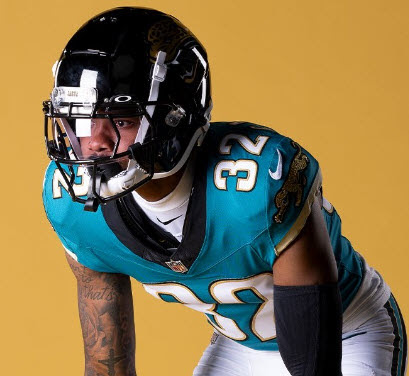
Jacksonville Jaguars Announce 'Prowler Throwbacks'

By John Turney


The club calls them "Prowler Throwbacks." and are supposedly based on the  According to the team they are based original 1995 expansion uniforms.

Well, they are close. They are based more on 1998 than 1995. In 1997 they changed the numbers but added black underarm panel and in 1998 they got it right by eliminating that. 


The first couple of years the uniforms had block numerals—


The 1997 rounded numerals and black panel jersey—


Then they settled on this in 1998 and this is what Jags have chosen as thee 1995 Throwback. 

No, they are not from 1995-96 or even 1997 but no matter, the ones from 1998 and after they debuted today are great—

Side note, click here for a good story about the 1997 preseason font by Paul Lukas, the home run king of sports uniforms.

He explains the problem with legibility for the changed number set and the change to what they replaced them with, which is what was the font they used today.


The Jags also brought back their original logo—

There is not much difference ... but might as well make the look complete, rather than mix and match throwback uniforms with the newer logo.


Regardless, there isn't a lot to say -- The Jags get an "A" for these. Goes to show classics almost always look great and these are no exception.

Well done.


Wednesday, July 17, 2024

Raiders Defensive End Mt. Rushmore

By John Turney 
When Hall-of-Fame defensive end Howie Long appeared recently on "The Rush With Maxx Crosby" podcast, he spent over an hour talking with Crosby and his co-hosts. But before he left, he was asked to name his Mt. Rushmore of Raiders' defensive linemen ... and he struggled to come up with an answer.

Instead, he rambled through all sorts of Raiders greats, few of whom were defensive linemen.

He rattled off Cliff Branch ... and Ted Hendricks ... and Jim Otto, Art Shell and Gene Upshaw, before eventually getting around to Greg Townsend, Reggie Kinlaw, Lyle Alzado and Chester McGlockton. After that, Crosby let him off the hook, and the segment closed. 

Or, so it seemed.

I'm here to finish the job by naming the Raiders' Mt. Rushmore of defensive ends, albeit with one important ground rule: The player must have spent a minimum of five years with the franchise. So that eliminates Alzado, Khalil Mack, Sean Jones and plenty of others, which reduces the field. 

But that doesn't make the job easier. I empathize with Howie. Limiting the answer to just four was a tough task. 

But here goes.

4. Greg Townsend—At first, Townsend played on passing downs. He would come into the game at left defensive end and immediately have an impact -- mostly because he was so smooth. At 240 pounds and with great speed, he could get upfield and befuddle NFL right tackles.

In that role, he averaged ten sacks a year but only 22 tackles.

Eventually, he became a starter and upped his game as he gained 30 or more pounds, added strength and acquired experience. In that role, he again averaged ten sacks a year -- or as many as when he was a designated pass rusher. However, his tackles per season average jumped to 50.

He'd become a complete player, taking down running backs as easily as he did quarterbacks.

In his Raiders' career, he was credited with a franchise-record 107-1/2 sacks, 25 forced fumbles and 46 passes defensed. Without question, he was one of the elite pure pass rushers of the 1980s and early 1990s. 

The TCU product was a four-time first-or-second-team All-AFC pick and went to two Pro Bowls. He was second-team AP All-Pro twice (1990-91) and in 1990 named first-team All-NFL by the NEA and Sporting News.


3. Ike Lassiter—You may not know this name, but you should. Lassiter was acquired from the Denver Broncos in 1965, stayed five years with the Raiders, then was off to the Patriots in 1970. But those five years are what matters because Oakland is where he played his best football.

As a Raider, he was a beast -- probably as accomplished a defensive end as there was in the AFL, and that includes teammate Ben Davidson, as well as Denver's Rich Jackson, the Jets' Gerry Philbin and Kansas City's Jerry Mays. They have gained more acclaim than Ike but not the production.

Lassiter was the Raiders' left end from 1965-69, and in 1967 -- when the Raiders set the then single-season record with 67 sacks -- he led the team with 17 (unofficially) and in his five years with the club averaged just over 12 sacks per season. According to Raiders' gamebooks, he also averaged 72 tackles a year in that span on a very good Raiders' run defense.

In my opinion, Lassiter was better than everyone in team history except the next two names you're about to read. Pretty good for a ninth-round pick (by the Rams) out of Saint Augustine’s University - an HBCU located in Raleigh, N.C.


2. Maxx Crosby—Yes, Crosby is already near the top of this list. Entering his sixth year, he's one of the NFL's top four edge rushers the last few years. But because he competes with others like Myles Garrett, Nick Bosa and T.J. Watt, he hasn't gained as many All-Pro notices.

He should.

He's playing in an era not unlike the mid-1970s when Carl Eller, Jack Youngblood, Claude Humphrey, L.C. Greenwood and Harvey Martin battled for a couple of All-Pro spots. That's one reason why Crosby's highest honor is second-team All-Pro, though he's been All-AFC the last three years, as well as a Pro Bowl invitee.

Plus, he has more time. He's only 26. So those numbers will increase.

His array of pass-rush moves is as complete as anyone in the NFL, with Crosby perfecting a highly effective inside swim move that has him get close to quarterbacks more often than most. According to the analytics company, Sports Radar, Crosby has been in the top two in QB pressures the past two seasons and was in the top 10 three years ago. 

According to Pro Football Focus, another analytics group, he was fourth in 2023, third in 2023 and first in 2023. Yet a third source, Sports Information Solutions, had Crosby first the past two years.

Bottom line: No matter the source, Crosby is at or near the top in pressures metrics. But even without the numbers, he passes the eye test. Just watch a game, and you can't help but notice his elite skills as he beats opposing tackles and zeroes in on quarterbacks.

"I don't know that there's anybody that puts it together quite the way you do," Long told Crosby on his podcast. "I really, really mean that." 

Crosby's also someone who plays all the time The last two years he's been on their field just over 95 percent of snaps. For this era, that is an astonishing number for a defensive lineman. Most teams rotate defensive fronts to keep them fresh.

Crosby is also solid vs. the run, with 89 tackles two years ago and 90 this past season. Like his snap percentage, his tackle totals are unusually high for a defensive end.  In his five-year career, he averages 74 total tackles a year and just under 10-1/2 sacks.


1. Howie Long—The man Crosby questioned on his podcast is someone he didn't name -- himself. But he was the best defensive end in Silver-and-Black land.

Young fans of today's game look at Long's career sack total, and think it pales in comparison to other Hall-of-Fame defensive ends like Reggie White and Bruce Smith, each of whom had more than double his total.

And they're right.

But then some go a step farther, suggesting he's not worthy of the Hall of Fame, and that's absurd. What they don't realize is that Long was a two-gap 3-4 defensive end, playing nose up on an offensive tackle much of his career. He didn't get to line up on the outside of a tackle and beat him off the edge. Instead, he had to push his opposing lineman into the backfield and read the flow of the play.

If it went to his right, he'd take the gap to his right. If the flow was to his left, he had the gap on his left. Ask anyone who had to play it: It was HARD.

His best chance to rush the passer was when the Raiders went to their Bandit, Pirate and Desperado packages, which were composed of four defensive linemen and five, six or seven defensive backs. In those sets, Long was a three-technique, usually to the right side where he gave guards ...  or a center and a guard ... fits.

Sometimes, however, he'd even play the nose position. That's when the Raiders used a Bear front, mimicking Buddy Ryan's "46" defense, so that he couldn't be double-teamed. In that front, the center had to take him one-on-one, and it often was a mismatch.

Long was an eight-time Pro Bowler and a three-time All-Pro. He was also the 1985 NFLPA AFC Defensive Lineman in the Year -- an honor based on a poll of his peers. AFC offensive and defensive linemen knew who was the best, and they put Long's name on the ballot most often.

These days, he'd be called a "DI" (defensive interior), but it doesn't matter what he's called. He was a load for opposing linemen, ending his career with 91-1/2 sacks, including a career-high 13 in 1983. No, it's not an overly high number, but had pressures been kept then, Long would have totals similar to other elite defensive interior players in today's league.