Tuesday, May 24, 2016

1963 Associated Press AFL and NFL Players of the Week

THINGS YOU CAN NEVER LAY YOUR HANDS ON
Complete Lists
By John Turney


Well, almost complete. We hesitated publishing this, the first of a new series, since we are missing one key award, Week 12, 1963 in the AFL. We simply have not been able to locate it. We think it exists, but for various reasons (a loss of a lot of data in a computer crash, and the ghettoization of Google Newspaper Archives to name two) we've quit looking. We are hopeful some astute reader who has access to online newspapers or even old microfilm will get interested and fill in the gap. But since this is one of only a couple holes in 11 years the Associated Press announced these awards we went ahead and are posting it.

The other gaps you see are weeks the AP did not release any awards. In 1963 it wasn't until Week 6 that they began the awards. In coming seasons, 1964 for example, they only went from Week 5 through Week 11. We couldn't begin to guess why. But eventually it became a weekly award and named some interesting, even esoteric names, which we like.

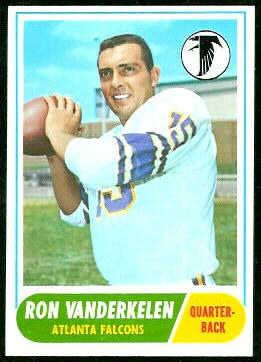
There are lots of players whose names you'd expect, but there are a few outliers. Bob Schmitz of the Steelers and Ron Vander Kelen of the Vikings. Schmitz, for example, scored a safety that provided the margin of victory for the Steelers. Vander Kelen came off the bench to lead the Vikings to a tie with the powerful 1963 Bears, who won the NFL title that season.

Schmitz is not the only defender to get the weekly award, Larry Wilson of the Cardinals won the Week 12 citation.

One note, the weeks on the chart are for the season week, which does not correlate with the date. The dates on the chart are the day the AP story ran, which was in the middle of the week, with the games being played on the previous Sundays (or Friday, Saturday or on occasion Monday).

So, with that explanation here are the 1963 winners, such as they are:

 Here is the AP story than crossed the wire on December 5, 1963 about Vander Kelen's day:


Note: Thanks to BD Sullivan of the PFRA who noted the Week 12 games in the AFL were cancelled due to the tragic assassination of President John F. Kenndy the prior week. 

Monday, May 23, 2016

Funny, Since Duane Thomas Was Always Fighting "The Man"

RETRO AD
By John Turney

"Listen to the man"?  Suuuure Duane. Glad we found this, I always wondered what brand those shoes were. Saw them from time-to-time in the 1970s. Didn't know what they were, now I know. They were officially licensed by the NFL, too. Wonder if their choice of spokesman hurt sales.


The 1980s Had Some Great Posters. This One Isn't Bad.

LOOKING BACK
By John Turney

In our ongoing series we've looked at and posted some odd posters. Here is another. And another. Some were better than others. Here we look at one that isn't bad.

At least it makes the offensive line look a lot better than this one does:
Yikes!


Sunday, May 22, 2016

Short Yardage Specialists Through the Years

LOOKING BACK
By John Turney
While this is not an exhaustive list, it is composed of the players we feel filled the role of a short yardage back from the time we first noticed the role being used commonly in the NFL.

While it was certainly not begun in 1973, it was a year in which we could find players who had fewer than 100 carries, a good percentage of them being touchdowns, very few starts and a very low yards per carry average. We remember seeing most of them play.

Many of the great backs were never taken out of the game on short yardage and goal line. Jim Brown was his own short yardage back, as was Dickerson, Payton, Faulk. About the only great back taken out of games consistently on short yardage and goal line was Barry Sanders.

Some teams, back in the day and still to this day, used a quarterback as the short yardage back. Jack Kemp was never shy about calling his own number. Roman Gabriel was sometimes led his team in rushing touchdowns for a season. Tom Brady is still an excellent short yardage ball carrier if it's less than a yard to go.
But we were not looking for those players, we wanted to look at the specialists. Not the greats, not the quarterbacks or even the starting fullbacks. Specialists in the same vein as nickel backs or designated pass rushers.

Here are our lists and in the comments we will name who might have been the "All-Pro" for this position through the years.
Robert Holmes was an effective, powerful short yardage back for Kansas City and with the Chargers, in 1973, he filled the role of short yardage well. He's our Second-team pick. Touchdown Tony Baker was the power back in the 1973 record-setting Rams backfield. He entered the game in short yardage and goal line situations and, like Holmes, scored seven touchdowns. On the 41 occasions, Baker carried the ball less than 4 yards to go, he converted 28 of them. He's the First-team All-Pro.

For 1974 our choices are Banaszak for First-team and Baker for Second-team All-Pro. The following season Don McCauley is the First-team All-Pro and John Cappelletti, who took over Baker's role as a SY specialist is Second-team. McCauley will appear again and again and what is interesting is that he had duel roles for the Colts in this era. He was the SY guy as well as the 3rd down back, averaging over 40 catches a season from 1976 through 1981. McCauley wasn't a big, bruising back like Baker or Holmes, but he seemed to have a nose for the end zone, averaging seven touchdowns a season from 1975 through 1979.
In 1976 Seattle's Hugh McKinnis is the Second-team All-Pro behind McCauley.

Pete Banaszak and McCauley are so very close in 1977 but we will go with Banaszak as First-team and McCauley Second-team. Banaszak carried the ball 14 too many times in 1976 or he would have been the Second-team layer rather than McKinnis. Additionally, in 1975 Banaszak carried the ball a lot due to injuries to other fullbacks so he got "starters minutes" that season but he proved his worth totaling 16 rushing touchdowns but had too many carriers to qualify as a specialist.

In 1978 the First-team All-Pro short yardage specialist is Hank Bauer and the backup All-Pro is McCauley. Bauer's eight rushing touchdowns put him over the top.

The following season we are going First-team with Bauer (8 TDs in 22 rushes) and Tom Newton of the Jets for Second-team. 
Arnold Morgado gets First-team nod in 1980 over Mosi Tatupu of the Patriots. It wasn't a stellar year for the position, but these two were most effective. In 1981 Johnny Davis is First-team over Roosevelt Leaks of the Bills, who gets the backup nod.

The 1982 strike year skews everything so we are going only with Johnny Davis's 1 touchdown in four carries for the Second-team. Seems fitting since the sides couldn't work out a deal that season. Frank Hawkins of the Raiders is the First-team pick.

In 1983 we are choosing James Owens as First-team and Larry Kinnebrew for the Second-team.

Huge Pete Johnson personified the role of Jets Tony Paige is the Second-team All-Pro behind Johnson.
short yardage specialist in 1984. His twelve touchdowns (none were one yard, one was two yards and two were three yards) tops all players in this role, likely since 1950, which is as far back as we looked. Oddly, this was Johnson's last season. The
Paige is the Second-team pick in 1985 as well, behind the Dolphins Ron Davenport who tallied 11 touchdowns in the "Johnson" role.

Buford McGee of the Chargers is the only player we found with significant numbers in 1986. Ottis Anderson, who played with both Giants and Cardinals is the Second-teamer.

In 1987 we are going with Robb Riddick for the First-team and Brent Fullwood as Second-team All-Pro SY specialist.

Giant Ottis Anderson is a clear First-team All-Pro specialist in 1988 and Robb Riddick is Second-team, though you could make the case he was more effective than Anderson. Riddick had over the maximum carries (111) but his 12 TDs made up for the time he spent outside the short yardage rule. Roddick was a smaller (195) back and spent considerable time in the base offense as Thurman Thomas's backup.

Big, pounding Cardinal Tony Jordan is an honorable mention. Jordan moves up to the First-team in 1989 and former bear starter Matt Suhey is the Second-team All-Pro, though neither really scored enough touchdowns to satisfy us, so it was not a great year for this role.

Mel Bratton of Denver is the First-team All-Pro in 1989 and Leroy Hoard is the Second-teamer. Long time back Gerald Riggs, in his final season adopted the SY role and excelled with 11 touchdowns (he also did a great job running down and covering kickoffs). He's an easy choice for First-team All-Pro for 1991. Vince Workman of the Packers is his backup.

In 1992 Eric Bieniemy, small for the role, is the First-team pick and Denver's Greg Lewis is the Second-team All-Pro.  Rodney Culver is First-team in 1993 and Napoleon McCallum is next. McCallum didn't have the classic body type, but he, in some ways, mimicked how Marcus Allen ran in short yardage.

In 1994 two Derricks, Moore of Detroit and Clark of Denver are First- and Second-team, respectively.

In 1995 former Charger starter Marion Butts took the SY role for the Oilers and garners a First-team selection by us.  Rodney Culver is the Second-team selection. Ki-Jana Carter is the sole selection in 1996.

For 1997 Leroy Hoard is the First-team pick and Lamont Warren is the Second-team choice.

Mario Bates is the top selection and Touchdown Tommy Vardell is the backup. Vardell violates our criteria since he was the starting fullback, but he did this enough, we felt an exception was warranted

In 1999 Bates repeats as First-team and Zach Crockett is the Second-teamer. Crockett is elevated to First0-team in 2000 and his backup is the Chiefs Frank Moreau. Crockett repeats as First-team in 2001 and the Second-teamer is Raider teammate Tyrone Wheatley. 

Zack Crockett is, for the third consecutive year, the First-team SY specialists in 2002 and the Colts James Mungro backs him up.  Crockett gets yet another First-team All-Pro pick in 2003 and is backed up by Arlen Harris who filled in for a sore-kneed Marshall Faulk in the Rams Sy packages.

Greg Jones is top SY player in 2004, backed up by Ron Dayne. In 2005 Jerome Bettis is the First-team pick and Brandon Jacobs is the Second-team player with Mike Alstott honorable mention
Marcel Shipp gets the First-team in 2006 and is backed up by T.J, Duckett. Reuben Droughns is First-team in 2007 and fast (for his size) Samkon Gado is the Second-team pick. T.J. Duckett is top dog in 2008, followed by BenJarvus Green-Ellis.

Chris Brown of Houston is First-team in 2009 and Donald Brown of the Colts backs him up. 

In 2010 Javarris James of the Colts is a classic 46 carries, 112 yards, and a 2.43 average and six touchdowns, easy First-team All-Pro choice. John Kuhn was the starting fullback for the Packers, but in 2010 he started only two games and scored four short-yardage touchdowns. As the roles conflate it gets harder to meet our original criteria, so we go with Kuhn for the Second-team.

2011 brings Kuhn to the First-team. Kuhn had 3 starts, 30 carries 78 yards, a 2.60 average, and 4 touchdowns. We love those numbers. Anthony Dixon of the 49ers is his backup,

For 2012 Jamie Harper of the Titans had 19 carries for 30 yards and 3 touchdowns. He's the Second-team pick. Mike Tolbert had a duel role, like Kuhn, as a lead blocker and SY specialist. He's the First-team pick. The next year, 2013, the First-team pick is Knile Davis of the Chiefs and Michael Bush of the Bears is the Second-teamer. The 2014 season's First-team pick is Chris Polk of the Eagles and the Second-teamer is Benny Cunningham of the Rams. Finally, in 2015 the picks are: First-team Khiry Robinson of the Saints and the Second-team pick is James White of the Patriots.

Saturday, May 21, 2016

1965-1975 All-Mid-Decade Teams

OPINION
By John Turney

A couple of months ago we chose a  2005-2015 All-Mid-Decade Teams and a 1995-2005 team  as well as  1985-95 and 1975-85  to represent the best players from that era, realizing that just an All-Decade team that began in 1960, 1970, 1980, etc., was a bit arbitrary.

Now, here is our 1965-1975 All-Decade team:

Centers were easy, though both Otto and Tingelhoff got most of their honors in the 1960s, they were still excellent players into the early to mid-1970s.  Bob DeMarco, Jon Morris, Len Hauss,  and Forrest Blue get a mention due to their own honors (which were hard to come by with Otto and Tingelhoff in the league at the same time). Blue was a steady All-Pro with the 49ers then after he left, then nothing. A curious career.
Jim Otto
Mick Tingelhoff
Tom Mack and Gene Upshaw lead a large group of guards of which several could be Second-team selections over our choices of Budde and Sweeney. Among them (all honorable mentions) are Gene Hickerson, Larry Little, and Gale Gillingham. In fact, Little, though mostly associated with the 1970s did start in the 1960s and was good. But his impact was in the 1970s.

Gene Upshaw
The tackle position has good players, but it wasn't as deep as the guards. Tyrer and Brown (1964-73 is his "decade") are the top two tackles. Ralph Neeley had to move to left tackle to make way for Rayfield Wright and that interrupted his string of All-Pro selections but he was still solid on the left side after being All-Pro on the right. Winston Hill gets the other Second-team slot over Charlie Cowan, who is an honorable mention as is Ernie McMillan and Norm Evans. Hill, Cowan and McMillian both played left- and right tackle in their careers and were honored at both.
Jim Tyrer
Bob "Boomer" Brown
Winston Hill
Jerry Smith is an honorable mention behind Jackie Smith and Charlie Sanders.

For both 1965-74 and 1966-75, Fran Tarkenton is the most honored (though by a small margin) and has the most passing statistics in terms of yards, completions, touchdowns, and wins. Namath gets the Second-team pick due to his impact, skill set, and Super Bowl win. Honorable mentions are many: Roman Gabriel, John Brodie,  Bob Griese, John Hadl, Len Dawson and Sonny Jurgensen. Gabriel was close to Tarkenton in wins and in passing statistics, he also was an MVP. He's the first runner-up.

Namath, Gabriel, Tarkenton
Brodie was All-Pro in 1965 and 1970 and was an MVP in 1970. Griese came a bit later but was a Super Bowl-winning quarterback as was Dawson, though he and Jurgensen were winding down and sharing playing time in the early-1970s. 

Kelly and Little are the RBs with Csonka and Brown behind them, It should be noted that the carryover from the 1960s talent affected the selections here. Running back is a good example. From the floating decade we use, (anything from 1964-73 to 1965-74 or 1966-75) Gale Sayers is All-Pro the most (Five times). More than any of our four selections. Next is O.J. Simpson with four All-Pro selections. From 1966-75 Simpson is the leading rusher with over 8200 yards. From 1965-74 he is second. Thus, it could be argued that Sayers and Simpson could be the picks for this team. However, we chose to put players with shorter careers into the decade they most fit and the 1960s fit Sayers and the 1970s fit Simpson. 
Leroy Kelly
Floyd Little
Larry Csonka
Larry Brown
In fact John Mackey, Lance Alworth, Don Maynard, Herb Adderley, Dick LeBeau, Johnny Robinson
and Larry Wilson and others are qualified for this team in terms of years of service and honors. But they are so ensconced in 1960s lore that we really felt they were 1960s players even though they have several years in the 1970s. None had overly long careers like a Mel Hein that would fit with putting them on two All-Decade teams in a row. So, if folks object, please comment. It was a tough decision, but the purpose of this exercise is to recognize the players who were overall the best in the 10-year periods we've designated. However, we would love to hear opposing views.

Charley Taylor and Paul Warfield are the top WRs. We feel like Taylor fits here and not on the 1960s teams he often chosen for. Fred Biletnikoff is in the same boat in our view. Bob Hayes and Otis Taylor tied for the last spot. 
Charley Taylor
Fred Biletnikoff
Bob Hayes
Paul Warfield

Deacon Jones and Eller were the top honors guys. Jones had most sacks. Eller had 86 sacks from 1965-74 and 86½ from 1966-75. He was All-NFC in 1975 so his decade is the latter. Second-team is Paul Zimmerman's favorite, Rich "Tombstone" Jackson. He had a short career due to a late start and a severe knee injury. He only had 43½ sacks in this decade but was considered, in his prime a top run defender and excellent pass rusher. He was part of a great run defense in 1970 with the Broncos who also sacked the QB 50 times. He was All-AFL in 1968-69 and All-Pro in 1970 and All-AFC in 1971. 

Carl Eller
Deacon Jones
Claude Humphrey edged our Gerry Philbin (short career), Bubba Smith (short career) and Verlon Biggs (93½ sacks from 1965-74). Humphrey began late (1968) and missed 1975 with an injury but we felt his impact early qualified him for this team. However, he would likely be a Second-team selection for the 1970s as well.  We also give Bill Stanfill and Ron McDole and honorable mention as well.
Rich Jackson
Bubba Smith
This is where Olsen and Lilly fit. Not the 1970s when they both were on the Official All-Decade Team. They also fir in the 1960s as well. Buck Buchanan was in his prime here, too. We tied Page and Greene, and they would 100% be the tackles for any 1970s team, too. Their impact was pretty amazing in the early 1970s. Manny Fernandez, who played both end and tackle, is an honorable mention.
Bob Lilly
Merlin Olsen
Buck Buchanan
Joe Greene
Alan Page
Again, this is THE Butkus decade. When some pundits take and "AP only" approach to awards we always point to Butkus. When the AP Defensive Player of the Year award is listed in an article as the only DPOY Award we ask "How many times did Butkus win it?". Answer: Zero. It wasn't created until 1972. But, Butkus did win two NEA Defensive MVP Awards (1969 and 1970). To us, that ends the "AP only" school of thought on All-Pros and Awards. 


Backing up Butkus is Willie Lanier and honorable mentions Tommy Nobis, Nick Buoniconti and Lee Roy Jordan. Mike Curtis is also an honorable mention. Curtis was an excellent middle linebacker and outside linebacker and was honored at both positions, like Renfro and Green.

Bobby Bell is similar to Butkus in that this is his "decade". We pair him with Chuck Howley.  Backing them up is a trio of Hall of Famers: Dave Wilcox, Chris Hanburger and Dave Robinson. Honorable mentions are Andy Russell and George Webster.
Bobby Bell
Chuck Howley
Dave Wilcox
Willie Bown and Jimmy Johnson are the top corners followed very closely by Lem Barney
and Emmitt Thomas. Pat Fischer is an honorable mention.
Willie Brown
Jimmy Johnson
Lem Barney
Emmitt Thomas
Ken Houston and Paul Krause are the safeties. Dick Anderson backs up Houston at strong safety. Renfro was a safety from 1964-69. Then, he was a very fine cornerback from 1970 through the rest of his career. We put him at safety. It was either that or put Cornell Green (who switched positions with Renfro) who got honors at both positions, as did Renfro. Carl Lockhart is an honorable mention at safety.
Ken Houston
Paul Krause
Dick Anderson
Mel Renfro
Stenerud fits here (as he does in a few decades) and Jim Bakken is next in honors and kicking percentages. Bakken beat out Jim Turner, Fred Cox, and Don Cockroft who were right on Bakken's tail in terms of percentages and honors. George Blanda, though he didn't have the kicking numbers as the others was a clutch kicker and his kicking prowess, in part, was why he won the 1970 AFC Player of the Year Awards. He gets an honorable mention and it could be argued he deserves the Second-team slot over Bakken.
Jan Stenerud
Jim Turner, honorable mention
Wilson and Lee were the top punters, though they seemed to have quite a few punts blocked.
Jerrel Wilson

Return men were based mostly on touchdowns and average since All-Pro teams rarely recognized return men in this era. Alvin Haymond is our special teams demon. He was the head of the Rams "Haymond's Headhunters" featured on the cover of Life magazine in 1971. Ceasar Belser was also an excellent bomb squad man.

Agree? Disagree? Post in comments section below