By John Turney 
We hear from the analytics crowd quite often that the NFL MVP has to be a quarterback because that position has the most "value". As if they invented that concept.
Though it may have been written before Buddy Parker wrote that in his book in 1955 We Play To Win!. He did use the work valuable he said "important'. However, the gist is the same.
That said, over the years plenty of running backs have been voted the MVP or Player of the Year (the nomenclature United Press (later United Press International) chose, though the award was the same). Remember the Associated Press (AP) started with "outstanding Player" then changed to "Player of the Year" then in 1961 Changed to Most Valuable Player (MVP), then changed back to "Player of the Year: in 1962 before permanently going with MVP from 1963 to the present. Understand this: The award was the same regardless of what they called it. The Newspaper Enterprise Association called it MVP two years before the AP started giving out an award.
The NEA, UPI, and AP were the big three that were recognized by the Offical NFL Record and Fact Book which is the official yearly record book published by NFL.
Later the Pro Football Writers of America (PFWA) began choosing an MVP and along with the Sporting News, those are the major awards accepted by the NFLPA and also by Total Football: The Official Encyclopedia of the NFL. Note the word "official" in the title.
With that background, the first MVP award will be the PFWA in mid-January but the most publicized is the AP MVP award with the hoopla of the NFL Awards show. Sp, mainly we are speaking of that, though try as it might, it is not an official award. It is just the one that is picked up by the most media outlets and gets the most discussion and the votes are released, unlike the PFWA. It should be noted that since 2004 the AP and PFWA have been sympatico in their selections.
Now, to the nitty-gritty.
Usually, and especially recently the award does go to a quarterback. The last running back to get the award was Adrian Peterson in 2012 (30.5 of 50 votes). Since then all running back combine have received a total of 16 votes.
This year could be different for a few reasons.
Through maybe 2/3 or 3/4 of the season Kyler Murray was the favorite and Tom Brady was close. Both of them played themselves (in our view) out of it this past weekend.
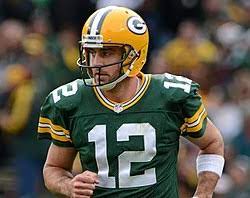 |
| Aaron Rodgers |
That leaves Aaron Rodgers as the top-ranking quarterback in our view with maybe a couple of comers.
However, Rodgers' deceptive (or to use the script from "The Natural"—a canard, a prevarication, a lie) answers about his vaccination status and then his COVID illness, missing a game undoubtedly left a bad taste in some voters' mouths in our view.
Additionally, in an era where MVP quarterbacks throw 40 or more touchdowns routinely, Rodgers, unless he really goes off, may end up with who knows- 32, 35? Sure, he could reach 40 but he may not play all the final games. If the number one seed is locked up he will all assuredly rest. He will likely pass 4,000 yards but likely not by much.
Our point is it is an excellent season, but is it the stuff of recent MVPs? It's close, but is it? The voters have to decide and with the COVID baggage that puts a drag on his candidacy, he is not a sure thing.
There are other QBs. Matthew Stafford perhaps, but he played himself out of it on his three-game losing streak when he and his offense kept throwing pick 6s and turning the ball over deep in their opponents' territory and running up garbage yards and points in those. He'd had a Pro Bowl year but MVP? Not really. In other games, he's been really terrific.
Jared Goff used to lead the Rams to 10-4 records. That is where Stafford is now.
Mahomes? Allen? Herbert? All really great years but do they check all the boxes for MVP? Maybe Mahomes who is coming one but they all would need to do a lot in the next few games to make their case.
Now, who else?
Jonathan Taylor is very interesting. There have been other running backs in the last decade who have had great years, but as we mentioned all of them combined have gotten about half the votes that Adrian Peterson did in 2012. The higher vote-getter was Todd Gurley in 2017 with eight. he hurt himself some by going down inside the ten a couple of times to run the clock out rather than score a touchdown so his final numbers were dinged, but he had no chance really.
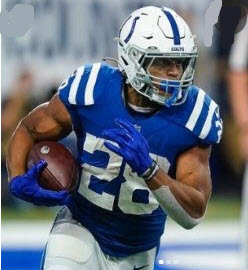 |
| Jonathan Taylor |
Derrick Henry was kind of like Taylor last year—a running back who an offense was built around that was dominant in it. The question is this: IS Taylor that dominant—MVP dominant.
As of now, he has 1,518 yards and 17 rushing touchdowns in 14 games. He will be leaned upon a lot in the next three games if the Colts are to push into the playoffs and make their seed as high as possible. It is possible, but not likely he will surpass 2,000 yards. But 1900 yards and 20+ touchdowns is quite reasonable. He also is averaging 5.6 yards a carry and has decent receiving numbers. Not stellar, but decent.
If he does those things and the Colts make the playoffs it will be because of him by and large. That would make him a very strong alternative to any quarterback in our view.
Next up is Cooper Kupp.
The last wide receiver to win a major award was Jerry Rice in 1990 when he was the Sporting News Player of the Year. But if you don't like that one he was the PFWA and NEA MVP in 1987. John Elway was the AP winner garnering 36 votes, Rice had 30.
Jerry Rice the 1987 consensus MVP winning two of the accepted MVP awards that year no matter what the "AP only" crowd thinks. Rice was the MVP.
There had been some winners before but they were far and few between. Harlon Hill (NEA-1955), Lance Alworth (AFL UPI-1963), Gino Cappelletti, (AP/UPI 1964). Cappelletti doubled as a kicker and led the AFL in scoring that season. The NFL's Official MVP went to Don Hutson in 1941 and 1942 so there is that as well.
 |
| Cooper Kupp |
So, what would Kupp have to do in order to crack the wide receiver glass ceiling for MVP?
Right now he's leading the NFL with 122 catches and 1,625 yards and 14 touchdowns. He is likely to win the receiver triple crown. But Steve Smith did that in 2005 and he was not even considered. But his numbers were lower in sixteen games than Kupp's in 14. So there is that.
Kupp is on pace to be very close to breaking the NFL record for receptions. However, in our view, that's a bit dubious because the NFL season is now 17 games (NFL records should be on a per-game basis in our view). So, will that matter to voters? Unknown. But a total of 140-150 receptions is still amazing, record or not.
He's also on pace for 1973 receiving yards. Again, would be a record. Again, with the 17-game caveat. If he gets 17 touchdowns that will not be as noteworthy since the record is 23.
The eye test for Kupp should also be considered. If you've seen him play you'd know his receiving skill set is certainly top-notch, but his high level of blocking and running after the catch has bailed out the Rams offense in every game, several times a game. Those kinds of intangibles should be part of the mix as well.
Kupp also got a nice compliment from Shannon Sharpe, though not an endorsement for MVP—

It will be interesting to see if the rareness of the achievements are considered in the MVP race. By that we mean Kupp's achievements, whether they break records or not are rarer, from a historical perspective than either Taylor's or Rodgers'. The numbers of 140+ catches and 1900+ yards and 17+ TDs are just not as common (if achieved) as 1900 yards rushing and perhaps 18-20 receiving TDs.
What if it were (to use round numbers) 150 catches, 2000 yards, and 20 TDs? Would that do it and break the ceiling? Once again, unknown.
That is not to denigrate Taylor's season it's just counting up the number of times, even on a per-game basis the numbers have been reached. the same is true for Rodgers, and the rest of the QBs mentioned, this is unless someone goes off the next three weeks.
In communicating with people in the know it seems like Kupp has the longest row to hoe. Taylor seems like he has a legitimate shot. Rodgers is tainted but still is likely the front-runner. The rest need big holiday seasons to leap Rodgers and Taylor.
It will be fun to have a race where the winner is not clear and obvious like basically the last decade or more. We have not had a close vote in the AP MVP voting since 2005. This year promises to be like that unless big changes occur in the next three weeks.