Showing posts sorted by date for query ROBERTSON. Sort by relevance Show all posts

Friday, October 23, 2026

Lawrence McCutcheon: The Quiet Engine of the 1970s Rams Passes Away

By John Turney 
Lawrence McCutcheon in 1969 (l) and 1977 (r)
Lawrence McCutcheon, the durable running back who powered the Los Angeles Rams' ground game through the mid-1970s and later spent more than three decades in the franchise's front office, died Friday. He was 76.

His family said McCutcheon, known as Clutch, passed away on October 23 with family at his bedside after a long battle with Parkinson's disease."It is with great sadness that we share the passing of our husband, brother, father, grandfather, and great-grandfather, Lawrence McCutcheon," the family said in a statement. "

"The Los Angeles Rams are deeply saddened by the passing of Lawrence McCutcheon," the team said in a statement. "His impact on this organization spanned generations, and he embodied what it means to be a Ram ... his legacy is woven into the fabric of our team. We extend our heartfelt condolences to the McCutcheon family as we celebrate a life that gave so much to the Rams and to our game."

Through a decade-long playing career and another 32 years in the Rams' front office, Clutch "earned the respect and admiration of teammates, opposing players, colleagues, and fans alike," added the Rams franchise, and it rings true since he was the Rams' best skill position player of the mid-1970s. For the Rams fans of that era, Clutch will be remembered forever.

Born and raised in Plainview, Texas, McCutcheon saw himself as an ordinary kid rather than a standout rural athlete. That changed when he moved from Booker T. Washington High School in Houston to Plainview High for his senior year. He found the new environment "pretty pleasant," and it did not hurt his play: the Bulldogs went 7-3 in 1967 and then won seven games in each of the next two seasons.

 Playing against higher-level competition regularly, he said, gave the local kids a better chance to be seen by college scouts which happened with his oppotunity to play at Colorado State University in Ft. Collins. There, McCutcheon established himself as one of the premier running backs in Colorado State history. 

He played three seasons in the Western Athletic Conference and became the first CSU player to rush for 1,000 yards in a season—doing so twice. 
McCutcheon at Colorado State
In 1969, he rushed for 797 yards and nine touchdowns at 5.5 yards per carry and became the first Ram to gain more than 200 yards in a game (213 against Wichita State) and was awarded with second-team All-WAC honors.

As a junior in 1970, he ran for 1,008 yards and added 486 receiving yards (1,494 yards from scrimmage), earning honorable-mention All-American recognition from the Associated Press while ranking fourth among the national leaders in yards per game and was elevated to first-team All-WAC

In his senior year of 1971 he carried 261 times for 1,112 yards and eight touchdowns and earned first-team All-WAC honors once again. He finished with 2,917 rushing yards, 67 receptions for 838 yards, 3,755 yards from scrimmage, and 27 total touchdowns. A three-year letterman, he remains in the school record books for running backs, is a member of the CSU All-Century Team, and was inducted into the Colorado State Athletics Hall of Fame.
McCutcheon in 1972 preseason
A third-round pick of the Rams in 1972, McCutcheon saw limited regular-season action as a rookie, spending most of it on the taxi squad (the forerunner to today's practice squad) but played extensively in the preseason, where he was said to have a fumbling problem and it landed him in Rams coach Tommy Prothro's doghouse and he only played three games in the season and didn't carry the ball at all. McCutcheon felt he wasn't part of the team and did think surgery on a knee he hurt in college affected him. 

But then things changed for the better,

When Head coach Chuck Knox arrived in 1973, he reviewed the '72 preseason film and concluded McCutcheon could be his starting fullback. He was correct. In the 1973 preseason, McCutcheon earned the starting job.

Even though there was still a fumbling problem, it was soon corrected. Rams great Tank Younger, then a Rams' scout, taped into a handle to a football and presented it to McCutcheon as a reminder to hold on to the ball. Lesson learned, problem solved.

McCutcheon led the Rams in rushing for five consecutive seasons (1973-77), earning a Pro Bowl selection each year. He also prided himself on being a complete back, one who runs, catches and blocks, attributing it to why he became a starter in 1973.

In 1974, he told the press about his success: "All it takes is quickness and blocking," he said. "If you have our kind of blocking and my kind of ability, you should gain 1,000 yards every year. Quickness is the ability to hit between the blockers as soon as the hole starts to open. Speed only help on end runs."

Going on, "A back might have 9.6 speed and still not be a good inside runner because he isn't a particularly fast starter. But quickness, the ability to accelerate, is the key ingredient."

McCutcheon feels his ability to block and catch passes also impressed Knox. "On a pass play, a running back is always single-covered. It's the only opportunity I have to go one-on-one against a defensive man. On running plays, it's 11 against one." 
1973
He was a first-team All-Pro selection by the Newspaper Enterprise Association (NEA) in 1974 and a second-team NEA All-Pro in 1973, while also earning first- or second-team All-NFC honors throughout the 1973-77 stretch. 

McCutcheon produced four 1,000-yard seasons in that span, peaking at 1,238 yards and seven touchdowns in 1977. In the 1975 playoffs, he rushed for 202 yards against the St. Louis Cardinals—the second-highest total in pro football history at the time—helping the Rams to a 35-23 victory. 

In 1976 Knox moved him to halfback; over the next two seasons he averaged just over 1,200 rushing yards and ranked in the top five in Proscout, Inc., evaluations. Injuries later limited his production but had a final hurrah by throwing a halfback option pass in Super Bowl XIV in a 31-19 loss to the Steelers.

With the Rams, he carried 1,435 times for 6,186 yards and 23 touchdowns. For a period, those totals made him the franchise's all-time leading rusher; he now ranks fourth behind Steven Jackson, Eric Dickerson, and Marshall Faulk. 

In the postseason, he rushed for 687 yards, fifth-most in NFL history at the time of his retirement after the 1981 season. He also added 184 receptions for 1,683 yards with the club and appeared in 11 postseason games, including Super Bowl XIV, where he threw a 24-yard touchdown pass to Ron Smith that briefly gave the Rams the lead.

During his 1973-77 peak, he rushed for 5,523 yards; only O.J. Simpson gained more on the ground in that five-year window. His 7,029 yards from scrimmage in the same span ranked behind only Simpson, Lydell Mitchell, and Chuck Foreman.
McCutcheon in 1980 and 1981 with Broncos, Seahawks and Bills
In 1980, the Rams traded McCutcheon to the Denver Broncos, where he was expected to bolster the running game. That did not materialize, and he was released during the season and signed with Seattle for the remainder of the season. 

In 1981, he signed with the Buffalo Bills and was reunited with Knox, who employed him as a backup and as one of "his guys"—a group of players who had performed well for Knox in Los Angeles, including Isiah Robertson, Bill Simpson, Ron Jessie, and others.

After his playing days ended, McCutcheon returned to the Rams organization as a scout. He rose to director of player personnel, a post he held from 2003 until his retirement in 2016, giving him 42 years with the franchise.

In the end, McCutcheon’s career embodied the unglamorous virtues he himself described: quickness into the hole, reliable blocking, and good hands rather than pure speed or raw power. He wasn't going to bowl anyone over like an Earl Campbell or run away from someone like an O.J. Simpson. He was a workhorse, steady, strong and one who would get you a first down; it might not look spectacular, but it was reliable. 

Those same traits carried him from Texas to the Colorado State backfield through 42 years with the franchise—on the field and later in the front office—leaving the Rams organization and its fans with a lasting standard of steady, professional production.

He will always be a Rams legend and will be missed.

Tuesday, September 23, 2025

Senior Player Nominees Announced for Pro Football Hall of Fame Class of 2026

 By John Turney 
A couple of weeks ago, the Pro Football Hall of Fame released the preliminary list of 162 players nominated for the Hall's Class of 2026 in the Seniors category.

Here is the list with some brief commentary.

Quarterbacks (9): Ken Anderson, Charlie Conerly, Roman Gabriel, John Hadl, Jack Kemp, Don Meredith, Earl Morrall, Jim Plunkett, Doug Williams

Ken Anderson has had most of the momentum. He played 16 years and six or seven were good, and maybe four were elite, including his 1981 MVP campaign. I'd think he has a good chance to be a finalist.

Conerly, Gabriel, Morrall and Kemp also had MVP seasons in the NFL or AFL accepted by media organizations. Kemp, Plunkett and Williams started for league champions and Hadl was a backup for an AFL champion.


Backs/Running Backs (16): Alan Ameche, Ottis Anderson, Larry Brown, Earnest Byner, Roger Craig, John David Crow, Chuck Foreman, Cecil Isbell, Verne Lewellen, Jack Manders, Mercury Morris, Don Perkins, Billy Sims, Herschel Walker, Byron "Whizzer" White, Paul "Tank" Younger

Some new names here. My personal favorites are Larry Brown, Craig and Foreman among recent backs. But who I would most like to see advance to the pinnacle of the HOF process is Verne Lewellen. He was one of the best players of his era, at any position and checks all the boxes.


Ends/Wide Receivers/Tight Ends (30): Fred Arbanas, Todd Christensen, Mark Clayton, Ben Coates, Gary Collins, Isaac Curtis, Carroll Dale, Lavvie Dilweg, Boyd Dowler, Mark Duper, Henry Ellard, Jimmie Giles, Charley Hennigan, Billy Howton, Harold Jackson, Keith Jackson, Billy "White Shoes" Johnson, Brent Jones, Homer Jones, Steve Jordan, Eric Martin, Stanley Morgan, Jay Novacek, Art Powell, Del Shofner, Lionel Taylor, Otis Taylor, Rick Upchurch, Bobby Walston, Billy Wilson

Like Lewellen, I am for Lavvie Dilweg to get a bust one day. Both have similar credentials and were teammates in the late 1920s and early 1930s.

Among the recent receivers, Del Shofner and Art Powell stand out in my eyes. Powell was close a couple of years ago but was voted down at the last moment. The major 'knock' was that his best seasons were in the early AFL, and many think the level of competition was not as high as it was later in the decade of the 1960s. Shofner was a five-time first-team All-Pro, but after his elite seasons, he kept getting hurt and didn't compile a pile of numbers like some of the others.

Harold Jackson and Stanley Morgan are mentioned a lot and have strong supporters on social media. Among tight ends, Todd Christensen has folks pushing for him. All excellent players, but their peaks, to me, don't match Shofner and Powell.


Offensive Lineman (35): Heartley "Hunk" Anderson, Bruce Armstrong, Stew Barber, Dick Barwegen, Ed Budde, Ox Emerson, Gale Gillingham, Charles "Buckets" Goldenberg, Ken Gray, Dennis Harrah, Jay Hilgenberg, Chris Hinton, Joe Jacoby, Mike Kenn, Bob Kuechenberg, George Kunz, Riley Matheson, Max Montoya, Jon Morris, Ralph Neely, John Niland, Bart Oates, Marvin Powell, Duane Putnam, Dick Schafrath, Jerry Sisemore, Doug Smith, Walt Sweeney, Bob Talamini, Fuzzy Thurston, Jim Tyrer, Bob Vogel, Ed White, Ray Wietecha, Al Wistert

My first choices would be Al Wistert and Ox Emerson. The Blue Ribbon committee that will narrow this list of 162 to 50 advanced Wistert last year, but not Emerson. I am hoping for both this year to make the next round.

The more modern linemen that I will support are Mike Kenn, George Kunz and Joe Jacoby. Jim Tyrer had his shot last year, and it seems the opposition to how his post-NFL career went is too strong to be overcome. 

Defensive Lineman (15): Houston Antwine, Gene Brito, Roger Brown, Earl Faison, Mark Gastineau, L.C. Greenwood, Ed "Too Tall" Jones, Jim Marshall, Leonard Marshall, Harvey Martin, Jerry Mays, Tom Sestak, Fred Smerlas, Neil Smith, Bill Stanfill

There are maybe a few types of players in this position group. First, guys with high peaks and short/shorter careers, i.e., generally guys who left a lot on the table or may have been felled by injuries. Those are Brito, Faison, maybe Roger Brown, Faison, Tom Sestak and Bill Stanfill.

Then there are the players with longevity, but didn't have as high a peak as the first group. Antwine, Greenwood, Too Tall, Jim Marshall, Martin, Smith and Mays.

Fred Smerlas had a high peak and also played for a long time. But he never gets much traction, being a nose tackle. 

If I could pick three, it would be Smerlas, but also would include Brito and Sestak.

One thing that strikes me is that this may be the strongest position group here, from top to bottom.

Linebackers (25): Carl Banks, Maxie Baughan, Cornelius Bennett, Bill Bergey, Matt Blair, Mike Curtis, Joe Fortunato, Larry Grantham, Tim Harris, E.J. Holub (also OL), Vaughan Johnson, Lee Roy Jordan, Seth Joyner, Greg Lloyd, Wilber Marshall, Rod Martin, Clay Matthews Jr., Bud McFadin, Karl Mecklenburg, Matt Millen, Tommy Nobis, Isiah Robertson, Pat Swilling, Darryl Talley, Keena Turner

Like the defensive linemen, this is a deep group. But in this group, it seems like the players with longevity get my preference. Baughan, for instance, is one of them. Clay Matthews as well.

But there are some all-around linebackers that I love here, but they seem like they will have a tough route to Canton. Bennett, Blair, Grantham, Joyner, Lloyd, Marshall and Talley.

Among the MLBers Nobis, Bergey and Jordan have the best cases but I wonder outloud if these players just cancel each other out because none really stand out among the others. Their cases are just too similar to differentiate. 

Defensive Backs (27): Dick Anderson, Bobby Boyd, Dave Brown, Joey Browner, Butch Byrd, Don Doll, Pat Fischer, Goose Gonsoulin, Dave Grayson, Cornell Green, Merton Hanks, Lester Hayes, Warren Lahr, Albert Lewis, Tim McDonald, Eddie Meador, Lemar Parrish, Jimmy Patton, Eugene Robinson, George Saimes, Jake Scott, Dennis Smith, Jack Tatum, Everson Walls, Charlie Waters, Abe Woodson, Louis Wright

Glad to see Abe Woodson make the list. He's all but forgotten, but in his day, he was an elite cornerback. I like Albert Lewis, Louis Wright and Lemar Parrish among the corners.

Eddie Meador and probably Tim McDonald are the top safeties -- at least I see them that way.

Kickers/Punters (3): Jim Bakken, Jim Breech, Nick Lowery

If you like analytics -- comparing players to how they compared to their peers then Bakken and Lowery would be Hall of Famers. Kicking percentages just get higher and higher, so you cannot compare kickers who played in the 1960s-1990s in the same light as now. A couple of good sources rate Bakken and Lowery as a cut above. 

Special Teams (2): Mel Gray, Steve Tasker

White Shoes Johnson and Rick Upchurch should be listed here, not with the receivers. They were starting receivers at times, but they were all-time great returners and why they should be considered for the Hall of Fame.


Tuesday, June 17, 2025

Matt Blair—Hall of Famer?

 By John Turney
The Minnesota Vikings’ Matt Blair has never been a finalist for the Pro Football Hall of Fame. In fact, in 20 years of modern-era eligibility since 1990, he was never a semifinalist. And since then? Well, since then, nothing's changed.

He hasn't been a semifinalist as a seniors' candidate, either.

In short, he's gotten the short end of the stick in that process, mostly because he was a playmaking dynamo -- a star linebacker who could do it all. Tackle. Force fumbles. Snag interceptions. Sack quarterbacks. He did it. 

Granted, plenty of all-time greats check those boxes. But with Blair, there was more. He had an extra gear that they did not: He could block kicks, and he did it with a reckless, game-changing flair. And it's that ability that not only makes him stand out from others but should have the Pro Football Hall-of-Fame's seniors committee on his case ... sooner rather than later.

Overcoming a knee injury in his junior season at Iowa State, Blair was drafted in the second round (51st overall) by the Vikings in 1974. Despite lingering questions about the injury, the Vikings did not hesitate -- with then-coach Bud Grant saying that, were it not for the knee issue, Blair would've been one of the first picks of the draft.

In his rookie year, he started a handful of games and made enough big plays on special teams that he was voted to the league's All-Rookie team. He spent the next year doing much the same before breaking through in 1976 when he locked down the left linebacker position and never looked back.

In an era stacked with elite outside linebackers -- Hall of Famers like Jack Ham, Ted Hendricks, Robert Brazile, Chris Hanburger, and Pro Bowl studs like Isiah Robertson, Brad Van Pelt and Tom Jackson -- Blair still shined. He snagged first-team All-Pro in 1980, second-team in 1981 and punched tickets to six straight Pro Bowls (1977-82). You could make a case he deserved Pro Bowl nods in ’76 and ’83, too.

In 1980, Blair was also voted the NFC's top linebacker by the NFL Players Association. Not just the top outside linebacker, mind you, but the top linebacker, period -- prompting one writer to say that "if (Blair) played in a high-exposure city, he'd be worshipped by the football world."

He might be right. Blair was a model of consistency, piling up splash plays that flipped games and fueled Vikings' victories. And his knack for blocking kicks? That was his calling card, a rare skill that turned games on end in ways stats don’t always capture. In all, he blocked 21 kicks -- a semi-official figure that doesn't include three more blocks in the playoffs.

You could count on one hand the number of players with that many rejected kicks/punts. 
"All of a sudden," Dolphins' coach Don Shula said, "this guy, Matt Blair, was jumping up like he was on a trampoline. Then, all of a sudden, he's blocking my guy's kick."

Blair acknowledged his extraordinary ability to block kicks, but the son of an Air Force serviceman always remained humble -- making sure the "grubbers" received the recognition often reserved for the Vikings' "leaper." 

"I can't do it by myself," he said. "The guys who penetrate the line should get credit, too."

As significant as it was, his special-teams' resume is not the whole story of Matt Blair. If it were, we wouldn't be talking about him as a Hall-of-Fame candidate. He made splash plays on defense, too. A lot of them, in fact, finishing his career with 23 sacks, 19 defensive fumble recoveries, 16 interceptions and -- according to official NFL gamebooks -- 981 tackles.

"He's got the capacity to be around the ball," said Grant. "If it's one on the ground or in the air and up for grabs, Blair is going to be someplace in the vicinity. He's literally a natural, a player tremendously gifted."

In 1978, for example, Blair showcased his versatility by making 151 tackles, defending 12 passes, forcing five fumbles and producing four sacks, according to NFL gamebooks. He also intercepted three passes, recovered three fumbles and returned one 49 yards for a touchdown against the Chicago Bears, a key play in a 24-20 win. Plus, for good measure, he blocked a kick.

Well, of course he did.

The next year, he blocked another five and again made 151 total tackles, had four sacks and intercepted three passes. He also forced a pair of fumbles and recovered two. But those are the two years prior to his first-team All-Pro year of 1980 -- perhaps his best season -- and it didn't stop there. In 1981, he had over 100 tackles for the sixth consecutive season and blocked five more kicks, sacked the quarterback a career-high six times, forced four fumbles and recovered two others.

You get the point. He was a big-play machine, year after year. And that's what you need to know. Correction: That's what voters need to know.

Blair appeared in two Super Bowls with the Vikings, Super Bowls IX and XI, but both were losses -- first to the Pittsburgh Steelers, then the Oakland Raiders. In Super Bowl IX, he blocked a Bobby Walden punt that was recovered in the end zone, preventing the a shutout, but it's possible the two losses are factors keeping Blair out of Canton. I mean, let's be honest: It sure seems like a lot of Vikings waited a long time to get their Gold Jackets. Plus, some like Blair never had a shot.

Outside of Hall voters, however, Blair’s accomplishments have been widely recognized. In 2010, he was named one of the 50 greatest Vikings of all time, and two years later he was inducted into the Minnesota Vikings’ Ring of Honor. He was also selected to the Vikings’ 25th and 40th Anniversary Teams.

Additionally, Blair was honored by his alma maters. In 1999, he was inducted into the Iowa State Athletics Hall of Fame. There, he earned Coaches’ All-American honors. In 2008, he was enshrined in the Northeastern Oklahoma A&M Athletics Hall of Fame, recognizing his contribution to its NJCAA national championship team before transferring to Iowa State.

All that's left, then, is the Pro Football Hall of Fame. 

Sadly, Blair passed away in 2020 at the age of 70. So, I'm urging the Hall's seniors committee not to forget who and what he was. At the very least, give the 6-foot-5½ inch, 232-pound prototypical linebacker --  a tackler, a sacker, an interceptor and a leaper --  a chance to have his case heard. Because Matt Blair's career demands it. 
Note: TFL are tackles for loss, not run/pass stuffs


Tuesday, April 22, 2025

State Your Case: Why Can't Isiah Robertson Register with Hall Voters?

By John Turney 
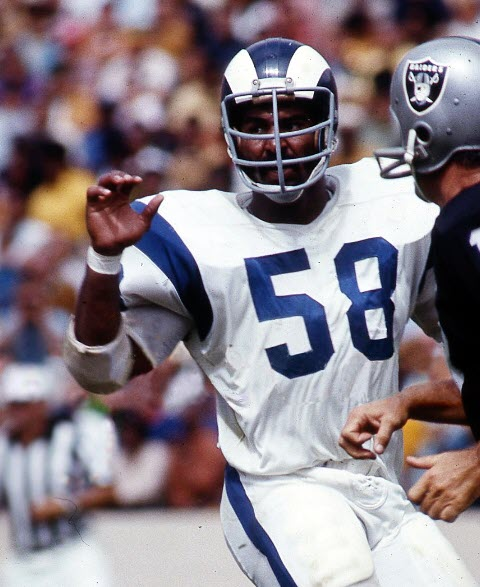
Sometimes history forgets deserving players, so it's left to us to remember them -- which is how I'd describe Isiah Robertson, whom former NFL defensive lineman Phil Olsen once called "the finest athlete I ever played with."

Robertson was a transformative figure in the NFL, widely regarded as one of the most formidable linebackers of the 1970s. He was on the leading edge of outside linebackers who were approximately 20 pounds lighter than linebackers of the 1960s and, as a result, faster.

A lot faster.

Clocked at 4.5 seconds in the 40, Robertson was among the fastest linebackers in the league when he entered the NFL in 1971 as a first-round draft pick of the Los Angeles Rams. He went on to play 12 seasons where he became one of the game's most decorated linebackers, known as much for game-changing plays as he was for his exceptional speed.

But we'll get to that.

His athletic prowess was evident at Southern University, where he made 112 tackles and 45 assists in his 1970 senior year, earning All-American honors from The Sporting News and TIME magazine. He also returned an interception 103 yards for a game-winning touchdown against Grambling with seconds remaining. Playing in the middle, Robertson called himself the "Black Dick Butkus".

The Rams' 10th overall pick in the 1971 draft, Robertson quickly adapted to the pros, earning a starting spot as a weakside linebacker as a rookie. But he just didn't start; he exploded onto the NFL scene, voted the NFL's Defensive Rookie of the Year, second-team All-NFL, and first-team All-NFC. He was also named to his first Pro Bowl.

He had four interceptions and (unofficially) four sacks, which may not sound like much. But it's a rarity for a linebacker -- especially one in his first pro season -- to have four or more of each in the same season. Robertson -- known as "Butch" -- was the first, and only one has done it since.
As a result, he was one of the cornerstones of a Rams' defense that from 1973-1978 allowed fewer points than all but the Pittsburgh Steelers ... intercepted more passes than all but the Steelers and Raiders .... and had more sacks and allowed fewer rushing touchdowns than all but Dallas. No defense, however, allowed fewer yards,

The point? Those Rams' defenses were great, and Robertson was, too.

After his stellar rookie year, he was second-team All-NFC in 1972 (UPI), first-team All-Pro in 1973 (AP, PFWA), second-team All-Pro in 1974 (AP, PFWA, NEA) and first-team again in 1975 (NEA) and 1976 (AP). He earned his last All-Pro notice as a second-team All-Pro in 1977 (AP, NEA), the same year he went to his sixth Pro Bowl. For good measure, he was first-team All-NFC in 1973, 1975, 1976, 1977 and second-team in 1974.

But it wasn't the accolades that separated him from others. It was the big plays. In 1973, he returned an interception 49 yards for a touchdown against the Giants on Monday Night Football. The next season, his 59-yard interception return for a TD not only showcased his electrifying open-field abilities but sealed a playoff defeat of Washington and former Rams' coach George Allen.

"One of my trades finally got the best of me," Allen said, referring to a 1971 trade with Washington that landed Robertson in Los Angeles.

One season later, Robertson was at it again -- this time returning an interception 76 yards for yet another score on  Monday night.

By 1978, however, things with the Rams soured. Robertson wanted to be one of the highest-paid linebackers in the NFL, and the Rams wouldn't meet his demands. So he pouted, lost his starting and was traded to Buffalo where Chuck Knox, a former coach with the Rams, signed him to a four-year, $1-million contract, making him one of the game's best-paid linebackers.

The move worked out for both parties. Robertson was happy and productive, producing 96 tackles in his first season with the Bills, with two interceptions and a 23-yard touchdown return. In 1980, he contributed 85 tackles as the Bills improved from 5-11 to 11-5 and won the Eastern Division. In 1981, he added more tackles, helping Buffalo reach the playoffs as a wild card.


Wherever Robertson was, it seemed, success followed. He played 168 games, starting 150 and missing only three, while earning six first-or second-team All-NFL selections (1971, 1973–1977) and six Pro Bowl nods. But Robertson had the numbers, too. According to official NFL gamebooks, he totaled 879 tackles -- with nearly 70 behind the line of scrimmage -- and produced 24-1/2 sacks and 25 interceptions. He also forced 24 fumbles, recovering 14, and had four defensive scores in the regular season and another in the playoffs.

That makes him one of only 14 linebackers with 24 or more sacks and 24 interceptions. Eight of them are in the Pro Football Hall of Fame. 

Yet, despite his contributions and productivity, Isiah Robertson remains underrecognized and overlooked for the Pro Football Hall of Fame. He's never been a finalist nor a semifinalist. Worse, he was on the preliminary ballot only once, the year he was first eligible. As a seniors' candidate, he's been nominated multiple times, but that's where his candidacy starts and ends ... and that's not right.

Maybe he's been ignored because he wasn't chosen to the 1970s' all-decade team, but voters seems to forget that his peers three times voted him the NFC's Linebacker of the Year. Or maybe it's because he never was on a Super Bowl-winning team. Except that argument doesn't hold, either. Plenty of players without Super Bowl rings have Gold Jackets. 

I don't know what's happened ... or hasn't. All I know is that nothing should keep Isiah "Butch" Robertson's candidacy from serious consideration by the Hall's seniors committee. He did too much to merit anything less.

Career stats—

Honors—

Monday, September 2, 2024

Ram Tough: The Long History of Unhappy LBs, Money, Injuries and Departures

By John Turney
When the Rams traded LB Ernest Jones to Tennessee, fans were surprised. They shouldn't have been. It's been their history.

Earlier this week, Los Angeles Rams' fans saw something that caught most of them by surprise: According to ESPN's Jeremy Fowler, Rams' inside linebacker Ernest Jones had been given permission to seek a trade. They knew Jones was in the final year of his rookie contract and that, because the Rams historically haven't valued the inside-linebacker position. he'd likely go elsewhere to find the money he wanted. 

But now? No way. Conventional wisdom said that 2024 was going to be his audition for a life-changing contract.

Conventional wisdom was wrong.

Two days later after the ESPN report aired, Jones was traded to Tennessee, along with a 2026 sixth-round draft choice, for a 2026 fifth-round pick.  That's not much for a linebacker whom Pro Football Focus ranked as the NFL's seventh-best at his position, contract year or not.

Not only was it a surprise to fans; it was a surprise to Jones, who said he expected to be with the Rams this year. But that didn't happen, and maybe it had something to do with a problematic knee that caused him to miss practice or perhaps he irritated coach Sean McVay. No one knows, including Jones.

What is known, however, is that it's not the first time the Rams have let quality linebackers go, either by not signing them as free agents or, as here, trading them away. There's a history there, so let's take a look.

Perhaps the first notable exit was by Larry Morris. a two-way player who was a good fullback and an even better linebacker. The Rams chose him in the first round of the 1955 draft, but he couldn't stay healthy. So, they gave up and traded him to Washington for the rights to Gene Brito.
Larry Morris
So what happened? Brito was injured in 1959, had a very good year in 1960, then fell ill with a muscle degenerative disease that eventually caused his death. Meanwhile, Morris couldn't come to an agreement with Washington owner George Preston Marshall, so he was shipped to the Chicago Bears. where he excelled. He became the most valuable player of the 1963 NFL championship game and respected enough that Hall-of-Fame voters named him to the NFL 1960's all-decade team.

Then, in 1971 George Allen, who coached the Rams from 1966-70, became Washington's new coach and wanted a pile of his former players. So he engineered a trade with the Rams that sent a linebacker to Los Angeles plus seven draft picks for linebackers Maxie Baughan, Jack Pardee and Myron Pottios, plus defensive tackle Diron Talbert, guard John Wilbur, running back Jeff Jordan and a draft pick.

The 35-year-old Pardee had been the Rams' left linebacker, and he played well in 1971 (five interceptions, All-NFC) and OK in 1972 before he retired. Middle linebacker Myron Pottios, who was 32, started for a year and parts of two more. He was experienced and smart but lacking in range. 
Jack Pardee
And then there was Baughan.

For five years he'd been the Rams' right linebacker, but after the trade he retired and didn't play for Washington. He hurt a foot, spent time on the taxi squad and injured reserve, then went into coaching. But four years later, when injuries depleted Washington's linebackers, he was called back after two years coaching at Georgia Tech. He joined Allen's staff in 1974, with Allen coaxing the 36-year-old to play if there were further injuries. But he contributed little in terms of trade value.

Now look what the Rams gained in return.

Marlin McKeever, the linebacker Washington included in the big trade, started two years for the Rams and was good in 1971 and, like Pardee in Washington, more like average in 1972. The real prize, though, was the player the Rams chose with the first-round pick they acquired: Isiah Robertson, who became one of the NFL's best outside linebackers and one of the best linebackers, period, in club history.

Eight years later, though, that all changed.

In 1978 Robertson, by then a six-time Pro Bowler, thought he was underpaid and made that clear to the Rams, the media and anyone else who would listen. In return, he was accused of not playing hard and dividing the team with his commentary on his contract. Eventually, he lost his starting job that season to second-year linebacker Bob Brudzinski and served only as a coverage specialist in passing situations. 
Isiah Robertson
The next spring the Rams remedied the situation by trading him to Buffalo, which welcomed him with a four-year $1 million contract, and Robertson responded with several good seasons, including 1980 when he played at a Pro Bowl level.

Now, back to Brudzinski. 

He played great in Robertson's place until he had contract problems of his own in 1980 when the process was repeated. But he didn't complain. He just up and left after midseason. You heard me. He walked out on the Rams and never played for them again.

The following year, they sent him to Miami on Draft Day in a complicated multi-pick deal that, in the end, netted them inside linebacker Jim Collins, who had several solid seasons. But it was George Andrews who replaced Brudzinski at right outside linebacker, and while he was good, he wasn't as good as Brudzinski. 

With the Dolphins, Brudzinski became one of the "Killer Bs" and was a solid, albeit unheralded, member of those defenses.

Winner? Loser? You tell me.
Bob Brudzinski
There was another Rams linebacker who departed in 1981. That was Jack "Hacksaw" Reynolds who'd been their starter at middle linebacker since 1973. However, the "book" on Hacksaw, who was going on 34 years old at the time, was that he was "too old, too slow and couldn't cover anybody" -- something that offended Reynolds so much that he had a T-shirt made with that on it.

Reynolds wanted a no-cut contract for more money than the Rams were willing to offer for someone they thought was declining in skills. 

But was he? 

The San Francisco 49ers didn't think so. They signed him and all he did in the Bay Area was start for the Niners for four seasons and help them win two Super Bowls - -something the Rams would not do until nearly two decades later.
Jack Reynolds
But the most costly offload of a linebacker in Rams' history happened in 2002 when middle linebacker London Fletcher became a free agent, and the Rams let him walk ... to Buffalo, where the Bills gave him a five-year, $17.1-million blockbuster deal.

Meanwhile, the Rams replaced him with a middle linebacker named Jamie Duncan who played for Tampa Bay, which is significant to the story. The Rams' defensive coach was Lovie Smith, and he'd brought the so-called Tampa-2 defense with him when he went to the Rams the year before. But he did more than that. He convinced the team's front office that Duncan could replace Fletcher and that Fletcher would not be missed.

He was wrong. Fletcher's absence was felt.

The Rams lost one of the best linebackers they'd had in a long time, with Fletcher playing another 12 NFL seasons -- five in Buffalo and seven in Washington -- and playing so well that he deserves Hall-of-Fame consideration.
London Fletcher
Since then there have been a couple more linebackers the Rams let go, but none on the scale of the Fletcher misjudgment. In 2018, for instance, they traded away Alec Ogletree, their starting middle linebacker who was second-team All-Pro in 2016. Oddly, the Rams seemed to have liked him, giving him a four-year, $42.8 million extension in 2017.

But the following spring they shipped him to the Giants for two mid-round picks, and it's uncertain why. Maybe he didn't live up to expectations of the new Rams' regime, which included the newly-hired McVay. No one knows. What is certain is that Ogletree was one of the few at his position to gain top dollar from the Rams.
Alec Ogletree
He had a terrific initial season in New York, with five interceptions -- including two returned for touchdowns -- but his play eventually dropped off, and he bounced around to a couple of teams after that. In L.A., meanwhile, he wasn't missed. The Rams had special-teams standout Cory Littleton waiting, and coaches believed he was ready to start in their base defense. 

They were right. 

Littleton had two outstanding years as a starter (and continued to play top-level special teams), averaging 130 tackles, two interceptions and four sacks annually, and he did it more cheaply than Ogletree. But a couple years later, it was his turn to get paid -- to the tune of $35.2 million over three years (with $22 million guaranteed) -- but it wasn't with the Rams. It was with the Las Vegas Raiders, who signed him as a free agent.
Cory Littleton
However, Littleton was little more than adequate and, after failing to live up his contract, followed Ogletree's path and bounced around with others after the Raiders released him.

Then, two years later, in 2021, our story comes full circle when the Rams drafted Ernest Jones out of South Carolina. He became a starter at midseason of his rookie year, helped the Rams win the Super Bowl and remained a starter through 2023. 

So, what now?

Jones's replacement -- at least at the moment -- is Troy Reeder, and let's just say he's not a favorite in Los Angeles. He's been a part-time starter for the Rams the last several years (minus a year he played for the Chargers), and the results haven't been great. Nevertheless, Rams' coaches seem confident in him, which is all that matters. So he's the guy for now.

However, the eventual replacement for Jones could be a 2024 UDFA out of LSU named Omar Speights. He's been lights out so far-- with Pro Football Focus ranking him as the NFL's fourth-highest off-ball linebacker this preseason -- but he isn't the starter. Yet.

Time will tell, as it will for Ernest Jones in Tennessee. 
Ernest Jones
Will he go on and offer the Titans the kind of elite linebacking that London Fletcher brought to Buffalo in 2002, or will he fade into mediocrity, as Ogletree and Littleton did for the Giants and Raiders? Or, maybe, as we've witnessed, it will be somewhere in between.

No matter what happens, we know that what happened this week with Jones and the Rams shouldn't have surprised the club's fans. It's just the latest in a long history of a team's decisions that involve linebackers, injuries and money.

Friday, June 14, 2024

Remember When Two Teams Swapped Rosters ... Twice? This NFL Vet Does

 By John Turney

Merlin and Phil Olsen

What? Really? 

Are you telling me there really was a time when the Rams' entire roster was swapped with the Colts' roster, only to have both rosters traded back to each other?

"Yes, that's right," said someone who knows. "When (NFL owner) Carroll Rosenbloom and Robert Irsay traded the Colts for the Rams, everything was traded. The equipment. The desks. All the assets and liabilities. Everything. And that included all the players, so they had to be traded back."

That someone is former NFL player Phil Olsen, brother of Hall-of-Famer Merlin Olsen. But how would he know?

Good question. Rosenbloom, then the Baltimore Colts' owner, wanted to own the Los Angeles Rams. So he worked out a deal in July, 1972 where Irsay would buy the Rams, then swap them for the Colts and cash. But some of the niceties were never brought up or discussed ... until Olsen is questioned.

"Ed Masry was my agent and lawyer," he said, "and he was an extremely smart and aggressive attorney. He was my brother Merlin's lawyer and also Roman Gabriel's. You'll remember his name from Eric Brockovich fame.

"Ed caught wind of the deal and used the information to get Gabriel a bonus for not trying to block the trade."

It turns out that Gabriel had a no-trade clause in his contract and was one of the few -- and perhaps only -- individual with veto power over a trade.

"Merlin didn't," said Olsen. "I didn't. But Ed had negotiated one for 'Gabe.' So when he found out what was going on and how it worked, he used that as leverage and reasoned that, with the swap of assets comes the swap of the players. So the only way to get them to the right team was to trade them back"

Consequently, Gabriel was entitled to compensation for waiving his no-trade clause ... at least in Masry's thinking.

"Roman got the compensation, and it was sizable," said Olsen. "I think it was maybe three or four hundred thousand dollars, which was a lot of money back then."

According to the papers, Gabriel's salary was $125,000 at the time. So, chalk one up for Masry. But it wasn't the first time the shrewd lawyer took advantage of holes in the system.

"Prior to the 1970 NFL draft," Olsen said, "I was expected to go high. But I didn't want to go back East. I wanted to play in Denver, in the Intermountain West, (and) I expressed that with Ed. So he sent a letter to everyone drafting in front of the Broncos, telling them not the draft me; that I wouldn't sign."

Masry's bluff didn't work. The then-Boston Patriots chose Olsen with the fourth overall pick, leaving Olsen in an uncomfortable situation. Other than holding out, there really wasn't much he could do, and he wasn't going to go that sit out the season. He wanted to play in the NFL.

So, he signed with the Patriots -- a one-year contract with a one-year team option.

"Ed was a bold advocate," Olsen said, laughing.

But Olsen never played with the Patriots. Practicing for the College All-Star game that summer, he suffered a serious knee injury in a collision with what he called  "a big, but a very clumsy player" and was sidelined for the year. At the end of the season, his one-year contract expired, and the Patriots didn't exercise their option.

Apparently, they'd forgotten about it.

"They had some turnover in the front office," Olsen said, "and for some reason the Patriots didn't exercise my option, nor did they for a number of other players who also were in the same situation as I was."

Which, according to Olsen, made him and those players free agents.

"I got a call from Ed asking if the Patriots had contacted me about the option," Olsen said, "and I told him, no, I hadn't. So he went to work in getting me to Los Angeles. He was sure that missing the deadline made me a free agent."

So Olsen ended up in Los Angeles to play next to his Hall-of-Fame brother in what newspapers reported as a "loophole in Olsen's contract," while Masry ended up in NFL commissioner Pete Rozelle's office to discuss a sticky situation he wanted kept quiet.

"Ed and I flew to New York," Olsen said, "and met with Rozelle and Ed laid out our position. The Patriots were not happy and were concerned about me leaving."

So Rozelle struck a deal.

"He agreed to let me be a free agent," Olsen said, "if we did not reveal the details of how my free agency came about. He didn't want the Patriots to lose any more players if they found out about the implications of the team's lack of exercising the options. 

"It would have been chaos, but, as far as I know, Ed was the only player representative who was on top of it. The others were not yet wise to the situation. I was able to sign with the Rams, and Rozelle would name the compensation the Patriots would receive. That ended up being a first-round pick and a third, I think."

That's exactly how it turned out, but only after the Patriots tried to pry a top player (Isiah Robertson and Jack Youngblood were mentioned) and a 1972 first-rounder from the Rams. That didn't happen. Instead, Rozelle settled on a 1972 first-round pick, $35,000 cash to reimburse Olsen's original signing bonus, and "additional compensation at the end of the 1971 season."

As it turned out, that was the 1972 third-round pick Olsen mentioned -- a package Rozelle called "just compensation" but left the Patriots furious.

"As it stands, I have nothing but total dissatisfaction with the settlement," said Upton Bell, then the Patriots' general manager. "It's an example of giving to a team that already has and taking from a team that has not."

Olsen played four years for the Rams, first as a defensive tackle next to his brother; then as a third defensive end behind Youngblood and Fred Dryer.

"I went from being a starter," he said, "to playing maybe one-third of the snaps. So I played out my option." 

Then he decided to move.

"John Ralston was the coach of the Denver Broncos," Olsen said, "and he'd recruited me to go to Stanford when I came out of high school before I settled on Utah State. He was interested in signing me. So Ed worked out a deal".

Only one problem: Compensation.

To avoid having Rozelle decide the terms, the Rams agreed to trade Olsen's rights for the rights of unsigned wide receiver Otto Stowe, plus a draft pick. That meant Olsen finally would play where he wanted five years earlier and get what he wanted where he wanted ... or not.

Surprisingly, the Broncos asked him to change positions and move from the defensive line to the other side of the ball and play center.

"They didn't tell me until I got to Denver," Olsen said. "But I wanted to do what John asked me. So for the next two years I split time at center with myself and Bobby Maples alternating quarters. He'd play the first and third, and I'd play the second and fourth quarters. I also was the captain of the special teams."

Those special teams were elite, especially in 1976 when Rick Upchurch was returning a punt for a touchdown or Olsen was blocking kicks seemingly every other week.

Though Olsen was expected to be the full-time center in 1977, those plans were derailed by a player revolt that forced the firing of Ralston and had Red Miller replace him. Miller didn't see Olsen as his next starting center; he wanted him to play left tackle. And that was a no-can-do.

"Red brought his own center with him," said Olsen, "and didn't give me a chance to keep the job. I told him I didn't mind moving to tackle, but I wanted a chance to compete at center ... and if I got beat out, that was fine, I'd move. But, he didn't want competition at the center position. He wanted the guy he was bringing in to start."

Faced with playing a position he'd never tried before on a surgically repaired knee, Olsen retired and moved on to business interests. His NFL career, he thought, was over. But, to his surprise, Buffalo coach Chuck Knox -- who had just joined the Bills -- wanted him to play center there.

Knox had been Olsen's coach in Los Angeles in 1973-74.

When Olsen agreed, the Bills worked out a deal that sent a conditional 1979 draft pick to Denver. His early practices impressed coaches and the media, but one final knee injury in July felled him. After undergoing surgery, he spent the season on injured reserve.

However, he wasn't exactly finished.

"I was disappointed (to get hurt)," he said, "but it turned out well because I got to do a little coaching and a little scouting. I'd fly to cities and watch games and come back and report to the coaching staff and also I'd work with some of the linemen on techniques."

After the year, though, Olsen retired for good. Officially, he played for two teams in his NFL career, but unofficially he was on the rosters of four. Olsen had gone from the Patriots to the Rams to the Broncos and finally the Bills -- with none via a conventional player-for-player trade.

Furthermore, each time the move technically was as a free agent. However, that doesn't count the time he was traded to the Colts, then traded back to the Rams, in the franchise swap of 1972. 

What a long, strange trip it was.

Wednesday, April 3, 2024

Aaron Donald, the G.O.A.T.?

By John Turney 
Sometimes players referred to as "generational" eclipse the usual standards and must be measured on a more stringent scale reserved for rare players. Names like Jim Brown, Johnny Unitas, Dick Butkus, Lawrence Taylor, Jerry Rice and Tom Brady are prime examples.

But so is Rams' defensive tackle Aaron Donald, who retired last weekend. 

In terms of his legacy, you can't ask questions like, "Will he be in the Hall of Fame? Or, "Will he be a first-ballot Hall of Famer?". The answers are obvious. No, for Aaron Donald, it's more appropriate to ask, "Is he the greatest defensive tackle of all time?" In other words, did his career measurably surpass his predecessors?

Let's explore.

THE CASE FOR AARON DONALD

Before Donald established himself as a dominant force, the "Mr. Rushmore" of defensive tackles was pretty much a consensus consisting of Hall-of-Famers Bob Lilly, Joe Greene, Merlin Olsen and Alan Page. They were dominant for a long time, played on great defenses and won the most personal accolades, i.e., the "alls," such as All-Pro, Pro Bowls all-decade, etc.

There can be considerable discussion as to which one was the best, and there was. But then Aaron Donald entered the game in the last decade, and the debate changed. The 6-foot-one, 280-pound first-round pick out of Pitt started his career with a bang, and that bang never stopped, even through his final season.

Considered undersized for a defensive interior player, he blew people away at the 2014 NFL scouting combine by running a 4.67 40-yard dash (one that included a 1.63 10-yard split) and bench-pressing 225 pounds 35 times. All are between the 90th and 99th percentiles for his position, and all were accomplished by someone in the bottom ten percentiles in height and weight.

We should have known then. Aaron Donald was a dynamo that came in a relatively small package.

As a rookie three-technique for the St. Louis Rams, Donald was a second-team All-Pro, made the Pro Bowl and was easily the NFL Defensive Rookie of the Year. In his next nine seasons, he was a consensus All-Pro eight times, went to every Pro Bowl and was voted Defensive Player of the Year three times.

No player has ever won that more.

He also logged 111 sacks, forced 24 fumbles and incessantly pressured quarterbacks while being double-and-triple-teamed and held more often than you can count.

Donald made a habit of sealing games with big plays, with Super Bowl LVI the most notable example. He closed out that victory with a signature move -- breaking through the Cincinnati interior to force quarterback Joe Burrow into a hurried ... and incomplete ... pass on Cincinnati's final play.

During his time in the NFL, no player had more QB sacks, regardless of position, and none was celebrated as often in the new world of defensive metrics. The analytics site, Pro Football Focus (PFF), graded him as the NFL's top player three times ... its best defensive player six times ... and seven times the top-graded defensive interior lineman. It also had him producing the most pressures of anyone, with pressures characterized as a combination of sacks, quarterback hits and hurries. 

But PFF was not the only one to rave about Donald. 

Check other organizations that tracked QB hits, hurries, knockdowns, pressures and disruptions -- sites like Next Gen Stats, Football Outsiders, Sports Radar and Sports Information Solutions. You find the same conclusions. Aaron Donald was atop their charts year-in and year out.

In addition to his 111 career sacks, a little digging into NFL gamebooks reveals that he had 92 tackles for losses on plays other than sacks, usually plays involving a running back. He was so quick that he could get into his gap before an opposing guard could defend it. But if that player tried to anticipate Donald's first move ... that is, if he attacked too quickly ... then Donald would just slip behind him and "backdoor it," as Donald put it.

Result: A running back going nowhere. 

Donald was also someone who couldn't be displaced in run blocks, even if it was a double team. His strengths and leverage wouldn't allow it. As a result, he wasn't a one-trick pony, someone like a pass-rush specialist, if you will. He was as dominant against the run as he was in pass plays, as other, more detailed, metrics illustrated. Whether it was "pass rush win rate" (ESPN Analytics), "double team pressure leaders" or "run stuff rate" (both Next Gen Stats), Donald was the leader in the years those stats were available.

I guess what I'm saying is that Aaron Donald was more than just elite for a defensive tackle; he was super-elite, ultra-elite ... one of the best players in the NFL for a full decade. He was both stout and slippery, a master of hand use who could read blocks and blocking schemes. In short, he was king of the physical and mental aspects of defensive interior line play.

Stats and metrics told you that. Opponents told you that. TV announcers told you that. So did opposing coaches and teammates. Virtually everyone and everything --  including your eyes -- told you that he was special.

THE "MT. RUSHMORE" OF DEFENSIVE TACKLES

So back to the question: Was Aaron Donald the G.O.A.T.? Let's take a peek at what the four "Mt. Rushmore tackles" accomplished and then decide:

Bob Lilly

14 seasons, seven consensus All-Pro seasons and 11 Pro Bowls.

One Super Bowl ring.

Unofficial sack total -- 95-1/2.

By far the best player on the great Dallas "Doomsday" defenses. He never won a Defensive Player-of-the-Year award. But the NEA didn't award one until 1966, while the AP began in 1972. Had there been one in 1964, it would have been Lilly, and there were other years where he'd have been in the running.

For the Rushmore tackles, there are far too many positives to cover. So let's just grant that they built their reputations on rare abilities and accomplishments. Separating them won't be easy, but citing possible "holes" in their near-perfect resumes can help ... and all four, to small degrees, have imperfections.

For example, prior to his era of dominance (call it 1964-72) Lilly was "spinning his wheels" (as Tom Landry called it) as a left defensive end. So he was moved to right defensive tackle in mid-1963 when Landry implemented the "Flex defense" full-time on likely run downs. The idea was to prevent offensive tackles from "do-dad" blocking Lilly (now called "duo" blocking), and it worked to perfection.

Bob Lilly became a legendary defensive tackle. 

Then, in Lilly's final two years, especially 1974, he was slowed by a bad back and removed on passing downs. Perhaps Landry thought in years 13 and 14 of Lilly's career where he was slowed by an ailing back, the team was better off with Bill Gregory in the game on third and long situations.

Nevertheless, he was "Mr. Cowboy" and one of the all-time greats.

Joe Greene

13 seasons, three times consensus All-Pro, 10 Pro Bowls.

1972 and 1974 NFL Defensive Player of the Year.

Four Super Bowl rings.

Unofficial sack total -- 77-1/2.

At his peak (1969-mid-1975), "Mean Joe" may have been the most feared defensive tackle of the four. He was unblockable and could not be intimidated.

But remember: We're dissecting these careers, and upon close inspection, find that in 1975 Greene was slowed by a pinched nerve in his neck -- an injury that lingered through 1976 and one that, by Greene's admission, limited him.

While he wasn't as effective a pass rusher afterward, he remained a dominant run stuffer and a Pro Bowl-level player. But he was no longer someone who would compete for the Defensive Player of the Year as he did the first half of his career.

His strength and quickness remained, which meant he could still be devastating vs. the run in Pittsburgh's "Stunt 4-3" scheme. However, the last half of his career, he wasn't the pass rusher he was before.

Merlin Olsen

15 seasons, five-times consensus All-Pro, 14 Pro Bowls.

No Super Bowl rings.

Unofficial sack total -- 91,

Olsen's peak was not as high as Lilly, Greene or Page, but he was more consistent doing what he was asked in tandem with Deacon Jones and, later, Jack Youngblood. With two elite edge rushers who were as fast as they were quick, someone had to make sure there were no gaps in the defensive line, and Olsen often was that someone. He had to be aware of traps, screens, draws, you name it ... anything that could hurt an aggressive defense.

"That became my job", Olsen said.

 And he did it well, making a ton of plays. 

Olsen's only significant setback was a knee injury that occurred in the Pro Bowl following the 1970 season, and it probably affected him through the 1971 season. Nevertheless, he had fabulous years after that. Unfortunately, by then Greene and Page had established themselves as the top two defensive tackles in the game.

In the final analysis, Olsen had no negatives in his career. He was consistent from one year to the next. But if he was the league's best defensive tackle in the NFL, his reign was short. It would have been in 1969 and 1970 ... and that's a maybe, and it was only by a fraction over Lilly. Still, he was a top-two finisher many times, if you follow.

Alan Page

15 seasons, five-times consensus All-Pro, 9 Pro Bowls.

1971 NFL MVP.

No Super Bowl rings.

Unofficial sack total -- 148-1/2.

Of these four candidates, Page had the highest peak, mostly because he was the first defensive player to be voted an NFL MVP. Plus, to this day, he was as effective a pass rusher from the inside as the game has seen -- right there with Donald and John Randle. 

Lighting quick off the snap, Page could make guards look silly. Coach Bud Grant gave him the freedom to play anywhere from opposite a center to the inside of an opposing tackle, which was unusual for that era. But it worked, with Page in the conversation as best-ever defensive tackle for the first decade of his career.

But then something happened.

Late in his career, he not only attended law school but took up marathon running, too. In the process, he shed over 20 pounds, dropping his weight from around 245 pounds to 225 or so. And he played at that weight from 1977 through the rest of his career. 

Page contended the weight loss was "mostly fat," but, whatever it was, it had an impact on his career. He suddenly was displaced by offensive linemen, so much so that Grant released the former MVP early in the 1978 season. From there, he went on to Chicago where he played well as a pass rusher but wasn't as strong stopping the run as you'd expect from an all-time great.

But in 1980-81, then-Bears' defensive coach Buddy Ryan began implementing his "46 defense," with Page positioned over center and a defensive lineman placed to either side over the guards. It created a one-on-one match for Page with the center, and it worked. Even at a lighter weight, Alan Page excelled.

THE VERDICT

Okay, now that we've explored and explained some facts about the competition, there's one other factor that should be included ... and that's supporting casts. In other words, whom did these candidates play with and how much help did they have?

Lilly had solid players like Jethro Pugh and George Andrie flanking him, but he also had Chuck Howley, Lee Roy Jordan, Mel Renfro, Cornell Green and others who made the "Doomsday" defense what it was. All were All-Pros. Howley and Renfro are Hall-of-Famers. Cliff Harris is too, but he was more of a "Doomsday II" player, the second iteration of the famed Cowboys' defense.

Bottom line:  Lilly had a lot of help.

Joe Greene was part of the "Steel Curtain" and shared the defensive line with Pro Bowl-level players like L.C. Greenwood, Dwight White and Ernie "Fats" Holmes. But look who was behind them: Elite players galore in the second and third levels, four of whom are in the Hall of Fame -- Jack Lambert, Jack Ham, Mel Blount and Donnie Shell.

Like Lilly, Mean Joe had help.

As part of the "Fearsome Foursome" of the 1960s, Merlin Olsen played on one of the top two or three front fours ever. But he was part of terrific defenses in the 1970s, too. 

Hall-of-Famers Deacon Jones and Jack Youngblood were on his left, while Pro Bowlers like Roger Brown and Larry Brooks stood to his right. Teammates who went to Pro Bowls or who were named All-Pro included Maxie Baughan, Isiah Robertson and Jack Reynolds.

Yep, Olsen was not alone, either.

Then there's the Purple Gang that surrounded Page in Minnesota. Hall-of-Fame defensive end Carl Eller and Pro Bowl defensive end Jim Marshall teamed with him on the line, while Hall-of-Fame safety Paul Krause roamed deep. There were also Pro Bowl linebackers and defensive backs in there with him, as well.

That makes it four-for-four in Mt. Rushmore tackles as elite parts of elite defensive units that were some of the league's best-ever. They could stop the run, sack the quarterback, pick off passes, limit yards and shut out opponents. In short, they were dominant.

So, now, what about Aaron Donald? How were the defenses he played on? Answer: Good but not great.

From 2014-23, the Rams generally were in the top 10 of most of the same categories mentioned, with the exception of team sacks. They were third there. But with the rest, they finished more like sixth, eighth and ninth. Donald played on one top defense (arguably the NFL's best in 2020) and some good ones, but he also played on some that were merely average.

Or worse. 

As for the "help" question, Donald teamed with really good players for a short time, but, for most of his career, he didn't have Hall-of-Fame-caliber teammates. Granted, he played with All-Pro Jalen Ramsey for a few years and had Von Miller for half a season, and those two contributed to the Rams' Super Bowl victory in 2021.

Pro Bowler Robert Quinn was there for Donald's rookie season of 2014, too, and linebacker Bobby Wagner was a second-team All-Pro in 2022. But they were the exceptions, not the rule. Simply put, there weren't a lot of  Rams' defenders dotting Pro Bowl rosters from 2014-2023, where there were with Lilly, Greene, Olsen and Page.

In fact, former Rams' defensive line coach Mike Waufle (who implored the Rams to choose Donald in 2014, calling him the "best player in the draft") suggested last weekend on the NFL's Sirius XM Radio channel that the Rams' inability to provide Donald consistent support from edge rushers may, in part, have contributed to his early retirement. That's not to say Donald did it all alone. He didn't. He had help, but it wasn't at the position-to-position talent level of the Cowboys, Steelers, Rams and Vikings. 

Of course, the elephant in the room is the era, and that matters when trying to pick the G.O.A.T. because ignoring it leaves out important and relevant details.  The 1960s and 1970s were simply different than the 2010s in countless ways. For instance, Donald never went into an NFL game with a size advantage vs. those blocking him. His advantage was his strength and quickness, and they more than compensated for 20, 30 or 50-pound disadvantages. 

With the exception of Alan Page, our old-school guys were considered large men -- even at 265 or 275 pounds -- and in almost every game they played, they held size advantages over their opponents. Oddly, Donald weighed roughly the same, but he played in an era where that was considered small.

Then there's the question of how the game was played. In Donald's era, linemen could do far more with their hands than decades ago, and it showed on countless replays. There you could see offensive linemen grabbing Donald on plays where nothing was called. In my opinion, the "eye test" tells you that Donald had it tougher in terms of tactics used against him. 

Enough already. I know what you're wondering:  If there is evidence that Donald is the best ever? Well, yes, there is.

And yes, he is.

Given the totality of everything -- personal honors, statistics, team success, era considerations, amount of surrounding star power, and the "eye test" -- Aaron Donald is the G.O.A.T. of defensive tackles. He stood above his peers and at a greater level than his predecessors.

He just did. 

Donald also didn't have any of the nit-picks mentioned above about Lilly, Greene, Olsen and Page -- that is, unless you think playing 10 years doesn't compare to 13, 14 or 15 seasons or that Donald didn't play for elite defenses.

But those two points would be about it. Aaron Donald retired when he was elite, so he didn't have the decline that can happen with prolonged careers. Plus, he holds the advantage over the four others in nearly every category, which -- for me, at least -- makes him the best defensive tackle ever, bar none.

Surprising? It shouldn't be. Not at this point. It's simply a matter of four guys who drew 10s on a scale of 1-10 and Donald ascending to a level that, as Spinal Tap guitarist Nigel Tufnel might say, "goes to 11."

It's that simple.

Tuesday, January 23, 2024

Four Rams Make All-Rookie Team for First Time since 1964

By John Turney 
In 1961 United Press International (UPI) began choosing NFL All-Rookie teams and in 1974 the Pro Football Writers of America (PFWA) followed suit. For the most part, these are the only organizations that have had their annual teams used in NFL Publications, with some exceptions. 

Additionally, many publications covering the NFL have had All-Rookie teams - Pro Football Weekly, Sports Illustrated, Football Digest, The Sporting News, USA Today, ESPN.com and many more—including Chris Willis of NFL Films choosing one every year for us.

Today the PFWA announced its All-Rookie team and among the selections were four Los Angeles Rams—receiver Puka Nacua, guard Steve Avila, outside linebacker Byron Young, and defensive tackle Kobie Turner.

Using just the major teams (PFWA and UPI) 2023 marked the second time four Rams have been named All-Rookie. It happened in 1964 when UPI named quarterback  Bill Munson, receiver Bucky Pope, center Joe Wendryhoski and kicker Bruce Gossett to their team.

There has been one other year when the Rams had four players make someone's All-Rookie team. That was in 2014 when defensive tackle  Aaron Donald (PFWA, ESPN, Sports Illustrated), cornerback E.J. Gaines (PFWA, ESPN), running back Tre Mason (PFWA, Sports Illustrated); and tackle Greg Robinson (Sports Illustrated). Donald, Gaines and Mason made the major team (PFWA) and the others made either ESPN's list or Sports Illustrated's.  

Rams fans might bristle seeing that Greg Robinson made anyone's All-Rookie team but as a rookie but he was not terrible his first year but was not rated as highly as the players that made the PFWA team -- the Titans' Taylor Lewan and Ja'Wuan James of the Dolphins.

In 1962, 1971 and 1977 the Rams had three All-Rookie players if all sources are used. And if all sources are used for 2023 the Rams have a fifth All-Rookie player. Chris Willis picked Ethan Evans as the punter on our PFJ squad.

If you look at just the immediate impact of rookie classes it could be argued that 2023 is the best in franchise history with 2014 being close. 

The Class of 1971—Jack Youngblood, Isiah Robertson and Dave Elmendorf—had had the biggest long-term success if you don't look at it from just an immediate standpoint. In a handful of years we will see if the 2023 Rams rookies can build on what they've done in their first year.