Wednesday, August 17, 2022

Hall of Fame Senior Nominee—Joe Klecko

 By John Turney 
Art credit: Duane Potosky
Joe Klecko's versatility was noteworthy. In his four Pro Bowl appearances three of them were at different positions along the defensive line. That ability to excel anywhere along the line likely allowed him to emerge from the Hall of Fame Seniors Committee. That, and some great testimonials from his opponents add to his Hall of Fame case and he undoubtedly will be voted in by the full committee next January. 

In 1981 he was All-Pro and a Pro Bowler as a right defensive end. In 1983 and 1984 he was a Pro Bowler as a 4-3 defensive tackle. And in 1985 he was All-Pro and a Pro Bowler as a tilted nose tackle. Additionally, he was Second-team All-AFC in 1978-79 and 1986. In 1978 he was a 3-4 defensive end making four positions he received post-season honors.

In 1981 he was the NEA Defensive Player of the Year and was second in the voting for the AP Defensive Player of the year, second in the voting to Lawrence Taylor. Klecko also led the NFL (unofficially) with 20½ sacks that season as he was a vital cog in the Jets playoff appearances in that season.

The Temple star ended his career with 76 sacks and was a good kick blocker early in his career blocking five placekicks in his first three seasons. In 1985, the season he moved to nose tackle in Bud Carson's 3-4 defense he had 7½ sacks and forced five fumbles, and in an era of great nose tackles he beat them out for All-Pro honors that season.

Klecko was the glue of the New York Sack Exchange, the leader, the one who set the tone for the defense and his fellow linemates—Mark Gastineau, Marty Lyons, and Abdul Salaam. After he hurt a knee in 1982 Klecko moved inside to defensive tackle and was the one who had to often cover run plays since surpeme pass rusher Mark Gastineau was all about getting to the quarterback and not always conscientious in playing the run.

Hall of Fame center Dwight Stephenson said Klecko was a "great defensive lineman", and considered him one of the two best interior linemen he had ever faced. Stephenson added, "He was a dominating and devastating lineman. He really was. No one played the game better than him."

High praise.

Here is some more high praise—
All-time great Anthony Muñoz also added praise for Klecko, "In my 13 seasons, Joe is right there at the top of the defensive ends I had to block, up there with Fred Dean, Lee Roy Selmon, and Bruce Smith". Munoz continued, "Joe was the strongest guy I ever faced, He had perfect technique but he was such an intense, smart player."

The praise keeps coming— 
"I think it's time for Joe Klecko to get that nod. I really believe that," said Howie Long. In a lot of ways, Klecko is like Howie Long and Hall of Famer Dan Hampton—versatile guys who played more than one position well. Both Long and Hampton played inside, on the nose and outside as defensive ends. They were complete defensive linemen.

In 1981 Paul Zimmerman wrote in Sports Illustrated, "Klecko's attributes include tremendous quickness off the ball, great strength and a boxer's instinct for knocking away an opponent's hands and beating him to the inside position. And, says Green Bay Coach Bart Starr, Klecko has "something within him that flames very hot."

Klecko stands to almost certainly be inducted into the Hall of Fame after the full committee meets prior to the Super Bowl in 2023. That committee rarely votes down the Seniors Committee nominees.

“Listen, to be elected into the Hall of Fame has to be the piece de resistance in your career,” Klecko told The Athletic in a 2090 article. Now, in all likelihood, Klecko has that final event of his NFL playing days.

Klecko's career stats—

Hall of Famer Senior Nominee—Ken Riley

 By John Turney 
Ken Riley, a collegiate quarterback (at Florida A&M), transitioned well to cornerback in the NFL. He was a fifteen-year starter and intercepted an impressive 65 passes which are still tied for fifth all-time.

He was First-team All-Pro once and a Second-team selection twice, light for a Hall of Famer, but it is probable that his production as an interceptor and the Bengals lack of representation (and an upset fanbase) in the Hall that got him over the top in yesterday's senior committee meeting. In January is he a shoo-in to receive 80% "yes" votes and be voted into the Pro Football Hall of Fame.

Riley, who passed away in 2020, in all likelihood will be elected by the full Hall of Fame Committee when they vote "yes" or "no" on all three of the 2023 senior nominees. It is not common for a Senior Committee's recommendation to be rejected. So, Riley will take his place among the best-ever at his position and get his Gold Jacket.

Hall of Famer Mel Blount said this about Riley in 2021, "He played it as well as anybody, even including myself,” Blount said. “He played tremendously all of those years. It’s an injustice, not only to the Hall of Fame but to guys like myself who are in the Hall of Fame."

“The Rattler”, Riley's nickname, will soon make his mark with Hall of Fame induction.

Ken Riley's stats and post-season honors—


Hall of Fame Senior Nominee—Chuck Howley

 By John Turney 
Art credit: Merv Corning
Yesterday the Hall of Fame Seniors Committee met and picked three nominees that will be submitted to the entire committee before next year's Super Bowl. One of them was Chuck Howley. He will have to get 80% of the full committee to vote "yes" for him to be elected to the Hall of Fame—So it is not a sure thing though it would be unfathomable for him to be voted down. There have only been a few instances that a senior nominee was rejected by the full Hall of Fame Committee.

Here are Howley's partial statistics and his complete post-season honors. 

Howley began his career with the Chicago Bears and he played quite a lot as a rookie and picked off a pass. The next season he severely injured his knee and it kept him out of football for a year. 

In 1961 he got a ring from Dallas, and feeling his knee was sufficiently healed, the Cowboys traded for him and he began thirteen seasons with the star on his helmet.

Howley was always a favorite of famed writer Paul Zimmerman who noted his coverage ability, "Jack Ham was the best pure coverage linebacker, with second place going to...oh, I guess I’d have to say Chuck Howley." 

Howley was a terrific all-around athlete lettering in football, track, wrestling, gymnastics, and swimming at the University of West Virginia where he was named to the All-Southern Conference team three times as a gridder.

He totaled 26 sacks and 25 interceptions in his career and was a First-team All-Pro five times and was either First- or Second-team All-Conference or a Pro Bowler in 1963 and from 1965-71.
Art credit: Merv Corning
In Super Bowl V he was voted the game's MVP though Dallas lost that game to the Colts. The next year, versus Miami he picked off a pass and was a key part of the defense that dominated the Dolphins.

In eleven playoff games, Howley intercepted four passes and had 1½ sacks, and recovered two fumbles taking one of them to the house against the Browns in 1968.

 "I don't know that I've seen anybody better at linebacker than Howley," said Tom Landry. Howley himself said, "I just hope I can be considered the best at my position."

And now as one of the three senior nominees and nearly certain Hall of Fame induction he will always be considered one of the best at his position.

Monday, August 15, 2022

The Story of Len Ford: Rectifying a Diminished Legacy—Part 5

 By Nick Webster 
The Decline
As the 1955 season approached Ford was adding extra unwanted pounds. Having returned from his broken jaw low of just over 200 pounds to 225 for the 1950 Title, he played the better part of 1951 to 1954 in the 245 – 255 Lbs. range. Coming into 1955, Ford was well above that coming into camp. Again, he entered the season nicked up, again with a sore foot bothering him.

The Browns had another successful campaign sending Otto Graham off as an MVP and a champion, winning a title over the Rams. Both the Browns’ offense and defense ranked first in the league in points, though again, the pass rush was less ferocious than in earlier years. The team logged just over a sack per game and Lenny only had three confirmed sacks, though he likely netted double that amount, given what isn’t known from film.

The Browns – along with the rest of the league – are now running a full-time four-man line on defense.  This has eliminated some of Ford’s advantages, he’s back to playing with his fist in the dirt and is more frequently engaging directly with offensive tackles at the snap.

Ford remains first-team All-Pro though he was not a consensus choice for the first time since his injury-shortened 1950. Gene Brito, Andy Robustelli and even Tom Scott picked up first-team spots and the most impactful D-Line play of 1955 was surely that of Gene Brito. Brito notched numerous sacks but more importantly made impactful game-changing plays with a frequency of no other D-Lineman with numerous stuffs and timely forced fumbles. Brito’s play single-handedly won games against the Browns, Eagles and 49ers. A Defensive Player of the Year would have to be selected among Brito, emerging middle linebackers Joe Schmidt and Dale Dodrill, or a defensive back with Jack Christiansen again in the running.  The Washington DC Touchdown Club, admittedly biased, named Brito the NFL MVP – not just defensive Player of the Year – though Otto Graham was accepted as the League’s best, but Brito did receive votes which was rare for a defender, and he tied for fourth in UPI vote tally.

In the summer of 1956, only Darrel Brewster, Carleton Massey, and Ford are considered locks to make the club. Early in camp, Ford is replaced by youngsters, perhaps to save his legs and to get a better look at youngsters as the roster is beginning to turn over. Paul Brown believed, in early August, that Ford was actually better prepared than at the same time a year ago, though his weight is still elevated.

Ford notches a short sack in the first game of the year against the Cardinals, but this is not his best statistical campaign. He’s only known to have had two sacks on the season, though again, he was likely in the mid-to-high single digits if unassigned sacks could be attributed. A mid-season tilt against the Steelers sees Ford and Steeler lineman Bob Goana ejected for fighting. Lenny felt he was being illegally held and kicked at Goana who retaliated with a punch, a melee ensued with Goana and Ford on the turf and numerous Browns running to the rescue. Ford now held an inauspicious and very unofficial record of being tossed out of 3 league games. In the 1970s Joe Greene would join Ford, who would log another ejection in 1958, getting kicked out of four games, putting Lenny in select company. By December, Paul Brown is formally rotating Lenny with Jim Ray Smith, and the rest appeared to improve Ford’s play.  

The Browns’ defense again leads the league allowing just under 15 points per game, though the team flounders with the offense nearly going first-to-worst, unable to replace Otto Graham with George Ratterman or Tommy O’Connell (they finish 11 of 12 in PPG with under 14).

Post-season honors accurately reflect Ford’s diminished performance in 1956 as, for the first time since 1950, he doesn’t make a single First-team All-Pro. The mantle of best D-Lineman has shifted to Andy Robustelli, Gino Marchetti and Gene Brito. Ford did not make the Pro Bowl, and only received honorable mention from UPI and second team honors from the New York Post. The likely defensive Player of the Year, were one awarded, would have been selected from Joe Schmidt or Bill George as the league was entering the age of the star middle linebacker.

For the first time going into 1957, Ford’s status with the team is in question. Ford is the lone D-Lineman who is still around from the 1950 team, he’s older, nicked up, heavier and facing competition from younger talent. There’s even speculation that Lenny will not make the squad. In camp in late August, Paul Wiggin, the Stanford rookie who will be a mainstay for the next decade, is taking considerable snaps away from Ford. Bill Quinlan, back from the Army and down from the Hamilton Tiger-Cats of the IRFU (to become the CFL), mans the left defensive end spot. Talk around camp turns, however, and would sound familiar to modern ears, Ford is “trimmed down”, “best shape of his life” however, he’s trimmed to around 265, well north of what’s optimal and even that is achieved by way of a rubber shirt.

Lenny holds his starting role and the teams’ pass-rush is better than in prior years, though it’s mostly driven by Quinlan and Bob Gain. Ford has 3.5 known sacks though he’s likely – again – to have been in the mid-single-digits. Lenny posts 1.5 sacks in both the second and third game of the season but his performance stalls down the stretch. The October 27 matchup against the Cardinals sees Lenny and tackle Len Teeuws involved in a melee as the teams were leaving the field at the end of the half by the Comisky first-base dugout.  Lenny may have been lucky the action occurred after the gun sounded and off the field of play or a fourth ejection would likely have come in 1957. Going into December, Lenny is bothered by a sore shoulder and increasingly ceding time to rookie Paul Wiggin. Finally, on December 8 visiting the Lions, Wiggin and Quinan start and right and left end respectively; Ford doesn’t play, missing his first game since 1950. The Browns are again in the title race, boosted by spectacular rookie RB Jimmy Brown, and Paul Brown plays a balancing act of resting players (Ford in Detroit) but keeping them in playing shape, Lenny finishes up as the starter in New York.  Again, there is post-season disappointment and again at the hands of the Lions who won their third title of the decade all at the expense of the Browns.
Len Ford brings pressure on Conerly in his final game as a Brown, but Conerly gets the pass off for a long gain as the aging For is unable to finish

After the season Ford undergoes surgery on his right shoulder at his alma mater the University of Michigan to fix the injury he’s been living with all season long. Lenny is almost shut out of post-season voting but makes Second-team UPI, on reputation alone, again a Pro Bowl visit was not in the offing.

In May of 1958, Ford’s days in Cleveland come to an end, Lenny is traded to the Packers for an undisclosed 1959 draft choice at the time, which would later be their fourth pick.  Paul Brown calls the trade part of the teams’ continuing rebuilding program noting that Lenny, “should be able to help the Packers for a couple years.” Acquiring Packer Coach Scooter McLean says Ford, “still has the speed and finesse to put a lot of pressure on the passer.” McLean notes that he expects “fierce competition” on the D-Line acknowledging however that he’s not 100 percent sure Ford will make the team. The Associated Press notes that, “His last big year was 1954” . 

Ford battled Jim Temp and Nate Borden for his position on the Packers’ squad. When the time rolled around to report Lenny was late to camp, though he was not considered a holdout, an inauspicious start to what will be a challenging stint with the Packers. When Lenny does arrive, he’s “sick” and doesn’t suit up for the first few practices. Lenny has trimmed down however showing up at just 255 while admitting that he would report to the Browns weighing as much as 280 pounds, “I even played at that weight, but it was no good.” After fully sitting out a few days Ford begins participating in light calisthenics, however, days later he finds himself in the hospital saying, “I’ve been feeling terrible, even the medicine doesn’t work.” On exiting the hospital Lenny has slimmed down more, tipping the scales at 251 pounds Ford again deals with nagging injuries during camp with pulled muscles holding him out a few days.
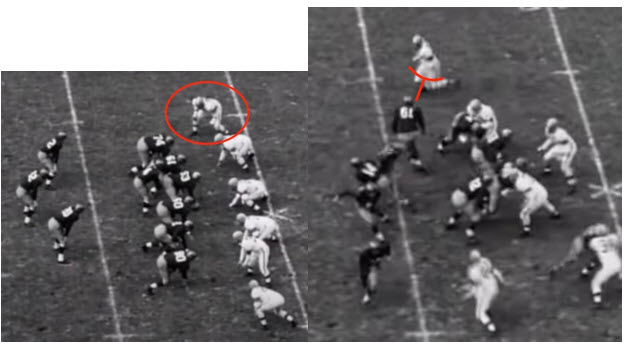
Ford in the ‘Green-and-White intrasquad scrimmage for the Packers and back in his three-point stance

Packer Coach Scooter McLean, a former halfback for the Bears under George Halas, is not the disciplinarian that Paul Brown was, and the team is known for its wild ways; not a good fit for the drinking and partying Ford, nor such partners in crime as Paul Hornung.  An October letter to the Press-Gazette penned by nine fans asked, “(W)hy pay $4.75 to see the Packers on Sunday afternoon when for the price of a drink you can see them any night on the town.” You can understand the famous phone call Bart Starr made to his wife upon meeting Lombardi saying, “we’re gonna’ win now,” in this context.

Ford started the opening game in late September hosting the Bears in City Stadium and logged the team’s only sack, an 11-yard loss, but the Bears prevailed 34 – 20. The following week, Ford was ejected from his fourth league game in the Week 2 matchup against the Lions. Tossed for slugging declining future Hall of Famer Lou Creekmur in frustration after the star continued to hold, the game resulted in a 13 – 13 tie. In Week 3 against the defending champion Baltimore Colts, Ford notched a second sack that was controversially not called a fumble. Per Packer accounts, Unitas was clearly separated from the ball before he hit the ground and there was a clean recovery by rookie Ray Nitschke. Alas, the QB was ruled down. This continued a surprisingly promising start to the year for Lenny, though the Pack lost yet again. From there on out, things deteriorated, Ford only logged half a sack that is known for the remainder of the year and certainly finished with less than five sacks, a disappointing season. Ford admitted that he was playing “quarter-to-quarter.”

Given the difficulty of travel in the era – particularly from remote Green Bay – the team would couple trips to the West Coast at the end of the year. In fact, for the ninth consecutive season, the Pack would travel to the Coast for back-to-back Road games against the two California teams.  In 1958 it was a December seventh tilt in Kezar Stadium against the 49ers followed by a Week 12 closing matchup against the Rams in the Coliseum.

After a bad loss to the 49ers on December 7 the Pack went to Los Angeles to prepare for the season’s final game with just one win and one tie in hand, and rumors that Packer brass was in contact with Curly Lambeau about his returning to the team to replace Coach McLean. The team trained in Brookside Park in Pasadena – the same location Paul Brown had his Browns train when Lenny was there – just a stone’s throw from the Rose Bowl during the week of practice. Lambeau removed his name from consideration publicly but did visit the Pack in camp on Wednesday as speculation turned to the next coach being Blanton Collier, University of Kentucky head coach and former Browns assistant during Lenny’s stint.  

Despite the possibility of being reunited with Collier, mid-week Len Ford said he’ll retire after the finale against the Rams stating, “Circumstances could make me change my mind but right now I’m planning on retiring for good as a player.” A nod to what everyone knew, Ford admitted, “I’m not the football player I was five or six years ago . . . I was faster then and more active.”  Also unspoken, Lenny in far better shape, lighter, and less hooked on the bottle. Astutely, Ford also noted that strategy changes have impacted him, “They used to pull guards out to block against us defensive ends” of course this was when defenses played five-man lines, “which meant that I got a start of two or three steps. With that start, it was easy to just overpower the guard or run around him and just step over the back. Now . . . the tackle plays head-on with us defensive ends. You don’t get those two or three steps anymore”. It turns out Blanton Collier was wrong about moving to a four-man line to get Ford “closer to the QB.” Upon reflection, Ford always played better as a ‘stand-up’ end, even on the five-man line; and his primary pass rush ‘move’ was what would today be called ‘speed-to-power,’ which, as Lenny noted, benefitted from being further from the blocker at the snap.

Finally, on the Friday night before the finale, Ford didn’t come to bed and was first seen walking into practice the following morning. Coach McLean approached him asking where he’d been to which Lenny replied, “I got lost in the fog on the freeway.” Teammate Jim Temp recalled that ‘He obviously got drunk or got some broad. But he was gone’. Scooter’s patience had run out, he had a 1-9-1 record, a team known more for carousing than their play on the field, and an alcoholic aging star showing up late to practice after a full night out. Ford was suspended, the official reason was for ‘breaking training rules’.

The following day in the Coliseum the Packers lined up without Lenny on the line for the first time, the D-Line featured the typical left end Nate Borden at right end, backup Jim Temp replacing Borden at left end and the tackle alignment Hawg Hanner and J.D. Kimmel unchanged. Despite another loss, the Ram game was a surprisingly good Packer showing. After the game, coach McLean said of Ford, “That’s an awful way to finish a great career and he’ll be terribly sorry when he realizes what happened.” The team also refused to pay Ford’s salary for the game $916.66 off his $11,000 annual salary over 12-games.  That would become a matter of contention as the years passed. 

Post Retirement

Post-retirement Ford didn’t meet with the same success as he had on the field. Lenny and his wife divorced in 1959 though they remained close and would often dine together with the children at her home.

In 1960 Ford was fined $150 for a reckless driving charge in Detroit, but this charge and the associated fine were arrived at only after traffic judge George Murphy had reduced the original report of drunken driving.

In December 1961, Ford filed suit against the Packers in Wayne County Circuit Court in Detroit to collect the game check from his final game plus $10,000 for damage to his reputation caused by the Packers' releasing him.

Lenny spent his post-football years working at the Considine Rec Center in Detroit as an assistant recreation director. He attended classes in Detroit but he never graduated with the law degree he sought but most of all Ford struggled with alcohol, a problem that had begun during his playing days. A teammate would remark that you could find Lenny in practice as the player with the snow melted around him as he was “sweating out the alcohol.” In 1958, Lenny’s Packer roommate Nate Borden said Len would get up in the morning, pour a water tumbler full of Vodka and drink it right down. Descriptions of him in his post-playing days are sad. People remarked on his lack of drive, his physical decline, and his inability to move forward. In his later days as alcohol took over Lenny was not taking care of himself.  He lost weight and was in poor physical condition, some certainly due to aftermath of rough play, but some due to abuse. Years later in 1980, friend and ex-Dodger pitching great Don Newcombe, himself a recovered alcoholic, would lament, “(H)is life was decimated because of alcohol . . . He became a wino stumbling around in alleys . . . why didn’t somebody find Lenny Ford and help him?”

In February of 1972, Lenny was hospitalized with a heart condition, Ford suffered a heart attack and died shortly after in the Hospital on March 14. Survived not only by his ex-wife, sister, and daughters but sadly also by his mother – his end coming far too soon. Lenny was laid to rest at Lincoln Memorial Cemetery in Hillcrest Heights, Maryland just across the Anacostia River from where he grew up and played as a kid in D.C.  The plaque at his grave reads, somewhat oddly: “Leonard Guy Ford, Jr., 1926 – 1972, Lenny N.F.L., Cleveland Browns, 1950 – 1959”.


Legacy
As early as 1949, Ford was already considered a college great, even drawing mention along with Bob Mann and Bill Hewitt by a first-term Congressman from Michigan’s fifth district – and ex-Michigan Wolverine football great – Gerald R. Ford in a Touchdown Club Speech on January 8, 1949, in Washington, DC.

In Jim Brown’s 1964 autobiography Off My Chest, he rated Ford as the best defender he ever saw, Gino Marchetti second. He was always considered a tough player up there with the likes of Ed Sprinkle, Leo Nomellini, Bulldog Turner, and Hardy Brown.

In 1969 when the NFL revealed its 50th Anniversary Team Lenny was the second defensive end behind Gino Marchetti. The team technically didn’t field 11 players on defense so only one DE one DT, etc. were selected. This structure technically meant that Ford was an honorable mention or Second-team, though he would be First-team on a squad of 11 that had two DEs. When the NFL issued its 75th Anniversary Team in 1994, Gino Marchetti, Deacon Jones, and Reggie White were the three DEs selected with Lenny dropping off.  

Finally, the NFL's 100th Anniversary Team selected in 2019 had DEs Gino Marchetti and Deacon Jones as unanimous selections and Doug Atkins, Bill Hewitt, Lee Roy Selmon, Bruce Smith, and Reggie White closing out the team. Bizarrely, Doug Atkins and Bill Hewitt each completed their careers prior to the selection of the 50th-anniversary team of which Ford was a member, yet somehow, they leap-frogged him on the 100th.

In 1976 Ford was posthumously elected to the Pro Football Hall of Fame in, at the time, the smallest class the Hall had initiated (tied with 1972’s three-man class) along with Packer fullback Jim Taylor and player/coach Ray Flaherty.  Ford’s family requested that both Morgan State and Michigan be listed on his profile.  Ford was presented for enshrinement by his old high school coach Ted McIntyre and his daughter Deborah accepted on his behalf saying.  “He was guided by the philosophy that winners never quit and quitters never win and if he was alive today, I’m sure he would be a symbol of that wisdom.”  She finished off with, “To my father, who longed for this day . . . Congratulations, Daddy.  You’ve made it”.

A 1977 Pro Football Digest All-Time Team now placed Deacon Jones in the second slot above Ford. Ford was placed in the Hall of Honor at University of Michigan in 1996, the second ‘Ford’ in the Hall, joining former President Gerald Ford.

So where is Lenny’s place in the pantheon of pass rushers?  In our view his peak is on par with the best of all time, as good as that of Gino, Deacon, Reggie, and J.J.; but like J.J. albeit for different reasons that peak was too short to be on the Mt. Rushmore of pass rushers which suites Marchetti, Jones, and White with a great debate for the final spot. Leonard Guy Ford was an all-time great and a marvel to watch but both his athletic peak and his life were unfortunately short making him in many ways a sad cautionary tale.  

Hall of Fame Snubs and Partisanship

 By John Turney 
Tomorrow social media will be full of complaints regarding the three senior candidates who will be chosen—no matter who the three turn out to be.

These are the players who are being considered—
Bengals fans want both their guys to get it. Jets fans are wanting Joe Klecko. Bronco partisans tout Randy Gradishar. And so it goes.

This is proper and to be expected. People want "their guys" to be in the Hall of Fame. However, Hall of Fame fans want the three best players of this group of twelve to be the nominees.

So, you will read "snub" a lot on Twitter and on media sites that cover specific teams. Some of it is venting some of it riles fan bases up. 

We're hoping for the best three.

Sure, there is partisanship on the committee of twelve that will do the cutdown votes and will be narrowed to the three nominees—A writer from city A will fight for "his guy" from city A. The same for a writer from city B—he will push for the player from city B. 

But lets hope that the committee will be fair, look at the credentials, weigh them and vote for the players with the best resume, not the guy they covered as a beat writer. The Hall of Fame is for the truly great, the best of the best and just because city C or D thinks they do not have enough players in the Hall of Fame should not carry any weight—partisans of city C or city D will disagree but they have to look at the full picture and carer about putting in the best first and put partisan interests away. 

Fans and even voters may bring those types of things up, it is only natural but the integrity of the Hall is a higher priority even if fans or voters think it may be unfair to a city to have, in their view, two few representatives in the Hall. 

What is fair is putting the best three of the twelve in—regardless of home fan views. The interests of the Hall outweigh the interest of partisans.

How are the best three to be chosen? There we have to trust the voters, who usually do a good job, to be conscientious in their voting. It does get tricky because each voter has varying criteria for what is a Hall of Famer and who is the best. But as long as they don't let their own biases creep too far in then the selections will be very good. And we think that will happen. We as fans then should weigh and measure those chosen through that lens and not with the lens of  "My guy from my favorite team got snubbed."

The Hall of Fame is not something that is meant to validate your team. It is for the best of the best and the Senior Committee was created to pick those who have fallen through the cracks not to create bragging rights by adding someone from city A, city B, city C, city D, and so on.

Thoughts On The Senior Category Final 12

 By John Turney 
Tomorrow the Seniors Committee of the Pro Football Hall of Fame will meet virtually to choose three candidates for the Hall of Fame. Those three will then be presented to the full committee prior to the 2023 Super Bowl in Glendale, Arizona.

The committee is composed of twelve voters and for the first time, all twelve will be included in the discussions and voting. In previous years a rotating group of five would meet and choose a candidate(s). 

Recently there has been only one senior player who would emerge from this process. In the recent past, there also was a period when two players would be selected. This year there will be three.

Here are our thoughts on the twelve players on the final list who will be considered—

Ken Anderson: Quarterback (1971-1986)
A four-time pro-bowler who started at quarterback for the Cincinnati Bengals from 1971-1986.
Anderson has been on the modern category Final 15 twice. He has four passing titles and an MVP season as well. The knock is he had a few seasons in the middle of his career that were subpar. This "donut hole" is in a sense like Kurt Warner's—who played great for three years with Rams and then the Cardinals he played well and in between he had several years of not-so-spectacular play. 

Maxie Baughan: Linebacker (1960-1970, 1974)
A nine-time Pro-Bowler, Baughan played linebacker for the Philadelphia Eagles (1960-65), the Los Angeles Rams (1966-1970) and the Washington Redskins (1974).
Went to a lot of Pro Bowls but also 1960s Pro Bowls were in a league with fewer teams. He was All-Pro in 1964, 1966, and 1967. He was the defensive signal caller with the George Allen-coached Rams. He had 24½ sacks and 18 picks. He also has a ring as a rookie starter for the 1960 Eagles.

Randy Gradishar: Linebacker (1974-1983)
Centerpiece of the “Orange Crush Defense,” Gradishar played all 10 seasons as linebacker for the Denver Broncos, seven of which were Pro Bowl years.
Gradishar stands out in that he was the NFL Defensive Player of the Year in 1978 and was third in the voting in 1977. He was All-Pro in 1977, 1978, 1979, 1980, and 1981 and Second-team All-Pro in 1983 and was also All-AFC in 1976 and never missed a game. He was also the first 3-4 inside linebacker to make an All-Pro team—breaking the 4-3 middle linebacker streak.

Historian TJ Troup said this, "(B)ased upon film study and what I learned from Billy Thompson Randy had pass defense responsibilities no other inside linebacker ever had before or since"

It is odd that there is no member of the Orange Crush honored in the Hall of Fame, from the mid-1970s through the early 1980s they were consistently among the NFL's best in defensive passer rating and in stopping the run.

Chuck Howley: Linebacker (1958-59, 1961-1973)
Being the only player on a losing team to win Super Bowl MVP (Super Bowl VI), Howley received six Pro Bowl selections and five first-team All-Pro selections while playing for the Chicago Bears (1958-59) and the Dallas Cowboys (1961-1973).
A Paul Zimmerman favorite who wrote that Howley was among the best weak-side linebackers ever. He was, like Baughan, able to rush the passer (26 sacks) and cover well (25 picks) and throw in 18 recovered fumbles. He has a ring and also a Super Bowl MVP trophy. 

Though Dr. Z touted Howley as a weak-side great, remember that he played the strong side (called Sara in Dallas terminology) more than "Wanda" (Cowboys term of weak-side or "Will" position).

Cecil Isbell: Tailback/Defensive Back/Halfback (1938-1942)
Of Isbell’s five playing years with the Green Bay Packers (1938-1942), he had four Pro Bowl appearances. 
Isbell was the thrower and Don Hutson was the record-setting pass catcher. He was All-Pro twice and Second-team All-Pro three times and led the Packers to one NFL Championship. 

Joe Klecko: Defensive End/Defensive Tackle/Nose Tackle (1977-1988)
A member of the famed “New York Sack Exchange,” this defensive powerhouse had four Pro Bowl selections and two first-team All-Pro honors in his 12-year NFL career, all spent with the New York Jets. 
Klecko is akin to Howie Long and Dan Hampton. He played multiple positions well. He led the NFL in sacks in 1981 with 20½ and in 1985 was the top NFL nose tackle—and was All-Pro both seasons. He was also a Pro Bowler as a 4-3 defensive tackle in 1983 and 1984. Earlier in his career he played 3-4 defensive end as well.

Bob Kuechenberg:  Guard/Tackle/Center (1970-1983)
A member of the Miami Dolphins Hall of Fame and a six-time Pro Bowler, Kuechenberg spent the entirety of his 14-year career as a member of the Dolphins.
A two-time First-team All-Pro and a Second-teamer once and also an eight-time modern-era finalist . He was the model offense guard according to John Hannah and Joe DeLamielleure. Some say he was the best offensive linemen on those great Dolphins teams. A master at the trap block and could lead sweeps and well and showed great balance in pass protection. If the Hall voters like textbook players, Keuch qualifies

Eddie Meador: Cornerback (1959-1970)
Meador played his entire career with the Los Angeles Rams, where he earned selection to two first-team All-Pro teams and six Pro Bowls. He is a member of the NFL’s All-Decade Team of the 1960s. He finished his career with 46 interceptions, which remains a Rams franchise record.
A three-time All-Pro (two consensus) Meador began his career as a cornerback and he moved to free safety in 1964. TJ Troup noted that Meador, "(H)is knack for a key takeaway, and his tackling ability place him above all the other candidates."

Meador was a great placekick holder who could run a fake into the end zone and is the Rams all-time leader in blocked kicks with 12.

Tommy Nobis: Linebacker (1966-1976)
Nobis was the first player the expansion Atlanta Falcons drafted and played his entire career in Atlanta. He won NFL Rookie of the Year, played in five Pro Bowls, selected first-team All-Pro (1967) and is a member of the NFL’s All-Decade Team of the 1960s.
Nobis was stuck on a lot of poor teams and still played well. However, he was First-team All-Pro just once and Second-team once. He also didn't pick off a lot of passes, recover a lot of fumbles, or total a lot of sacks. So, compared to the other linebackers his "stat" box is not checked.

Ken Riley: Cornerback (1969-1983)
Riley played his entire career with the Cincinnati Bengals and recorded 65 career interceptions, more than any other player not already in the Hall of Fame and the most by a player who saw action exclusively at cornerback. He was named first-team All-Pro in his final season.
His case is simple and divisive in some ways—If you go by his interception total and you think the Bengals are getting shorted by Hall voters you think he's a Hall of Fame. If you go by post-season honors (All-Pros and Pro Bowls) you don't think he belongs. In most cases, Hall of Famers check the "stat" box AND the "honors" box. Riley could be the exception.

Sterling Sharpe: Wide Receiver (1988-1994) 
Sharpe made five Pro Bowls and three first-team All-Pro teams during his seven-year career with the Green Bay Packers. His 18 touchdown receptions in his final season is still good for third best all-time.
He had a career like Terrell Davis and Dwight Stephenson in that he had a high peak but an injury ended his career early. Probably the second-best wide receiver behind Jerry Rice over the course of his career. He checks the stat box and the honors box but not the "longevity" box nor the "ring" box. It will be interesting to see how far he goes given that usually skill players often get the benefit of the doubt and the blockers and tackles have a tougher row to hoe.

Everson Walls: Cornerback (1981-1993) 
Playing most of his career with the Dallas Cowboys, Walls made three first-team All-Pro teams, four Pro Bowls and led the NFL in interceptions three times while in Dallas. He finished his career with the New York Giants and Cleveland Browns and helped New York to victory in Super Bowl XXV.
Walls had 57 interceptions, just eight fewer than Ken Riley, in an era where the league-wide interception percentages dropped from 5% (1969-83) to 3.9% (1981-93). He has a ring and was a three-time First-team All-Pro and had three interception titles. 

Walls played for three teams, after leaving Dallas he went to the Giants, playing for Bill Belichick's defense, and then was signed by Belichick to play corner for his Browns teams. Belichick must have liked something about Walls.

Sunday, August 14, 2022

The Story of Len Ford: Rectifying a Diminished Legacy—Part 4

By Nick Webster 

Len Ford and Otto Graham

Remaining at the Top

1952 was a great year for pass-rushers. The same season would see Norm Willey’s famous game in the Polo Grounds where he logged 15, er 13, er 11, er 8 sacks. Gino Marchetti (who would later join Ford on the first All-Time NFL Team) would jump onto the scene as a rookie for the ill-fated Dallas Texans and a young second-year Ram named Andy Robustelli would round into form.  But sack counts aside – the numbers aren’t sufficiently complete to determine who definitively led the league in sacks in 1952 – the end the league was most concerned about was Len Ford.

The Browns opened 1952 avenging the championship loss against Los Angeles at home. Lenny, now wearing #80 as the NFL changed its uniform number guidelines after the 1951 season, had a relatively quiet day on the pass rush. However, for the second time, Lenny was dismissed from a game, this one certainly better deserved than the 1950 booting, after a fourth-quarter fight with Bill Lange. Ford exclaimed, “He’d been annoying me all afternoon and I couldn’t take it any longer”. Sounding like a player who deserved to be tossed. Though one must consider that Lange’s collegiate career ended in 1950 when he was tossed from his Dayton game against Chattanooga on Thanksgiving Day for slugging an official; this wasn’t a matchup of two choir boys.  Controversy always swirled around these incidents of Ford’s. Lange later claimed that Ford was confused and that he’d only entered the game three plays earlier.

There is no film of the Rams tilt to open the year, but we do know that in the weeks following Lenny went on a tear notching sacks in seven consecutive games from Week 2 at Pittsburgh to Week 8 at home versus the Steelers. Ford topped out with 3.5 of the team’s seven sacks in the October 26 home matchup with the Redskins. Ford’s mercurial personality came out in that ‘Skins tilt, having bloodied little Redskin QB Eddie LeBaron’s nose Lenny was purported to have gently picked LeBaron off the ground and beg, “I’m awfully sorry, but I hope you understand that I’m just doing my job.” October 26 was also the day where the Eagles and Norm Willey tore into Giant QBs in the Polo Grounds and the traveling Dallas Texans, with rookie Gino Marchetti leading the charge, nailed 49er Y.A. Tittle for 95 yards lost and likely 10 sacks. Were records complete, it might have been the greatest pass rush weekend in NFL history. Ford followed the 3.5 sack Redskin game with a 2.5 sack road game against Bobby Layne and the Detroit Lions.    

Ford is still the ‘sprung-coil’, the Skins try to block him with the ‘flaring guard’ strategy here Gene Pepper

Ford had at least 14 sacks in the 12-game 1952 season as the Browns again won their division but disappointingly lost the Championship game to the team who would be their new nemesis, the Detroit Lions. The 14 sacks are the most any player is known to have had in 1952, though depending on what you believe about Norm Willey, Gino Marchetti, or Andy Robustelli he might have been eclipsed.  We do know that to that point in the season on October 26 Willey had been used sparingly at end and likely picked up his first sacks of the season in that Week 5 game. Robustelli had 10.5 known sacks in ’52 though if you assign the Rams’ 16 missing sacks pro-rata he’d land with 16 (the same approach for Ford and the Browns – with only five sacks missing – would land him on 15.5). Marchetti is a difficult case as so little exists on the nomadic Dallas Texans. He had three sacks in a spectacular debut at home against the Giants, could they block any quality pass rushers in 1952, and had 6.5 known sacks though the Texans had 30 missing sacks on the season including eight missing from that game at San Francisco where Gino had 1.5 of the two sacks accounted for. We may never know for certain who led the NFL in sacks in 1952, but we know for certain that Ford was among the leaders and most well regarded.
 
At season’s end Ford was again the only consensus First-team All-Pro end with Pete Pihos and Larry Brink sharing honors among AP, UPI, and New York Post. However, if it were voted on today, Night Train Lane and his historic 14 interceptions would win Defensive Player of the Year. But in that era players were required to establish themselves prior to receiving high honors and, in fact, Lane only received honorable mention as defensive halfback with five different players receiving some First-team honors, including Lane’s teammate Herb Rich. Given that only middle guard Stan West and defensive tackles Arnie Weinmeister and Thurman McGraw were also consensus first teamers you’d have to consider that Ford would receive votes and possibly win a 1952 Defensive Player of the Year.

The Browns would lose the 1952 Title to the Detroit Lions who would – over the course of the next few years – battle back and forth with the Browns for Team of the Decade Honors.
Doug Atkins (83)
In January 1953, again at the Bellevue-Stratford Hotel in Philadelphia, the Browns selected another future Hall of Fame defensive end, Doug Atkins of Tennessee. Atkins came out of Tennessee at 6’8” 240 pounds. with a pedigree as both a Football and Basketball star, perhaps Paul Brown thought he was getting Len Ford 2.0. Atkins was a 1952 All-American at defensive tackle and despite a very disappointing performance in the Vols Bowl Game against Texas, he was tabbed as a top end in the draft, in part because his height would disqualify him from eligibility from the Military Draft.  Offseason speculation would swirl around exactly what the Browns rotation would be at end, though the general expectation was that Ford would continue at right end with Atkins stepping in for George Young at left end.

Ford suffered nicks and bumps during the preseason and wasn’t 100% going into the ’53 season with nagging foot injuries. In the opener in Milwaukee County Stadium against the Packers, Ford and Atkins did start at right and left end, respectively, with a healthy dose of George Young spelling the ailing Vet and the Rookie. Lenny and Doug showed very little and didn’t post a sack against a Packer team whose pass protection was far from the best in the league. The following week, however, Ford showed he was still at the top of his game posting three sacks for 11, nine, and 10-yards. There is unfortunately little published about the Week 4 contest against the Eagles, a game in which Lenny and Don Colo are known to have split a 12-yard sack, which unfortunately leaves 51 yards of sacks (likely five sacks) unaccounted for by the Browns. This is an outing where accounts indicate Lenny had a great game, the Pittsburgh Courier saying he was “ranging all over the field, breaking up plays before they started, and bringing down ball carriers with vicious tackles. Ford participated in at least 60 percent of the Browns tackles during the contest”- certainly an exaggeration, but the point remains.  

Ford registered two, one, and one sacks in weeks 4 – 6 to complete a five-game stretch with at least 7.5 sacks, and likely more. However, Lenny would go sackless for the three games that followed and Atkins (who missed weeks 4 – 6 with injury) was slow to work his way up to expectations. The Browns defense performs well as a whole, however, first in points allowed leading them to an 11 – 1 record, though the line play is slightly off with Ford posting 10.5 known sacks (probably a couple more, particularly in the Eagle game) but with Atkins not playing up to George Young’s prior level, and with Bill Willis at 32 finally showing his age, posting just one sack after 11.5 and eight in each of the previous two seasons.

In 1954, both the league as a whole and the Browns were in the process of shifting to a four-man line.  While many squads accomplished this by dropping the conventional Nose guard into what would become the middle linebacker position Willis sometimes drops, but sometimes stays on the line in four-man fronts, typically as the right defensive tackle. In later years, Blanton Collier would say part of their motivation in going to the four-man line was to get Ford closer to the passer; this is likely apocryphal; the entire league was moving in the same direction and Lenny’s most devastating play was from a five-man line. But Ford was still the physical freak that scared teams in 1953, it would become lore decades later that his running-mate Atkins was a freak who hurdled blockers.  In fact, in 1953 it was Ford who could still leap tall buildings in a single bound and from whom Atkins was learning. Lenny still did things nobody else could. Not much is made of Ford grooming and bringing Atkins along, yet in 1953 Ford is primarily a stand-up DE, even when they go to a four-man line and Atkins – possibly a function of having been primarily a tackle in college – plays with his fist in the dirt.  
Nov first, 1953 Against Washington, Ford blows by the tackle trying to block him

Approaching the oncoming help from the RB, Ford leaps

Hurdling, landing and hitting the passer causing an errant throw

Doug Atkins, now with the Bears, shows what he learned from Lenny leaping over a blocker in this 1957 clip

Following the 1953 season, Ford is again the lone consensus All-Pro at defensive end with Robustelli and Norm Willey each splitting First-team slots in two of the four primary teams. Gene Brito probably doesn’t get the awards attention he deserved in his first year fully focusing on defense. At this point, it’s clearly Ford, Robustelli, Willey, and Brito who are at the top of the game. Film study shows, however, that while Brito is extraordinarily effective, he is a different “finesse style” defensive end, using speed and agility but rarely power, to make plays in the backfield, and he cannot hold the edge against the run like Lenny.  A Defensive Player of the Year probably goes to a defensive back with Jack Christensen of the Lions or Tom Keane (part of the same AAFC dispersal draft as Lenny) of the Colts would be likely leading the tally, though again, Lenny would be on the list.

In the post-season the Browns are again disappointed in the championship game by Christensen’s – really Bobby Layne’s – Detroit Lions, a second straight disappointment in a Title game, this time by a single point.
 
As the 1954 season approached, Ford began experiencing some minor injury problems typical of a defender accumulating wear and tear. Just as problematic, Atkins was not developing at the left end as Paul Brown would hope and the Brownies headed into their first season without Bill Willis, now retired, in the interior. As a team, however, the Browns’ D finished first in the league in points allowed for the third time in their five years in the NFL, finishing second in each of the other years; but they were doing it differently.

Through three weeks the Browns as a team totaled just two sacks, and Ford had no confirmed sacks, though one of the two sacks is unidentified. Following the third game at Pittsburgh Paul Brown replaced Doug Atkins with the diminutive end Carleton Massey, a rookie from Texas.  On the right side Ford was called out as performing, “below par.” According to the Plain Dealer he, “didn’t seem to have his customary zip during the practice schedule.  However, that was attributed to the fact that many of the experienced gridders use the exhibition for conditioning, so they’ll be ready when the bell rings.  The bell tolled a month ago and Lenny still isn’t operating at anything near his usual efficiency.” The change to Massey at left end jarred something as the Browns netted three sacks in the fourth game, more than in the season to date, with the Plain Dealer noting that the “line looked better than it has all season with ends Carlton Massey . . . and Len Ford giving Lamar McHan a bad afternoon.” By November Ford, along with Massey, was operating “as well as ever,” probably having shed some extra offseason weight. Against the Giants at the Polo Grounds, Ford notched two sacks and teamed with Walt Michaels to knock Charlie Conerly out of the game. Ford and Massey both constantly pressured the passer and Paul Brown praised the D-Line.

The following Week, the tenth of the regular season, Len Ford missed the Browns charter flight to D.C. on Saturday, the day before the game. Knowing what would come later in his career and life, one wonders if the offseason weight gain coupled with this transgression were the first cracks beginning to show as Lenny was perhaps starting to let his personal issues with alcohol and self-control affect his play. Ford did make it to D.C. and the Browns won the matchup clinching a share of the title, but the D-Line didn’t log a sack. However, Lenny was constantly double-teamed and drew an intentional grounding penalty with the papers noting that he turned in, “his usual strong game”.  

To the eye, Lenny is taking more plays off and not chasing plays away with the same vigor as in prior seasons. He’s not as solid in holding the edge against the run as in ’51 – ’53, but he constantly attracts double-teams and is still exceptionally effective when motivated. By season’s end, Lenny had regained his form after an admittedly slow start. Ford is named team MVP and is consensus First-team All-Pro for the fourth consecutive season alongside his first consensus running mate with Eagle end Norm Willey picking up those honors. Lenny is still considered a top – or top two – end in the league with Gene Brito off playing his trade in Canada for a season and Gino Marchetti in just his second season at DE after experimenting on the offensive Line in 1953.

The Browns end 1954 on a high note finally taking the Championship back from the Lions after losing in each of the previous two Title games to Bobby Layne’s team. The Browns trounce the Lions 56 – 16, and Lenny nabs two of the six Browns interceptions. In the Pro Bowl in early January, Lenny again shows up big, with the East defense powering the first two TDs.