Thursday, February 23, 2023

Is Justin Jefferson’s 2022 Season the Best-Ever by a Vikings Receiver?

 By John Turney 
Being a consensus All-Pro, and a consensus Offensive Player of the Year ought to seal the deal for being the best-ever season by a Vikings wideout, right?

After all, Justin Jefferson did those things and more.

He led the NFL with 1,809 receiving yards, something no Viking had ever done, and it also set a team record. 

So is it the best?

It would be tough competition - the Vikings have been blessed with quite a few great receivers over the years - Randy Moss, Cris Carter, Ahmad Rashad, and others. 

So, where would Jefferson's 2022 season fall among the career years of those others?

Taking the best season from each great Vikings receiver and ranking them, based not only on stats but taking into account the era they played and also considering post-season honors from both major sources like the Associated Press (AP) and Pro Football Writers of America (PFWA) but All-Pro teams picked scribes who are in the writers' wing of the Hall of Fame, here is one take on the top seasons by wide receivers in Skol-land.

The list—

20. Hassan Jones, 1990 - Jones had 810 receiving yards and seven touchdowns, and three 100-yard games. He had been second fiddle to Anthony Carter for a few years and he filled that role pretty well. They'd been to playoffs three previous seasons but the wheels came off in 1990 but Jones kept it together and had a good year. 

19. Bernard Berrian, 2008 - A ninety-nine-yard touchdown catch propelled his yards per catch to 20.1 yards, still the sixth highest in team history among qualifiers and the highest in twenty-one years at the time. He ended the season with 964 yards and seven scores.

18. Bob Grim, 1971 - The Vikings got Grim as part of the bounty from the Fran Tarkenton trade four years earlier and 1971 was the only year he really contributed. 

He caught 45 passes for 691 yards for seven touchdowns and added 127 yards on end-arounds and reverses and went to the Pro Bowl, showing that in football's dead ball era 800 yards from scrimmage could get a wide receiver some recognition. 

After the season he was part of the package the Vikings sent to the Giants for - - Fran Tarkenton.

17. Nate Burleson, 2004 - When Randy Moss went down with an injury in 2004 the second-year wide receiver had to pick up the slack. 

In the five games Moss missed (he actually started two of them but had a total of one target in them), Burleson had two 130-yard receiving games and ended the year with 1,006 yards and nine touchdowns. 

16. Leo Lewis, 1984 - Little Leo was a slot guy, mostly coming off the bench on passing downs, the 5-8, 170-pound Lewis started a handful of games at split end due to injuries to Sammy White. But, during a disaster of a season for the Vikings, he was a bright spot, leading the led the team in receptions, receiving yards, and touchdowns. 

15. Stefon Diggs, 2019 - Diggs' talent level is higher than fifteenth on any list, but in this era 63 catches for 1,130 yards and six touchdowns is decent, but not stellar, though his 17.9 yards per catch is very good for recent years. The next season in Buffalo is when he began to have career years, but he was just getting started in Minnesota.

14. Paul Flatley, 1965 - By the mid-1960s coach Norm Van Brocklin had made the expansion Vikings a fairly competitive team and Flatley was the outside playmaker for those squads. 

He was the NFL Rookie of the Year in 1963 and was a Pro Bowler in 1966 but the previous season was his career year. He caught 50 passes from Fran Tarkenton for nearly 900 yards for nearly eighteen yards a catch and nine touchdowns. 

13. Sidney Rice, 2009 - In seven NFL seasons, Rice had only one good one. It was the year Brett Favre arrived and took, with Rice's help, the Vikes to the NFC championship game. Rice's 1,312 yards and eight scores took him to the Pro Bowl.

12. Jake Reed, 1996 - Reed was on the verge of being cut when one of his coaches suggested they get his eyes checked. The doctors found an issue - he needed glasses. Once fitted for them Reed's career was recharged. 

He had four very good seasons in the mid-1990s but lost his starting job in 1998 when a rookie named Randy Moss arrived on the scene. His career year was probably 1996 when he had 1,320 yards receiving and averaged 18.3 yards a catch.

11. Adam Thielen, 2018 - In his career year, Thielen did a very good Wes Welker impression. He caught 113 balls for 1,373 yards and nine touchdowns and was voted to the Pro Bowl. 

He dropped just three passes and his catch percentage was 73.9 percent and his first-down-to-target percentage was the highest of his career.  In 2020 he caught 14 touchdowns and that year was considered but he dropped more than double the passes and some other metrics were not as high. 

10. Percy Harvin, 2011 - Harvin's biggest fan, Brett Favre was gone but Harvin stepped up his game. In addition to Harvin's 967 receiving yards he had 345 rushing yards plus he returned kicks for 520 yards. 

Only two players in the history of the NFL have had 900-300-500 in those three categories in the same year.  The other? Lionel James of the 1985 Chargers. 

9. Sammy White, 1976 - White burst onto the scene in 1976 and was the NFL Rookie of the Year and a Pro Bowler. He had 906 receiving yards (then third-best in team history) and ten touchdown receptions, one short of the team mark. He also caught three more touchdowns in the playoffs, including one in Super Bowl XI.

8. Jerry Reichow, 1961 - In the Vikings' inaugural year former Lion and Eagle flanker caught eleven touchdown passes setting a record not broken by a Vikings receiver until thirty-four years later when Chris Carter caught seventeen. 

Thirty-four years.

In the league opener, a 37-13 shocker over the Chicago Bears, he caught three passes for 103 yards and a score. In the season finale, also against the Bears he caught six for 90 yards and three touchdowns. Apparently, Reichow knew how to beat the Bears' coverages.

For the season, Reichow caught fifty passes for 859 yards and a 17.2 yards per catch average and was one of two Vikings that went to the Pro Bowl. 

For a receiver on an expansion team to put up those kinds of numbers is special.

7. Gene Washington, 1969 - In this era choosing a 39-reception season to be sixth on a list of career years may look odd to some younger NFL fans. 

It is one of those IYKYK (if you know you know) things. In that era, teams like the Vikings (or the Dolphins, Cowboys, Rams, Steelers, and others) did not throw the ball a lot and relied on strong defenses, and a year like Washiington's was noteworthy 

In fact, he was All-NFL according to Pro Football Weekly and the New York Daily News and second-team All-Pro both by the AP and UPI as well as being a Pro Bowler. 

For receiving numbers in the NFL and changing eras context matters.

Consider this:  In 1969 the Vikings only threw 2,498 yards and 24 touchdowns as a team and Washington caught 32.9 percent of the total team passing yards - a higher percentage than Cris Carter's 1,371 yards were for the 1995 Viking passing yardage total. 

Even though the Vikings fell short of winning the Super Bowl, in the playoffs Washington caught eight passes for 219 yards (27.4 average) and a score.

6. John Gilliam, 1972 - Gilliam's story is similar to Washington's but he had four excellent campaigns in the Twin Cities. He played a role for the Vikings that Paul Warfield played for the Dolphins or Bob Hayes did for the Cowboys in their glory days - maybe only catch 40 balls a year but they'd go for over 800 yards and maybe eight touchdowns.  

More importantly,  receivers like Warfield, Hayes, and Gilliam would keep defenses honest, not allowing them to pack the box and stop the running game. Having a deep threat was important and having a great one, and Gilliam was one, was even better. 

When Gilliam arrived and Fran Tarkenton returned in 1972 the Vikings went just 7-7, not what was expected, but they were Super Bowl contenders the rest of Gilliam's tenure but 1972 was probably his best season in purple.

He caught 47 passes for 1,035 yards and seven touchdowns and his 22.0 yards per catch led the NFL, he was also a Pro Bowler and his year drew notice from Paul Zimmerman in his pre-Sports Illustrated (SI) days. Then, Dr. Z was writing for the New York Post and he chose Gilliam for his Post All-Pro team.

5. Ahmad Rashad, 1979 - On ABC's Monday Night Football, Howard Cosell had a habit of calling Pittsburgh Steeler wide receiver Lynn Swann the "Practically perfect wide receiver." When Fran Tarkenton was on the telecast and Rashad was playing he'd retort by saying that Rashad was the "Nearly perfect wide receiver".

Tarkenton was right. Rashad was as talented as anyone in his era. 

In 1979 he set career highs for catches, yards, and touchdowns and was second-team All-Pro and was voted to the Pro Bowl, and like Gilliam, Rashad's career year was noticed by Paul Zimmerman, then with Sports Illustrated, who picked him for his personal All-Pro team. So did Joel Buchsbaum, the talent evaluating guru for Pro Football Weekly, who chose him for the Gannett News Service All-Pro team.

4. Cris Carter, 1995. In 1994, Cris Carter was a consensus All-Pro and in 1995 he was a second-team All-Pro. But the numbers favor the latter season as his career year. The competition at wide receiver was just tougher for the post-season honors.

He tied his career high in receptions (set in 1994) and set highs for yards and touchdowns, leading the NFL with 17. 

Carter was no speedster, but he could run well enough but what he will always be known for is his tremendous hands, the ability to get both his feet down for sideline catches, and his fade routes in the end zone that accounted for so many of his touchdowns. Those are his"things" if you will.

3. Anthony Carter, 1987. For Carter, the announcer that had a pet saying about him was John Madden. On CBS telecasts when the Vikings were playing, he'd say, "If I coached Anthony Carter I'd write myself a note and the note would say, 'get the ball into Anthony Carter's hands at least ten times in this game.'" 

Madden was an Anthony Carter fan.

In 1987 Carter didn't have a 1,000-yard season but it was a strike year, but on a per-game average 1987 was his top season but by just a hair over 1988. But, add in his playoff totals for both seasons and it is not close - 1987 was better in yards per game and it's not particularly close.

He set the team record for yards per reception at 24.3 and was chosen All-Pro by USA Today, was 
a second-team All-NFC pick, and a Pro Bowler. 

He was uncoverable in the NFC playoff game in San Francisco catching ten passes for 227 yards and also carrying the ball once for 30 yards. 

It was a terrific year.

2. Justin Jefferson, 2022 - Nope. Jefferson still has time but he does not yet own the best season by a Norseman wide receiver. 

This year was a great one, though.

As was previously mentioned he led the NFL in yards receiving and in catches. He was the Offensive Player of the Year, a consensus All-Pro, and a Pro Bowl starter. 

His 1,809 receiving yards are almost 200 more than the previous record. And he's only 23. He was plenty of time to overtake the top player on the list.

1. Randy Moss, 2003 - Cris Carter left after the 2001 season so Moss was on his own for the second year and he was in Scott Linehan's offense for the second year as well. Quarterback Daunte Culpepper was terrific in 2000 but had a couple of down years but things clicked in 2003.

Moss had to transform himself into more than just a deep threat, with Carter gone he had to run more underneath routes, go across the middle more, and be a more complete receiver. He also showed more maturity and leadership. 

All of it worked and Moss had his career year with the club.

Moss broke his own team record for receiving yards with 1,632 and tied the team record for touchdown passes held jointly by himself and Cris Carter with 17. 

All the honors followed - consensus All-Pro, Pro Bowl, and was voted the NFC Player of the Year by the Washington Touchdown Club.

He'd had other tremendous All-Pro years before, but in 2003 he put it all together and though the team didn't have the success it had his rookie year (a field goal short of the Super Bowl) it was a year no one could accuse Moss of quitting in a game or a season. He dominated all year. 

It's just too bad the Randy Ratio didn't last. Within two years Moss was traded away from the Vikings to Oakland and a couple of years after that it took a fourth-round pick from Bill Belichick to resurrect his career in New England.

Tuesday, February 21, 2023

Chet Mutryn and the Marshall Faulk Number

 By John Turney 
Chet Mutryn
The famed Bill James, a pioneer prophet of sports analytics religion, has inspired more than one generation of fans into developing and refining statistics and metrics, and also challenging and reformulating said statistics and metrics. And it has been good for sports. 

The metrics or sabermetrics movement started by James began with baseball, his area of expertise, and has spread to football, basketball and likely every other sport.

James has developed too many metrics to mention but one we find interesting is his Power-Speed number. 

It was intended to measure a baseball player's ability to hit home runs and steal bases. Rather than just adding up the total of home runs and stolen bases and dividing by two and getting a mathematical mean he used the harmonic mean of the two. 

The mathematical mean would not give the desired result.

 A player with 10 home runs and 50 stolen bases and a player with 30 stolen bases and 30 homers would have the same average or mean. As would a player with fifty dingers and ten swipes of bases.
The harmonic mean solves that issue. 

On the website, Baseball Reference succinctly says, about the Power-Speed number, "To do well you need a lot of both".

PFJ's Nick Webster has used the same method for defensive linemen using sacks and tackles for loss to roughly measure performance in playing the pass and the run—to do well one needs a high number of sacks and a high number of tackles for loss on run plays.

Over twenty years ago Stats, Inc., now called Stats Perform (STATS) used the same method to measure running backs that rushed for a lot of yards and had a lot of yards receiving. They called it the "Marshall Faulk Number" and published it in one of their annual publications called the "STATS Pro Football Scoreboard". At the time Faulk was rushing for 1,000 yards and catching passes for near or over that number so they named it after him.

Why it wasn't called the Roger Craig Number we don't know, he rushed for over 1,000 yards and caught passes for over 1,000 yards in 1985, the first in the NFL to do it. 

Regardless, STATS used the harmonic mean of rushing and receiving totals rather than the mean for the same reasons James did in the Power-Speed number.

Here is a similar example to the home runs and stolen bases graphic—

However, since the turn of the century, we've not seen STATS update their list. 

So we took the liberty of doing so, but also applied the number per scheduled game since schedules have varied over the years from ten, eleven, twelve, fourteen, sixteen, and now to seventeen games. The more games in a season the easier it is to achieve the higher number.

So, Faulk is still at the top but Christian McCaffrey's 2019 season is close. Craig's 1985 season has fallen to sixth. 

There are also names football fans would expect to see as well, all-around backs who run and catch well.

But was is most interesting to us is the player at twenty-six—Chet Mutryn who played for the Buffalo Bills of the AAFC. In 1948 he had 823 yards rushing and 794 yards receiving. When prorated to a 16-game schedule that would produce a Faulk number of 923.7 yards, better, for example, than any season Marcus Allen had in that metric.  

Lenny Moore and Frank Gifford are higher on the list, but they are more well-known. They played in the National Football League, not the All-American Football Conference (AAFC),  and won NFL championships and both are in the Pro Football Hall of Fame. 
Mutryn? Even hardcore fans would have trouble summoning up recollections about him. It's hard to even find a decent photo of Mutryn online.

In many ways, he was typical of many of the players of his era. 

He was a do-it-all star in college and was drafted by the pros, his career was interrupted by WWII, he served in the military, and then returned and played pro football. 

Collegiately he starred at Xavier college in Ohio where he was twice Little All-American and was inducted into the school's athletic Hall of Fame. He was drafted by the Eagles but his Naval service delayed any thoughts of pro football right away, anyway.

After the War, he returned to finish his degree and the Cleveland Browns of the newly formed AAFC acquired him but quickly shipped him to Buffalo to show off his wares. 

Mutryn was a player who could run, catch, block, return kicks and punts with the best of the halfbacks on his era. And like the George McAfees, Bill Dudleys, Whizzer Whites, and others he could throw you a pass or kick the ball if you needed him to.

He played left halfback in the T-formation offense which was the most-utilized scheme of the era. It was a Clark Shaughnessy-developed offense and in it, the backs could run the ball or almost as often motion horizontally into either flat and then turn upfield or sometimes check through the line of scrimmage vertically and then turn horizontally. And if there was time, a route could be up out and up. 

Game films will show teams like the Cleveland Browns, the Los Angeles Rams, the Philadelphia Eagles, and almost everyone but the Pittsburgh Steelers (who still ran the single-wing), doing similar things but Mutryn had the speed to really make it work, to get deep. 

In 1948, his "Faulk Number" season, he helped get the Bills to the playoffs, where they won a game before getting trounced in the championship game by the mightly Browns, and was a consensus All-AAFC. 

Back then there was no award for offensive player of the year but if there were Mutryn would have been a strong contender for it. He tied for the league in rushing touchdowns (with ten), led in yards per reception (20.4), yards from scrimmage (1,617), kickoff return average (26.3), all-purpose yards (2,248), total touchdowns (16), scoring (96 points), and had the longest run (68 yards). 

Yards from scrimmage was not kept as a statistic at the time, it wasn't until much later that Elias Sports Bureau added it to the list of official figures released in the "NFL Record and Fact Book". However, looking back it is interesting to note Mutryn's 1,617 yards from scrimmage would have been a combined NFL-AAFC record until someone named Jim Brown came into pro football and obliterated it again and again.

His 2,288 all-purpose yards, adding yards from scrimmage plus return yardage, again not a thing yet, would have been the pro record until 1962 when the Eagles' Timmy Brown topped it. 

And think about this:  In 1965 Gale Sayers was a rookie, tearing up the NFL running, receiving, returning kicks and punts and being a general menace his all-purpose yardage total was sixteen yards fewer than Mutryn's 1948 total.

It wasn't just about a single season with Mutryn, either. Though his career was just five years he did have other achievements. He was All-AAFC in 1947 and 1949 in addition to his banner 1948 season and after he played a single season in the NFL with the Baltimore Colts (they green and silver franchise than went belly up after the 1950 season) he retired, refusing to play for the Philadelphia Eagles who had obtained his rights.

He finished his pro career with 3,031 rushing yards, 1,850 receiving yards, 1,902 yards on kick returns, and returned punts for 537 yards. At first glance, those numbers don't catch your eye, but he was the first professional player to be part of a 3,000-1,300-1,500-500 club of those respective yardage categories.

And that is important. 

Three years later Hall of Famer Bullet Bill Dudley joined Murtyn in the club. It has been seventy years since Dudley retired and there have only been fourteen more members who have been added to the roster. 

Fourteen. And five are in the Pro Football Hall of Fame - it's a pretty elite group.

Not only are there few new players with those all-around numbers, but Mutryn has the highest yards per rush, yards per reception, and average punt return and has the second-highest kick return average, just one-tenth a yard behind Ollie Matson. 

(click to enlarge)
Perhaps the mostly forgotten Mutryn needs to be remembered a little bit more. And can someone find some good shots of him?

Saturday, February 18, 2023

Billy Hillenbrand—One of the First-Dual Threat Running Backs

 By John Turney 
Bill Hillenbrand of the Baltimore Colts carrying the ball versus the Buffalo Bills
Billy Hillenbrand only played three seasons of pro football but he left his mark on the game, one that few know about. 

He was a University of Indiana legend, once being voted the top gridder in that school's history. As a junior, in 1942, he led the NCAA in punt return yards and punt return average and was a consensus All-America selection. The previous season he got some All-American notice as well.

Hillenbrand served in the Army from 1943-45, during which time he was drafted in the first round by the New York Giants but never played for them. 

When he returned from WWII the Giants offered $7,500 a year but the Chicago Rockets of the upstart All-American Football Conference met his asking price of $10,000 and more to Hillenbrand's liking, offered a three-year contract, so he signed and was off to the Windy City.

In 1946 the Rockets had a crowded backfield with Bob Hoernschemeyer, Elroy Hirsch (who both went on to become NFL stars) and other similar types of players competing for the ball and Hillenbrand carried the ball just fifty times all season which was fifth on the team.

So being stocked at halfback, the Rockets traded Hillenbrand to the Baltimore Colts for a fullback - Bill Daley and a player to be named later.

Charm City turned out to be charmed for Hillenbrand. They played a T-formation rather than the single-wing like the Rockets and could throw the ball, especially in his second year with the Colts when Y.A. Tittle arrived to play quarterback.

In the "T", any of the three backs could motion from the backfield to the flank and run routes outside and it allowed for more wide-open offenses. It was a Clark Shaughnessy, the "Father of the T-formation", signature and it suited the former Hoosier well.

In 1947, Hillenbrand was one of two backs to rush for over 200 yards and catch passes for over 700 yards in the same season - the first time that had ever happened in pro football and both were in the AAFC.

The following season, two more players in the AAFC achieved that but Hillenbrand stepped it up a notch and was the first professional player ever to rush for 500 yards and catch passes for 900 yards in the same season with totals of 510 rushing yards and 970 receiving yards. 

To this day only seven other players in NFL history have matched that feat - Marshall Faulk, who did it twice, Lenny Moore, Roger Craig, Lionel James, Charlie GarnerAustin Ekeler and Christian McCaffrey. Note that Hillenbrand played fourteen games, Moore twelve, and all the others played sixteen games.

Hillenbrand hung 'em up after 1948 and became a successful businessman. He will never be known as an all-time great football player, except in Bloomington, but when one can be in a club that includes names like Faulk, Moore, Craig, McCaffrey and others you've achieved something special and it is worth remembering.

Wednesday, February 15, 2023

Adjusting Receiving Yards for 'Inflation'—Equitable Footing For Past Era Receivers

 By John Turney 
Don Hutson
The NFL's passing game has exploded over the last forty-five years and it means receiving yards are easier to get than in previous generations, relatively speaking.

There are, of course, counterarguments to everything but rule changes allow for linemen to block in ways they could not prior to 1978, and defensive backs cannot defend like they could prior to 1978.

The passing game is much more sophisticated, but so have defensive coverages. Players now get far more reps and are much better athletes than in previous generations. 

But now, they throw a much higher percentage of passes, giving many more opportunities to pile up yardage so it really comes down to how much to adjust for the era. 

One thing is for certain, players of the 1950s played twelve games, from 1978 through 2020 they played sixteen, and in between they played fourteen, so that is one factor that is easy to adjust for.

Greater minds than ours can do a much better job someday but we used 1950-69 as the baseline, an average of passing yards per game from that time, and then made adjustments pre-1950, the 1970s, and then from 1980-2022.

Pre-1950, players (and the only one in the top twenty-five is Don Hutson) gets a fifteen percent increase. It should be a little higher but he was such an outlier it is hard to get a fix.

The dead ball era of the 1970s gets a ten percent bump. Yes, the rule changes took place in 1978 but the yards passing per game began to rise more sharply in 1980. 

From 1980, to adjust for the "inflation" yards are reduced by fifteen percent. Is this about right? Too much? Too little? It is a little too generous strictly going by the numbers but perhaps makes up for the defenders being better, but they are as equal to the task, relatively speaking, as the defenders of the past.

So, if someone wants to debate the inflation rate, we'd gladly concede, tell us the number, use a rolling average, and we'd be all for it. 

However, this is how it shakes out given the parameters we've set out—
Don Hutson played, generally, ten games a season. So the big jump was prorating his yards over fourteen-game seasons. Then the fifteen percent era adjustment was added in. It takes him to fourth all-time.

And of course, Jerry Rice stays at number one. Don Maynard and Charlie Joiner make big jumps and Terrell Owens and Randy Moss drop to six and seven followed by Isaac Bruce.

Essentially, players whose entire careers were played after 1979 keep 74.4 percent of their years which is about equal parts adjusting from sixteen games to fourteen and era adjustment.

Others had to be adjusted differently because they played part of their careers in the 1970s and/or part of their careers in the 1950s with a twelve-game schedule.

Don Hutson got a 49.4 percent increase and 80.2 percent of that is just the conversion from a nine and ten-game schedule to fourteen games. 

So, as a back-of-the-envelope calculation, it does give players from previous generations more equitable footing to be compared to modern players.

Monday, February 13, 2023

Eagles Quarterbacks—The Top Seasons In Franchise History

By John Turney 
Jalen Hurts
In Super Bowl LVII Jalen Hurts proved his worth as a quarterback even though his team fell three points short of an NFL title. He played well. Had the Eagles won he would have been the game's MVP. 

Unfortunately, he made just one error, an unforced one, dropping the football that was picked up and run back for a touchdown by the Chiefs which proved ultimately to be the difference in the game.

The performance capped off a nearly-perfect season for Hurts. 

Nearly.

So, how does his season compare to individual seasons by other Eagles quarterbacks throughout the history of the franchise? 

Taking the only best season from each starting quarterback, their career year if you will, here is an analysis and ranking.

11. Michael Vick, 2010. After being suspended for two seasons for violation of the NFL's personal conduct policy Eagles head coach Andy Reid gave Vick a second chance. Vick had served most of that time in federal prison after pleading guilty to his involvement in illegal dog fighting. 

Vick got his chance to start his second year in Philadelphia when Kevin Kolb was injured, and though Vick missed some time himself he had a fine year. He was 8-3 as a starter, threw for 21 touchdowns and just six interceptions and had a 100.2 passer rating. He also ran for 676 yards and nine touchdowns. 

He received the Bert Bell Award which is presented annually to the best player in the NFL by the Philadelphia-based Maxwell Football Club. He was also the consensus NFL Comeback Player of the Year. 

Also, Vick was voted the NFC Player of the Year by the Kansas City Committee of 101, an organization that polls 101 national sportswriters and sportscasters and began giving various awards in 1969. Vick was also second in the AP Offensive Player of the year voting.

10. Nick Foles, 2013 - It was Michael Vick's turn to have someone replace him in 2013. Foles was the guy and all he did was break all sorts of team passing records that still stand all while winning eight of the ten games he started.

He led the NFL with a 119.2 passer rating which was third all-time behind a couple of guys named Aaron Rodgers and Peyton Manning. He also showed a knack for completing the long ball. He led the NFL in yards per completion, yards per attempt, and touchdown percentage. 

It was quite a surprising season for an unknown backup.
9. Roman Gabriel, 1973 - The Eagles had just a 5-8-1 record in 1973 they were coming off a miserable 2-11-1 season so five wins was an accomplishment. In fact, they had a chance to be 7-7 but a late Giants field goal allowed them to tie the Eagles and a last-second miss on a field goal attempt cost the Eagles a victory against the Bills.

Gabriel led the NFL in completions, passing yards, and tied for the lead in touchdown passes. He was and was voted to the Pro Bowl and was selected All-pro by legendary Sports Illustrated's Paul Zimmerman, who then pick his annual team for the New York Post. Like Vick, he was awarded the NFL Comeback Player of the Year Award.

His 3,219 passing yard total is notable because it was accomplished in what football historians call the NFL's dead ball era. When adjusted for that era and prorated to a sixteen-game season that total is closer to 4,500 yards, give or take, and his 23 touchdowns convert to around 30.

8. Sonny Jurgensen, 1961 - Jurgensen led the NFL in completions, passing yards, and touchdown passes and was an All-pro and a Pro Bowler and a runner-up in the UPI Player of the Year voting. The Eagles were 10-4 but finished a half-game behind the NFL Eastern Conference champion New York Giants. His 32 touchdown passes are still the second-most in team history.
7. Ron Jaworski, 1980 - Jaws top the Birds to the Super Bowl and was not able to finish the season with a victory but it was a good ride, especially thumping the Dallas Cowboys in the NFL Championship Game. 

The Eagles were 12-4 and the number one seed in the NFL, Jaworski was All-NFC, a Pro Bowler and third in the AP MVP voting and won the Bert Bell Award, and set career highs in almost every passing category.

6. Carson Wentz, 2017 - In just his second season Wentz was having a great year in 2017 but went down with an injury and didn't get a chance to take the Eagles to the Super Bowl. Nick Foles had to do that and he won the thing.  In 13 games Wentz set the franchise record for touchdown passes and his 101.9
passer rating is fourth best.

He was second-team All-pro, voted to the Pro Bowl and was another Eagle winner of the Bert Bell Award. He was also third in the voting for the AP MVP award.

5. Donovan McNabb, 2004 - McNabb had many great seasons but 2004 was his best. He set career highs in completion percentage (64.7), touchdowns (31), and passer rating (104.7) and posted 13 wins, also the most of his career. In addition, he was voted the NFC Player of the Year by the Washington Touchdown Club, an organization that had been naming players of the year since 1945.

He led the Eagles to the Super Bowl but like Hurts and Jaworski, he fell short of the proverbial brass ring, losing to Tom Brady and the New England Patriots.
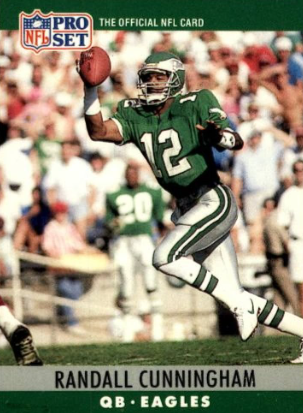
4. Randall Cunningham, 1990 - Playoff success is not part of Cunningham's resume, at least in Philadelphia but he was a force who could be dominant at times. He had a couple of years that could have been selected but 1990 was his career year.

He completed 271 of 465 passes for 3466 yards that went for 30 touchdowns. He also ran for 942 yards and five scores, accounting for 35 total. He was the PFWA Most Valuable Player and first-team All-Pro (PFWA) as well as the runner-up to Joe Montana in the AP MVP voting.

If he's just had some playoff success in 1990 he'd be ranked higher on this list. Winning matters when judging quarterbacks.

3. Tommy Thompson, 1948 - Who? The man with two NFL Championship rings, one in 1948. Yes, it was a different game back then but consider this:  He threw for 25 touchdown passes that year, to lead the NFL - in twelve games. He was also the NFL's leading passer under the system that was used at the time.

The NFL did not introduce the NFL passer rating until 1973 but has since gone back and applied it to previous years. Thompson's 98.4 rating was not surpassed by any Eagle quarterback until Donovan McNabb's 2004 mark of 104.7 - fifty-six years. That is remarkable when considering how the passing game evolved over that time.

Thompson led the Eagles to the NFL Eastern Conference title and on a snowy day in Philadelphia's Shibe Park beat the Chicago Cardinals to punctuate his career year.

2.  Jalen Hurts, 2022- So close. Just three points short in the Super Bowl and Jalen Hurts would have been hoisting the Lombardi Trophy over his head, not Patrick Mahomes. 

As it was Hurts was the NFC Champion quarterback who had a 14-1 in the regular season, a 16-2 overall record. He was the runner-up in the AP MVP, was second-team All-Pro, All-NFC, and was voted to the Pro Bowl. He checked a lot of post-season honors boxes.

He threw dimes all season, deep, short, and intermediate, and was almost impossible to stop on short yardage. In all he accounted for 35 touchdowns, tying Randall Cunningham's team record, taking 13 into the end zone himself - setting the team record for quarterbacks for rushing touchdowns.

For the season he threw for 3701 yards and completed 66.5 percent of his passes, which is second-best in team annals. Only 1.3 percent of his passes were picked and that is third-best in the record books and his 101.5 passer rating is fifth-best.

It was a unique and special year but does it deserve to be first on this list?  Perhaps, is certainly a close call. But winning does matter and in a close call, it has to be the tie-breaker.
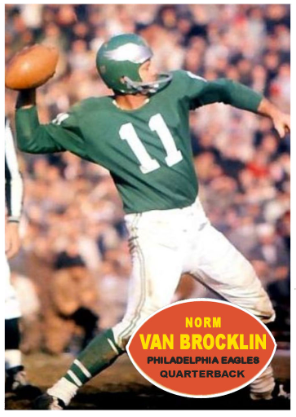
1. Norm Van Brocklin, 1960. In the Dutchman's final season, he led the Birds to the NFL's best record and beat the Vince Lombardi-led Green Bay Packers in the NFL Championship Game. It capped his Hall of Fame career. 

That year he was the consensus NFL MVP, a consensus first-team All-pro, and was second in the NFL in passing, passing yards, passing touchdowns, and a number of other passing categories. Basically, he was second in everything, statistically.

He led the Eagles to five fourth-quarter comebacks (including the title game), as per Pro Football Reference

Van Brocklin's 1960 season had statistics, post-season honors, and the championship and it's the top year by an Eagles quarterback.

Sunday, February 5, 2023

Did You Know?

By Jeffrey J. Miller

The National Football League did not have an “official” ball until its sixth season.  Apparently, it wasn’t a priority. The league adopted its first official game ball at the league meeting held August 1-2, 1925, at the Hotel Sherman in Chicago.  The balls used at the dawn of the American Professional Football Association (as the NFL was known in 1920 and 1921) were typically the model used in the college game, adopted in 1912. This ball had a circumference on the long axis from 28 to 28 ½ inches when tightly inflated, 22 ½ to 23 inches on the short axis, and weighed 14 to 15 ounces.  Referred to as a “prolate spheroid,” the ball was difficult to grip with one hand, making it hard for players with smaller hands to execute a credible forward pass.  In truth, the ball more closely resembled a watermelon than the football used today. 

During the two-day league meeting in the summer of 1925, the owners gave both Wilson and Spalding the opportunity to present their cases to become the ball supplier of the National Football League. Mr. Wyle of the A.G. Spalding Company presented their ball on August 1. This was the J5 model, which he advised would cost the league $6.75 per unit in lots of 20 dozen or more. These balls would bear a league stamp. Mr. Whitlock of the Wilson Company gave his pitch the next day. The Wilson A5 ball could be provided at a cost of $7.25 each. These footballs came with a new feature—guaranteed shape. As an added incentive, Wilson offered to provide a trophy to the league champions at the end of the season. 

After some deliberation, the owners voted to go with Spalding, and the J5 model became the league’s official ball on August 2, 1925.      

Though the National Football League did not adopt the ball with dimensions approximating those today’s players and fans recognize (28 to 28 ½ x 21 to 21 1/4) until 1934, this action demonstrates that the league’s founders were always looking toward the future and ways to improve their game. 

The Thomas E. Wilson Company took over as the official supplier of NFL game balls in 1941.

Friday, February 3, 2023

Sometimes the Best Trades are the Ones Not Made

 By John Turney 
John Ralston
The day before the Jets' second game of 1976 the club agreed to trade Joe Namath to the Denver Broncos. 

A trade that was never consummated.

In the very early Spring of that year, Namath had requested a trade to the Los Angeles Rams but it was reported by Dave Anderson of the New York Times that Rams owner Carroll Rosenbloom was not willing to pay the Jets' asking price or pay Namath's $450,000 salary so that deal went nowhere.

The Jets had Lou Holtz, a rookie coach, and a number one draft choice in Richard Todd, and a new offense that would feature some aspects of an option running game that Namath was ill-suited to. Namath not only had bad knees he had a hamstring injury that had nagged him for a couple of years.

Meanwhile, the Broncos had a coach that was the most successful in franchise history to that point -  John Ralston who had a record of 25-28-3 in his four years in Denver, under .500 but he had delivered the only two winning seasons Bronco fans had enjoyed in sixteen years.

However, Ralson who was a believer in thinking positively and was a certified Dale Carnegie instructor and would send his coaching staff to learning retreats and lecture players on Carnegie principles and it rubbed the players the wrong way. 

What also rubbed some players the wrong way was Ralston would make promises and not keep them and among those was a promise to bring in a "name quarterback". The former Stanford coach, who doubled as the Broncos general manager, was positive he could acquire Jim Plunkett when the Patriots put him on the market in the 1976 off-season. 

He couldn't.

Charley Johnson, the quarterback who'd led the Broncos to most of the Broncos victories during Ralson't tenure was gone. He'd retired to New Mexico.

That left the Broncos with strong-armed Steve Ramsey. Strong-armed and inaccurate and not trusted by the Broncos players. One of them was Lyle Alzado.

One day, early in the 1976 off-season,  Alzado wandered into the office of Mike Giddings, who was the director of pro scouting for the Broncos. It was a new position in the Broncos front office and it is likely that Giddings was the first to act in that capacity for any NFL team, one that focused only on evaluating NFL talent, not collegiate players.

"Pro scout . . .",  Alzado asked incredulously. "What the heck is a pro scout?" Giddings replied, "It's the league, which nobody's doing. Everybody's scouting college."

"Yeah, that's what I thought", Alzado replied, "Okay, pro scout, if you don’t mind, get us a damn quarterback because our guy is gonna kill us. He’s gonna go down, he’s gonna throw an interception, fumble in a crucial game, and he’s gonna kill us. Get us a quarterback."
Lyle Alzado
Giddings, as part of this duties, reviewed films of the 1975 Broncos seasons and gave reports to Ralston and the rest of the Broncos coaching staff with his now fairly well-known color grading system with blue being the top grade, red being next, then orange, then green, and so on. 

According to Giddings, when it came to Ramsey, "I said his grade was an orange or a green and Max Coley who was the offensive coordinator and backfield coach went berserk. How dare you? You don’t know Steve Ramsey. You haven’t been here." 

Giddings found out how committed Coley was to Ramsey. Later, Cooley cooled down and came to him and said, "Ramsey’s my guy, Mike. Sorry."

In the preseason Ramsey completed well under fifty percent of his passes and opened the season with a very poor performance in Cincinnati going 7 of 22 for 97 yards passing and two interceptions and no touchdowns. After seven preseason games and one regular season game, it was clear the quarterback position was a problem for the Broncos.

In week two the Jets traveled to Denver to play the Broncos and before the game, while sitting on one of the benches, two old friends met for a quick conversation—Giddings and Jets general manager Al Ward.

During the talk, Giddings said, "Joe’s gotta be going nuts." adding, "You got an untenable situation at quarterback. And we need a quarterback. This is a damn good Denver team and Ralson's going to get fired if we don’t get a quarterback." 

So, Ward and Giddings began to hammer out a trade for Namath. 

Ward said the Jets needed a receiver badly and the only one they'd take was Haven Moses. Denver had Rick Upchurch and Jack Dolbin so Giddings figured that Ralston would agree to that, at the time both were thought to have upsides. Ward added that the Broncos would probably have to throw in a third-round pick.

Giddings got back to Ward the same day, "After the game, I got him before they got on a plane. I said, “Okay. You got it, except you pay half Joe’s salary You pay 225 and throw in a fourth".

Ward tells him, "Done deal".   

"Can I take it to John (Ralston)? 

“Yup.” 

Giddings continues, "So, I take it to John. Namath’s coming to Denver, and the only people that know are John and me. However, one other person got involved, Max Coley."

No deal.

Coley told Ralston that he knew Ramsey was better than Namath.

What followed was a good year for the Broncos, their best ever to that point, but one with filled strife. 

In the game that essentially knocked the Broncos out of the playoffs, their fifth loss of the season was against the Patriots in late November.  The Patriots rolled over the Broncos 38-14 and Ramsey was awful. He was 11/28 for 124 yards and threw three picks and was sacked nine times. Ramsey just wouldn't get the ball off and when he did it was nowhere near the target. 

Giddings explained the situation further, "Alzado spent the year on injured reserve, they'd moved him to nose tackle and he got hurt (one of his scouting axioms is 'don't move blues') but he still traveled with the team, they let them do that in those days and Lyle was a leader on that team. Anyway, in the fourth quarter, Alzado comes by and he says, 'I told you. I told you we had to have a quarterback, goddamn you Giddings, why didn’t you get us a quarterback?'"

After the game, the Broncos are traveling to Providence to catch a plane since there was a storm and they couldn't fly out of Boston. Giddings recalls, "We know it’s over (playoff hopes), but we didn’t think that it would be over the way it ended up (in a blowout loss) and Lyle comes up and he taps me and says, 'Hey, Mike. I’m sorry. We know you had a deal for Namath. Thanks for trying'. And how he knew, I don’t know."

The Broncos won their final two games to end the season 9-5 but the players had a revolt against Ralston, the so-called Dirty Dozen who wrote a letter to the team ownership demanding changes they got them. The positive-thinking coach lost his job and became an instructor at the Dale Carnegie Institute in Denver in 1977 and resumed coaching as an offensive coordinator with the Eagles in 1978.

Namath had a terrible year in New York, worse than Ramsey's in Denver. And like Ralston, Holtz lost his job. 

The next year Namath finally ended up in Los Angeles where he wanted to be and didn't do well. The Broncos found another strong-armed quarterback with knees that were not great but not nearly as bad as Namath's named Craig Morton and Haven Moses was part of the beginning of a new era of winning football in Denver.

All's well that ends well. Namath would have been better in Denver than with the 1976 Jets and it could have saved Ralston's job. For a time. But hazarding a guess it could have been just enough to keep Denver in the throws of mediocrity for another year or two. 

Ralston's replacement. Red Miller was what was needed.