Monday, March 27, 2023

Even The Greats Get Bested by a Rookie Once in a While

 By John Turney 
Jerry Stalcup is not a household name to even hardcore football fans - even devout Rams fans. 

His career was brief - a sixth-round pick by the Los Angeles Rams in the 1960 draft, he was not protected in the 1961 expansion draft and the new franchise, the Minnesota Vikings selected him so he played just a year in the City of the Angels.

He chose not to sign with the Vikings but rather joined the Broncos of the AFL. There he was the starter at one of the outside linebacker positions, in the blown and yellow vertical striped socks and everything.

Prior to the 1963 season, he was released by Denver, and poof -  his pro football career was over. From there he became a successful high school football coach. 

With the Rams he played both linebacker and guard and at the former, he picked off a pass. At the latter, he did get at least one moment he could put in his memory bank. 

It was one of those plays where a smaller man gets leverage on a bigger man and, well, embarrasses him. And by small, we mean small. Though listed at 6-1, 240 pounds later in his career his height and weight with the Rams was listed at 6-0, 220. 

Though an All-American guard at Wisconsin he was thought not big enough to play that position in the NFL so he was made a linebacker. However, in addition to special teams he ended up playing both offense and defense - one of at least five Rams that played both ways at times that season. 

Late in a mid-October game in Charm City during a 31-17 loss by the Los Angeles Rams to the defending World Champion Colts Stalcup got some reps at left guard. 

Starter Roy Hoard, also a rookie, was out of the game, possibly because the game was out of hand with the Rams trailing 31-10 but nonetheless Stalcup in the game.

On the play left guard Stalcup, #60, pancakes the legendary Big Daddy Lipscomb, #78 at right defensive tackle.  Lipscomb was listed at 6-6, and 285 pounds but few think he weighed that. He was likely over 300 pounds at this stage of his career.

To be fair, Lipscomb did get a bit of a trip with left tackle Lou Michaels (another of the two-way Rams players) and maybe that caused him to lose his balance. 

But either way, at the end of the play Big Daddy is on his back.

The play—

Fair use claim - for education and criticism
Credit: Indianapolis Colts

Obviously we not suggesting this would be a usual thing. When Lipscomb wanted to he could dominate. But on this play Stalcup got the better of him, probably on effort alone. 

Good play, rook. 

PFWA and HOF NFL Assistant Coaches Pantheons

By John Turney 
In 2014 the Pro Football Writers of America (PFWA) began to honor great NFL assistant coaches by giving them the PFWA’s Paul “Dr. Z” Zimmerman Award.

The award got its name from Zimmerman, who covered the NFL for 29 years for Sports Illustrated and for the New York Post for the 13 years prior to that.

He'd shown a level of detail to offensive line play and crediting assistant coaches among other things, which was rare in his era.

Last year the Pro Football Hall of Fame followed suit with their Awards of Excellence, which also honors other professions as well. 

Seven coaches have received  Awards for Excellence in the Assistant coach category—
2022 — Alex Gibbs, Jimmy Raye, Terry Robiskie, Fritz Shurmur and Ernie Zampese
2023 — Sherman Lewis, Tom Moore and Dante Scarnecchia

So far, twenty have been recipients of the Dr. Z Award—
2014 — Jim Johnson, Howard Mudd, Fritz Shurmur and Ernie Zampese
2015 — Dick LeBeau, Tom Moore and Dante Scarnecchia
2016 — Monte Kiffin and Wade Phillips
2017 — Bud Carson
2018 — Joe Bugel and Emmitt Thomas
2019 — Gunther Cunningham and Mike Westhoff
2020 — Bill Arnsparger and Romeo Crennel
2021 — Rod Marinelli and Bobby Turner
2022 — Leslie Frazier and Greg Knapp

Coaches who have received both honors—Tom Moore, Dante Scarnecchia, Fritz Shurmur and Ernie Zampese.

Dick LeBeau is in the Pro Football Hall of Fame partially as an assistant coach and also has a Dr. Z Award. People can decide where he fits in terms of honors.

The following are Dr. Z Award finalists that have yet to receive the award:  Jim Hanifan, Bobb McKittrick, Bruce DeHaven, Jim McNally, Dave Toub, Terry Robiske, Dick Hoak,  Floyd Peters, Buddy Ryan, Bobby Turner, John Teerlinck and Keith Butler.

Wednesday, March 22, 2023

2023 Pro Football Hall of Fame Awards of Excellence Winners

By John Turney

In 2022 the Pro Football Hall of Fame, in an effort to recognize significant contributors to the NFL, announced the Awards of Excellence program.

In a statement Hall of Fame President Jim Porter said, “These 20 outstanding Assistant Coaches, Athletic Trainers, Equipment Managers and Public Relations personnel not only helped to determine results on the field, but they also helped to promote the game’s growth, safety and popularity over several decades of devotion to their teams and to the National Football League.”

Four categories were included - Assistant coaches, Athletic trainers, Equipment managers and Public relations personnel.

This year a fifth category was added - Film/Video directors.

Today the Hall of Fame announced the 2023 winners of the Awards.

Film/Video directors -  Mike Dougherty, Milan "Mickey" Dukich, Thom Fermstad, Henry Kunttu and Al Treml

The distinction of being the NFL's first full-time film director is held by Mickey Dukich. He was hired by Rams head coach Sid Gillam in 1956. His official title was Cinematographer and he stayed with the Rams through 1994, not making the move to St. Louis.

Treml began filming NFL games in 1964 and three years later was hired by Vince Lombardi making him just the second full-time film director in league history. He served in that capacity in Green Bay through the 2000 season. 

Henry Kunttu was hired in 1969 by the Buffalo Bills and he was in that job for 42 seasons. He also has directed television commercials and industrial films in addition to his work for the Bills.

Dick Vermeil hired Dougherty in 1976 and he served the Eagles through the 2012 season as their film/video director. He was instrumental in moving the NFL from film to videotape in 1986.

Fermstad was with the Seahawks since the franchise began in 1976 as their film/video director and held the job for 36 years. He had been with the Vikings for the three years prior when Jack Patera hired him to join him in Pacific Northwest.

Assistant coaches - Sherman Lewis, Tom Moore and Dante Scarnecchia

Moore, 84, first coached in the NFL with the 1977 Steelers the first of nine NFL teams he coached for - most notably as Peyton Manning's offensive coordinator during the quarterback's prime.  He is still working on the offensive staff of the Buccaneers.

Bill Walsh gave Sherm Lewis his start in the NFL after he spent 14 years as an assistant coach at Michigan State. Later he was the offensive coordinator for Mike Holmgren in Green Bay. He also coached for Minnesota, Detroit and Washington.

Scarnecchia coached for the New England Patriots in various capacities from 1982 through 2019 with the exception of 1989 and 1990 when he with the Colts. He was the offensive line coach for Bill Belichick and earned six Super Bowl rings.

Athletic trainers - J. Lindsy McLean, Bob Reese and Lamar "Bubba" Tyer

McLean served the 49ers from 1979 through 2003, earning five Super Bowl rings along the way. Prior to that, he'd served 16 years as a trainer for three universities. 

After his retirement from the NFL McLean came out as gay in a magazine article. He detailed the verbal and physical harassment he suffered in his 25 years with the club, some of it brutal. 

Now a Professor of Psychology at Radford University Reese was the Jets' head athletic trainer for just under 19 years (April 1977 through February 1996). Prior to that, he worked for the Bills as an assistant trainer from 1972 to 1976.

Hired by George Allen in 1971 Tyer served as the head trainer for 25 years then as Director of Sports Medicine for another dozen years for Washington.

He was called out of retirement in 2021 for a short time which was the second time he was asked to return. He'd previously retired in 2003 but was convinced to return by Joe Gibbs began his second stint with the club.

Equipment managers - William T. "Buck" Buchanan, Robert "Bob" Noel and Bill Simmons

Buchanan was the equipment manager for the Dallas Cowboys from 1973 through 1998 and was part of four NFL championships.

Noel spent 43 years with the franchise starting part-time with the Packers in a part-time equipment role in 1951 then was hired by Lombardi as the first full-time employee. He worked as the assistant equipment manager until 1977 and then as head equipment manager until 1993 season. 

Simmons was the equipment manager for the St. Louis Cardinals from 1966-1987. His son, Dan "Chief" Simmons, was a 2022 Awards of Excellence winner who worked for the elder Simmons in 1972 before working 42 years for the Saints as their head equipment manager.

Public relations personnel - Greg Aiello, Kevin Byrne and Budd Thalman.

The NFL's spokesman for the majority of his 27 years in the league's Park Avenue offices, Aiello was in the NFL for 39 years - the first dozen with the Dallas Cowboys in public relations.

Byrne officially retired in 2020 but remained as a consultant to the Ravens' franchise for whom he served for 41 seasons.

Thalman was with the Buffalo Bills from 1973 through 1986 and then served as the Sports Information Director for Penn State until he retired in 2001. Prior to his time with the Bills he worked for the Associated Press for a short time then as the SID for the Naval Academy.

Recipients will be honored June 28-29 in Canton, Ohio.

Last year's Awards of Excellence winners were —

Assistant Coaches - Alex Gibbs, Jimmy Raye, Terry Robiskie, Fritz Shurmur and Ernie Zampese

Athletic Trainers - George Anderson, Otho Davis, John Omohundro, Jerry Rhea and Fred Zamberletti

Equipment Managers - Sid Brooks, Ed Carroll, Tony Parisi, Dan “Chief” Simmons and Whitey Zimmerman

Public Relations personnel - Joe Browne, Charlie Dayton, Joe Gordon, Jim Saccomano and Gary Wright

Monday, March 20, 2023

George Kunz—The Gentleman Tackle

 By John Turney 
George Kunz
The NFL's golden age of left tackles was from the mid-1980s through the mid-2000s. That was when Anthony Munoz, Gary Zimmerman, Willie Roaf, Tony Boselli, Jonathan Ogden, Walter Jones and Orlando Pace - Hall of Famers all roamed NFL stadiums.

A generation earlier, when the top defensive ends were playing on the left side it was the right tackles that were the premier tackle, not the left. It was the mid-1960s through the early 1980s that were "peak right tackle".

Hall of Famers like Bob Brown, Ron Mix, Ron Yary, Rayfield Wright and Dan Dierdorf were all protecting the frontside of quarterbacks. Even Hall of Famer Art Shell, who was indeed a left tackle, was mostly a front-side blocker since his quarterback was left-handed. 

The "blind side" was not yet a thing. 

However, one name is missing from the great right tackles of that era - George Kunz.

Why?

Because he was great.

"George was as good as any of us, Rayfield, Dan, and myself", said Ron Yary. "He was every bit as strong, quick and smart as anyone who played."

He was known for being quick on the snap and a "wicked drive blocker" and also a good pass protector.

In fact, the Associated Press (AP) voters agreed in 1975 when Kunz beat out Wright and Dierdorf on their All-Pro team.

However, younger fans don't remember but All-Pro team that had as much, if not more, gravitas in that era was the Newspaper Enterprise Association's. (NEA). The NEA was a rival press organization to the AP (and United Press International) and starting in 1955 they polled NFL players and published the Players' All-Pro team. 

It was included in the NFL Record and Fact Book and is still included by the Pro Football Hall of Fame when they compose bios for Hall of Fame players and candidates.

It was on the NEA team that Kunz got recognition - the players knew his quality. He was first-team All-Pro in 1972 and 1973 making him a three-time first-team All-Pro.

He was a second-team selection in 1976 and 1977, second-team All-NFC in 1974, and went to a total of seven Pro Bowls. In fact, every year Kunz was healthy (he missed five games in 1970 with a knee injury) he got some level of postseason honor, including being the 1976 AFC Offensive Lineman of the year and the 1977 NFL Offensive Lineman of the Year.

Kunz was a man of letters, intelligent but also almost stoic and nice, almost to a fault. He wanted to be a priest as a young man but chose athletics and academics instead and transferred from a seminary school to a regular high school.

His coach at Notre Dame, Ara Parseghian, said that Kunz had a "certain something that set him apart, both talent-wise and spirit-wise." 

A consensus All-American as a collegiate tackle, and even played some tight end and was also an Academic All-American. He was the second overall pick in 1969 by the Falcons where he became an immediate starter. 

His time in Atlanta ended in 1975 when he was traded to the Baltimore Colts to the Falcons could draft quarterback Steve Bartkowski. Colts' General Manager Joe Thomas coveted him and called him "One of the best drive blockers anyone has seen in a long time." 

It was in Charm City that Kunz says he played his best football by his own accounting. He had more experience and he was bigger. He was an avid weight lifter prior to college but Parseghian told him to get down to 245 pounds.  

But by the time he got to the Colts had built himself up from around 250-260 pounds, his weight in Atlanta, to 270 or so, without losing any of his quickness but with added strength.

Whitey Dovell, his line coach with the Colts said Kunz was, "simply the best pro lineman I've ever coached."

Defensive end Jack Youngblood adds, "Oh yeah, I remember when he was traded out of my division and was happy I didn't have to face George twice a year anymore. Then, the schedule comes out and it turns out the Colts are on it and I have to face him that year."

Youngblood continued, "George was kind of a mixture of Rayfield, Dan, and Ron in a way. On running plays he was quick off the ball like Rayfield, he could get into you if you were not careful. And if he did that big 'un could move you like Yary could. On pass plays he'd short-set you like Dan would do. Meet you at the line of scrimmage so you couldn't do your moves, take away your momentum."

It also needs to be noted that Kunz, the gentleman tackle, was a tough man. 

Very tough.

However, he postponed the operation because his coach asked him if he could possibly play the season opener (against the reigning Super Bowl champion Dallas Cowboys) because by the time the doctors told Kunz surgery was necessary it was too late to prepare another player to replace him.

Kunz complied and played through the pain. 

The following year, after missing 15 games in 1978, he wanted to play in 1979 and reported to camp but the X-rays showed the back had not recovered so he was forced to retire.

But still, the fire burned, and while he was pursuing other things, including being a color commentator on NFL games for NBC he quietly worked out with the goal of getting back to the game and "finishing what he started."

The following Spring, he passed a physical and was cleared to play for the 1980 season, which he did, starting at his old right tackle spot. He and his coach thought he could help the Colts, who'd been in the doldrums for a couple of seasons.

But he was not his old All-Pro self, not the difference maker he'd been when he first got to Baltimore.

And what a difference he had made.

In his first three years with the Colts, they were a top-ten offensive team in rushing, passing and total offense. In the two years he was out they fell to near the bottom.

In his two-year absence, the Colts quarterbacks were sacked 101 times, more than in the three previous years combined and most notably Bert Jones kept getting hurt.

But it was more of a domino effect and without the big tackle and the wheels did come off the offense in his absence so it cannot be simply a coincidence. 

In his final year he played with a broken thumb and a "cracked" elbow that left him "without any strength in that arm." He also had another back injury, a spinal concussion and that ended things for the season and as it turns out his career. 

In all, Kunz played eleven seasons and played 129 games, starting 126. That is roughly the same amount of starts as Bob Brown, Ron Mix and Rayfield Wright and more than Boselli, Jimbo Covert and his final coach Mike McCormack. 

He has the same number of Pro Bowl appearances as Ron Yary, Zimmerman, Pace and Jackie Slater and more than seven other Hall of Fame tackles and he was first-team All-Pro as many or more times than the following:  Boselli, Bob St. Clair, Slater, Covert,  McCormack and Winston Hill.

Kunz deserves a chance to be "in the room" (or now "on the Zoom") to have his Hall of Fame creds discussed. 

He certainly measures up.

Sunday, March 19, 2023

The 1951 Rams Foray Into a 4-3 Defense

 By John Turney

The 1951 Los Angeles Rams won the NFL Championship by beating the Cleveland Browns 24-17. It was a franchise noted for a record-setting offense and rightly so.

Their defense was not nearly as good. They were average, at best.  They ranked ranking right in the middle in the fewest points allowed (sixth of twelve) and eighth in fewest yards allowed. 

Teams had to do a lot to try and keep up with the Los Angeles scoring machine because their defenses were going to be in for a long day.

The Green Bay Packers were attempting to build a passing game. 

Head coach Gene Ronzani hired Ray "Scooter" McLean as a backfield coach. They'd been teammates with the Chicago Bears in the 1940s. 

While the Pack still ran the T-formation they also ran a one-back offense and became more-pass happy than even the Rams. 

They set an NFL record for most passes and led the NFL in completions and were second in passing years to only Los Angeles. 

That was needed because no team was worse at running the football. Their leading runner was quarterback Tobin Rote with 523 yards. 

No other back ran for more than 190 yards on the season.

It worked pretty well, they were 3-3 at midseason though did not win a game after that. But they generally moved the ball and teams had to take notice.

In week four the Rams traveled to the outskirts of Milwaukee to take on the Packers and the new-fangled passing offense. 

The Rams countered with a 4-3 defense when the Pack spread it out. When they were in the T, the Rams stayed in their usual 5-2.

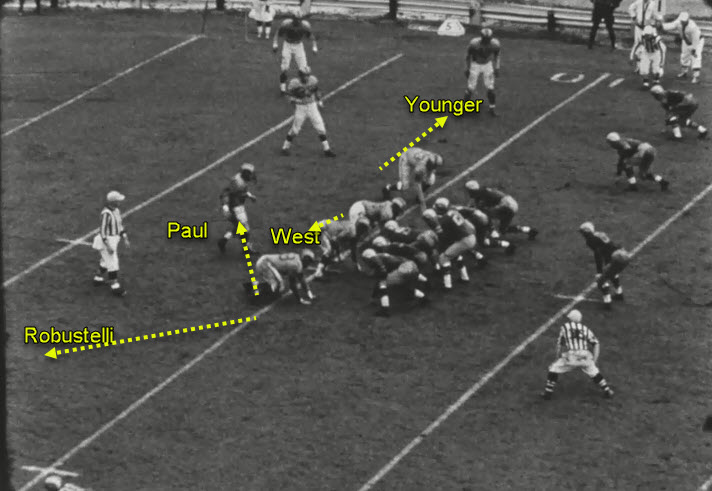
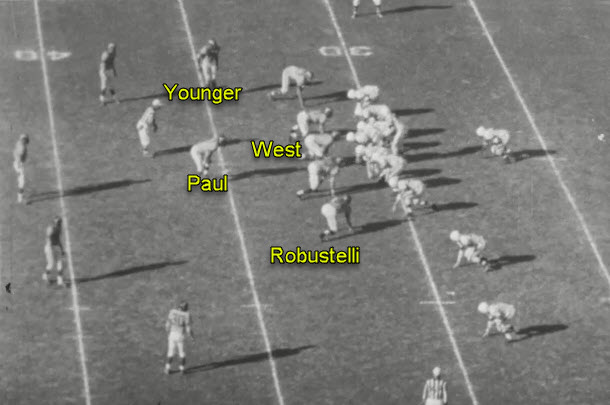
Here is the Rams 5-2 with linebackers Don Paul and Tank Younger near the line of scrimmage and the middle guard, Stan West over the center and rookie Andy Robustelli at right defensive end.

In the one-back, the Rams used the same personnel but shifted to this alignment—

Robustelli dropped to a wide linebacker position, Paul moved from outside to middle linebacker. Stan West stayed at defensive tackle but didn't drop like he sometimes would do in the 5-2. He stayed on the line of scrimmage as a rusher, either over the center or like here shaded on the center creating a form og and overshift to the three-receiver side of the Packers formation.

Here is another shot of the 5-2, Packers in the T—


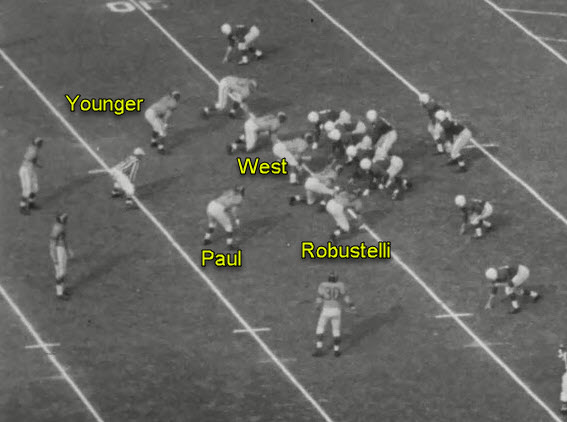
And the 4-3, we'll call it an overshift, with the line moved to the tight end (three-receiver) side—

Here are the four players who would move depending on the formations of the Packers—

So it was an innovative way to use the same personnel to run either scheme. 

Most games if the Rams wanted Younger to be out wide, essentially as a corner then West would drop back at the snap or just after and play the middle—essentially the precursor of the middle linebacker that most of the teams did.

In this alignment, to prevent shot passes over the middle West might be asked to drop in the middle. 

The linebackers Paul and Younger are wide so the only way to cover the short middle was to have the middle guard drop after the snap. The only other option would be to have him stand there presnap which is what eventually happened in the NFL but that left the middle vulnerable to short runs, at least in the minds of coaches at the time. 


Here is the same idea in the second Packers game of 1951, Paul and Younger are out of the shot—


Again, 5-2 linebackers are wide so in this case West could be asked to drop

In this case, with a split end to the right, Tank Younger, the left linebacker walks out to him and would sometimes run with him in man coverage, other times he'd sit in a zone and read the quarterback and break to the ball.

In these two shots Paul is in the middle and to a lesser degree so is Younger and in this case West would not drop—he'd be a rusher or run defender, not a cover guy—

The Rams were a 5-2 team with some wrinkles of where the two linebackers would aline. Sometimes Don Paul was more in the middle sometimes outside over a tackle or end.

Younger could be in the inside shade of a tight end or walked out to a de facto cornerback position.

Stan West was aligned over the center but could drop at the snap or hit the center with a blow then drop. Andy Robustelli was the right defensive end in all cases.

But versus the Packers in Milwaukee, they pulled out a 4-3 to combat a one-back offense and they used it a good deal of the time - and shut the Pack out.


Friday, March 17, 2023

Remembering Linebacker U

 by Joe Zagorski 
During the 1960s and 1970s in the National Football League, several colleges across the nation gained a reputation for producing quality athletes at one specific position on the gridiron. One of those schools was Penn State University, who behind head coaches Rip Engle and then later, Joe Paterno, seemed to churn out linebackers left and right.  

And not just any old linebackers, mind you. No, Penn State was sending high-quality linebackers to the NFL Draft, and many of them would make a name for themselves in the pro ranks. So often and so many great linebackers came to the NFL from Penn State, that the university was respectfully regarded for a time as “Linebacker U.” 
Jack Ham
Perhaps the most successful PSU linebacker to make a name for himself in the NFL in the 1970s stayed in the state of Pennsylvania.  Jack Ham was born and raised in Pennsylvania and was drafted in the second round in 1971 by the Pittsburgh Steelers. 

His impact on their team was almost immediate.  He missed only nine regular season games during his 12-year pro career. He intercepted 32 passes and recovered 21 fumbles. He also was named to eight straight Pro Bowls and played in four Super Bowls during the 1970s, each of which his team won.  In 1988, Ham was named to the Pro Football Hall of Fame.

Ham’s greatest talent was his ability to drop back into zone defenses, and tightly cover opposing tight ends and setbacks coming out of the offensive backfield. Moreover, almost any ball he touched, he caught.  He was a ballhawk, and he was always around the ball carrier. 

The knowledge that he gained at Penn State served him well in the NFL, and it was readily apparent that his coaches with the Steelers did not have to touch on the fundamentals with Ham. Nor did they really have to stress the keen nuances of playing his position of outside linebacker. Ham was indeed given plenty of proper tutelage in his years at Penn State. Nicknamed “Dobra Shunka” by Pittsburgh’s fans of Polish ancestry, the label stood for “Great Ham,” which Jack Ham certainly was. He was truly a great linebacker.

Dave Robinson
Another legendary linebacker to come out of the Penn State ranks was another member of the Pro Football Hall of Fame. Dave Robinson. The 6-foot-3, 245-pound outside linebacker, was big enough in the mid-1960s to the early 1970s to play on the defensive line if he wanted to, yet still could drop back quickly enough into the coverage zones of the defensive secondary. 

He played for 12 years in the NFL, the first 10 with the Green Bay Packers, and the last two with the Washington Redskins. He intercepted 27 passes during his career, and he also recovered 12 fumbles from 1963 to 1974. He won three NFL Championships with the Packers (1965-1967) and was a member of Green Bay’s Super Bowl I and II world championship teams. 

He was one of the most reliable linebackers in pro football history.  In 10 of his 12 seasons, he did not miss a game. At Penn State, Robinson played for head coach Rip Engle.

Many other linebackers came to the NFL from Penn State. True, they were not as successful as Jack Ham or Dave Robinson, but they each made a name for themselves on the pro teams that they played for. In random order, those linebackers included the likes of John Skorupan, Greg Buttle, Ed O’Neil, and Charles Zapiec.

John Skorupan
John Skorupan was drafted in the sixth round of the 1973 NFL Draft by the Buffalo Bills. He was a mainstay on their defense and their various special teams units until 1978 when he became a member of the New York Giants. Skorupan saw action in 92 games during his eight-year pro career. 

He only intercepted two passes during his career, but he was as reliable and as dependable as they come. The Bills and the Giants did not usually have strong defenses during the 1970s, and a player of Skorupan’s caliber generally had to contribute a lot of his efforts just to keep the opposing scores down as much as possible. 

Skorupan’s main claim to fame was that he was the Giants’ left outside linebacker just before the great Hall of Famer, Lawrence Taylor, took over for him at that position in 1981.

Greg Buttle
Greg Buttle also played in New York, but for the Jets and not the Giants. Buttle entered the NFL with plenty of fanfare, and he did not disappoint. Even though the Jets were not a winning team for most of his nine years in pro football, Buttle nevertheless played every play as if it was his last. 

Buttle was a consensus All-American at Penn State, and he parlayed that success immediately in the NFL by being named to the league’s All-Rookie team. 

Like Jack Ham, Greg Buttle only played for one pro team after being drafted by the Jets in the third round of the 1976 NFL Draft. He intercepted 15 passes and recovered seven opponents' fumbles during his career. 

His best asset was his speed.  Buttle was one of the fastest linebackers in the league, especially during his first few years in pro football.  

Ed O'Neil
Another fast Penn State linebacker who went on to play in the NFL was Ed O’Neil, who was drafted very high by the Detroit Lions. O’Neil was the eighth player selected in the first round of the 1974 NFL Draft. He played a total of seven years in the league, the first six of which were in Detroit. 

O’Neil’s final season (1980) as an active player was as a member of the Green Bay Packers.  O’Neil was one of those players that every good team needs…a type of athlete who can fill in at any linebacker position, and the type of player who has the smarts to understand the multitude of strategies in the pro game.  

Like all good Penn State linebackers, O’Neil was groomed to make a quick transition from the college to the pro ranks, thanks to the knowledge that he picked up from his coaches at PSU.
Charlie Zapiec
Charles (or Charlie) Zapiec is the final linebacker on this list, but his story is very different from those of the other men mentioned in this article. 

While Zapiec’s size and weight were similar to most of the others (he stood 6-foot-2 and weighed 216 pounds), his location after his college days at Penn State was definitely different. Zapiec was drafted in the fourth round of the 1972 NFL Draft by the Dallas Cowboys, but he did not stay there. Zapiec was released before the 1972 regular season began.  

Almost immediately, he was claimed by the Miami Dolphins, who kept him on their roster for almost three full weeks. He was somewhat discouraged by his lack of success in the NFL following his departure from Miami, and when the Ottawa Roughriders of the Canadian Football League gave him a shot to make their team, he jumped at the chance. 

He stayed there during the 1972 and 1973 CFL seasons. Zapiec was waived once again, however, but he remained in Canada when another opportunity came his way. The Montreal Alouettes gave him a chance to play on their defense, and he settled there for five years from 1974 to 1978. They were the best and most productive five years of his pro football career. Zapiec was named to the CFL All-Star team in four of those five seasons.  

The above names are by no means a complete list of linebackers who have played for the Penn State Nittany Lions and who also went on to play pro football. But it is a good overall representative inventory of those players who have etched their names in both categories. 

For over ten years, many scouts, personnel directors, and coaches across the NFL knew that if their teams were in need of a linebacker, the first place to look for a good one was a college known as Linebacker U.

Sources Used:
Antonacci, Chris.  “The Legacy of Linebacker U.”  The Daily Collegian, September 2, 2000.
Zagorski, Joe.  “The NFL in the 1970s: Pro Football’s Most Important Decade.”  Jefferson, NC.
 McFarland & Company, Inc., 2016.

Joe Zagorski is a member of the Pro Football Writers of America and the Pro Football Researchers Association.  He has written numerous articles and books about pro football, its games, and its personalities.  His upcoming book, a narrative about the 1973 Buffalo Bills, is entitled The 2,003-Yard Odyssey: The Juice, The Electric Company, and an Epic Run for a Record.  It will be published by Austin-Macauley Publishers (New York) sometime later in 2023.  

Wednesday, March 15, 2023

CHARLEY BROCK: "Tough as Nails"

By TJ Troup 
Charley Brock
Every player who enters the league wants to win a championship and contribute. Thus when a team wins a title we can all look at the roster of who was on the team, and who contributed. How many men played a decade for the same team, and had a winning season each year? 

This is the saga of one of the handful of men pre-modern era (before 1950) that can state he made both lists. Charley Brock was chosen by Green Bay in the third round of the '39 draft, was joining a team that had a winning tradition, and was a contender in '38. 

Late in that season, the Packers lost to the Giants to close the regular season and then lost the rematch with the New York Giants in the Championship Game. The Packers of '39 were well coached and talented, and though they stumbled at mid-season in a loss to the Bears (30-27)—the men in dark blue and gold ran the table and shut out the Giants in a very convincing title game clash. 

Charley Brock got plenty of playing time at center, and linebacker, and in the win over NYG, the lean youngster intercepted twice. Without a doubt a sparkling rookie season for young Charley. 

The NFL did not keep individual interception stats then, yet through research have learned he intercepted 8 times and returned an errant Eagle pass 42 yards for a touchdown. Brock also intercepted the legendary Sammy Baugh three times in the victory over the 'Skins. The 1940 Packers were not able to defend their title as they finished 6-4-1. Brock is still playing center, and linebacker and intercepted three times. 

Over the years the games between the Bears and Packers had become a trademark of hard-hitting, spirited football. With so many outstanding players for both teams. The defending champion Bears of 1940 split the two games with Green Bay in '41, and as such a tie in the standings, and a playoff game. 

The Bears not only beat Green Bay, but they also defend their title with a win over the New York Giants. Brock has become a mainstay at center and continues his sterling play at linebacker. Green Bay has a strong season in '42 with a record of 8-2-1, but lost both games to the Bears. Losing at home to the Bears to open the season, the Packers traveled to the Windy City to take on the Cardinals. 

Trailing 14-10 in the 4th quarter Brock picks a Cardinal fumble and strides 20 yards for the winning touchdown. Though he had many fine games previous to this one, this is one of those games that every defensive player dreams of. 

Earlier in the game, Brock had intercepted twice. The NFL did not have a player of the week award in those days, but no doubt he would have been defensive player of the week. 

Five weeks into the campaign and Charley Brock has registered five interceptions from his right linebacker post, but he is not the only right linebacker who can read the quarterback and intercept. Clyde "Bulldog" Turner of Chicago is the first Bear to intercept in four consecutive games and goes on to lead the league with eight interceptions. 
Bulldog Turner
Charley Brock intercepted against the Eagles in late November and finishes with six for the season. Every Packer player knows the division crown runs through the North Side of Chicago, but again in 1943 the Packers cannot beat the Bears. 

They tie on opening day, and later in the year lose the rematch in Chicago. Brock continues to pilfer passes as he latches onto four errant throws in '43. 

He is part of the record-setting brigade that steals nine, yes folks, NINE Lions passes on October 24th victory. Anytime a team has a record of 29 wins, just 2 losses, and a tie you would expect them to be playing for a championship, but the Packers from 1940 through 1943 just cannot beat the Bears or Giants. 

Their record against these two longtime rivals in this four-year time period is 2-7-2. Since Charley has played such exceptional football on a consistent bases week after week he begins to receive recognition (second-team All-Pro in '43). 

 Again in '44 Green Bay loses to the New York Giants and the Bears, but they win the rest and finally wins the division. The rematch with the Giants in the title game is a classic as Coach Lambeau makes some needed adjustments to the offensive game plan—while Brock and his compadres on defense stifle the New York offense. Brock is again a champion and is again voted second-team All-Pro. 

Many times when I write here at the Journal relish detailing aspects of how each man played his position. Film study is needed, and have enough film from 1943 and '44 to do so. Brock is 6' 2" yet looks taller as he bends over the ball. 

His snaps to the Packer backs in the Notre Dame box offense Green Bay uses are crisp, and accurate. Every snap I saw was a tight spiral. After the snap he usually position blocks a defensive tackle or middle guard, and almost always leads with his left shoulder. 

He is not a pile driver as a run blocker but is nonetheless effective. Green Bay aligns in a standard 6-2 defense as Brock aligns on the right side, sometimes stacked behind the end, sometimes walked off farther outside. He is quick to read the play and takes excellent pursuit angles. He is not a physical tackler, yet he displays raw strength as he more than once in film study wrestled a ball carrier to the turf. 

No doubt there are times he is in man coverage, yet usually, he drifts back into his assigned area and then plays the ball in flight. He is instinctive in diagnosing plays and is uncanny on pass defense. Charley Brock's season of 1945 stands as one of the best ever for an outside linebacker. 

For the first time, the league keeps individual fumble recoveries and Charley leads the league with five recoveries. When a player has a game like Don Hutson does against the Lions on October 7th he is going to get the headlines, yet in this game, Charley again intercepts a Lion pass, and motors 31 yards for a touchdown. 

Green Bay is in a dogfight to win the western conference crown with an improved Detroit Lions team, and the Cinderella Rams led by Waterfield. Brock makes tackle after tackle during the year against the run, and with two games to go, he has recovered three opponent fumbles and intercepted twice. Have watched the Giants vs. Packers film at the Polo Grounds many times.—just one of those games you treasure watching. 

The New York Giants has Junie Hovious at tailback, and he is a pre-Tarkenton scrambler. Very entertaining, but Junie on the second Giants possession throws across the field where Brock is laying in wait. The veteran's timing is textbook as he cuts in front of the receiver and dashes 38 yards to the New York thirty-yard line. 

Five times in the first half Hovious has completed passes to Ward Cuff, but in the third quarter Cuff on a running play where he gains 16 yards Charley not only forces the fumble he returns the ball 30 yards to the New York six-yard line. 

Late in the quarter, Hovious pitches the pigskin toward George Franck, and there is Brock again, He intercepts and dashes 27 yards to score. Can only speculate that this is Charley Brock's best game—numerous tackles, many in pursuit in the open field, two interceptions, and a key fumble recovery in the Green Bay win. 

Detroit and Green Bay meet at Briggs Stadium for second-place money as captains Callahan and Brock meet for the coin toss. Again film study is a joy as Brock again wrenches the ball free for a 5th and league-leading fumble recovery, he intercepts late in the game. He returns 26 yards, and as such leads, the league in interception yards returned. 

How many men have ever led the league in opponent fumble recoveries, and interception yards returned in the same season you ask? 

Only one—Mr. Charley Brock. 

For the only time in his career, Brock is voted first-team All-Pro. The Packers are 5-3 with three games to go in '46, but falter and cannot keep pace with the future league-champion Bears. Brock does not intercept in '46, but again leads the league in opponent fumble recoveries with five! 

Twice against the Lions in October Charley falls on Detroit fumbles. He again receives All-Pro recognition (Pro Football Illustrated) for his stalwart play. Green Bay struggles in '47 yet manages to again finish above .500 with a mark of 6-5-1. 

Now in his tenth season, he is spelled much more often at center but still plays a vital role in the Packer defense at right outside linebacker. November 30th against the Los Angeles Rams he again intercepts and recovers an opponent fumble in the same game. 

His outstanding career comes to a close and I feel compelled to evaluate and compare his career to other men who played the position. 

The best pre-modern era outside linebacker, also played on the right is Mel Hein. He is also a bulwark in the offensive line for the Giants. Bulldog Turner is a close second; a pile-driving blocker on quarterback sneaks and very instinctive as a right outside linebacker against both the run and the pass. 
Mel Hein
Those two Hall of Famers stand out, but what about Charley Brock? 

Can draw many comparisons between these three men and who was the best defensive centerfielder in the '50s. Mantle and Mays were breathtaking, yet watch Richie Ashburn cover ground, and catch everything he got near. 

Charley Brock is the poster boy for the takeaway in pre-modern era football. During the 60 games he played in from 1942 through 1947, he took the ball away 28 times! 

Today would have been Charley's 107th birthday. Time to pay tribute to this outstanding player.