Showing posts sorted by relevance for query ROBERTSON. Sort by date Show all posts

Friday, December 7, 2018

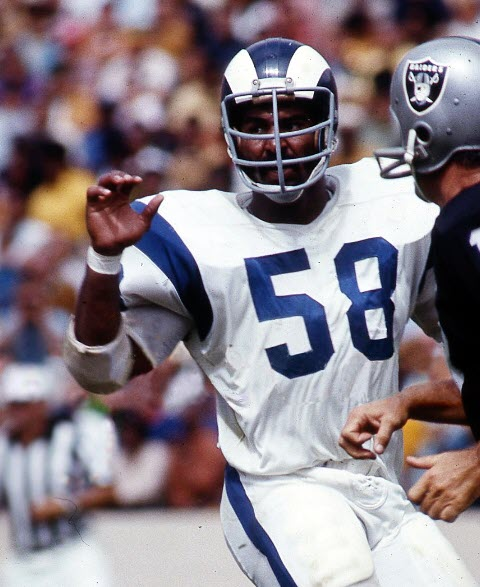
R.I.P. Butch Robertson

LOOKING BACK
By John Turney
Credit: Merv Corning
Former NFL All-Pro linebacker Isiah Robertson (nicked named Butch) was killed in a car crash near Dallas on Thursday night, December 6, 2018, He was just 69. Robertson, according to police was killed after his limo went round a corner at an 'unsafe speed' —the crash is still under investigation.

Robertson was a First-round draft pick (10th overall) by the Los Angeles Rams in 1971 and was the NFL Defensive Rookie of the Year, an All-Rookie selection and a Second-team All-Pro that year.
He played twelve years in the NFL, eight with the Rams and four with the Buffalo Bills. He was a three-time First-team All-Pro and a Second-team All-Pro three other seasons and was a six-time Pro Bowler and was a First- or Second-team All-NFC pick seven times.

He was named the NFC Linebacker of the Year in 1973 and was the second-leading vote-getter for the NFL Defensive Player of the Year that same seasons (was runner-up to Dick Anderson). In 2016 he was voted to the Pro Football Researcher Association's "Hall of the Very Good" noting his excellence of play.

He ended his career with 879 tackles and 24½ sacks and 25 interceptions and he scored four defensive touchdowns. He also forced 24 fumbles and defensed 79 passes in addition to his pick total.

He was a personal favorite of Howard Cosell, due to Robertson seemingly making a big play in every game the Rams were on Monday Night. When that happened Cosell would make sure the audience knew how "good that Isiah Robertson was".
His roommate, as a rookie, was Jack Youngblood, a fellow rookie and fellow alum of the College All-Star game in Chicago that year. a game that both excelled in. "Butch was one of the top 4-5 athletes I had the privilege of playing with, he's right up there with Monte Jackson, Nolan Cromwell, Johnnie Johnson and Eric Dickerson in terms speed, agility, reactions—those types of things. If he played in this recent era he'd have been like a Derrick Brooks or Lance Briggs, a buck-type 'backer who could flow over the top and make a play or get into coverage and find the ball and take it to the house for you. He was a good rusher—every few games he could sting the offense on a linebacker dog and get a sack and force a fumble." Youngblood then added, "Damn, this news sucks. Butch could be a bit of trouble—he had his demons but I loved that kid, He could play some ball."

Mike Giddings agreed,  "Gifted OLB, one of first OLBs to fit modern game—could run with most RBs, cover any TE, and play the run via technique and quicks." All-Pro safety Nolan Cromwell's views were sympatico with Giddings, "He was a very athletic linebacker that could cover any back or tight end in the league. He had the knack of making BIG plays."

Fred Dryer added, "This is heartbreaking—Butch and I had a special gameday relationship. He was a unique person and personality and a gifted athlete and a great teammate. He loved to laugh and was the focal point of much kidding. Come game day you never knew what to expect because he made so many big plays—he was really something special as a player as a teammate and as a friend".

Robertson attended Southern University from 1967-70, and was inducted into the Black College Football Hall of Fame in 2017.  In 1970 he made 112 tackles and had 45 assists. Isiah was chosen to The Sporting News and TIME 1970 All-American team in 1970 as well as being named AP and UPI small college All-American Teams.

Originally the Rams saw him as a middle linebacker, the position he played in college, but when they got him to camp he was best suited for the outside position. His first two seasons he was a weakside linebacker, always away from the tight end but in 1973 moved to what the Rams called the "buck" linebacker, always on the right. However, in that era, tight ends were usually on the offensive right putting Robertson on the weak side most of the time anyway.

He had a knack for the big play as evidenced by his interception, forced fumble and sack totals. In addition to his four defensive touchdowns, he had an additional pick-six in the 1974 playoffs, stealing a Sonny Jurgenson pass and returning it for a score to seal the victory for the Rams.

Robertson was a tremendous athlete with excellent speed and flexibility. His teammates loved him but often lamented the fact that he'd sometimes play the wrong coverage and still make a big play. Such was the case for the 59-yard touchdown in the 1974 playoff game. Jack Reynolds once told us that the reason Sonny Jurgenson threw the ball where he did was because no Ram was supposed to be there, but "Butch was" and he caught the ball and did what he often did—weaved his way through traffic to the end zone.

The contract issues in 1978 caused Robertson to be accused of loafing in practice and led to his benching, though he still came in on passing downs after he had lost his job to Bob Brudzinski. After the season, Chuck Knox, the Bills coach saw value in Robertson and shipped a 4th round pick to the Rams for Butch's services. Said Giddings, Robertson had a "second career" at Buffalo by adjusting to the loss of step with smarts."

Actually, Robertson's "second career" almost happened in Green Bay. 

According to Dryer, the day George Allen was fired by Rams owner Carroll Rosenbloom he told Jack Youngblood and Fred Dryer that he'd traded Butch to the Packers. After practice, under a goalpost, and among other things Allen told the two defensive ends that Robertson was no longer a Ram.

Youngblood remembers Dryer asking him, "He can't do that, can he?" Youngblood responded, "I dunno, I don't think so."

Later that afternoon Youngblood drove Fullerton for the late meetings, where the Rams camp was located, pulled into a parking space and he sees Rosenbloom in the bushes  -  urinating. 

Rosenbloom comes out of the bushes and sees Youngblood and says to him "He's killing us. I gotta fire him."  And that was the whole conversation according to Youngblood.

Youngblood continued into the meeting rooms and sat down and Rosenbloom announced to the team that Allen had been fired. According to both Youngblood and Dryer, the trade of Robertson (not ever finalized was invalidated by Rosenbloom) was one of, if not the final straw in what had been a series of disputes between Allen and Rams brass.

With the Bills, Robertson played outside linebacker in a 3-4 defense rather than in the 4-3 that the Rams ran. He played on the left in his initial season there and in 1980 he moved back to his more usual right-side post, albeit still in a 3-4 scheme. In his time with the Bills he helped Knox rebuild the Bills and turned them into a playoff team in 1980-81 and then he retired after the 1982 season.

Robertson's contract issues were solved in Buffalo as well. In 1979 he was the NFL's highest-paid linebacker at $230,000, in 1980 he was the NFL's second-highest-paid linebacker, also at $230,000 and he received that same salary in 1981 and 1982 though he dropped down the 'highest paid' lists as others got fatter contracts.
After retiring from football and conquering his own addictions Robertson founded a drug and alcohol rehabilitation center in Mabank, TX, very near to where the fatal crash occurred last night.
Robertson is often remembered as the guy who Earl Campbell ran over in a game in the Astrodome in 1978. And Butch took a lot of ribbing for it. And he'd bristle but lived with it but also liked people to know later in the game he knocked Campbell out of the game with a hit to the thigh and the Rams held on the win that game. In recent years the two have posed together for photos, so it ended all with an "all's well that ends well". 
Butch, you will be missed, you were one of a kind.

Tuesday, April 22, 2025

State Your Case: Why Can't Isiah Robertson Register with Hall Voters?

By John Turney 
Sometimes history forgets deserving players, so it's left to us to remember them -- which is how I'd describe Isiah Robertson, whom former NFL defensive lineman Phil Olsen once called "the finest athlete I ever played with."

Robertson was a transformative figure in the NFL, widely regarded as one of the most formidable linebackers of the 1970s. He was on the leading edge of outside linebackers who were approximately 20 pounds lighter than linebackers of the 1960s and, as a result, faster.

A lot faster.

Clocked at 4.5 seconds in the 40, Robertson was among the fastest linebackers in the league when he entered the NFL in 1971 as a first-round draft pick of the Los Angeles Rams. He went on to play 12 seasons where he became one of the game's most decorated linebackers, known as much for game-changing plays as he was for his exceptional speed.

But we'll get to that.

His athletic prowess was evident at Southern University, where he made 112 tackles and 45 assists in his 1970 senior year, earning All-American honors from The Sporting News and TIME magazine. He also returned an interception 103 yards for a game-winning touchdown against Grambling with seconds remaining. Playing in the middle, Robertson called himself the "Black Dick Butkus".

The Rams' 10th overall pick in the 1971 draft, Robertson quickly adapted to the pros, earning a starting spot as a weakside linebacker as a rookie. But he just didn't start; he exploded onto the NFL scene, voted the NFL's Defensive Rookie of the Year, second-team All-NFL, and first-team All-NFC. He was also named to his first Pro Bowl.

He had four interceptions and (unofficially) four sacks, which may not sound like much. But it's a rarity for a linebacker -- especially one in his first pro season -- to have four or more of each in the same season. Robertson -- known as "Butch" -- was the first, and only one has done it since.
As a result, he was one of the cornerstones of a Rams' defense that from 1973-1978 allowed fewer points than all but the Pittsburgh Steelers ... intercepted more passes than all but the Steelers and Raiders .... and had more sacks and allowed fewer rushing touchdowns than all but Dallas. No defense, however, allowed fewer yards,

The point? Those Rams' defenses were great, and Robertson was, too.

After his stellar rookie year, he was second-team All-NFC in 1972 (UPI), first-team All-Pro in 1973 (AP, PFWA), second-team All-Pro in 1974 (AP, PFWA, NEA) and first-team again in 1975 (NEA) and 1976 (AP). He earned his last All-Pro notice as a second-team All-Pro in 1977 (AP, NEA), the same year he went to his sixth Pro Bowl. For good measure, he was first-team All-NFC in 1973, 1975, 1976, 1977 and second-team in 1974.

But it wasn't the accolades that separated him from others. It was the big plays. In 1973, he returned an interception 49 yards for a touchdown against the Giants on Monday Night Football. The next season, his 59-yard interception return for a TD not only showcased his electrifying open-field abilities but sealed a playoff defeat of Washington and former Rams' coach George Allen.

"One of my trades finally got the best of me," Allen said, referring to a 1971 trade with Washington that landed Robertson in Los Angeles.

One season later, Robertson was at it again -- this time returning an interception 76 yards for yet another score on  Monday night.

By 1978, however, things with the Rams soured. Robertson wanted to be one of the highest-paid linebackers in the NFL, and the Rams wouldn't meet his demands. So he pouted, lost his starting and was traded to Buffalo where Chuck Knox, a former coach with the Rams, signed him to a four-year, $1-million contract, making him one of the game's best-paid linebackers.

The move worked out for both parties. Robertson was happy and productive, producing 96 tackles in his first season with the Bills, with two interceptions and a 23-yard touchdown return. In 1980, he contributed 85 tackles as the Bills improved from 5-11 to 11-5 and won the Eastern Division. In 1981, he added more tackles, helping Buffalo reach the playoffs as a wild card.


Wherever Robertson was, it seemed, success followed. He played 168 games, starting 150 and missing only three, while earning six first-or second-team All-NFL selections (1971, 1973–1977) and six Pro Bowl nods. But Robertson had the numbers, too. According to official NFL gamebooks, he totaled 879 tackles -- with nearly 70 behind the line of scrimmage -- and produced 24-1/2 sacks and 25 interceptions. He also forced 24 fumbles, recovering 14, and had four defensive scores in the regular season and another in the playoffs.

That makes him one of only 14 linebackers with 24 or more sacks and 24 interceptions. Eight of them are in the Pro Football Hall of Fame. 

Yet, despite his contributions and productivity, Isiah Robertson remains underrecognized and overlooked for the Pro Football Hall of Fame. He's never been a finalist nor a semifinalist. Worse, he was on the preliminary ballot only once, the year he was first eligible. As a seniors' candidate, he's been nominated multiple times, but that's where his candidacy starts and ends ... and that's not right.

Maybe he's been ignored because he wasn't chosen to the 1970s' all-decade team, but voters seems to forget that his peers three times voted him the NFC's Linebacker of the Year. Or maybe it's because he never was on a Super Bowl-winning team. Except that argument doesn't hold, either. Plenty of players without Super Bowl rings have Gold Jackets. 

I don't know what's happened ... or hasn't. All I know is that nothing should keep Isiah "Butch" Robertson's candidacy from serious consideration by the Hall's seniors committee. He did too much to merit anything less.

Career stats—

Honors—

Friday, August 11, 2023

Two Games in Two Days—Isiah Robertson and Jack Youngblood

by John Turney 
Jack Youngblood at LDE, Isiah Robertson at LLB
in the College All-Star Game in Chicago, 1971
Aaron Rodgers didn't make his New York Jets' debut in last week's Hall-of-Fame game, but that's no big deal. He hasn't played a preseason game since 2018 when he was with Green Bay. But when Rams' rookie defensive end Jack Youngblood suited up for the 1971 Hall-of-Fame contest, it was news.

The reason: He played the night before in the College All-Star Game in Chicago against the Super Bowl-champion Baltimore Colts.

Honest.

But he wasn't the only one. Teammate Isiah Robertson also played two games in consecutive days -- joining Youngblood to play the Houston Oilers at Canton's Fawcett Stadium. 

The Rams won, 17-6, but that's not the story.

Youngblood and Robertson were.

That they even made it to Canton was impressive. They'd spent part of the previous evening on Chicago's Rush Street, joining teammates at the city's night spots after pushing the Colts to the finish line and falling to a 24-17 defeat.

The All-Stars were praised by some of the Colts' veterans, as well as the media, with Youngblood one of those cited. He played so well that he finished third in voting for the game's MVP. Also mentioned was Houston's rookie quarterback, Dan Pastorini.

But it was Youngblood's linemate, Richard Harris, who won the award. He and the rest of the Rams' defense spent most of the evening in the Colts' backfield, then hit the town afterward to enjoy their freedom and celebrate their performance.

"We went up one side of Rush Street and down the other," Youngblood said.

That should've been the end of the story. But it wasn't. After going to bed early that morning, Youngblood and Robertson were awakened by Rams' administrator and former player Tank Younger and hauled to the airport to meet the team in Canton.

" 'Butch' (Robertson) asked why we couldn't go directly to Los Angeles", recalled Youngblood, "He didn't see why we needed to go to Ohio for one day."

But they did.

The pair of first-round draft picks slept on the flight until they touched down in the Canton-Akron airport and were whisked to Fawcett Stadium. There, they were dropped off and told by rookie coach Tommy Prothro that they would play that day ... on special teams.

Two games in two days.

The bleary-eyed Youngblood and Robertson didn't play much --only on special teams to cover kicks and punts -- because Rams' coaches thought it was something they could do without practicing with the specialty units. Blocking on returns or for kick protections, however, might present problems.

"All 'Butch' and I did," said Youngblood, "was run down and try to tackle the guy with the ball."

They must have done all right. No kicks were returned for scores, and there were no major breakdowns in the 10 or so plays  where they participated. By contrast, Pastorini -- who was the College All-Stars' leading rusher 24 hours earlier -- didn't play for Houston.

Jerry Rhome and Lynn Dickey did, handling all the snaps as Houston's quarterbacks.

Since the inception of the Hall-of-Fame game in 1962, there have been 188 Hall-of-Famers on rosters of teams that played in the annual event, though all didn't play in the game.

In 1971 there were six.
Youngblood (left) and Robertson (right)
in their rookie season in Dallas
On the Oilers' roster were Ken Houston and Charlie Joiner. The Rams' future Hall-of-Famers were Deacon Jones, Tom Mack, Merlin Olsen, and Jack Youngblood. Olsen, who was coming off postseason right knee surgery didn't play.

Youngblood, who was coming off a game and night on the town, did. 

Prior to the contest, the Hall's Class of 1971 was inducted, and it was one of the strongest ever. Jim Brown and Vince Lombardi led a field that included Andy Robustelli, Y.A. Tittle, Norm Van Brocklin, Bill Hewitt and Frank “Bruiser” Kinard.

Legends all.

When Saturday's Class of 2023 is introduced, it will include seven inductees who participated in the Hall-of-Fame game --Ronde Barber, Chuck Howley, Joe Klecko, Ken Riley, Zach Thomas, DeMarcus Ware ... plus Don Coryell, who coached.

It will not, however, include anyone who played twice in two days.

Saturday, December 8, 2018

Phil Olsen's Comments on Isiah Robertson

By John Turney
Phil Olsen
This comment came after we had posted our story on the untimely death of Isiah Robertson and we are doing a separate post rather than editing the first one due to its length but also it's thoughtfulness.

The comment is from Phil Olsen, a defensive tackle for the Rams at the time that Robertson entered the league.

"Isiah “Butch” Robertson was a good friend of mine.

We came to the LA Rams the same year, 1971. Butch and Jack Youngblood were the Rams first- round draft choices that year and I had arrived via free-agency from the Boston Patriots. Butch lived in the Harbor Lights apartments in Huntington Beach with Jack & Diane Youngblood, Connie and me and another LA Ram, Rich Saul and his wife Eileen. Almost daily, we would carpool to practice at Blair Field in Long Beach.

Butch had a standing invitation to join us for dinner. Many nights, our wives would have collaborated to shop for ingredients and they would then cook the food and serve it family-style. Other nights, each couple would cook their own dinner. Butch would routinely make the rounds to see what we were all having for dinner before deciding where he wanted to eat. Eileen, Diane, and Connie took good care of Butch and they always made sure he had plenty to eat. He could be as rough as a cobb when he was with and around the guys, but he was always cordial, charming and well-mannered when he was around our wives.
Isiah Robertson

Butch drove a purple Cadillac Eldorado, which was his trademark “ride” for years. People recognized the car and knew who was driving it. One morning, I was standing outside the LA Rams’ practice facility at Blair Field just before practice. I saw Butch come around the corner in his Caddy with a motorcycle policeman riding right behind his car. I thought it was a little bit strange because the officer didn’t seem in a hurry and there were no lights flashing on his motorcycle.

Butch simply pulled in and parked quickly. He then jumped out of his car and raced into the player’s dressing room briefly shouting to the officer who was then climbing off his motorcycle that “he was late for practice and had to run.”

The police officer approached me and asked, “Who was that?” That, I said, was Isiah Robertson #58.  “I thought so,” he said. “Tell him to slow down.”  I’ve been trying to pull him over for the last five miles with no luck.  So, I finally decided just to follow him all the way to his destination. The officer shook his head, slowly climbed back on his motorcycle and rode off.

Butch found personal faith in God shortly after his NFL career ended. For many years, he’s been operating a facility for troubled youths in Texas called “Isiah’s House.”

Butch will be missed!"
Isiah Robertson, Chuck Knox, and Phil Olsen

Monday, September 2, 2024

Ram Tough: The Long History of Unhappy LBs, Money, Injuries and Departures

By John Turney
When the Rams traded LB Ernest Jones to Tennessee, fans were surprised. They shouldn't have been. It's been their history.

Earlier this week, Los Angeles Rams' fans saw something that caught most of them by surprise: According to ESPN's Jeremy Fowler, Rams' inside linebacker Ernest Jones had been given permission to seek a trade. They knew Jones was in the final year of his rookie contract and that, because the Rams historically haven't valued the inside-linebacker position. he'd likely go elsewhere to find the money he wanted. 

But now? No way. Conventional wisdom said that 2024 was going to be his audition for a life-changing contract.

Conventional wisdom was wrong.

Two days later after the ESPN report aired, Jones was traded to Tennessee, along with a 2026 sixth-round draft choice, for a 2026 fifth-round pick.  That's not much for a linebacker whom Pro Football Focus ranked as the NFL's seventh-best at his position, contract year or not.

Not only was it a surprise to fans; it was a surprise to Jones, who said he expected to be with the Rams this year. But that didn't happen, and maybe it had something to do with a problematic knee that caused him to miss practice or perhaps he irritated coach Sean McVay. No one knows, including Jones.

What is known, however, is that it's not the first time the Rams have let quality linebackers go, either by not signing them as free agents or, as here, trading them away. There's a history there, so let's take a look.

Perhaps the first notable exit was by Larry Morris. a two-way player who was a good fullback and an even better linebacker. The Rams chose him in the first round of the 1955 draft, but he couldn't stay healthy. So, they gave up and traded him to Washington for the rights to Gene Brito.
Larry Morris
So what happened? Brito was injured in 1959, had a very good year in 1960, then fell ill with a muscle degenerative disease that eventually caused his death. Meanwhile, Morris couldn't come to an agreement with Washington owner George Preston Marshall, so he was shipped to the Chicago Bears. where he excelled. He became the most valuable player of the 1963 NFL championship game and respected enough that Hall-of-Fame voters named him to the NFL 1960's all-decade team.

Then, in 1971 George Allen, who coached the Rams from 1966-70, became Washington's new coach and wanted a pile of his former players. So he engineered a trade with the Rams that sent a linebacker to Los Angeles plus seven draft picks for linebackers Maxie Baughan, Jack Pardee and Myron Pottios, plus defensive tackle Diron Talbert, guard John Wilbur, running back Jeff Jordan and a draft pick.

The 35-year-old Pardee had been the Rams' left linebacker, and he played well in 1971 (five interceptions, All-NFC) and OK in 1972 before he retired. Middle linebacker Myron Pottios, who was 32, started for a year and parts of two more. He was experienced and smart but lacking in range. 
Jack Pardee
And then there was Baughan.

For five years he'd been the Rams' right linebacker, but after the trade he retired and didn't play for Washington. He hurt a foot, spent time on the taxi squad and injured reserve, then went into coaching. But four years later, when injuries depleted Washington's linebackers, he was called back after two years coaching at Georgia Tech. He joined Allen's staff in 1974, with Allen coaxing the 36-year-old to play if there were further injuries. But he contributed little in terms of trade value.

Now look what the Rams gained in return.

Marlin McKeever, the linebacker Washington included in the big trade, started two years for the Rams and was good in 1971 and, like Pardee in Washington, more like average in 1972. The real prize, though, was the player the Rams chose with the first-round pick they acquired: Isiah Robertson, who became one of the NFL's best outside linebackers and one of the best linebackers, period, in club history.

Eight years later, though, that all changed.

In 1978 Robertson, by then a six-time Pro Bowler, thought he was underpaid and made that clear to the Rams, the media and anyone else who would listen. In return, he was accused of not playing hard and dividing the team with his commentary on his contract. Eventually, he lost his starting job that season to second-year linebacker Bob Brudzinski and served only as a coverage specialist in passing situations. 
Isiah Robertson
The next spring the Rams remedied the situation by trading him to Buffalo, which welcomed him with a four-year $1 million contract, and Robertson responded with several good seasons, including 1980 when he played at a Pro Bowl level.

Now, back to Brudzinski. 

He played great in Robertson's place until he had contract problems of his own in 1980 when the process was repeated. But he didn't complain. He just up and left after midseason. You heard me. He walked out on the Rams and never played for them again.

The following year, they sent him to Miami on Draft Day in a complicated multi-pick deal that, in the end, netted them inside linebacker Jim Collins, who had several solid seasons. But it was George Andrews who replaced Brudzinski at right outside linebacker, and while he was good, he wasn't as good as Brudzinski. 

With the Dolphins, Brudzinski became one of the "Killer Bs" and was a solid, albeit unheralded, member of those defenses.

Winner? Loser? You tell me.
Bob Brudzinski
There was another Rams linebacker who departed in 1981. That was Jack "Hacksaw" Reynolds who'd been their starter at middle linebacker since 1973. However, the "book" on Hacksaw, who was going on 34 years old at the time, was that he was "too old, too slow and couldn't cover anybody" -- something that offended Reynolds so much that he had a T-shirt made with that on it.

Reynolds wanted a no-cut contract for more money than the Rams were willing to offer for someone they thought was declining in skills. 

But was he? 

The San Francisco 49ers didn't think so. They signed him and all he did in the Bay Area was start for the Niners for four seasons and help them win two Super Bowls - -something the Rams would not do until nearly two decades later.
Jack Reynolds
But the most costly offload of a linebacker in Rams' history happened in 2002 when middle linebacker London Fletcher became a free agent, and the Rams let him walk ... to Buffalo, where the Bills gave him a five-year, $17.1-million blockbuster deal.

Meanwhile, the Rams replaced him with a middle linebacker named Jamie Duncan who played for Tampa Bay, which is significant to the story. The Rams' defensive coach was Lovie Smith, and he'd brought the so-called Tampa-2 defense with him when he went to the Rams the year before. But he did more than that. He convinced the team's front office that Duncan could replace Fletcher and that Fletcher would not be missed.

He was wrong. Fletcher's absence was felt.

The Rams lost one of the best linebackers they'd had in a long time, with Fletcher playing another 12 NFL seasons -- five in Buffalo and seven in Washington -- and playing so well that he deserves Hall-of-Fame consideration.
London Fletcher
Since then there have been a couple more linebackers the Rams let go, but none on the scale of the Fletcher misjudgment. In 2018, for instance, they traded away Alec Ogletree, their starting middle linebacker who was second-team All-Pro in 2016. Oddly, the Rams seemed to have liked him, giving him a four-year, $42.8 million extension in 2017.

But the following spring they shipped him to the Giants for two mid-round picks, and it's uncertain why. Maybe he didn't live up to expectations of the new Rams' regime, which included the newly-hired McVay. No one knows. What is certain is that Ogletree was one of the few at his position to gain top dollar from the Rams.
Alec Ogletree
He had a terrific initial season in New York, with five interceptions -- including two returned for touchdowns -- but his play eventually dropped off, and he bounced around to a couple of teams after that. In L.A., meanwhile, he wasn't missed. The Rams had special-teams standout Cory Littleton waiting, and coaches believed he was ready to start in their base defense. 

They were right. 

Littleton had two outstanding years as a starter (and continued to play top-level special teams), averaging 130 tackles, two interceptions and four sacks annually, and he did it more cheaply than Ogletree. But a couple years later, it was his turn to get paid -- to the tune of $35.2 million over three years (with $22 million guaranteed) -- but it wasn't with the Rams. It was with the Las Vegas Raiders, who signed him as a free agent.
Cory Littleton
However, Littleton was little more than adequate and, after failing to live up his contract, followed Ogletree's path and bounced around with others after the Raiders released him.

Then, two years later, in 2021, our story comes full circle when the Rams drafted Ernest Jones out of South Carolina. He became a starter at midseason of his rookie year, helped the Rams win the Super Bowl and remained a starter through 2023. 

So, what now?

Jones's replacement -- at least at the moment -- is Troy Reeder, and let's just say he's not a favorite in Los Angeles. He's been a part-time starter for the Rams the last several years (minus a year he played for the Chargers), and the results haven't been great. Nevertheless, Rams' coaches seem confident in him, which is all that matters. So he's the guy for now.

However, the eventual replacement for Jones could be a 2024 UDFA out of LSU named Omar Speights. He's been lights out so far-- with Pro Football Focus ranking him as the NFL's fourth-highest off-ball linebacker this preseason -- but he isn't the starter. Yet.

Time will tell, as it will for Ernest Jones in Tennessee. 
Ernest Jones
Will he go on and offer the Titans the kind of elite linebacking that London Fletcher brought to Buffalo in 2002, or will he fade into mediocrity, as Ogletree and Littleton did for the Giants and Raiders? Or, maybe, as we've witnessed, it will be somewhere in between.

No matter what happens, we know that what happened this week with Jones and the Rams shouldn't have surprised the club's fans. It's just the latest in a long history of a team's decisions that involve linebackers, injuries and money.

Friday, September 1, 2023

Both the 1973 and 2023 Rams Defenses Had Major Overhauls on Defense

 By John Turney 
2023 preseason - Chargers at Rams
In 1973 legendary Los Angeles Times writer and original Hall-of-Fame voter Bob Oates wrote an article entitled, "Merlin Olsen and the ??????????"

Read: Merlin Olsen and the 10 question marks.

It was a commentary on a Rams' defense that had gone through a lot of changes from the previous year, with Olsen -- a future Hall-of-Famer -- the only known quantity. All the rest were question marks. Fifty years later, someone could write a similar article with the same headline, only substituting "Aaron Donald" for Olsen because he faces the same kind of season.

And perhaps worse.

What Oates detailed 50 years ago was that though there would be some 1972 returnees, the Rams had doubts about how well they'd perform in new uniforms ... under a new head coach ... and a new defensive coordinator ... with a new defensive scheme.

As examples, Oates offered Isiah Robertson, Dave Elmendorf, Jack Youngblood, Larry Brooks (the starter in the last half of 1972) and Fred Dryer. As it turned out, all thrived in the new defense. But in the Summer of '73 that was no sure thing:

-- As a rookie in 1971, Robertson was a Pro Bowler. But he regressed in 1972. Would he rebound to his previous level of play? He did -- making the Pro Bowl again and was a first-team All-Pro for the first time. He picked off three passes and, in "Butch" Robertson style, returned one 49 yards for a touchdown on Monday Night Football, earning raves from announcer Howard Cosell.

-- Fellow rookie Elmendorf was a fine free safety in 1971 but moved to strong safety in 1972. So, 1973 would be his second season at that position where he'd be the leader of the secondary in only his third NFL season. Could he do it? The answer was yes. He was the glue of the secondary and was even honorable mention All-NFC.

-- Yet to show his Hall-of-Fame ability, Youngblood was the predominant starter at left end in 1972 when he led the club in hurries. One problem: He never seemed to get out of coach Tommy Prothro's doghouse. One year later, he was a preseason question mark in Oates' eyes ... and rightly so. He would stay at left end, but there was no way to know what would happen. What happened was he produced 16-1/2 sacks, 13-1/2 tackles for losses on run plays and was voted second-team All-Pro. He also went to his first Pro Bowl.

-- Brooks took over the right defensive tackle position at midseason in 1972, so '73 would be his first full year as a starter. As a rookie 14th-round draft choice, he was accomplished. But, one year later, he had to prove he was legit. Could he? Absolutely. He had nine sacks and led the Rams' defensive linemen in tackles.

-- Dryer was known more as a pass rusher when he was a starter for the New York Giants, but he'd have to play the run to fit into what new coach Chuck Knox wanted. 

"We want to stop the run,"Knox said, "and get the other side into an obvious passing situation and get into our best pass rush and pass coverage."

Dryer spent 1972 as a nickel rusher in the Rams' "57 defense" -- a passing-down package that featured three defensive ends and Olsen. The 6-6, 222-pound right defensive end (listed at 240 but nowhere near that) could get after the quarterback. But could he defend the run? Time would tell.  And it did. He played the Ray Malavasi "butt technique," taught to stop an offensive tackle's charge, and still managed to sack the quarterback 10 times -- including three in one game vs. Green Bay where two produced safeties, setting an NFL single-game record. 

On the second level, aside from Robertson, the Rams were going to start Ken Geddes and Jack Reynolds. Both had been with the Rams, but Geddes kept breaking bones (an arm and a leg in 1972), and Reynolds could never beat out veteran middle linebacker Marlin McKeever.

But in 1973 the man known as "Hacksaw" finally did, leading the team in tackles, while Geddes stayed healthy.
1973 preseason - Chargers at Rams
The left cornerback position had several changes from camp right up to the season opener. The competition featured one of the Rams' starters from the previous year. But they were not up to snuff so the Rams looked elsewhere and traded for veteran Charlie Stukes. 

So that was a question-mark position. Could the 30-year-old Stukes still cover? He could, leading the Rams with five interceptions

The right side was just as dubious. Gene Howard was excellent in 1971, slumped in 1972 and was beaten out by rookie Eddie McMillan in 1973. So the question there was: Could the rookie keep up? McMillan did, picking off four passes and voted to the All-Rookie team.

In 1972 the free safety was converted cornerback Jim Nettles, who was adequate in coverage but wasn't known for his tackling. To remedy that, the Rams drafted 6-1, 225-pound Cullen Bryant (later converted to running back) to play there. Nettles was moved back to corner and then was cut. As insurance, the Rams traded for future Hall-of-Fame Herb Adderley for a few day-stint at free safety. So Bryant played most of the preseason. But he couldn't hang on to the job since he didn't look to have what it takes for a nFL safety and Rams moved in another direction by signing journeyman Steve Preece. 

The Rams were his fourth team in five years, so the question there was obvious: How talented was this guy? The former Saints', Eagles' and Broncos' safety started all 14 games, had two interceptions and fell on two fumbles.

Bottom line: The questions posed during a 2-3-1 preseason were answered later that year, with the Rams going 12-2 and reaching the playoffs for the first time since 1969. The defense ranked first overall, first vs. the run and allowed the fourth-fewest points, while Olsen went to his 12th consecutive Pro Bowl was the NFLPA NFC Defensive Lineman of the Year.

By all accounts, the retooling worked. In all likelihood, Aaron Donald probably won't fare as well.

Returning with the three-time NFL Defensive Player of the Year are off-the-ball linebacker Ernest Jones and Jordan Fuller, though it's no guarantee he starts. It's possible it will be former Rams' safety John Johnson III. Russ Yeast has a lock on one of the safety positions, but Fuller (one of the team captains) seems to have the edge on the other at this moment.

Yeast is in his second season, and his next start will be his second in the NFL. Meanwhile, Fuller is coming off an injury that cost him 14 games in 2022, while Johnson is back after two years in Cleveland. All three are question marks, no matter who starts.

Jones was not the lead inside linebacker in 2022. Bobby Wagner was. Since the third-year 'backer out of South Carolina will be the play-caller for the first time, that makes him a question mark as the Rams' "green dot" guy.. 

In the base 3-4 defense Christian Rozeboom is penciled in as the inside linebacker to be paired with Jones. He's played 27 NFL games but never started one. But the Rams play base about 1/3 of the time or less, so his playing time will be limited, and his impact less than others.

Michael Hoecht was moved from the defensive line to outside linebacker last year by coordinator Raheem Morris, and the move worked: In six starts he had 4-1/2 sacks -- not bad for someone who never played the edge in the NFL or college. But he's still unproven. We haven't seen if he can be productive for a full season.

Opposite Hoecht, the other edge will probably be manned by third-round pick Byron Young. He had 23 snaps in the preseason, mostly because coach Sean McVay doesn't believe in playing starters in meaningless games. That means the former Dollar General manager has almost as much NFL experience as the number on his jersey (zero).

Add another question mark to the list.

On the back end, one presumed starter is cornerback Ahkello Witherspoon. Signed as a free agent from the Steelers, Witherspoon never played a full 16/17-game schedule and has really been a starter one season -- 2018 when he started 12 of 14 games for the 49ers. The question here is: Is he a placeholder for rookie Tre'Vius Hodges-Tomlinson? Nobody knows. Either way, Hodges-Tomlinson played well in the preseason and is aggressive. Ability isn't the question with him. Size is. 

Another presumed starter is Derion Kendrick, who may be the slowest starting cornerback in the NFL, while Cobie Durant is the nickelback, slot or "Star" as the Rams like to call the position. He's shown promise but is only in his second season and didn't play the entire year as a rookie. Though his ability is apparent, it's only fair to ask questions about him, too.

Two more questions are the nose tackle and the defensive lineman opposite Donald. Bobby Brown III is the nose. At 6-4, 324 pounds, the former Texas A&M Aggie has the size and athleticism to play the position, but he's in his first year as a starter. So he's an unknown.

So is the defensive end/tackle. It could be Earnest Brown IV, Jonah Williams or Mr. Irrelevant, seventh-round Desjuan Johnson, a rookie out of Toledo who played well in preseason.  Brown IV reportedly is bulked up and ready to start, but who knows? Williams has 208 NFL snaps but only 28 tackles and a 1/2 sack. That is not inspiring. 

Then there's rookie Kobie Turner. He'll be in the rotation at defensive end or nose tackle and may get snaps spelling Donald. Any way you look at it, other than Donald, the defensive line is a big-time question mark.

But this isn't the first time the Rams' defenses have been overhauled. There was one in 1966 when George Allen came to town, and it worked. There was another in 1983 when John Robinson was hired, and the Rams went to a 3-4 defense. That worked, too. Then, in 1991, Jeff Fisher was hired by Robinson to switch the defense to a "46"-based 4-3. That failed, and Robinson was fired. 

After a terrible defensive performance in 2000, while trying to defend the 1999 NFL title, coach Mike Martz hired Lovie Smith to bring in the Tampa-2 defense. That worked for a few years until Smith was hired to coach the Chicago Bears.

This year it remains to be seen what happens. But, on paper, it doesn't look good. Nevertheless, games aren't played on paper, and maybe the 10, 11, 14 or however many players are on sub-packages these days fare better than presumed. And maybe 2023 will be less like 1991 and more like other rebuilding seasons.

Maybe.

We'll talk again at mid-year. By then, we'll have answers to those questions.

Thursday, June 30, 2016

Dr. Z's New York Post All-Pro Teams

LOOKING BACK
By John Turney
I first became familiar with Paul Zimmerman's work in 1979, especially when he chose who All-Pro team for Sports Illustrated after that season. I was perplexed because I didn't see the familiar names that were on the AP, PFWA and NEA All-Pro teams, the ones that were usually published in the NFL Record and Fact Book.

Every year after that I'd enjoy looking forward to seeing his teams. In his books he'd mentioned that began his practice of choosing his teams in the New York Post in 1969, I once called him to see if he kept copies of those teams, and he said, "You'd have to contact the Post".

Eventually, through the miracle of Interlibrary loan and microfilm, I was able to get those teams. I first published them in 1999 in All-Pros: The Modern Years.
Zim was proud of picking a guy a year before the rest of the football writers and eliminating those who were All-Pro at the end of a long string, thinking that sometimes a player got honors a year or two after he's lost his effectiveness.

I once sent him a list of his selections that seemingly preceeded the rest of the All-Pro world catching up, here are those from 1969-78:

1969
Randy Rasmussen

1970
Rayfield Wright
Larry Little
Chuck Walton
Ed Flanagan

1971
George Kunz
Cedrick Hardman
Isiah Robertson

1973
Jack Youngblood
Bob Kuechenberg
Otis Sistrunk
Lemar Parrish

1974
John Hannah
Wally Chambers
Dave Elmendorf

1975
Blaine Nye
Vern Den Herder
Jerry Sherk
Robert Brazile

1976
Tom Jackson
Charlie Waters

1977
Steve Nelson
Louis Wright

1978
Lee Roy Selmon
Jim Youngblood
Pat Thomas

Since Sports Illustrated and MMQB is celebrating Paul Zimmerman this week, we though we'd add our two cents. Here are his selections from 1969-78. (1979 to the end is available in Sports Illustrated Vault)

New York Post 1969 All-AFL Team
Selected by Paul Zimmerman
Offense:
WR      Don Maynard, NYJ
WR      Warren Wells, Oak
TE       Bob Trumpy, Cin
OT       Jim Tyrer, KC
OT       Winston Hill, NYJ
OG      Ed Budde, KC
OG      Randy Rasmussen, NYJ
C         E.J. Holub, KC
QB      Daryle Lamonica, Oak
RB       Floyd Little, Den
RB       Matt Snell, NYJ
  
Defense:
DE       Rich Jackson, Den
DE       Gerry Philbin, NYJ
DT       John Elliott, NYJ
DT       Tom Keating, Oak
MLB   Willie Lanier, KC
OLB    Bobby Bell, KC
OLB    Larry Grantham, NYJ
CB       Willie Brown, Oak
CB       Butch Byrd, Buf
S          Dave Grayson, Oak
S          Johnny Robinson, KC

New York Post 1970 All-NFL Team
Selected by Paul Zimmerman
Offense:
WR      Gene Washington, SF
WR      Marlin Briscoe, Buf
TE       Charlie Sanders, Det
OT       Winston Hill, NYJ
OT       Rayfield Wright, Dal
OG      Larry Little, Mia
OG      Chuck Walton, Det
C         Ed Flanagan, Det
QB      Fran Tarkenton, NYG
RB       Larry Brown, Was
RB       Ron Johnson, NYG

Defense
DE       Rich Jackson, Den
DE       Deacon Jones, LA
DT       Alan Page, Min
DT       John Elliott, NYJ
MLB   Dick Butkus, Chi
OLB    Andy Russell, Pit
OLB    Larry Stallings, StL
CB       Jimmy Johnson, SF
CB       Willie Brown, Oak
FS        Spider Lockhart, NYG
SS        Jerry Logan, Bal

New York Post 1971 All-NFL Team
Selected by Paul Zimmerman
Offense
WR      Paul Warfield, Mia
WR      Otis Taylor, KC
TE       Charlie Sanders, Det
OT       George Kunz, Atl
OT       Rockne Freitas, Det
OG      John Niland, Dal
OG      Larry Little, Mia
C         Forrest Blue, SF
QB      Len Dawson, KC
RB       John Brockington, GB
RB       Larry Csonka, Mia
  
Defense
DE       Carl Eller, Min
DE       Cedrick Hardman, SF
DT       Alan Page, Min
DT       Bob Lilly, Dal
MLB   Willie Lanier, KC
OLB    Ted Hendricks, Bal
OLB    Isiah Robertson, LA
CB       Jimmy Johnson, SF
CB       Willie Brown, Oak
FS        Bill Bradley, Phi
SS        Ken Houston, Hou

New York Post 1972 All-NFL Team
Selected by Paul Zimmerman
Offense
WR      Harold Jackson, Phi
WR      John Gilliam, Min
TE       Ted Kwalick, SF
OT       Rayfield Wright, Dal
OT       Winston Hill, NYJ
OG      Larry Little, Mia
OG      Tom Mack, LA
C         Forrest Blue, SF
QB      Joe Namath, NYJ
RB       Larry Brown, Was
RB       Larry Csonka, Mia

Defense
DE       Claude Humphrey, Atl
DE       Jack Gregory, NYG
DT       Joe Greene, Pit
DT       Bob Lilly, Dal
MLB   Willie Lanier, KC
OLB    Chris Hanburger, Was
OLB    Dave Wilcox, SF
CB       Willie Brown, Oak
CB       Jim Johnson, SF
FS        Bill Bradley, Phi
SS        Dick Anderson, Mia

New York Post 1973 All-NFL Team
Selected by Paul Zimmerman
Offense
WR      Harold Jackson, LA
WR      Harold Carmichael, Phi
TE       Charle Young, Phi
OT       Rayfield Wright, Dal
OT       Art Shell, Oak
OG      Reggie McKenzie, Buf
OG      Bob Kuechenberg, Mia
C         Jim Langer, Mia
QB      Roman Gabriel, Phi
RB       O.J. Simpson, Buf
RB       Larry Csonka, Mia

Defense
DE       Claude Humphrey, Atl
DE       Jack Youngblood, LA
DT       Joe Greene, Pit
DT       Otis Sistrunk, Oak
MLB   Willie Lanier, KC
OLB    Isiah Robertson, LA
OLB    Phil Villapiano, Oak
CB       Robert James, Buf
CB       Lemar Parrish, Cin
FS        Jake Scott, Mia
SS        Dick Anderson, Mia

New York Post 1974 All-NFL Team
Selected by Paul Zimmerman
Offense
WR      Cliff Branch, Oak
WR      Drew Pearson, Dal
TE       Rich Caster, NYJ
OT       Ron Yary, Min
OT       Art Shell, Oak
OG      Bob Kuechenberg, Mia
OG      John Hannah, NE
C         Jim Langer, Mia
QB      Ken Anderson, Cin
RB       Lawrence McCutcheon, LA
RB       Terry Metcalf, StL

Defense
DE       Claude Humphrey, Atl
DE       Bill Stanfill, Mia
DT       Joe Greene, Pit
DT       Wally Chambers, Chi
MLB   Bill Bergey, Phi
OLB    Ted Hendricks, GB
OLB    Jack Ham, Pit
CB       Robert James, Buf
CB       Roger Wehrli, StL
FS        Tony Greene, Buf
SS        Dave Elmendorf, LA

New York Post 1975 All-NFL Team
Selected by Paul Zimmerman
Offense
WR      Lynn Swann, Pit
WR      Mel Gray, StL
TE       Rich Caster, NYJ
OT       Dan Dierdorf, StL
OT       Art Shell, Oak
OG      Bob Kuechenberg, Mia
OG      Blaine Nye, Dal
C         Jim Langer, Mia
QB      Fran Tarkenton, Min
RB       O.J. Simpson, Buf
RB       Chuck Foreman, Min

Defense
DE       Jack Youngblood, LA
DE       Vern Den Herder, Mia
DT       Wally Chambers, Chi
DT       Jerry Sherk, Cle
MLB   Jack Lambert, Pit
OLB    Jack Ham, Pit
OLB    Robert Brazile, Hou
CB       Mel Blount, Pit
CB       Roger Wehrli, StL
FS        Paul Krause, Min
SS        Ken Houston, Was

New York Post 1976 All-NFL Team
Selected by Paul Zimmerman
Offense
WR      Cliff Branch, Oak
WR      Roger Carr, Bal
TE       Dave Casper, Oak
OT       Dan Dierdorf, StL
OT       Art Shell, Oak
OG      John Hannah, NE
OG      Gene Upshaw, Oak
C         Jim Langer, Mia
QB      Bert Jones, Bal
RB       O.J. Simpson, Buf
RB       Chuck Foreman, Min

Defense
DE       Jack Youngblood, LA
DE       Coy Bacon, Cin
DT       Wally Chambers, Chi
DT       Jerry Sherk, Cle
MLB   Jack Lambert, Pit
OLB    Jack Ham, Pit
OLB    Tom Jackson, Den
CB       Monte Jackson, LA
CB       Mike Haynes, NE
FS        Cliff Harris, Dal
SS        Charlie Waters, Dal

New York Post 1977 All-NFL Team
Selected by Paul Zimmerman
Offense
WR      Nat Moore, Mia
WR      Lynn Swann, Pit
TE       Dave Casper, Oak
OT       Art Shell, Oak
OT       Dan Dierdorf, StL
OG      Randy Rasmussen, NYJ
OG      George Buehler, Oak
C         Jim Langer, Mia
QB      Bob Griese, Mia
RB       Walter Payton, Chi
RB       Franco Harris, Pit

Defense
DE       Lyle Alzado, Den
DE       Harvey Martin, Dal
DT       Cleveland Elam, SF
DT       Larry Brooks, LA
MLB   Steve Nelson, NE
OLB    Jack Ham, Pit
OLB    Tom Jackson, Den
CB       Rolland Lawrence, Atl
CB       Louis Wright, Den
FS        Cliff Harris, Dal
SS        Charlie Waters, Dal

New York Post 1978 All-NFL Team
Selected by Paul Zimmerman
Offense
WR      Wesley Walker, NYJ
WR      Lynn Swann, Pit
TE       Dave Casper, Oak
OT       Dan Dierdorf, StL
OT       Leon Gray, NE
OG      John Hannah, NE
OG      Joe DeLamielleure, Buf
C         Mike Webster, Pit
QB      Jim Zorn, Sea
RB       Earl Campbell, Hou
RB       Walter Payton, Chi

Defense
DE       Al Baker, Det
DE       Lee Roy Selmon, TB
DT       Randy White, Dal
DT       Louie Kelcher, SD
MLB   Randy Gradishar, Den
OLB    Jack Ham, Pit
OLB    Jim Youngblood, LA
CB       Louis Wright, Den
CB       Pat Thomas, LA
FS        Thom Darden, Cle
SS        Charlie Waters, Dal