By Nick Webster
The Heights – 1951 – The Season of All Seasons
Prior to the start of training camp, Lenny indicated that he would wear a facemask for protection during the 1951 season, though not one as “cumbersome” as the one he wore in the 1950 Title game. However, he got comfortable without it in early action and would play maskless throughout the year. In 1953 after Otto Graham suffered a less severe jaw injury, he wore a plastic mask; this spurred Coach Brown to partner with Riddell on a more permanent solution. The result of this collaboration was the bar we’re all familiar with today, Brown would receive royalties for years as part of this collaboration. As training camp kicked off, Ford started better than ever. In an opener against the College All-Stars Lenny had a sack-forced-fumble where he then tackled the recovering lineman for a safety and a blocked punt in a dominating win over the College All-Stars. The league was beginning to evolve and rapidly integrate, the Green Bay Press-Gazette proclaiming that the “Packers Pull a ‘Cleveland’ With Four Negros in Action.” Ford had half a season as a full-time defensive player and a more settled personal life, in 1951, he was 25-years old, on the best team in football and primed for success.
The reigning Champion Cleveland Browns opened their 1951 season on the road against the powerful San Francisco 49ers at Kezar Stadium with almost 53,000 of the 59,000-seat venue filled. Temperatures were mild with spotty showers that had fans running for shelter prior to a downpour before halftime. The 49ers took it to the Browns in the opener, running the ball effectively and often with limited need for passing as they took the lead in the second quarter and stayed ahead throughout. The most effective running was by Verl Lillywhite who ran for 145 yards on 17 carries with Joe Perry effectively locked up with just four yards on 10 carries, despite scoring two touchdowns. The 49ers only dropped back 19 times, with 17 pass attempts and two sacks. Ford played almost entirely from a 3-point stance – something which will change over the course of the season – and only participated in 39 snaps (58% of the teams’ 67 total) as he was replaced by Jim Martin in Q4 with the Browns down on the scoreboard. Later in the season, we see Ford’s snaps limited due to fourth-quarter blowouts. This was the only time it occurred with the Browns down on the scoreboard. Despite few drop-backs and limited participation, Ford was effective and had the only two sacks the team produced, for 30 yards in losses. It was a disappointing result on the scoreboard, but Ford’s play was exemplary, portending things to come.
Week 2 had the Browns traveling down the California coast to Los Angeles for a rematch of last year’s championship game, but this time in the Coliseum, the home of the Rams. Typical for the era, when travel was slow and difficult, the Browns stayed out on the West Coast between games rather than travel back home. The Browns stayed at the Green Hotel in Pasadena and practiced “in secret” at the public Brookside Park near the Rose Bowl. Paul Brown was either pessimistic or playing possum in stating, “It’s simply not the ball club it used to be” in referring to his team after the 49er loss. Despite beating the Rams in both prior meetings – each at home in Cleveland – the Browns were initially established as 3-point underdogs as visitors off the loss to San Francisco.
The Rams kicked off to the Browns on a beautiful sunny day in the Coliseum with long shadows cast from the participants. The Rams got off to a strong start, scoring the first 10-points of the game and holding a 10-7 lead at the half. But in the third quarter, the Browns came on scoring 21 unanswered points on their path to a 38-23 victory. Ford played nearly 90% of the defensive snaps and was in a 3-point stance for three-quarters of those snaps, fewer than in the first game, but still playing primarily with his fist in the dirt. The Browns would only sack the Rams once, with Bill Willis darting up the middle for an early third-quarter sack. Ford got excellent general pressure, collapsing the pocket and making life difficult but with frequent double-teams and a missed tackle on both a potential sack and stuff, his stat sheet was clean with zero sacks, zero stuffs and a single QB hit on the game.
 |
| Ford in a two-point stance at RDE, quickly penetrates, too quickly for the Wideout to execute his down-block |
 |
| Ford makes contact and pushed the back further towards the goal-line, but misses the tackle |
 |
| The play is cleaned up by the onrushing Safety for a 5-yard stuff, forced by, but not credited to Ford |
Following their victory, the 1 – 1 Browns returned to Cleveland for a matchup against the 0 – 2 Washington Redskins. Two games in with a 2-sack game and a 0-sack game, this is where Ford would begin to dominate play. On the first Redskin series of the game, Ford nailed Redskin QB Harry Gilmer seven yards behind the line of scrimmage and, as the Associated Press put it, "The game really ended in the first two minutes when Cleveland's huge end, Len Ford hit Redskin QB Harry Gilmer as he attempted to pass and end George Young of the Browns plucked Gilmer's fumble out of the air and raced 60 yards for the opening touchdown." That gave the Browns a 7-0 lead that they’d never relinquish on their way to a dominating 45-0 victory over the still winless Redskins. Ford would be removed from the last couple series of this blowout, playing 69% or 47 of 68 snaps. Lenny was also a victim of friendly fire, being hit in the back of the head by a teammate, which may have precipitated his removal from the action. Lenny finished the game with two sacks for 13 yards and the critical early sack-forced-fumble that turned the game. Again, Lenny largely played with his fist in the dirt on over 80% of snaps.
The following week the 0–2–1 Steelers made the short trip to Cleveland to try and get off the schneid. Lenny increased his experimenting with playing upright from a two-point stance with a 50/50 split of two versus three-point stance. The Steelers are still running their old single wing, so Ford is rarely asked to drop into coverage and is on alert for running plays going wide. Ford plays most of the game logging 63 of the team’s 73 snaps picking up a half-sack for seven yards (shared with George Young), a stuff for two yards and a QB hit causing an incomplete pass as the Browns pitch a second consecutive shutout.
 |
| The Steeler scheme has Fran Rogel attempting to take on Ford, he goes low, Ford gets by and hits the QB and the ball goes feebly into the ground |
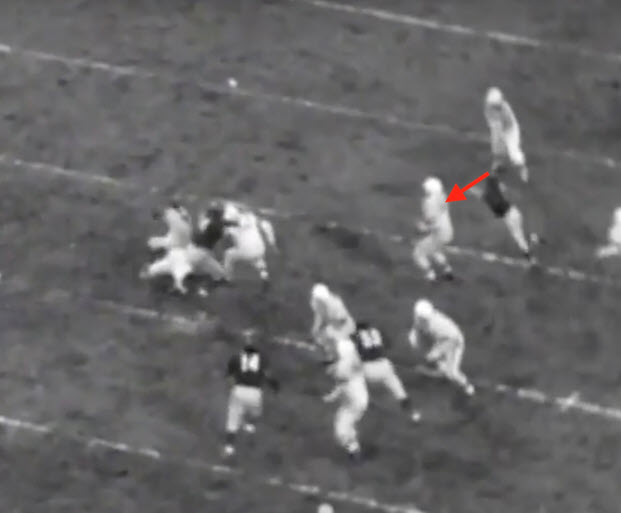
The Week 5 matchup against the Giants was a big game for the Browns, the Giants had the Browns’ number defeating them in both 1950 regular season games before losing the tight playoff matchup the prior December, allowing the Browns to move to the Championship. A tight contest played on a sloppy field saw the Brown take a one-point victory, 14-13, which, for the first time, required that Ford play every defensive snap. Lenny favored a three-point stance which he deploys on 84% of the 57 total snaps. Quick on the trigger, Ford draws an offside penalty but also posts two sacks for 20 yards and a forced fumble. His five-yard sack, the first of the game, is a thing of beauty a leaping sack, the style of which few can match.
 |
| Lined up in a two-point stance Ford rushes off the edge and then dispenses with a chip from the releasing receiver |
 |
| Ford is then engaged by G Bill Albright, who will be moved to defense in 1952 |
 |
| Lenny leaps and leaves his feet, while engaged with Albright |
 |
| And grabs Conerly, still in the air and over G Bill Albright, before taking him down for the sack |
Lenny’s second sack of the Giants game is a long 15-yarder. Conerly rolls to his right, away from Ford, but as Young brings pressure he pivots back and gets swamped by Ford forcing Conerly to fumble from the force of the brutal hit, though the Giants are able to recover. The spectacular leaping sack of the QB and blocker, as well as the brutality of the sack/forced fumble would each be highlight plays in the modern age.
Riding a four-game winning streak, the Browns headed to Comiskey Park to take on the Cardinals, the first time Lenny himself has suited up against the South-siders since the Pat Harder incident in 1950. Lenny is ready to play, despite the fact that Harder has been shipped off to the Lions, putting on his best performance of the season to date. Ford plays 90% of the teams’ 62-snaps in a nearly 50/50 mix of two and three-point stance. Lenny snags three sacks for 25-yards in losses (two solo and two shared – one each with Bill Willis and Derrell Palmer), two stuffs for 11.5-yards in losses (one solo and two of them shared), and a forced fumble, totaling seven tackles made in the backfield a number not matched by modern day greats J.J. Watt or Aaron Donald.
At the halfway mark of the short 12-game 1951 season Ford has logged 9.5 sacks, three stuffs, and three forced fumbles, but Lenny’s best work is yet to come.
In Week 7, the Browns return home for their first matchup of the season against the Eagles who suffered two humiliations against the Browns in 1950. Their second 1950 matchup, following the opening-game drubbing, was famous as well. The Eagles had continued to describe the Browns in a derogatory fashion as a “finesse” team after the 1950 opening-game loss. This left Paul Brown upset about Eagle Coach Grease Neale, “shooting off his bazooka,” Brown and his team took to prove they weren’t finesse only, by famously throwing no passes in their rematch victory. Unfortunately, this famous story excludes two critical details. First, the Browns did dropback to pass twice in the game; one resulting in a holding penalty and one in an Eagle sack, meaning there were no official pass attempts, but also showing that Brown was not committed to never passing. Second, the game was played in some of the worst passing conditions imaginable, with temperatures just above freezing and constant rain causing an increasingly muddy field. The first 1951 matchup with the Eagles would be different, with dry conditions and temperatures around 50 degrees. The Eagles jumped out to a 10-0 halftime lead, but the talented Browns come back, aided by another Ford classic, to win 20-17 on a fourth-quarter field goal by Lou Groza. Ford participates in 90% of the 79 defensive snaps in a down-stance for nearly 80% of his snaps, the last time in 1951 he’ll spend more time with his fist in the dirt than in a two-point stance. Lenny logs a single sack for seven yards, two stuffs for four yards and forced a fumble for the third-consecutive game, his fourth of the season.
Following the Eagle victory, the Browns traveled east to the Polo Grounds for an away rematch against the Giants and their vaunted defense. Following a shutout 10-0 victory, Cleveland’s third shutout of the season, Brown states incredulously, “Most everything the New York writers say about the Giants’ greatness on defense is true. What they overlook, or forget to say, is that we have gained more yards against them, scored more points and won more games than the Giants have against us . . . seems to me they should soon start to recognize and admit that our fellows are a pretty tough defensive outfit too.” Though eight weeks, the Browns are giving up 11.75 points-per-game to the Giants 17+ PPG, and Ford is the star of the tough outfit. Against the football Giants, Lenny plays 88% of the teams’ 68 defensive snaps, just one-quarter of them in a 3-point stance; and this is the last time he’ll play any meaningful snaps with his hand in the dirt. Ford’s defensive gem includes 2.5 sacks (one solo, two shared with Willis and one shared with Kissell) for 19yards lost and 1.5 stuffs for eight yards lost for a total of six tackles for loss.
Returning home the following week against the Bears, the Browns wallop their visitors getting off to a 21-0 lead on the way to a 42-21 victory. Ford is excellent, but Dub Jones is the MVP on this day going for six touchdowns (four rushing, two receiving) and doing so on just 12 touches (nine rushing attempts, four ending in the endzone and three receptions, two ending in the endzone). Years later, Gale Sayers will match Dub’s six touchdowns on 16 touches, nine runs, two receptions and five kickoff returns. The highlight reel defensive play of the game is turned in by the Bears’ Ed Sprinkle a sack + forced fumble + recovery with a touchdown return, though this is late in the fourth quarter of a blowout.
Ford has fully transitioned to a 2-point stance playing all but one snap from a standing position. He logs two sacks for 19 yards (a 12-yard sack in the first half and a seven-yard sack-forced- fumble in the fourth quarter – the seven-yard sack was recovered for a loss of just three by the Bears, so the teams’ “Yards Lost tackled” only reflects the three-yard loss). Lenny’s first sack is a prime example of the inability of a guard to flare out wide and stop Ford, who also logged two stuffs for nine yards. His second sack and forced fumble saw the Bears blocking Lenny with a back cutting across the formation to take him on, but it was not good enough. An apparent blemish on his game was a roughing the passer penalty negating a long 95-yard interception return touchdown; closer inspection shows it was Ford’s pressure that caused the errant throw to begin with. For a man with 14 sacks to this point in the season, however, it’s just Lenny’s second penalty to go with a mere five-yard offside penalty in the first Giant game.
 |
| Giants flare out a guard in protection against Ford, who plants his right foot in the dirt . . . |
 |
| . . . and cuts back underneath the flaring guard, to bear down on the passer |
|
 |
| And closed the deal
with a sack |
 |
| Ed Sprinke bears down on Otto Graham who’s focused downfield |
 |
| Sprinkle leaps in the air his right arm extended in a Tomahawk chop which will become a popular fumble forcing move several decades later |
 |
| He knocks both the ball and Otto’s helmet loose, causing the fumble |
 |
| Which Sprinkle scoops up for a recovery and long TD return |
The following week the Cardinals came to Cleveland for what would be the first of a three-game series of blowout victories, dominant Brown defensive performances, and early departures for Ford-all with the game well in hand. The Browns scored in the first minute-and-a-half of the game then, on the first play after the Cardinals took possession, Bill Willis swooped in for an eight-yard sac’s this is the way the whole game went for the slumping Cardinals. The Cardinals are not flaring guards out wide or using backs to block Lenny but are typically blocking him with a tackle, perhaps responding to tape of the prior week’s game against Chicago. Ford has only his second game of the season without a sack or a stuff, though he does recover a fumble following a botched handoff in the backfield. He is pulled at halftime of the blowout, replaced by Bob Oristaglio. Ford participated in just 47% of the 75 snaps, all from a 2-point stance. The Browns poured on the pass rush in the second half, the ends pinning their ears back, resulting in a seven-sack second half and a nine-sack game, George Young picking up four and Bob O. three.
In the second game of the spectacular three-game run, the Browns traveled to Pittsburgh and muddy Forbes Field. Despite it being December, Forbes still bore the sand (now mud) infield from a season of use for the Pittsburgh Pirates, with discernable lines at the edge of the old infield. Ford was spectacular, with a huge first-half to bury the Steelers. Standing up for all but two snaps, he finished with five sacks, 2.5 stuffs, a forced fumble, and a total of seven tackles for loss. He logs an eight-yard sack early, his second sack is a zero-yarder (this is a sack under the modern definition, in fact, TJ Watt had two zero-yard sacks in his 2021 modern record campaign and Michael Strahan had one zero-yard sack in his 2001 campaign which set the previous modern sack record).
 |
| An early 8-yard sack sees Lenny come off the edge and around RB blocking to hammer the QB before George Young can get in |
 |
| Ford notches a 0-yard sack as the QB cannot make a gain attempting to escape the pocket |
On Lenny’s third sack the Steelers, inexplicably, leave Ford unblocked and he blasted through for the sack and his sixth forced fumble of the season, which Ford himself recovered on the eight-yard line.
 |
| Lenny off right end unblocked blasts the QB and the ball comes out which Ford recovers deep in Steeler territory |
Deep in Steeler territory, this essentially put the game away with a 21-0 lead after a short Graham TD pass. At the end of the first half, Ford has three sacks, 1.5 stuffs and a forced fumble that he recovered deep in Steeler territory. Lenny’s fourth sack saw the Steelers try to block him with a back that Lenny nimbly sidesteps before pulling the QB down again. Lenny’s final sack is a ‘mop-up’ of the QB scrambling from pressure, dodging potential sackers Bill Willis and then George Young, before being ‘bear hugged’ by Lenny and held up till the whistle blows. Ford is pulled from the game in the early fourth quarter and replaced by Bob O, participating in just 71% of the defensive snaps. The Browns completed their fourth shutout of the regular season, a number only exceeded by the 1944 Giants and 1976 Steelers with five each.
 |
| Ford dodges a cut-block attempt by the Steeler RB |
 |
| Lenny’s fourth sack results after an attempted cut-block from the back fails and he beat George Young in to make the play |
 |
| Ford’s 5th sack of the Steeler game was a ‘mop-up’ sack, Willis getting early pressure and missing the diving sack, Young coming in but missing a tackle, with Lenny the beneficiary |
Going into the final week of the season the Browns are carrying a 10-game winning streak after losing in Week 1 and are about to complete a historic three-game sack streak. They headed to Shibe Park in Philadelphia on a frigid day with snow piled up off the sides of the frozen turf and in the back end of the endzone. Temperatures were below 20 degrees F and wind speeds were approaching 20-MPH. For the first time in the 1951 regular season – and for the first regular season game since Week 4 of 1950 – the Browns did not wear their white jerseys, going with Brown as the home Eagles wore White.
The entire line got excellent pressure throughout the game with nary a dropback that’s unmolested. Ford picked up his first sack after George Young whiffed and his second as he and Young met at the quarterback, Young overrunning Burk so Ford takes him down alone. Bill Willis finished second on the team with an impressive 11.5 sacks for the season, likely the highest per-game total ever for a man playing over the center. Most of Willis’ sacks result from quickness with the small but agile Willis beating the blocker off the snap and getting in quickly. George Young, however, often got excellent pressure from his left end position but was beaten to the punch by Ford. Young’s impressive nine-sack season would likely have had four to five additional sacks were his running mate not arriving at the QB first.
 |
| Ford as stand-up right end swoops in for the sack after George Young misses |
 |
| Lenny logs his second sack of the Eagle game |
Lenny’s third sack of the game was a devastating highlight-reel play. In the shadows of the Eagles own goal post Adrian Burk took the snap from his own 9-yard line. Ford was in a 2-point stance, as he was in all but a single snap in this game. Burk faked a pitchout to the right and dropped back, but Lenny was unblocked and slammed the quarterback back into his own goal post, only the frozen metal preventing a safety. Ford and Burke slid down the goal post to the ground, with the referee slipping and falling at their feet as he’s contacted by the falling Burk on the slippery field.
 |
| Lenny is unblocked and gets immediate pressure |
 |
| Burke is hit and slammed against his own goal post |
 |
| The Goal post is the only thing saving him from a Safety as Burke slides down for a sack at the one-yard line, resulting in a fourth-down punt from a snow pile in the back of the endzone |
The ensuing punt was made off a snowbank piled in the back of the endzone following the sack back to the one-yard line. After one more series, Ford was pulled in the mid-third quarter for Bob O., who himself picks up 2.5 sacks after Ford’s departure. Lenny participated in just 58% of the 65 plays the Eagles run, playing entirely from a 2-point stance. The right end position combines for 5.5 sacks on the day and the team totals 11 for 92-yards lost.
The three-game run from December second at home against the Cardinals to the final game victory against the Eagles sees the Browns outscore their opponents 101 – 37 and pick up nine, nine, and 11 sacks, respectively, for 29 sacks over the three-game span. In the 70+ years since no team has recorded nine-or-more sacks in three-consecutive games with only the ’89 Vikings of Chris Doleman and Keith Millard logging three-consecutive eight-or more sack games. The 29-combined sacks in three weeks also exceeds the highest since, with the ‘Gold Rush’ of the 1976 San Francisco 49ers posting 10, seven and eight sacks to log 25 total over a three-week span. In the known NFL history, the 1951 Browns had the most sack-per-game in any NFL season at 4.92/per game.
Summarizing the Greatness
Len Ford completed the season with 23 sacks for 188 yards lost, 13 stuffs for 47yards lost, 6 forced fumbles, and 40 tackles for loss, all on just 638 of his team’s 818 defensive snaps in a 12-game season.
Ties the Single Season Record: Based on research we’ve completed at the Journal, this would tie Bubba Baker’s 1978 for the most sacks in a single season, albeit in just 12-games.
Second in a 16-game Span: Adding the last four regular season games that Lenny played in 1950, he compiled 27 sacks in a 16-game span. His 12-game single-season sack streak stands alone above Reggie White’s 21 sacks in 12 non-replacement games in 1987, with the 16-game streak exceeded only by adding Reggie’s 10 sack streak to end 1986 to his 1987 total for 31 sacks in 16 games. Bubba Baker’s stalwart 1978 had him garnering 22 sacks between Week 2 and Week 13, Lenny had 23, though Reggie White did (excluding scab games) have 24 sacks in 12 consecutive non-scab games from Week 13 of 1986 to Week 12 of 1987.
Tied for Most in Consecutive Games: Lenny’s two-game stretch to end the season with 5 and 3 sacks, respectively was also unique. Players who put up those types of figures get game-planned for and shut down, typically, in consecutive weeks. In the official sack era (1982-to-date), the most sacks in consecutive weeks is 7 ½ shared by Kevin Greene (across the final game of 1988 and the first of 1989), Aldon Smith in a November 2012 run, and of all people Johnnie Cooks of the Indianapolis Colts across a couple of November 1984 games. Only prior to 1982 did any players match Lenny’s 8 sacks in two games, with Oakland’s Ike Lassiter accomplishing the feat across two October 1967 games and Cincinnati’s Mike Reid matching 8 in two games in October 1972. Bill Stanfill in 1973 and Jim Katcavage in 1964 matched the 7.5 sack, consecutive game streak.
Ford's 1951 SeasonMost Team’s sacks Per Game: The Browns total of 59 sacks in 1951 recently would have led the NFL in every year since 2013 when the Carolina Panthers posted 60 sacks in 16 games. On a per-game basis the Browns’ 59 sacks rates as the top known season in NFL history over the likes of Teams with Nicknames, like the Monsters of the Midway, The Gold Rush or the Doomsday defense.

Unfortunately, after all this success, the following week’s Championship game would be a massive disappointment. The Browns would again face off against the Rams for the Championship this time in warm Los Angeles. However, unlike the 1950 tilt, the Browns would lose in a tight game with Norm Van Brocklin hitting Tom Fears for a long fourth-quarter touchdown to pull ahead 24-17. Ford wouldn’t log a sack in the game despite generally excellent play.
As the honors rolled in after the season, Lenny was the only consensus First-team All-Pro defensive end, with the Rams’ Larry Brink and Lions’ Leon Hart splitting votes as the AP and UPI couldn’t agree. Along with Tank Younger and Emlen Tunnell, Ford was the first African American named to an All-Pro by either Associated Press or United Press. However, the likes of Duke Slater and Fritz Pollard made some newspaper teams prior to re-integration, and Bob Mann was certainly a snub in 1949. Evaluating performances, honors and verbatims there’s simply no doubt that were a Defensive Player of the Year issued in 1951, Ford would be the winner.