Friday, August 12, 2022

The Story of Len Ford: Rectifying a Diminished Legacy—Part 3

By Nick Webster 

The Heights – 1951 – The Season of All Seasons 

Prior to the start of training camp, Lenny indicated that he would wear a facemask for protection during the 1951 season, though not one as “cumbersome” as the one he wore in the 1950 Title game.  However, he got comfortable without it in early action and would play maskless throughout the year.  In 1953 after Otto Graham suffered a less severe jaw injury, he wore a plastic mask; this spurred Coach Brown to partner with Riddell on a more permanent solution. The result of this collaboration was the bar we’re all familiar with today, Brown would receive royalties for years as part of this collaboration.  As training camp kicked off, Ford started better than ever. In an opener against the College All-Stars Lenny had a sack-forced-fumble where he then tackled the recovering lineman for a safety and a blocked punt in a dominating win over the College All-Stars. The league was beginning to evolve and rapidly integrate, the Green Bay Press-Gazette proclaiming that the “Packers Pull a ‘Cleveland’ With Four Negros in Action.” Ford had half a season as a full-time defensive player and a more settled personal life, in 1951, he was 25-years old, on the best team in football and primed for success.

The reigning Champion Cleveland Browns opened their 1951 season on the road against the powerful San Francisco 49ers at Kezar Stadium with almost 53,000 of the 59,000-seat venue filled. Temperatures were mild with spotty showers that had fans running for shelter prior to a downpour before halftime.  The 49ers took it to the Browns in the opener, running the ball effectively and often with limited need for passing as they took the lead in the second quarter and stayed ahead throughout. The most effective running was by Verl Lillywhite who ran for 145 yards on 17 carries with Joe Perry effectively locked up with just four yards on 10 carries, despite scoring two touchdowns. The 49ers only dropped back 19 times, with 17 pass attempts and two sacks. Ford played almost entirely from a 3-point stance – something which will change over the course of the season – and only participated in 39 snaps (58% of the teams’ 67 total) as he was replaced by Jim Martin in Q4 with the Browns down on the scoreboard.  Later in the season, we see Ford’s snaps limited due to fourth-quarter blowouts. This was the only time it occurred with the Browns down on the scoreboard. Despite few drop-backs and limited participation, Ford was effective and had the only two sacks the team produced, for 30 yards in losses. It was a disappointing result on the scoreboard, but Ford’s play was exemplary, portending things to come.

Week 2 had the Browns traveling down the California coast to Los Angeles for a rematch of last year’s championship game, but this time in the Coliseum, the home of the Rams. Typical for the era, when travel was slow and difficult, the Browns stayed out on the West Coast between games rather than travel back home. The Browns stayed at the Green Hotel in Pasadena and practiced “in secret” at the public Brookside Park near the Rose Bowl. Paul Brown was either pessimistic or playing possum in stating, “It’s simply not the ball club it used to be” in referring to his team after the 49er loss. Despite beating the Rams in both prior meetings – each at home in Cleveland – the Browns were initially established as 3-point underdogs as visitors off the loss to San Francisco.

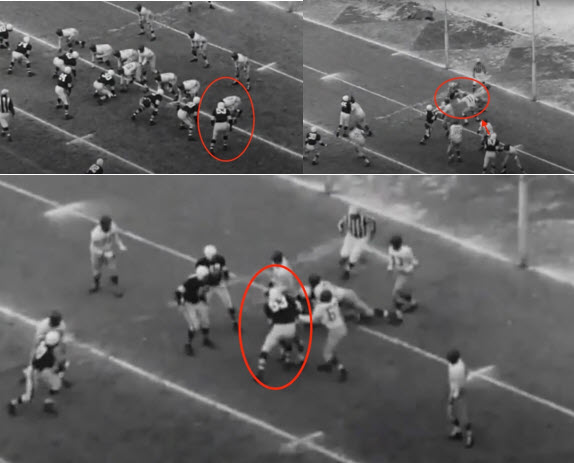
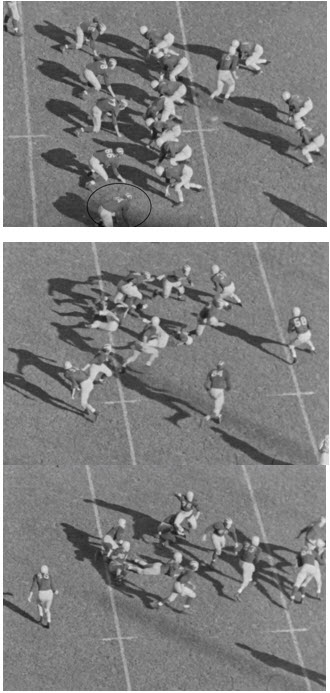
The Rams kicked off to the Browns on a beautiful sunny day in the Coliseum with long shadows cast from the participants. The Rams got off to a strong start, scoring the first 10-points of the game and holding a 10-7 lead at the half. But in the third quarter, the Browns came on scoring 21 unanswered points on their path to a 38-23 victory. Ford played nearly 90% of the defensive snaps and was in a 3-point stance for three-quarters of those snaps, fewer than in the first game, but still playing primarily with his fist in the dirt. The Browns would only sack the Rams once, with Bill Willis darting up the middle for an early third-quarter sack. Ford got excellent general pressure, collapsing the pocket and making life difficult but with frequent double-teams and a missed tackle on both a potential sack and stuff, his stat sheet was clean with zero sacks, zero stuffs and a single QB hit on the game.

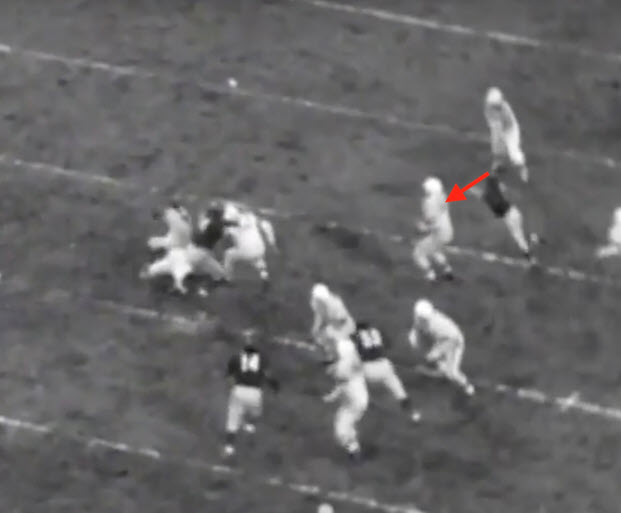
Ford in a two-point stance at RDE, quickly penetrates, too quickly for the Wideout to execute his down-block

Ford makes contact and pushed the back further towards the goal-line, but misses the tackle

The play is cleaned up by the onrushing Safety for a 5-yard stuff, forced by, but not credited to Ford
Following their victory, the 1 – 1 Browns returned to Cleveland for a matchup against the 0 – 2 Washington Redskins. Two games in with a 2-sack game and a 0-sack game, this is where Ford would begin to dominate play. On the first Redskin series of the game, Ford nailed Redskin QB Harry Gilmer seven yards behind the line of scrimmage and, as the Associated Press put it, "The game really ended in the first two minutes when Cleveland's huge end, Len Ford hit Redskin QB Harry Gilmer as he attempted to pass and end George Young of the Browns plucked Gilmer's fumble out of the air and raced 60 yards for the opening touchdown." That gave the Browns a 7-0 lead that they’d never relinquish on their way to a dominating 45-0 victory over the still winless Redskins. Ford would be removed from the last couple series of this blowout, playing 69% or 47 of 68 snaps. Lenny was also a victim of friendly fire, being hit in the back of the head by a teammate, which may have precipitated his removal from the action. Lenny finished the game with two sacks for 13 yards and the critical early sack-forced-fumble that turned the game. Again, Lenny largely played with his fist in the dirt on over 80% of snaps.

The following week the 0–2–1 Steelers made the short trip to Cleveland to try and get off the schneid.  Lenny increased his experimenting with playing upright from a two-point stance with a 50/50 split of two versus three-point stance. The Steelers are still running their old single wing, so Ford is rarely asked to drop into coverage and is on alert for running plays going wide. Ford plays most of the game logging 63 of the team’s 73 snaps picking up a half-sack for seven yards (shared with George Young), a stuff for two yards and a QB hit causing an incomplete pass as the Browns pitch a second consecutive shutout.

The Steeler scheme has Fran Rogel attempting to take on Ford, he goes low, Ford gets by and hits the QB and the ball goes feebly into the ground

The Week 5 matchup against the Giants was a big game for the Browns, the Giants had the Browns’ number defeating them in both 1950 regular season games before losing the tight playoff matchup the prior December, allowing the Browns to move to the Championship. A tight contest played on a sloppy field saw the Brown take a one-point victory, 14-13, which, for the first time, required that Ford play every defensive snap. Lenny favored a three-point stance which he deploys on 84% of the 57 total snaps.  Quick on the trigger, Ford draws an offside penalty but also posts two sacks for 20 yards and a forced fumble. His five-yard sack, the first of the game, is a thing of beauty a leaping sack, the style of which few can match.

Lined up in a two-point stance Ford rushes off the edge and then dispenses with a chip from the releasing receiver

Ford is then engaged by G Bill Albright, who will be moved to defense in 1952

Lenny leaps and leaves his feet, while engaged with Albright

And grabs Conerly, still in the air and over G Bill Albright, before taking him down for the sack
Lenny’s second sack of the Giants game is a long 15-yarder.  Conerly rolls to his right, away from Ford, but as Young brings pressure he pivots back and gets swamped by Ford forcing Conerly to fumble from the force of the brutal hit, though the Giants are able to recover. The spectacular leaping sack of the QB and blocker, as well as the brutality of the sack/forced fumble would each be highlight plays in the modern age.

Riding a four-game winning streak, the Browns headed to Comiskey Park to take on the Cardinals, the first time Lenny himself has suited up against the South-siders since the Pat Harder incident in 1950.  Lenny is ready to play, despite the fact that Harder has been shipped off to the Lions, putting on his best performance of the season to date. Ford plays 90% of the teams’ 62-snaps in a nearly 50/50 mix of two and three-point stance. Lenny snags three sacks for 25-yards in losses (two solo and two shared – one each with Bill Willis and Derrell Palmer), two stuffs for 11.5-yards in losses (one solo and two of them shared), and a forced fumble, totaling seven tackles made in the backfield a number not matched by modern day greats J.J. Watt or Aaron Donald.

At the halfway mark of the short 12-game 1951 season Ford has logged 9.5 sacks, three stuffs, and three forced fumbles, but Lenny’s best work is yet to come.

In Week 7, the Browns return home for their first matchup of the season against the Eagles who suffered two humiliations against the Browns in 1950. Their second 1950 matchup, following the opening-game drubbing, was famous as well.  The Eagles had continued to describe the Browns in a derogatory fashion as a “finesse” team after the 1950 opening-game loss. This left Paul Brown upset about Eagle Coach Grease Neale, “shooting off his bazooka,” Brown and his team took to prove they weren’t finesse only, by famously throwing no passes in their rematch victory. Unfortunately, this famous story excludes two critical details. First, the Browns did dropback to pass twice in the game; one resulting in a holding penalty and one in an Eagle sack, meaning there were no official pass attempts, but also showing that Brown was not committed to never passing. Second, the game was played in some of the worst passing conditions imaginable, with temperatures just above freezing and constant rain causing an increasingly muddy field. The first 1951 matchup with the Eagles would be different, with dry conditions and temperatures around 50 degrees. The Eagles jumped out to a 10-0 halftime lead, but the talented Browns come back, aided by another Ford classic, to win 20-17 on a fourth-quarter field goal by Lou Groza. Ford participates in 90% of the 79 defensive snaps in a down-stance for nearly 80% of his snaps, the last time in 1951 he’ll spend more time with his fist in the dirt than in a two-point stance.  Lenny logs a single sack for seven yards, two stuffs for four yards and forced a fumble for the third-consecutive game, his fourth of the season.

Following the Eagle victory, the Browns traveled east to the Polo Grounds for an away rematch against the Giants and their vaunted defense. Following a shutout 10-0 victory, Cleveland’s third shutout of the season, Brown states incredulously, “Most everything the New York writers say about the Giants’ greatness on defense is true. What they overlook, or forget to say, is that we have gained more yards against them, scored more points and won more games than the Giants have against us . . . seems to me they should soon start to recognize and admit that our fellows are a pretty tough defensive outfit too.”  Though eight weeks, the Browns are giving up 11.75 points-per-game to the Giants 17+ PPG, and Ford is the star of the tough outfit. Against the football Giants, Lenny plays 88% of the teams’ 68 defensive snaps, just one-quarter of them in a 3-point stance; and this is the last time he’ll play any meaningful snaps with his hand in the dirt. Ford’s defensive gem includes 2.5 sacks (one solo, two shared with Willis and one shared with Kissell) for 19yards lost and 1.5 stuffs for eight yards lost for a total of six tackles for loss.

Returning home the following week against the Bears, the Browns wallop their visitors getting off to a 21-0 lead on the way to a 42-21 victory.  Ford is excellent, but Dub Jones is the MVP on this day going for six touchdowns (four rushing, two receiving) and doing so on just 12 touches (nine rushing attempts, four ending in the endzone and three receptions, two ending in the endzone). Years later, Gale Sayers will match Dub’s six touchdowns on 16 touches, nine runs, two receptions and five kickoff returns. The highlight reel defensive play of the game is turned in by the Bears’ Ed Sprinkle a sack + forced fumble + recovery with a touchdown return, though this is late in the fourth quarter of a blowout.  

Ford has fully transitioned to a 2-point stance playing all but one snap from a standing position. He logs two sacks for 19 yards (a 12-yard sack in the first half and a seven-yard sack-forced- fumble in the fourth quarter – the seven-yard sack was recovered for a loss of just three by the Bears, so the teams’ “Yards Lost tackled” only reflects the three-yard loss). Lenny’s first sack is a prime example of the inability of a guard to flare out wide and stop Ford, who also logged two stuffs for nine yards. His second sack and forced fumble saw the Bears blocking Lenny with a back cutting across the formation to take him on, but it was not good enough. An apparent blemish on his game was a roughing the passer penalty negating a long 95-yard interception return touchdown; closer inspection shows it was Ford’s pressure that caused the errant throw to begin with.  For a man with 14 sacks to this point in the season, however, it’s just Lenny’s second penalty to go with a mere five-yard offside penalty in the first Giant game.
Giants flare out a guard in protection against Ford, who plants his right foot in the dirt . . . 
 
                        . . .  and cuts back underneath the flaring guard, to bear down on the passer

And closed the deal with a sack

Ed Sprinke bears down on Otto Graham who’s focused downfield

Sprinkle leaps in the air his right arm extended in a Tomahawk chop which will become a popular fumble forcing move several decades later

He knocks both the ball and Otto’s helmet loose, causing the fumble

Which Sprinkle scoops up for a recovery and long TD return
The following week the Cardinals came to Cleveland for what would be the first of a three-game series of blowout victories, dominant Brown defensive performances, and early departures for Ford-all with the game well in hand. The Browns scored in the first minute-and-a-half of the game then, on the first play after the Cardinals took possession, Bill Willis swooped in for an eight-yard sac’s this is the way the whole game went for the slumping Cardinals. The Cardinals are not flaring guards out wide or using backs to block Lenny but are typically blocking him with a tackle, perhaps responding to tape of the prior week’s game against Chicago. Ford has only his second game of the season without a sack or a stuff, though he does recover a fumble following a botched handoff in the backfield. He is pulled at halftime of the blowout, replaced by Bob Oristaglio. Ford participated in just 47% of the 75 snaps, all from a 2-point stance. The Browns poured on the pass rush in the second half, the ends pinning their ears back, resulting in a seven-sack second half and a nine-sack game, George Young picking up four and Bob O. three.

In the second game of the spectacular three-game run, the Browns traveled to Pittsburgh and muddy Forbes Field. Despite it being December, Forbes still bore the sand (now mud) infield from a season of use for the Pittsburgh Pirates, with discernable lines at the edge of the old infield. Ford was spectacular, with a huge first-half to bury the Steelers. Standing up for all but two snaps, he finished with five sacks, 2.5 stuffs, a forced fumble, and a total of seven tackles for loss. He logs an eight-yard sack early, his second sack is a zero-yarder (this is a sack under the modern definition, in fact, TJ Watt had two zero-yard sacks in his 2021 modern record campaign and Michael Strahan had one zero-yard sack in his 2001 campaign which set the previous modern sack record).  
An early 8-yard sack sees Lenny come off the edge and around RB blocking to hammer the QB before George Young can get in

Ford notches a 0-yard sack as the QB cannot make a gain attempting to escape the pocket
On Lenny’s third sack the Steelers, inexplicably, leave Ford unblocked and he blasted through for the sack and his sixth forced fumble of the season, which Ford himself recovered on the eight-yard line.  
Lenny off right end unblocked blasts the QB and the ball comes out which Ford recovers deep in Steeler territory
Deep in Steeler territory, this essentially put the game away with a 21-0 lead after a short Graham TD pass.  At the end of the first half, Ford has three sacks, 1.5 stuffs and a forced fumble that he recovered deep in Steeler territory. Lenny’s fourth sack saw the Steelers try to block him with a back that Lenny nimbly sidesteps before pulling the QB down again. Lenny’s final sack is a ‘mop-up’ of the QB scrambling from pressure, dodging potential sackers Bill Willis and then George Young, before being ‘bear hugged’ by Lenny and held up till the whistle blows. Ford is pulled from the game in the early fourth quarter and replaced by Bob O, participating in just 71% of the defensive snaps. The Browns completed their fourth shutout of the regular season, a number only exceeded by the 1944 Giants and 1976 Steelers with five each.
Ford dodges a cut-block attempt by the Steeler RB

Lenny’s fourth sack results after an attempted cut-block from the back fails and he beat George Young in to make the play

Ford’s 5th sack of the Steeler game was a ‘mop-up’ sack, Willis getting early pressure and missing the diving sack, Young coming in but missing a tackle, with Lenny the beneficiary
Going into the final week of the season the Browns are carrying a 10-game winning streak after losing in Week 1 and are about to complete a historic three-game sack streak. They headed to Shibe Park in Philadelphia on a frigid day with snow piled up off the sides of the frozen turf and in the back end of the endzone. Temperatures were below 20 degrees F and wind speeds were approaching 20-MPH. For the first time in the 1951 regular season – and for the first regular season game since Week 4 of 1950 – the Browns did not wear their white jerseys, going with Brown as the home Eagles wore White.  

The entire line got excellent pressure throughout the game with nary a dropback that’s unmolested.  Ford picked up his first sack after George Young whiffed and his second as he and Young met at the quarterback, Young overrunning Burk so Ford takes him down alone. Bill Willis finished second on the team with an impressive 11.5 sacks for the season, likely the highest per-game total ever for a man playing over the center. Most of Willis’ sacks result from quickness with the small but agile Willis beating the blocker off the snap and getting in quickly. George Young, however, often got excellent pressure from his left end position but was beaten to the punch by Ford. Young’s impressive nine-sack season would likely have had four to five additional sacks were his running mate not arriving at the QB first.  
Ford as stand-up right end swoops in for the sack after George Young misses

Lenny logs his second sack of the Eagle game
Lenny’s third sack of the game was a devastating highlight-reel play. In the shadows of the Eagles own goal post Adrian Burk took the snap from his own 9-yard line. Ford was in a 2-point stance, as he was in all but a single snap in this game. Burk faked a pitchout to the right and dropped back, but Lenny was unblocked and slammed the quarterback back into his own goal post, only the frozen metal preventing a safety.  Ford and Burke slid down the goal post to the ground, with the referee slipping and falling at their feet as he’s contacted by the falling Burk on the slippery field.  
Lenny is unblocked and gets immediate pressure

Burke is hit and slammed against his own goal post

The Goal post is the only thing saving him from a Safety as Burke slides down for a sack at the one-yard line, resulting in a fourth-down punt from a snow pile in the back of the endzone
The ensuing punt was made off a snowbank piled in the back of the endzone following the sack back to the one-yard line. After one more series, Ford was pulled in the mid-third quarter for Bob O., who himself picks up 2.5 sacks after Ford’s departure. Lenny participated in just 58% of the 65 plays the Eagles run, playing entirely from a 2-point stance. The right end position combines for 5.5 sacks on the day and the team totals 11 for 92-yards lost.

The three-game run from December second at home against the Cardinals to the final game victory against the Eagles sees the Browns outscore their opponents 101 – 37 and pick up nine, nine, and 11 sacks, respectively, for 29 sacks over the three-game span. In the 70+ years since no team has recorded nine-or-more sacks in three-consecutive games with only the ’89 Vikings of Chris Doleman and Keith Millard logging three-consecutive eight-or more sack games. The 29-combined sacks in three weeks also exceeds the highest since, with the ‘Gold Rush’ of the 1976 San Francisco 49ers posting 10, seven and eight sacks to log 25 total over a three-week span. In the known NFL history, the 1951 Browns had the most sack-per-game in any NFL season at 4.92/per game.

Summarizing the Greatness
Len Ford completed the season with 23 sacks for 188 yards lost, 13 stuffs for 47yards lost, 6 forced fumbles, and 40 tackles for loss, all on just 638 of his team’s 818 defensive snaps in a 12-game season.  

Ties the Single Season Record:  Based on research we’ve completed at the Journal, this would tie Bubba Baker’s 1978 for the most sacks in a single season, albeit in just 12-games.

Second in a 16-game Span: Adding the last four regular season games that Lenny played in 1950, he compiled 27 sacks in a 16-game span.  His 12-game single-season sack streak stands alone above Reggie White’s 21 sacks in 12 non-replacement games in 1987, with the 16-game streak exceeded only by adding Reggie’s 10 sack streak to end 1986 to his 1987 total for 31 sacks in 16 games.  Bubba Baker’s stalwart 1978 had him garnering 22 sacks between Week 2 and Week 13, Lenny had 23, though Reggie White did (excluding scab games) have 24 sacks in 12 consecutive non-scab games from Week 13 of 1986 to Week 12 of 1987.

Tied for Most in Consecutive Games: Lenny’s two-game stretch to end the season with 5 and 3 sacks, respectively was also unique.  Players who put up those types of figures get game-planned for and shut down, typically, in consecutive weeks.  In the official sack era (1982-to-date), the most sacks in consecutive weeks is 7 ½ shared by Kevin Greene (across the final game of 1988 and the first of 1989), Aldon Smith in a November 2012 run, and of all people Johnnie Cooks of the Indianapolis Colts across a couple of November 1984 games.  Only prior to 1982 did any players match Lenny’s 8 sacks in two games, with Oakland’s Ike Lassiter accomplishing the feat across two October 1967 games and Cincinnati’s Mike Reid matching 8 in two games in October 1972.  Bill Stanfill in 1973 and Jim Katcavage in 1964 matched the 7.5 sack, consecutive game streak.

Ford's 1951 Season
Most Team’s sacks Per Game:  The Browns total of 59 sacks in 1951 recently would have led the NFL in every year since 2013 when the Carolina Panthers posted 60 sacks in 16 games. On a per-game basis the Browns’ 59 sacks rates as the top known season in NFL history over the likes of Teams with Nicknames, like the Monsters of the Midway, The Gold Rush or the Doomsday defense.
Unfortunately, after all this success, the following week’s Championship game would be a massive disappointment. The Browns would again face off against the Rams for the Championship this time in warm Los Angeles. However, unlike the 1950 tilt, the Browns would lose in a tight game with Norm Van Brocklin hitting Tom Fears for a long fourth-quarter touchdown to pull ahead 24-17. Ford wouldn’t log a sack in the game despite generally excellent play.

As the honors rolled in after the season, Lenny was the only consensus First-team All-Pro defensive end, with the Rams’ Larry Brink and Lions’ Leon Hart splitting votes as the AP and UPI couldn’t agree.  Along with Tank Younger and Emlen Tunnell, Ford was the first African American named to an All-Pro by either Associated Press or United Press. However, the likes of Duke Slater and Fritz Pollard made some newspaper teams prior to re-integration, and Bob Mann was certainly a snub in 1949. Evaluating performances, honors and verbatims there’s simply no doubt that were a Defensive Player of the Year issued in 1951, Ford would be the winner.

Wednesday, August 10, 2022

The Story of Len Ford: Rectifying a Diminished Legacy—Part 2

 By Nick Webster 
Len Ford with the Los Angeles Dons
Draft and The Dons

After finishing at Michigan after the 1947 season Ford was not drafted by the NFL. While the NFL was technically re-integrated in 1946 when Kenny Washington was signed to the Rams, this was forced by a policy that required that Los Angeles teams be integrated to use city facilities. The Rams, relocating from Cleveland, therefore had to sign Kenny (and later Woody Strode) to make use of the Los Angeles Coliseum; but they, and other league teams, didn’t need to draft or add to their black players.  

Ford was selected, however, in the third round of the 1948 AAFC Draft by the Los Angeles Dons who, ironically, had ended up in a dispute over their use of the same Los Angeles Coliseum in their inaugural 1946 season when they employed no black players. In 1947 Ezzrett “Sugarfoot” Anderson – an African-American veteran from the Hollywood Bears (the same Minor League team for whom Washington and Strode previously played) – integrated the Dons. Ironically, the Dons had lobbied hard in February of 1948 to bring in Ford’s former Michigan head coach Fritz Crisler as their head coach. GM Harry Thayer asserted, “Crisler can write his own ticket”. Crisler declined the Dons’ offer and just a month later, in March, stepped down as Michigan Head Coach. This ended Crisler’s coaching career, but he stayed with the school as Athletic Director, a position he would hold for another two decades, becoming a beloved Wolverine whose basketball arena was later named after him.

In 1948 with the Los Angeles Dons Ford was an immediate, if inconsistent, contributor. Dons’ new coach Jim Phelan – a successful college coach who would ignominiously go on to one of the worst winning percentages in league history, including consecutive one-win seasons with the Yanks in ’51 and Texans in ‘52 – implemented a unique offense for the 1948 season. Dubbed the “Phelan Spread,” it was designed to highlight the skills of passer Glenn Dobbs and pass catchers Burr Baldwin and rookie Len Ford. As a receiver, Ford was third on the team in receptions but second in both receiving yards and receiving TDs, the latter two being good for eighth and fourth in the AAFC overall. There were some early season issues with Ford's hands and “second rate pass catching, or non-catching, by Len Ford . . .” but as the overall numbers reflect this was not enough to keep him off the field as an offensive weapon. Going back to his Michigan days Ford liked to go for one-handed catches. That sometimes allowed him to stretch out for the spectacular catch but could backfire with drops. He had a long reception of 53-yards against San Francisco and another 50-yarder later in the year while averaging just under 20 yards-per-catch, impressive for a man his size. These numbers and the descriptions speak to the amazing size-speed combo Ford was, he could go for 53-yards or, in an October bout with the Buffalo Bills, “take the ball from Bill fullback Schuette on the 5 and drag the latter across the goal.”

Primary sources are scant for the Dons of this era, but evidence suggests that Ford was a defensive impact-maker as a rookie as well. While Ford didn’t start in their opening game shutout of the Chicago Rockets, he clearly made an impact. On the steamy August day in Soldier Field, former Notre Dame QB Angelo Bertelli could do nothing as, according to Dick Hyland of the Los Angeles Times, “Dale Gentry, Bob Nowaskey, Burr Baldwin and Len Ford contributed greatly to this defensive work by rushing Bertelli until he was dizzy.” the following week Don Coach Jim Phelan saw enough of Ford that he was placed into the starting lineup for their tilt with the Browns. Wally Willis was quoted in the Oakland Tribune saying, “They put on a display a trio of defensive men who take a back seat to no one.  By name they are Len Ford, a giant end who played with Michigan last year . . . Wally Heap . . . and Bob Nelson.” Red Dawson, Buffalo Bills head coach went so far as to say Ford was, “the best he’s ever seen. Exceptionally fast.” By November of his rookie year the Dons’ brass believed Ford, “belongs on the Conference first-team selection. Unlike other star ends who have always made the club by catching passes, Ford plays both offense and defense and is particularly great at both.”  

At season’s end Lenny was named Second-team All-AAFC defensive end, behind established Yankee right end Jack Russell. It’s noteworthy, however, that the team was selected by coaches Carl Voyles of the Brooklyn Dodgers and Red Strader, the coach of Jack Russell’s own Yankees. The AP Team selected from combined AAFC and NFL representatives awarded Ford honorable mention as a rookie.

Off the field, Ford was the talk of the town in Los Angeles, enjoying access to all that Hollywood had to offer.  Described as the “Big Brown frame . . . the whispers of many a girl.” Or the man who was, “breaking more hearts than unrequited love.” This early off-the-field activity may have distracted from his on-field exploits, but later in his career they would take a greater toll as Lenny aged.

More first-hand evidence can be seen of Ford’s performance in 1949 as a Don. Again, Ford was a reliable pass catcher, though his numbers largely matched his rookie figures in an era where pass-catching numbers were increasing dramatically. The Dons’ passing overall was down in 1949, and Len’s flat figures now lead the team. His 36 receptions, including a team record eight in a late-October match against the Chicago Hornets, were aided by numerous targets from rookie quarterback George Taliaferro whose shoulder Ford had separated in that 1947 Big-Ten matchup. On the defensive side of the ball, he was effective again, even seeing some snaps at linebacker in replacement of injured starter Dan Dworsky mid-season. Inconsistency was still an issue in his sophomore campaign as a pro, Los Angeles Times Dick Hyland referring to him as an “in-and-outer . . . looking like a world beater on one play and flattened out on the next by someone his 235 pounds of spring-steel strength should handle with ease.” Later, in praise of left end Burr Baldwin Hyland would say that Baldwin, “makes that big Len Ford look like a No. 1 kind sissy.”  

In an October 23 tilt against the Bills, he stuffed a Bill for a 7-yard loss attempting to get around his left end. In the penultimate game of the season, playing near his Morgan State stomping grounds in Baltimore, Ford was the undisputed star of the game and would have been defensive Player of the Week honors had it existed at the time. In the second half, Ford sacked Colt quarterbacks three times and intercepted a fourth-quarter Y.A. Tittle pass, which he returned 45-yards down the sideline. This directly ended two of three late Colt advances and helped maintain the Dons’ margin in an eventual 21-10 road victory. 

The 1949 UPI All-Star team again placed Ford in the position of honorable mention, with a clear bias for offensive ends. First-teamers Mac Speedie and Alyn Beals were first-first-second and third-third-first in receptions, yards, and TDs. The Second-team was made up of Alton Baldwin and Dante Lavelli who were second-second-second and tenth-tenth-second, respectively, in the same categories. Ford’s one TD reception likely relegated him to honorable mention along with Jack Russell, who had beaten him out in 1948, but who was also similarly defensive-minded.

To the Browns, 1950 and the Injury

The AAFC regular season wrapped up in late November and shortly after the early-December playoffs the league was defunct, with the 49ers, Browns, and Colts heading off to a newly merged NFL.  Respecting that standard football contracts of the day had teams retain rights till June first, Bert Bell organized an AAFC disbursement Draft to distribute players from teams that didn’t survive into the new league, for June second of 1950. This draft was held at the Bellevue – Stratford Hotel on the corner of Broad and Walnut Street in Philadelphia, the same site as the 1950 collegiate draft, just blocks from Bell’s League Headquarters, and a short train ride from Bell’s suburban Philly home.  

Going into the draft, Ford was rumored to be highly desired by then Cardinal coach, VP and GM Curley Lambeau, new Ram head coach Joe Stydahar and new Packer front man Gene Ronzani. Paul Brown recounted later that Lenny was rumored to have an “attitude problem,” which may have impacted his draft status, but Brown believed it was nothing more than his hatred of being on a losing team. Ford’s Dons’ teammate, the Hollywood-born Cal grad tackle Bob Reinhard had signaled his intent to stay on the West Coast, regardless of who picked him. In a work of draft-day wheeling-and-dealing, Lambeau passed on Lenny to select Reinhard, then trading the star back to the West Coast Rams in exchange for three players Jerry Cowhig, Tom Keane, and Bob Shaw.  

But after an excellent AAFC career which saw him named First-team All-AAFC in both 1948 and 1949, Reinhard would start just seven games for the Rams in 1950 before his football career was over, due to chronic back problems. Of Cowhig, Keane, and Shaw, only Keane would come to any acclaim, posting a couple impressive years as a DB picking off 10 passes in 1952 and then making All-Pro with 11 interceptions for the Colts in 1953. Ironically, this success came after being released by the Cardinals in September 1950 prior to the start of the season. He then caught on and played two years for the Rams before seeing success with the 1952 Texans and 1953 Colts. Ford’s second-round selection by the Browns was viewed with some surprise by the local papers, but none of the earlier picks would compare to what was to come from Ford. Only Lou Creekmur, of those picked prior to Ford, would make the Hall of Fame. Ford’s official signing with the Browns was announced by the team on June 28. 

From his very first practices with the Browns Lenny drew praise, with Coach Brown’s first observation of the 1950 team being that, “Len Ford is a terrific end” and that “he splatters ‘em”. Of the 1949 starting defensive ends, only George Young returned. John Yonakor – a star in the early AAFC for the Browns – had come under criticism and was allowed to leave prior to the season; this left Ford as the presumptive starter, and he took advantage. The Browns typically deployed the 5-man line of George Young, John Kissell, Bill Willis, John Sandusky, and Ford from left to right across the line. Horace Gillom and Bob Oristaglio would see time as backup ends and Derrell Palmer and Chubby Grigg as backup tackles.  As would transpire over the following few years, the Brown would tinker with a 4-man line and occasional formations with Willis and Ford aligned side-by-side.

As September rolled around, the Browns prepared for what would be the biggest regular season game in years. The reigning NFL and AAFC Champs were pitted off against each other in Philadelphia, the entire world expecting a decisive Eagle victory. But on Sunday, September 17th the day following the game, the headlines showed the world was wrong.


Crush, Trounce, Rout, Wallop, Drub pick a verb; the Browns immediately staked their claim amongst the best in professional football. So overwhelming was the Browns defense against the Eagles attack that towards the end of the game the Eagles actually ceased using the T-Formation, failing back to their “Z-Wide Formation” a desperation spread formation. The Eagles suffered 18-yards “lost attempted pass,” likely two sacks but possibly one long sack, and the focus of press coverage was on the Browns spectacular offensive play. Ford received some notice for penalties, one a clipping penalty negating a long TD run by halfback Don Phelps, another a roughing the passer penalty for 15 yards. In fact, other than the scoreboard, the most notable disparity in numbers was the Browns 12 Penalties to the Eagles three. One wonders if the NFL refs had their fingers on the scale, albeit to no avail.

The following week the Browns trounced the Baltimore Colts, the weakest of the holdovers from the AAFC to the NFL, Lenny logged his first known sack in the NFL, a 10-yarder on Y.A. Tittle (no play-by-play or full game film of the first game against the Eagles are available to account for the 18 “yards lost attempting to pass.” In week three, the Giants and Browns met in Cleveland in what would be the Browns first loss in the new league. The Giants were a strong squad and – similar to the Browns – had a defense that benefitted greatly from an influx of AAFC talent, obtaining a future Hall of Famer in tackle Arnie Weinmeister and an All-Pro in defensive back Otto Schnellbacher, each from the AAFC’s New York Yankees. The 6-0 shutout at home saw the Browns throw four interceptions without a TD and lose the turnover battle 5-1. The game is best characterized as an offensive misfire rather than a defensive failure. The Browns sacked Conerly four times for 40 yards, and Len came up with his second known sack of the season, a 14-yarder.

In week four at Pittsburgh, the Browns returned to their winning form, however, there was little opportunity for the Browns and Ford to show pass-rushing prowess as the Steelers were still a full-time single-wing team. However, Ford did share a four-yard sack with John Sandusky and Lou Rymkus also took down Joe Geri in a pass attempt for five yards.

Week five would be a defining game of Ford’s career. In week one the Browns dispensed with the 1949 NFL Champs in the Eagles, now they faced the talented but facing 1948 Champs in the Chicago Cardinals. A tough game saw the Cardinals take a 21-10 lead in the early third quarter. This was aided by strict officiating aimed at the Browns, including a dubious Len Ford roughing-the-passer penalty to extend a scoring drive, before the Browns could pull within a TD at 24-17. The Browns came back again and took the lead in the fourth quarter. In the waning minutes of the game, African-American end and punter Horace Gillom was goaded into a scuffle and was ejected from the game. Then, in the final minute of the game, as the Cardinals attempted to come back, Ford made a big play. Lenny logged a 15-yard sack, beating the Cardinals risky blocking scheme which left fullback Pat Harder to handle Ford one-on-one as a pass-rusher, after executing a play-action fake.

Ford lined up wide, offensive tackle aligned to DRT and Pat Harder directly behind QB Jim Hardy, Bill Willis on the Nose in his familiar frog-stance

Ford gets a free release while Hardy and Harder execute play-action

Reverse angle: Harder attempts to block onrushing Ford, Willis has beaten him man creating pressure up the middle

Hardy bails out of Willis pressure, but Ford – unable to be stopped by Harder after building up a head of steam – is there to take Hardy down

A long 15-yard sack for Ford

On the ensuing and penultimate play of the game, another passing situation, Harder got his revenge.  Again, Ford was allowed a free release from his right end position, but there are three backs in the backfield with Harder still aligned behind center. The scheme no longer required Harder to carry out a play-action, but the 5’11” 200-pound fullback is still one-on-one against the 6’4” 245-pound Ford. As he approached Ford, Harder lead with his right elbow to Ford’s left jaw, and Lenny went down as if he were shot. Lenny stayed down, clearly hurt as a penalty flag flew in. After a short stoppage, he was helped off, having completed his last snap of the regular season. To add insult to injury – literally in this case – the flag was thrown against Lenny, and Ford, not Harder, was ejected, the head linesman, Bill Ohrenberger, informed Coach Brown that Ford had been holding. Coach Brown immediately protested, even prior to viewing game-film, “Ford?” yelled back Brown, “Why, he’s the fellow down on the ground, hurt.”
Ford aligned wide at right end, another free release

Harder with no play-action responsibilities slides to Ford’s side

Harder’s right-elbow to Ford’s left-jaw

Ford immediately goes to the ground

A penalty flag flies in just as Jim Martin arrives sacking Hardy for an 8-yard loss and a forced fumble

Ford is helped off the field

In the aftermath of the game, NFL Commissioner Bert Bell fined Ford $50 for the incident, based on hearsay, prior to seeing the film. However, Paul Brown protested as Ford was undergoing surgery for the injuries suffered just as he was informed of the fine. Bell, upon understanding that Ford was under the knife after the incident, rescinded the fine. The media also began noting the outsized penalties called against the Browns with headlines like, “Browns in Ideal Position to Protest Officiating in the NFL.”  To this point in the season, the Browns had been docked for 463 yards in penalties to their opponents' 263. This rate had the Browns producing 92.6 penalty yards per game, a pace that still today would hold the NFL record over the 2013 Seahawks who averaged 88.4 penalty yards per game. Over the remaining seven games the Browns would still be highly penalized but at perhaps a more reasonable rate of 72 yards per game. 

There were concerns of racial undertones to the gameplay as well with both Gillom and Ford ejected.  Paul Brown admitted to being “frightened” by thoughts of a rematch later in the year on Chicago’s majority-black Southside home Comisky Park. Commissioner Bell, upon review of the game film, did not see a need to fine or warn Harder, noting that he had a clean bill previously. The New York Daily News would later refer to this incident generally, including Ford’s ejection, as, “The worst decision in Football this past Autumn.” Coincidentally, Harder was bruised up prior to the Browns-Cardinals rematch and was used sparingly in that game.

The following week, irate Browns owner Mickey McBride demanded that the Cardinals cover the remainder of Ford’s salary and his hospital bills. McBride stated that Ford was, “deliberately slugged . . . there is too much slugging going on . . . Ford hadn’t done a thing out of line.” Cardinals President Ray Benningsen was unconvinced, and Coach Curley Lambeau dug his heels in saying Harder, “just put a good shoulder block on Ford.” Chicago and Ohio columnists came out at odds on the situation, the former noting the rough state of play earlier in the game, the latter focused on the final incident. More concerning for the Browns than the penalty situation, however, were Ford’s injuries. Ford had suffered a broken nose, broken jaw, a broken-cheek bone, a fractured bone in his forehead, two lost teeth, and several chipped and loosened teeth. Ford underwent surgery with Browns physician Dr. Vic Ippolito (a former local Case Western Reserve halfback) observing and plastic surgeon Clifford Kiehn presiding, Ford would have his jaw wired shut following the involved procedure.
Len Ford in Oct 1950, the aftermath of surgery for numerous broken bones

Following a loss in the next week’s rematch against the Giants, the Browns ripped off a 6-game winning streak to enter a playoff and a successful first season in the National League. When the Browns advanced to the NFL Championship game following their win, in their third try, over the Giants, George Young, Browns DE, was injured. Ford, mending from his injury two months earlier, noted Young’s condition and requested to play in the final. Coach Brown agreed, subject to the approval of the team doctor and plastic surgeon. Having had his jaw wired shut Lenny had dropped from 245 to 215 Lbs. on an all-liquid diet but had managed to return to 223, adding weight after having his wires removed.  Lenny had been exercising at the local YMCA since his release from the hospital and deemed himself in playing shape. The doctors also agreed Ford could play, provided we wore a special mask, which was being prepared.
Ford’s mask for the 1950 NFL Title game

The 1950 NFL Title game opened in Cleveland’s sloppy, snow-covered Municipal Stadium with the visiting Los Angeles Rams going for an 82-yard touchdown pass in the opening seconds of the game, immediately putting the Browns on their heels. In early action it was Jim Martin at right defensive end with George Young at left defensive end, playing through injured ribs. But, entering late in the first half, Ford played excellently at defensive right end for essentially the entire rest of the game. Incredibly, considering the circumstances, he registered a long-stuff, a long-sack and consistently pressured Rams QBs as a mainstay in the Ram backfield. In the end of a thriller, the Browns could call themselves NFL Champions in their inaugural season as part of the combined league, an incredible accomplishment.  Paul Brown would say that Ford proved he was a man that day.

1950 was also an interesting year for Ford’s former teammate and lifelong friend Bob Mann.  Having led the NFL in receiving yards in 1949, Mann was asked by the Lions to take a pay cut during the offseason. Refusing, Mann held out and was then dealt to the New York Yankees for Bobby Layne.  Mann arrived in New York to be told by Coach Red Strader that he had no idea why the trade was made, and that it was dreamed up and consummated by “the brass.” After participating in one series of an exhibition game between the Yanks and the Redskins, in which he caught a 50-yard touchdown, Mann was placed on waivers the next day, being told despite having already led the league in receiving – that at 170 pounds. – he was too light to play pro football. Finally, Mann was fired from his offseason job as a beer salesman with the National Beer Company which was, coincidentally, owned by Detroit Lions President Ed Anderson. Mann later claimed he was “blackballed” for his salary demands. Packer Coach Ronzani, in an address to a local Men’s club, denied that any team had been instructed to avoid Mann. Ronzani even said they had been in contact with him about a signing, but Mann was miffed and claimed he could make more money selling real estate than playing. Finally, in November of 1950, Mann would sign with the Packers where he remained through 1954 and the end of his career.

The offseason between 1950 and 1951 was also busy for the recovering Ford.  Lenny was healthy enough in late January to be the newest member of the Browns 12-man basketball squad. This continued his hoops experience from high school and Morgan State. Ford had also been a practice participant in hoops at Michigan and as a semi-pro in prior off-seasons for the New York / Dayton Rens of the National Basketball League.  

In his personal life, Ford followed Bob Mann in becoming a licensed real estate agent and purchased an investment property in his Detroit home. Ford got engaged to Geraldine Bledsoe a senior law school student from Wayne State University, who he had been dating since their days as undergrads at Michigan. Geraldine was introduced to Lenny by her father who was close with the football coaching staff at Morgan State. Upon Lenny’s moving to Michigan to play for the Wolverines, Geraldine’s father looked up Ford and introduced Lenny to his daughter. By June of that year the two wed in Plymouth Congregational Church in Pittsburgh, Pa. Geraldine, whose father was a practicing lawyer in the Detroit area, would go on to great personal success and provide Ford with two daughters Anita and Deborah before the two divorced in 1959. In May, Ford re-signed a contract extension with the Browns, the team fully confident they’d see the old Ford back in the Fall, in fact, they’d get much, much more.

Monday, August 8, 2022

The Story of Len Ford: Rectifying a Diminished Legacy—Part 1

 By Nick Webster 

Len Ford at Michigan

This long piece is dedicated to T.J. Troup who taught me that ‘the tape never lies’ and Chris Willis who provided so much support in its creation.

Here at The Journal, we enjoy diving deep on some of the best accomplishments, best seasons, and best players in NFL history. We all know about some of the great recent pass-rush seasons JJ’s 2012, Strahan’s 2001, Reggie’s 1987, and with some of the work we’ve done, since published by Pro Football Reference, Bubba Baker’s 1978, and Deacon’s dominance of the mid-’60’s. 1950s pass rush data is even more sparse; however, we do know that some of the great pass rush seasons occurred during that decade, and we’ll dive deep on one of those today.

Given the permanent move to two-platoon football, the 50s was when pass-rushing became a unique skill. No longer was an end’s defensive play valued in the context of his pass-catching or run blocking; for a defensive end, his defensive play became THE only factor in his evaluation. Prior to the 50’s, there were great pass rushers like Bill Hewitt, Jack Zilly, Ed Sprinkle and the like, but these were players who did it all and just happened to excel on the defensive side of the ball rather than being dedicated defenders; save Sprinkler’s later years in the ’50s.

The first wave of great full-time pass rushers were Sprinkle, Andy Robustelli, Norm Willey, Gino Marchetti, and Len Ford. And the first two-platoon breakout pass-rush season was Len Ford’s 1951, which we’ll cover in detail while discussing Ford and his life overall.

Len Ford was born to be a superstar pass rusher.  He was tall and long, with size and speed, and would look like any star outside linebacker or defensive end/edge rusher in today’s game.

Watching peak Len Ford on film is like watching peak Lawrence Taylor, and frankly he is more disruptive than Von Miller or Derrick Thomas; he is faster than anyone his size and bigger than anyone his speed, he looks different. Slightly bow-legged, his wife would later say she could always spot him on the field bow-legged with his hand on his hip, he played like a coiled spring ready to pounce and was able to thrust his large frame at any time with devastating power. Blocking schemes of the day frequently had offensive tackles go straight at defensive tackles aligned over them (similar to a 3-4 DE alignment today) asking an offensive guard to ‘flare-out’ and block the onrushing five-man line DE (think of a ‘wide-9’ alignment today); these blocking schemes simply were not fit for Len Ford, and he would exploit them routinely, as we will see.

Early Years

Ford was born Leonard Guy Ford Jr. and raised in Washington D.C. the second child and first son born to Leonard G. and Jerlean Ford. Lenny, as his friends called him, was a three-sport letterman at Armstrong High School less than two miles from the White House in Washington D.C.  Armstrong had a litany of famous alumni including Duke Ellington, Billy Eckstein, and, a decade or so later, Packer legend and fellow NFL Hall of Famer Willie Wood.  Ford lettered in baseball, football, and basketball, but as his Hall of Fame Presenter and High School Football coach Ted McIntyre said he was a “(B)oy who dreamed of Football instead of Cowboys and Indians.” He was named All-City in football as a Junior and Senior at tackle and end.  And was All-City in all three sports as a Senior.  Ford wanted to play football at colleges highest level but was not provided financial assistance by Ohio State. Coach McIntyre suggested, given the options, that he should attend nearby Historically Black College Morgan State.

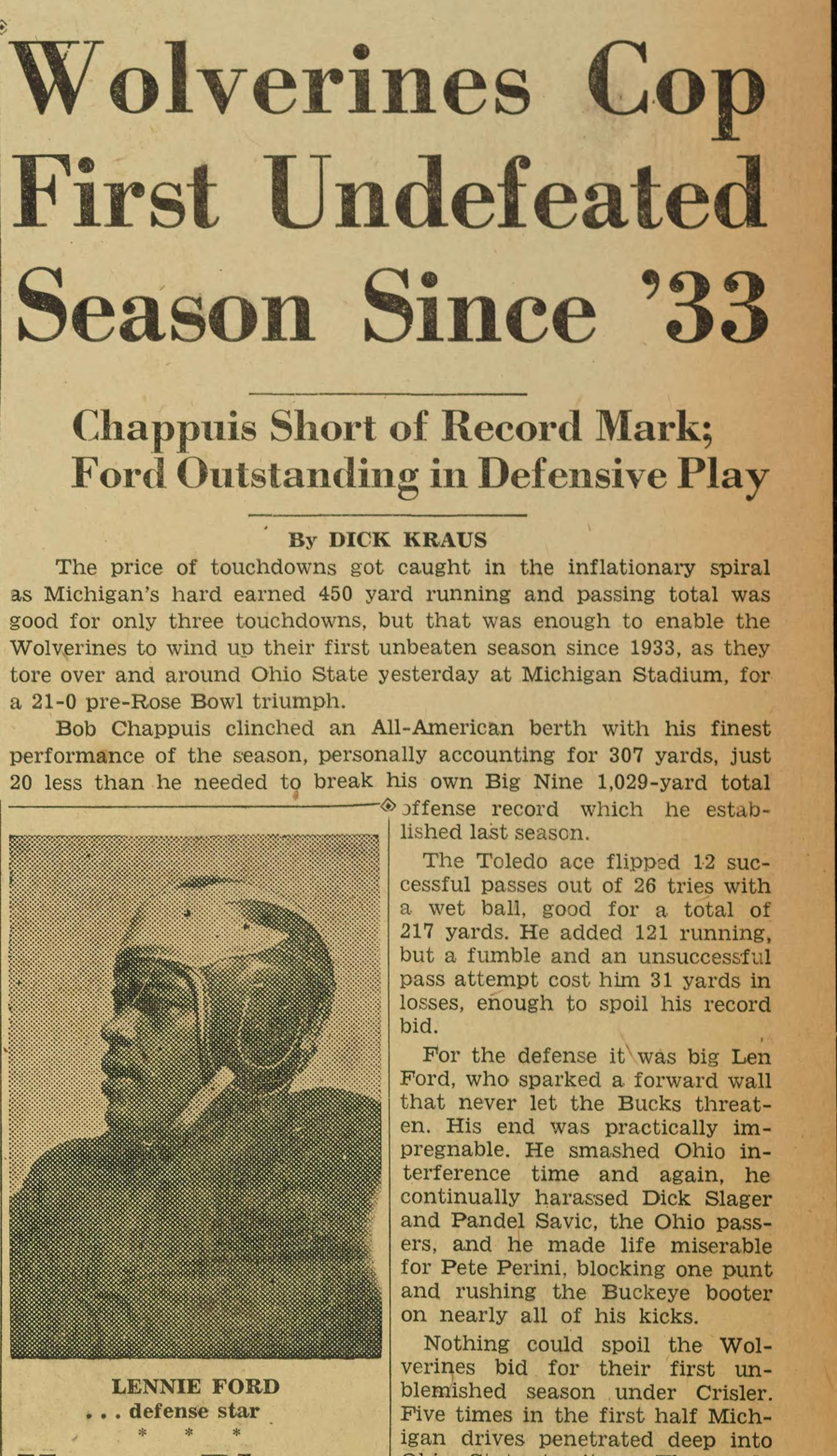
Ford spent a short stint at Morgan State in 1943 and 1944, where he played basketball as a frequent starter at forward and center, helping lead the ’43-’44 basketball team to a league title. Ford joined the football team for the Fall of 1944 in the midst of the teams’ glory years, and Lenny became a consistent starter at left end for the Bears. His coach Ed Hurt, had been leading the Bears since 1929 and would coach the team until 1959. During this run, they won Black National Titles in 1943 and 1944 and then again in 1946, after Lenny left. The 1944 Bears football team went 6-1 and did not give up a TD during the regular season. Their only loss was 2-0 to Tuskegee Air Base when a punt returner was downed for a safety. The only other score allowed was a field goal in their final game of the season at Virginia State.  The Bears did fall to Grambling however in their early January bowl game.  The coaching staff would be an integral part of Ford’s later life. Lenny left school for a brief stop in the Navy in 1945 as WWII was coming to an end.  As the war concluded, and with his grandmothers’ blessing, Ford decided to leave the D.C. area to play at the highest level of competition.  He applied for admission at five different Big-10 schools and received a single response, from the University of Michigan. For that 1945 season, Ford transferred to Michigan in hopes of one day playing in a Rose Bowl.  

Michigan

Wearing number 84 in 1945 then 87 in 1946 and 1947, Ford was a star at Michigan but shared time at left end during the 1946 and 1947 seasons with lifelong friend, number 81, Bob Mann, who was slightly built, fleet-footed, and a superior pass catcher, though less stout on defense.  This rotation – for the time - largely featured Ford at left end on defense and Mann on offense, with Ford occasionally spelling Mann on the offensive side of the ball. Viewing the “games started” figures at Michigan is misleading given the way we think of the game today.  In the ’46 and ’47 seasons, Ford would be considered the starting defensive end in all the games, but Mann was the starter on offense. In fact, Wolverines head coach, and Amos Alonzo Stagg disciple, Fritz Crisler would be known as the “Father of Two-Platoon Football.”  A few years later in 1949 Mann’s receiving prowess was illustrated as he joined Mac Speedie and Tom Fears as the fourth, fifth, and sixth players to reach 1,000 receiving yards in a pro season.  Ford was the tallest player on the Wolverines throughout his tenure entering the 1945 season at 6’5” but weighing only 190 pounds at the time, by 1946 Ford weighed in at 207 but was now listed at 6’4” (a modern combine measurement would likely list him at 6’4 ½), and he tipped the scales at 215 in 1947.  

Where these figures differ from College Football Reference, they have been verified with University of Michigan Archives, e.g.: Ford’s 3 receptions in 1947, https://www.sports-reference.com/cfb/players/len-ford-1.html

Ford was used sparingly on offense in 1945 as Coach Crisler pursued the then novel strategy of rotating offensive and defensive lines, but he still produced enough on the defensive side of the ball to join five Wolverine teammates and receive honorable mention, Ford as an end, by United Press. Lenny didn’t even play in the first 4-games of the season but saw meaningful action beginning in the Army game and was a mainstay on defense thereafter. In the loss to the #1 ranked Army team with 70,000 at Yankee stadium in attendance, Ford was called the “center of all eyes . . . only because of his outstanding work at right end.” That Ford garnered such attention was meaningful given that the Wolverines were facing the most formidable team in the nation. Army would go undefeated for the second straight year and featured 1945 Heisman Trophy winner Doc Blanchard and future 1946 Heisman Trophy winner Glen Davis.  But it was Ford, not Mr. Inside or Mr. Outside that caught the eye of the New York Times that day.

The following week at Illinois Ford had a breakout game with a forced fumble on a running play, three QB sacks for 23 Yards in losses, and his first career TD on a 15-yard blocked punt return, breaking open what was a 0-0 tie at the time. “Ford was devastating in his attack on the Illinois passing offense. He charged in relentlessly and downed the passer before he can flick the ball. The big, tall, powerful negro can’t be stopped by any one man and Illinois found that out.” The following week against Minnesota, “the lanky Ford delighted the crowd and received an ovation when he left the game for the last time.”

Ford punches the ball away from a ballcarrier for a first-quater forced fumble at Illinois in 1945

Ford comes in unblocked for a second-quarter sack of Illinois QB in 1945
Ford started the first three games of 1946 including the opener against Indiana the week two tilt against Iowa, and a loss against Army. Bob Mann would frequently sub-in before Ed McNeill supplanted him as starter in game 4 against Northwestern. Ford started again against Illinois but was used primarily on defense behind McNeill and Mann who started the remainder of the season. Ford did have the distinction of catching an extra-point pass after a blocked kick in the Wolverines rout of Michigan State. 

During the 1947 season, Mann started 8 games and was named Second-team All-American, but Ford was named Third-team All-American despite only starting just 1 game. Crisler continued the two-platoon of Ford on defense and Mann on offense. Ford played 231 minutes in the regular season and 32 in the Rose Bowl to Mann’s 207 and 25, respectively. Len scored a TD against Pittsburgh recovering his own teammate's fumble on an interception return and carrying it into the endzone. Lenny had another exemplary game against Indiana sacking their All-American quarterback candidate (and future Los Angeles Don teammate) George Taliaferro, knocking him out for a few critical games with bruised ribs and a shoulder separation. “Ford, labelled by some of the critics in the press box as the strongest defensive end they had ever seen, was a constant annoyance to the Hoosier attack.” He was singled out again for his spectacular play in the season-ending rivalry victory over Ohio State. 

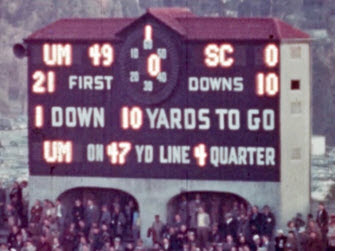
Following the regular season, the Wolverines were ranked #2 behind the top-ranked Notre Dame Fighting Irish. However, the Wolverines decisive 49-0 shutout Rose Bowl victory over #8 Southern Cal caused voters to reconsider, particularly given that the Irish had only beaten USC 38-7 earlier in December. In the nationally televised NBC game, Ford starred defensively, in on six tackles, had a shared 8-yard sack, and another sack-forced-fumble in the fourth quarter. Lenny also recovered a fumble on an Alvin Wistert (the brother of Albert of Eagles’ fame) sack forced fumble. On the offensive side of the ball, Lenny had two scampers on spinners for 16 and seven yards and a 12-yard reception.  The 1947 season became one of the original disputed NCAA Titles, the AP – unusual for the time – issued a new post-Bowl Poll that ranked Michigan #1. All these years later, this is still disputed, and Notre Dame still declares their 1947 team as the National Champion.
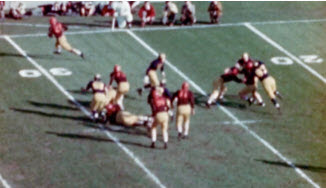
[Ford closing in to share an 8-yard sack in the first Quarter of the Rose Bowl]

[Ford’s fourth Quarter Tomahawk sack forced fumble in the Rose Bowl]

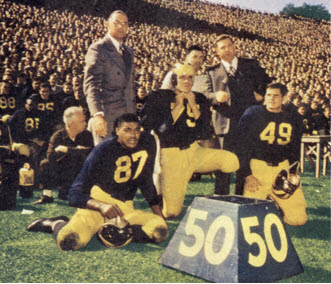
Ford with Coach and Teammates on the sideline at the Rose Bowl]

[Final score in 1947 Rose Bowl between Michigan and USC]
Michigan Coach Crisler’s strategy of rotating on offense and defense probably optimized team performance but may have limited Ford’s accolades. The Los Angeles Evening Citizen noted, “his big bid for mythical honors last fall was blocked by Fritz Crisler’s two-team system that utilized him on defense only.” Film study shows it wasn’t defense only, but by and large, the point holds. 

Saturday, August 6, 2022

Hall of Fame Judgements

 By Clark Judge 
When someone last week asked which speech I most wanted to hear Saturday at the Pro Football Hall-of-Fame’s Class of 2022 induction, I went for the layup.

“Dick Vermeil,” I said.

The reason: Simple. His would be the most emotional.

It made perfect sense … except for one detail. I was wrong.

It wasn’t Vermeil’s ceremony-ending address that we remember most from Saturday’s enshrinement. It was San Francisco defensive tackle Bryant Young’s. A tower of physical and emotional strength in his 14 years with the 49ers, Young fought to hold back tears as he paid tribute to the life … and death … of his son, Colby, who passed away in 2016 from pediatric cancer.

He was 15.

“He didn’t fear death as much as the process of dying,” Young said. “Would it be painful? Would he be remembered?  We assured Colby we would keep his memory alive and continue speaking his name.”
Then he paused.

“Colby,:” he said, his voice choked with emotion, :”you live on in our hearts. We will always speak your name.”

His audience stood and applauded, much as they had during Young’s Hall-of-Fame career. But this was different. It wasn’t a response to Bryant Young’s heroics as a football player. It was in recognition of a father’s strength to stand before a televised audience and dedicate his speech to a son left behind.
“From my pain, I found purpose,” Young said. “Letting someone grab my hand is as important as reaching for theirs. In an isolated world, personal connections matter more than ever. I keep my gaze on Christ and pour myself into good works, including the Pediatric Brain Tumor Foundation, and I’ve learned to live with God’s plan and timing … not mine.”

Young’s 10-minute speech was the most powerful moment of the three-hour event, with the former 49ers’ star demonstrating the poise, strength and, yes, courage that made him an eight-time recipient of San Francisco’s coveted Len Eshmont Award, given annually to the player who best exemplifies “the courage and inspirational play” of Eshmont, an original member of the 1946 49ers.
No other 49er won it more than twice.

“In this, my 10th year of eligibility, I enter the Hall as 22,” Young said, stopping to correct himself. “2022.”

Twenty-two, Young said, “was Colby’s favorite number.”

Then he thanked his listeners and left the stage.


THE CLOSING SURPRISE. The Hall had Vermeil close the ceremony as its eighth and final inductee, and it did it for a reason. The smart money was on him speaking the longest … and he did. Exceeding 22 minutes, Vermeil spoke longer than four others combined.  But that was expected. This wasn’t: Somehow, some way, he refused to break down. An emotional coach who often teared up when talking about players,  Vermeil defied expectations and held it together as he thanked a litany of persons throughout his high-school, collegiate and pro careers. “You notice I didn’t get to talking about a lot of other things that would make me cry,” he said as his audience laughed.” But when I talk about Carol Vermeil (his wife), it ain’t going to work. Carol Vermeil as a football coach has no equal. Never has. Never will. “

ON THE CLOCK. The Hall last year started to crack down on long acceptance speeches, imploring inductees to keep addresses to no more than six-to-seven minutes … and it worked. No speech exceeded 11-and-a-half minutes. That wasn’t the case Saturday, but only because of Vermeil. Otherwise, the Hall’s message that shorter is better seems to be working, and the envelope, please. Here are the lengths of speeches, listed in order of enshrinees’ appearances.

S LEROY BUTLER –5:19.

LB SAM MILLS (wife MELANIE MILLS) – 3: 14

DL RICHARD SEYMOUR – 9:26

ART MCNALLY (video) with granddaughter Shannon O’Hara) --1:40.

OT TONY BOSELLI --11:36

DT BRYANT YOUNG --10:09.

WR CLIFF BRANCH --(sister ELAINE ANDERSON) – 4:10.

DICK VERMEIL – 22:59. 

BUTLER’S MESSAGE TO REMEMBER. Some Hall-of-Fame candidates complain when they’re not first-ballot choices, but the former Green Bay safety isn’t one of them. Neither is Jacksonville tackle Tony Boselli, the first Jaguars’ player elected to Canton. Butler and Boselli each waited 16 years to be inducted, and both were all-decade choices. In fact, Butler was the last first-team all-decade pick from the 1970s, ‘80s and ‘90s to be inducted.  “Sixteen years is a long time,” he admitted, “but it’s worth the wait.” Pass it on.

BIG DAY FOR CARL PETERSON. The former NFL and USFL executive presented Vermeil for induction and is the pro football GM who gave linebacker Sam Mills a chance when others would not. That was back in 1983 when Peterson, then general manager of the USFL Philadelphia Stars, signed the 5-foot-9 Mills after he failed tryouts with the Cleveland Browns and CFL Toronto Argonauts.  Mills would go on to become a three-time USFL all-star and NFL standout with New Orleans and Carolina. He was elected to the Class of 2022 in his 20th … and final … year of modern-era eligibility.
THEY SAID IT. Rewind the videotape to Saturday’s best sound bites, and you might hear the following:

“When you play for the Green Bay Packers, a lot of doors pen up.  When you win a Super Bowl, all doors open up. And when you make the Hall of Fame, football heaven opens up.” – Safety LeRoy Butler.

“This is the greatest thing for an official: Doing the job. Hopefully, nobody’s even going to know you’re around. Make the calls the proper way, (and) they should be with a heavy dose of common sense.” – Art McNally, contributor inductee.

“Football … our game … has afforded me possibilities I never could have imagined. And with that privilege comes profound responsibility. The responsibility of stewardship. The responsibility to put others first … to take care of the details … to keep learning … to keep giving to the long-term strength of our game. Let us commit today … and every day … to be worthy stewards of our game and its values in recognition of these values with reverence for those who passed them to us.” – Defensive lineman Richard Seymour.

“I never, ever, wanted to let you down.’ – DT Bryant Young to his 49ers’ teammates.
“When it is not in God’s time, you cannot force it. When it IS in God’s time, you cannot stop it.  Clifford was delayed but not denied. He never, ever gave up on his dream.” – Cliff Branch’s sister, Elaine Anderson.

“I learned from my players. Many people said to me, ‘Coach, you impact players.’ It’s the other way around. Players impact me.” – Coach Dick Vermeil.

Wednesday, August 3, 2022

Was Lighter Better Than Heavier?

 By John Turney 
Back in the day beat writers would often include a player's size in articles and part of the "facts" we suppose and if there was something going on with a player's weight in a particular year you could often read about it in the papers or in magazine articles and so on.

That does not happen as much today for whatever reason we've noticed. But in the 1970s, for example, it made for some interesting blurbs, anyway.

According to media reports in the 1973 season the Dolphins defensive end Bill Stanfill contracted some sort of illness or virus in camp or preseason and lost some weight. Usually listed at 255 or so pounds Stanfill was down to about 242 pounds for at least part of the season. Still, he played through it and whether he gained the weight back during the latter part of the season we don't know but it was a heck of a season. Stanfill was All-Pro and had a career-high 18½ sacks.
In 1977 Harvey Martin was listed by the Cowboys at 248 pounds, about 12 pounds lighter than in previous seasons and he, too, had a career-year that season with 20 sacks, was All-Pro and the Defensive Player of the Year. 

Interesting. 
In a book published early in 1978 written by Paul Zimmerman—Mile High: The Story of Lyle Alzado and the Amazing Denver Broncos Alzado revealed that after playing his career in the 265-270 range the Broncos coaches wanted him to report to 1977 camp at 240 pounds. 

The logic was that the loss of weight would make Alzado quicker but still would be able to maintain his strength. Alzado pleaded with the coaches, according to the account, and a compromise was reached and Alzado played the 1977 season at 248 pounds. Again, it was a career-year, He was All-Pro and was the UPI AFC Defensive Player of the Year.

Surely there are stories of guys playing at an increased weight and having a career year and we're sure there are other stories of guys losing a few pounds to get that "extra step". 

Did the lighter weights contribute to these players being vaulted to the next level of success? Was it a coincidence? That is unknown. Our guess is that there was some causation but how much is impossible to prove.

It seems in many stories we read from that era that players, seemingly defensive linemen, viewed their bodies as test tubes and were always tinkering to get the right formula—the right mix of weight and speed/quickness. 

What does this mean? Not much. But it was sure fun to read stories like that. We wish there were more these days.