Tuesday, February 2, 2016

Denver Broncos All Career-Year Team

OPINION
By John Turney

Okay, the drill here is to pick the best individual seasons in the history of each franchise, which we will begin today with the Denver Broncos. By "Career-year" we mean the best performances at each position, with the following rule: Only one season per player per position. For example, here, we cannot pick Randy Gradishar's best two seasons and use both inside linebacker slots.

Here are the picks, First-team to the left, Second-team to the right.  
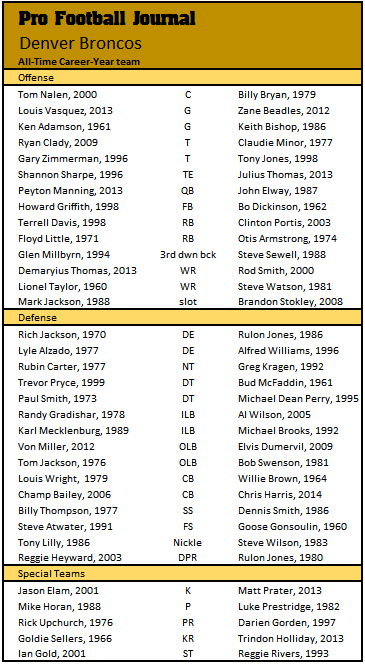
Usually we will favor quarterbacks who finish the job—they have a great season and win the championship game. In 1997 John Elway won it all and threw a career-high 27 touchdown passes so that was a contender. He'd had an MVP season (1987) and a slightly better statistical season (1993) and a great one in between (1997) but we went with 1987 as the best - the Super Bowl loss didn't ruin the year. He was the MVP and the top-ranked quarterbacked by the leader pro scouting firm.

But Peyton Manning's 2013 was just too good, even though Seattle beat them in the Super Bowl. He was the MVP, All-Pro, led the NFL in passing yards and touchdown passes, and tied for the best record in the league with Denver going 13-3. Had we won the big game it would have been just about a perfect season so he gets the top slot.

Craig Morton is an honorable mention for his 1977 season. He was the UPI Offensive Player of the year and got the Broncos to the Super Bowl.

Floyd Little
No, we have not seen Ken Adamson play. All we know is he was All-AFL in 1961.  Tom Glassic's 1978 season would be an honorable mention. There were lots of good seasons by running backs left off, but tough decisions rule the day. 

Nalen was an All-Pro and Bryan was a Second-team All-Pro in 1985, but we went with 1979 due to his high rating by Proscout, Inc. Jerry Sturm, 1964 and Casey Wiegmann, 2008 are honorable mentions as Pro Bowlers.

Mark Schlereth, 1998, gets an honorable mention as a Pro Bowler as does Tom Glassic in 1977

Eldon Danenhauer, 1962 (Pro Bowl), Mike Current, 1969 (Pro Bowl), Matt Lepsis, 2000, are tackles who deserve honorable mention. 

For this, we chose a 3rd down back since they were a big part of Broncos nickel offense in the 1980s and 1990s. 

The honorable mention running backs are Bobby Humphrey, 1990 (288-1,202-4.2-7), and Mike Anderson, 2000 (297-1,487-5.0-15).

For the honorable mention receivers we choose Anthony Miller, 1995 (Pro Bowl, 59-1,079-18.3-14), Ed McCaffrey 1998, (64-1,053-16.5-10), Ashley Lelie, 2004 ( 54-1,084-20.1-7),  Javon Walker, 2006 (69-1,084-15.7-8), Brandon Marshall, 2007 (102-1,325-13.0-7), Brandon Lloyd, 2010 (Second-team All-Pro, 77- 1,448-18.8-11), and Eric Decker, 2013 (87-1,288-14.8-11).

We also are giving Craig Morton, 1981, and Charley Johnson, 1973 on the honorable mention list. Morton was an AFC Player of the Year in 1977, and it was well-deserved, but we think 1981 was a better season, and it may have been his best NFL season.

We went with 1970 for Rich "Tombstone" Jackson since he was a consensus All-Pro, but 1969 may have been slightly better when he had 12½ sacks. However, the 1970 Broncos run defense was great and Jackson had 10 sacks that season. Ditto with Lyle Alzado, he was the AFC Defensive Player of the Year in 1977 but 1974 may have been his best, when he had 13 sacks as a 4-3 right defensive end. 
We may be shorting Bud McFaddin, he may have been the AFL's best defensive player in its first few seasons. But Paul Smith was Pro Football Weekly's AFC Defensive Lineman of the Year and was in double-digits in sacks. Perry was a Pro Bowler in 1996 but 1995 was a better season. In the latter he had 39 tackles, 8.5 stuffs, 6 sacks and 5 passes defensed and 2 forced fumbles and in the former he had 31 tackles, 4.5 stuffs, 3.5 sacks and 2 passes defensed and one forced fumble.

Leaving Barney Chavous's 1974 off is painful, may rethink that one, as well. In that year he had 9 sacks and 80 tackles and 3 FF but he does get an honorable mention. Bertrand Berry's 2003 season with 36 tackles and 11.5 sacks also is an HM. Reggie Hayward, 2004 (43 tackles, 10.5 sacks), Neil Smith, 1997 (Pro Bowl, 34 tackles, 8.5 sacks),  Derrek Wolfe, 2015 (50 tackles, 5.5 sacks, stout versus run), and DeMarcus Ware, 2014 (Pro Bowl, 10 sacks) also deserve mention. Ware is now a rushbacker, opposite of Von Miller, but in 2014, he was a defensive end, though he did drop some. These days edge rushers are often hard to define.

Dave Costa, 1969 (11½ sacks) is an honorable mention at defensive tackle as are Terrance Knighton for 2013 (43 tackles, 3 sacks as a nose tackle), Maa Tanuvasa, 1998 (45 tackles, 8.5 sacks)
Rulon Jones
Gradishar could have several seasons here, but we chose 1978 due to being a consensus NFL Defensive Player of the Year as he had 197 tackles, 7 stuffs, 4 INTs, 9 PD and was All-Pro. Karl Mecklenberg was All-Pro in 1989 and had 7.5 sacks.

D.J. Williams, 2010 (119 tackles, 5.5 sacks) is an honorable mention as is Brandon Marshall, 2014 (119 tackles, 9 PD, 2 sacks, 2 FF) and  Fred Forsberg, 1970, who had 16.5 tackles for loss that year.

Tom Jackson was not All-Pro in 1976, but he was in 1977. We went with 1976 because of the 7 interceptions and 4 sacks; Jackson was on Paul Zimmerman's 1976 All-Pro team for the New York Post. Bob Swenson's 1979 may have been as good or better than his 1981 All-Pro season as a SAM backer, but just another of those where a few seasons would work. 

It was very painful leaving out Simon Fletcher, in 1992, but the rushbacker slots went to Miller and Dumervil. If we revise this post at some point, we will look at it again but Fletcher gets a definite honorable mention he had 64 tackles (7.5 stuffs), 16 sacks, 9 PD and 5 FF and was named an All-Pro by Dallas Morning News. Miller, in 2012 had 68 tackles, 18.5 sacks, 6 FF and 14,o stuffs. Dumervil's year was composed of 49 tackles, 17 sacks and 4 forced fumbles but only .5 stuffs. 

Another OLBer honorable mention is John Mobley, 1997 (All-Pro, 132 tackles, 4 sacks and a pick 6) Others are John Bramlett, 1966 (Pro Bowler, 9½ sacks and 1 INT), Bill Romanowski, 1998 (Pro Bowl, 72 tackles, 7.5 sacks and 2 INTs), Mike Croel, 1991 (84 tackles and 10 sacks) and Danny Trevathan, 2013  (152 tackles, 3 picks, 2 sacks, 10 PD, and 3 F) are HMs as well.
Like Gradishar, several of Louis Wright's seasons would qualify, same with Champ Bailey and Atwater. It was hard to leave Gonsoulin on the Second-team, but Atwater is simply an All-time great.

In 1964 Willie Brown had 64 tackles and 39 passes defensed and was All-AFL. He takes a Second-team slot behind Louis Wright and Champ Bailey. Bailey was the NFL Alumni Defensive Back of the Year in both 2005 and 2006 but we went with 2006 with his league-leading 10 picks to go with the 85 tackles and 21 passes defended. Louis Wright takes the top slot for his 1979 season, though any season from 1976-79 could be the choice. In 1979 he had 66 tackles and 16 passes deflected and two picks, but his coverage was superb and his run support was unparalleled in the NFL at that time and was a consensus All-Pro and All-AFC pick. Chris Harris got the other Second-team slot for his 2014 Pro Bowl campaign.

Deltha O'Neal , 2001 (Pro Bowl, 9 picks), Mike Harden, 1986 (2 pick 6s), Nemiah Wilson, 1967 (Pro Bowl, 2 pick 6s), Steve Foley, 1978 (Second-team All-AFC), and Terrell Buckley, 2000 (6 picks, one for TD) are the HMs at corner.

Tyrone Braxton, 1996 (Pro Bowl, 9 picks, 1 TD), Brian Dawkins, 2009 (Pro Bowl, 116 tackles, 2 picks), John Lynch, 2005 (Pro Bowl, 61 tackles, 4 sacks, 2 picks) are the HMs at safety.
Bill Thompson
For kickers, went with honors more so than with statistics as the game changes over time because the kicking game is just really stunning these days with placement punts, etc. We do give Billy Van Heusen is an honorable mention for his 1973 season, he had a 45.1 gross average and a 40.5 net average.

Rick Upchurch's 4 punt returns for TDs in 1976 beat out Darrien Gorden's 3 in 1997. Detron Smith, 2000, is an HM special teamer as is Keith Burns in 2003 and Phil Olsen is, too, for this 1976 season as is Godwin Turk for his 1976 season when he would have been in contention for a Pro Bowl selection if they had that slot back then.
Agree, disagree? Let us know.

Carolina Panthers All Career-Year Team

OPINION
By John Turney

Okay, the drill here is to pick the best individual seasons in the history of each franchise, which we will begin today with the Carolina Panthers. By "Career-year" we mean the best performances at each position, with the following rule: Only one season per player per position. For example, here, we cannot pick Julius Peppers's best two seasons and use both defensive end slots. 

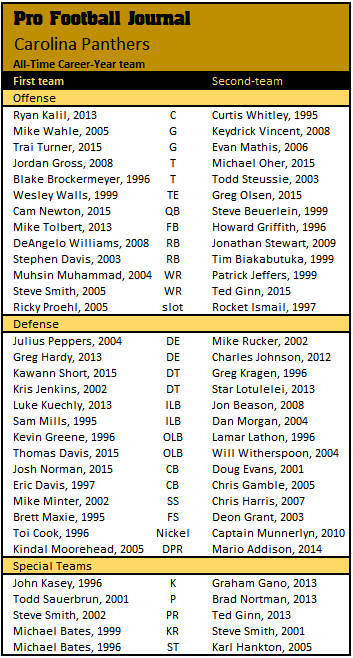
Let the debates begin: 
Kalil could have had either 2013 or 2015, we went with 2013 because he didn't miss a game and had just one holding call, but 2015 did have the Super Bowl appearance, so there is that. Curtis Whitley gets Second-team for 1995 when he was selected to Dr. Z's All-Pro team. What did he see? Probably was Proscout, Inc., saw. They were often Z's source for his esoteric picks and they are well respected.

Frank Garcia had several good seasons but we went with 1999 due to the good protection of Beuerlein when he was among the best passers in the NFL and gets an honorable mention.

Only two guards for the Panthers have been Pro Bowlers. After that, we went with Vincent for being a starter on the 2008 team that helped DeAngelo Williams rush for 18 touchdowns. Jordan Gross is the only All-Pro in franchise history at tackle, after that, it's solid play from others, but not stellar.

Wesley Walls's touchdown total puts him up on Olsen's great season in 2015. Mike Tolbert had a slight edge over Howard Griffith who was a great lead blocker wherever he played and who was an unsung player in the 1996 Panthers playoff run.

For wide receivers, both numbers and honors dictated the selections, as well as for the slot receiver. 

Williams's 18 TDs in 2008 sealed that and Stephen Davis was key to the Panthers Super Bowl run in 2003. 

Quarterback? Hmmm, who could it be? Cam Newton's 2015 season was among the best in NFL history, he will be one of very few that were All-Pro, MVP, and won a Super Bowl if he completes his mission next Sunday in Santa Clara. Beuerlein's numbers propel him past Delhomme and others.
Peppers has most of the best seasons, we went with 2004. Greg Hardy, yes, that Greg Hardy, was excellent on the field in 2013. Short was a PFJ All-Pro this year and Kris Jenkins was a force in the early 2000s.
Julius Peppers
Kragen still has the most tackles in a single season by a Panther defensive tackle. He was a nose in a 3-4 and Lotulelei is a nose in a 4-3.
Sam Mills
A pretty great tradition of linebackers gives this spot a lot of stellar seasons. Keuchly, Mills, Beason, Greene, Davis (4 picks 5.5 sacks in his career year), Lathan and 'Spoon. Keuchly was a Defensive Player of the year in 2013, Kevin Greene was the NEA Defensive Player of the Year in 1996 and led NFL in sacks, and Lathon was on his heels.

Mark Fields is an honorable mention for his 2002 season when he had 101 tackles and 7.5 sacks, 7 passes defensed, one pick and 10 run/pass stuffs.

Decent corner seasons, too, with Josh Norman in the DPOY conversation until late in the season in 2015. Eric Davis was voted to the Pro Bowl in 1997 but his 1997 season was better, he had the same number of interceptions and gave up four fewer touchdowns. 

Had to really look to fill out the roster of safeties. Chris Harris had 97 tackles and forced 8 fumbles in 2007, a rare achievement with his forced fumbles total. He and Charles Godfrey (with his five picks in 2010) get honorable mention.

Kasay was a big part of Panthers 1996 team that advanced to the NFC Championship game. Michael Bates was a great coverage player and a good kick returner.

Steve Smith's averages as a kick- and punt returner in the chosen seasons were not at the top in team annals but his touchdown production was and that matters most to us.
Agree? Disagree? Post comments and make your case and tell us where we screwed up.

Monday, February 1, 2016

Five Men I Wish I Could Have Interviewed

RETROSPECT
By Chris Willis, NFL Films
Tonight Super Bowl 50 will have its hype machine in full-tilt with the Annual Super Bowl Media Day in prime-time. This big event got me thinking recently about an article written in 1999 by the late Stanley Grosshandler (author of the 1968 football book "The Mighty Ones ") titled “Five Men I Wish I Could Have Interviewed.”  In the three page article he went through the reasons why he choose the five men he selected: Charlie Berry (because he played both Major League Baseball and in the NFL); Hugo Bezdek (because he might have been the most unusual character in NFL history); Norm Standlee, Ray Nolting and John Wiethe (Grosshandler played at University of Cincinnati while Nolting and Wiethe were on the coaching staff, as well as Standlee, who played for the 1941 Bears then served in World War II before playing seven years with the 49ers). After finishing the article I got to thinking about who would be on my list of the top five people I wish I could have interviewed. Boy, was it tough to narrow it down to just five.
Joe F. Carr. Colorization by John Turney
     First and foremost, I would’ve wanted to sit down and talk with Joe F. Carr, the former NFL President from 1921-1939, who guided the NFL through the Roaring Twenties and the Great Depression. I think I would have too many questions to ask. Topics such as- what was like being elected President in 1921; the Pottsville Controversy of 1925; the Red Grange Rule- of having no college player enter the NFL until his class had graduated; what was like to sit in Owners meetings with George Halas and George Preston Marshall, as well as Hall of Fame owners Art Rooney, Bert Bell, Tim Mara, and Charlie Bidwill; as well as asking him about his time traveling with the Columbus Panhandles.  
Red Grange. Colorization by John Turney
     Red Grange was a no brainer. Who wouldn’t want to talk to one of the greatest sporting stars of the Roaring Twenties. I’d definitely ask him about his relationship with C.C. Pyle his agent; what was the 1925-1926 barnstorming tour like; as well as what it was like meeting celebrities on that tour such as Babe Ruth, Douglas Fairbanks, Mary Pickford, Luther Burbank, and President Calvin Coolidge. I would also ask him what it was like doing early radio and television for the Chicago Bears.
Unitas with Steelers. Colorization by John Turney
    Johnny Unitas is one of my favorite players that I never got to see play live (wasn’t born until 1970), so I would definitely want to chat with him about his lengthy career. I could ask him about being cut by the Steelers in 1956; playing semi-pro football in his hometown of Pittsburgh for the Bloomfield Rams for six dollars a game; to making the Colts a household name by winning the “Greatest Game Ever Played” (also known as the 1958 NFL Championship Game); to his unique throwing motion; to his last year playing with the San Diego Chargers in 1973. I could also ask him about his famous crew-cut haircut, since he’s the reason I wear my hair in that style.
Brian Piccolo. Colorization by PFJ
     My fourth choice would be Brian Piccolo. It would be so cool to sit down and talk to the man, who despite dying at 26, influenced a generation of football fans and inspired one of the greatest sports movies of all-time- Brian’s Song. But the real reason to interview him would be to get to know him as a person. Most fans just know of the film. But what was Piccolo really like. I know he didn’t look anything like James Caan, so I would want to spend my time talking to him about his life and his philosophy of living, because he showed the world you can battle to the very end and still be a winner.
Bill Walsh. Credit:  Nils M. Solsvik Jr.
     My fifth and last choice was a tough one. But I narrowed it down to a few options. I thought about Pete Rozelle, Jim Thorpe, Don Hutson, Art Donovan and Bronko Nagurski. But I went with Bill Walsh. I choose Walsh for several reasons. One, the 49ers are my favorite team and I grew up watching them win three Super Bowls under the “Genius.” Two, because I love the passing game, so to be able to talk with Walsh about the West Coast Offense would be priceless. Third, to also talk about great players like Joe Montana, Ronnie Lott, Fred Dean, Jerry Rice and Steve Young would be pretty incredible.


This is my list.
  1. Joe F. Carr (Former NFL President and Hall of Famer, 1921-1939)
  2. Red Grange (Hall of Fame running back, 1925-1927, 1929-1934)
  3. Johnny Unitas (Hall of Fame quarterback, 1957-1973)
  4. Brian Piccolo (Chicago Bears running back, 1966-1969)
  5. Bill Walsh (Hall of Fame head coach, 1979-1988)
     Well, there are my five men I wish I could have interviewed. Four of the five men I choose are in the Pro Football Hall of Fame. I guess I went with a bunch of NFL heavyweights. Take some time to think about it while you watch the over 5,000 media members ask questions tonight. Who would be on your list of five???

Saturday, January 30, 2016

Dick Romanski - One Thing We Bet You Didn't Know

LOOKING BACK
by John Turney 


Dick Romanski, the Oakland Raiders long-time equipment manager passed away last November. He had held that job for the franchise for nearly fifty years. Much lore surrounded Romanski, the man who made sure Fred Biletnikoff and Lester Hayes had plenty of stickum or wrote obscenities on the Raiders practice footballs to keep players from taking them.

However, it was interesting to learn that Romanski would tweak the color of the Raiders helmets every so often to give them a different silver hue.

According to Helmet Hut's Dr. Del Rye: (I)t seems ironic that the standard silver hue that has been used over the past 40 years by teams such as the Lions, Oilers, Panthers, Patriots and Raiders has been formally labeled "Raider Silver" by the paint and helmet suppliers. 

Over the years the Raiders have unofficially changed the standard hue of their helmets more than any other team. According to current Raider's equipment manager Bobby Romanski, his father and former longtime Raider's equipment manager Dick Romanski would arbitrarily tweak the standard "Raider Silver" helmet paint formula.

 Some years Dick had a portion of blue color added to the standard formula which darkened the appearance of their helmets. One season, in what seems almost sacrilegious to the Raider image, a portion of pink color was added giving the helmets a subtle champagne glow. We are not sure what inspired Mr. Romanski to take it upon himself to make these changes but they were done during an era where the uniform colors and appearance were not as strictly regulated as they now are."

So, maybe it wasn't your eyes or lighting conditions or film that made the helmets look a bit different one year from the next. Some of these do look slightly different. You be the judge.