Monday, September 11, 2023

New Era, Same Result for Packers in Chicago

 By Eric Goska

Jordan Love posted a passer rating of 123.2
in Green Bay's 38-20 victory over the Bears
(photos by Eric Goska)

He passed the first test.

Jordan Love, waiting in the wings for three years, successfully kicked off his first season as the starting quarterback of the Green Bay Packers.
 
The organization and its fans can only hope his performance is a sign of another long run of excellence at the position.
 
Love passed for three touchdowns with nary a turnover as the Packers shrugged off the Chicago Bears 38-20 at Soldier Field. The win was the ninth in a row by Green Bay over its longtime rival.
 
Drafted 26th overall in 2020, Love has been under scrutiny since Day One. The questions surrounding his talent and leadership only intensified after Aaron Rodgers was traded to the Jets in April.
 
With but one start and 157 regular-season snaps under his belt, Love was something of an unknown. He had shown flashes – leading Green Bay to 10 fourth-quarter points against the Eagles last season – but no one could predict how he would fare once the training wheels came off.
 
Against the Bears, Love displayed poise, patience and an ability to bounce back from a relatively slow start. Lukewarm early, Love improved as the game progressed and finished with the highest passer rating for any Green Bay quarterback starting a season opener for the first time.
 
Nineteen players have started at quarterback in a season opener for the Packers since 1947. Love became the ninth to notch a win in his first season-opening start and just the third (Scott Hunter at Cleveland in 1972; David Whitehurst at Detroit in 1978) to have that victory come on the road.
 
In toppling Chicago, Love extended some trends that have arisen since Matt LaFleur became head coach in 2019. He found the end zone, connecting with receiver Romeo Doubs (twice) and running back Aaron Jones. He avoided throwing an interception. And he finished with a higher passer rating (123.2) than his Bears counterpart: Justin Fields (78.2).
 
Superior passing has been one reason why the Packers have taken nine straight from Chicago. Over that span, Green Bay has fired 22 TD passes to zero interceptions (118.8). Chicago’s numbers: 8 TD passes against 13 interceptions (71.5).
Love and receiver Christian Watson.
Watson did not play in Chicago.
 
Love didn’t come out blazing at Soldier Field. He completed 7 of 16 first-half passes for 81 yards and a TD (80.5). Aside from a 30-yarder to rookie receiver Jayden Reed, his longest completion was 16 yards.
 
But when the Packers turned to Jones at the start of the third quarter, Love’s game improved. His 51-yard collaboration with the running back ignited a touchdown drive that put Green Bay ahead 17-6. His 35-yard toss to Jones pushed that advantage to 24-6 and sent his passer rating above 100 for good.
 
Love hit on 8 of 11 passes for 164 yards and two TDs in the second half. His rating after intermission (154.4) was nearly 75 points higher than in the opening two quarters.
 
Love compiled a perfect passer rating (158.3) on third and fourth down. He found six different receivers in completing 8 of 10 passes for 141 yards and two scores as Green Bay converted 10 of 18 third and fourth downs.

Number-wise, Love bettered the work of his two predecessors when they opened a season for the first time. Rodgers posted a 115.5 rating in his first season-opening start against the Vikings in 2008. Favre checked in at 103.2 in downing the Rams 36-6 in 1993.
 
Next up for Green Bay: the Falcons in Atlanta. There, Love will become only the second Packers quarterback to be subjected to back-to-back road games to start a season.  Rodgers was the first in 2016 with the Green and Gold prevailing 27-23 at Jacksonville before falling 17-14 in Minnesota.
 
Off to a Good Start
Since 1947, highest passer ratings posted by Packers quarterbacks in the first season opener in which they started (minimum 15 pass attempts).
 
Rate    Quarterback      Att-Com-Yds-TD-Int    Date                    Opp.      Result
123.2    Jordan Love           27 – 15 – 245 – 3 – 0       Sept. 10, 2023     Bears        GB won, 38-20
117.7    Anthony Dilweg     32 – 20 – 248 – 3 – 0      Sept. 9, 1990       Rams        GB won, 36-24
115.5    Aaron Rodgers       22 – 18 – 178 – 1 – 0       Sept. 8, 2008       Vikings     GB won, 24-19
112.4    Scott Hunter           17 – 7 – 150 – 2 – 0         Sept. 17, 1972      Browns     GB won, 26-10
103.2    Brett Favre             29 – 19 – 264 – 2 – 1       Sept. 5, 1993       Rams         GB won, 36-6

1947 marked the first year in which the Packers embraced the T formation; that is, with the quarterback under center. 

Sunday, September 10, 2023

Puka Nacua Sets Rams Rookie Debut Receiving Records

 By John Turney 
Puka Nacua
Carroll Dale on September 23, 1960, caught 5 passes for 106 yards and a touchdown. 

That is significant because those are the most-ever for a Rams rookie making his NFL debut. The touchdown record is tied with Cooper Kupp who caught one in 2017 in his first game. 
Caroll Dale
Today Puka Nacua out of BYU broke the reception and yardage mark with ten catches for 119 yards in the Rams' open versus the Seattle Seahawks in Seattle's Lumen Field—A game the Rams won 30-13.

Nacua got his playing time due to an injury to Kupp who went on injured reserve late this week. Without that, he does not get the chance to get so many snaps.

His day was not flawless, there were a couple of drops and maybe route errors—one pointed out by FOX analyst Mark Sanchez but there were a couple of misfires by quarterback Matthew Stafford or the numbers might have been even bigger.

Additionally, Nacua is now one of four NFL players to catch ten passes for 100 yards in his first career game along with Keke Coutee, Anquan Boldin and Sid Blanks per ESPN Stats and Information.
Nice job, rook.

Stats via Stathead

Saturday, September 9, 2023

2023 Awards Predictions

 By John Turney 

Last year we got a few right but missed on the coach, the rookies and the Most Improved. Oh well, that's the nature of the beast. 

To be honest we probably won't get the MVP, OPOY and DPOY right like we did last year but here is this year's effort—

MVP—Joe Burrow, Cincinnati Bengals (what fun is it to Pick Mahomes two years in a row?)

Offensive Player of the Year—Christian McCaffrey, San Francisco 49ers

Defensive Player of the Year—Micah Parsons, Dallas Cowboys

Coach of the Year—Robert Saleh, New York Jets

Comeback Player of the Year—Damar Hamlin, Buffalo Bills

Offensive Rookie of the Year—Anthony Richardson, Indianapolis Colts

Defensive Rookie of the Year—Jalen Carter, Philadelphia Eagles

Most Improved Player (PFWA)—Cam Akers, Los Angeles Rams

Friday, September 8, 2023

Top Single Seasons by Chargers' Tight Ends

 By John Turney 
When Antonio Gates becomes eligible for the Pro Football Hall of Fame's Class of 2024, he could be the first tight since Tony Gonzalez in 2019 and the second ever to be a first-ballot choice. Yet Gates will still be seen as the second-best tight in the history of the Chargers -- L.A. or San Diego -- behind Hall-of-Famer Kellen Winslow, even though he broke most of Winslow's team records.

But what about individual seasons? Where would Gates' best season stand among the best tight ends who wore Chargers' uniforms? You're about to find out.

Taking the top season by each tight end in club history, then ranking them, I've come up with a list of the 10 best. Here they are:

10. Pat Curran, 1975—Curran was a backup with the Rams for years, but the Chargers hadn't had a tight end catch more than 19 passes the previous three years. So Chargers' coach Tommy Prothro, who was familiar with Curran when he coached in L.A., sent a third-round pick to the Rams for Curran and a running back.

In his first opportunity to start in the NFL, Curran responded with 45 receptions and 619 yards. The 45 catches were the most by a Chargers' tight end until 1980 when Kellen Winslow surpassed it.

9. Hunter Henry, 2019—He had solid but not spectacular numbers -- 55 receptions, 652 yards (11.9-yard average) and five TDs in 12 games -- but was a solid all-around tight end.

He had another good year in 2020, enough for Bill Belichick to give the 6-5, 250-pounder a three-year, $37.5 million contract to become a Patriot.

8. Bob Klein, 1979—What? A guy with just 37 catches, 424 yards and five touchdowns this high? Yep.  

First, Klein was as good a blocker as it gets from the tight-end position -- so much so that when he was with the Rams there was talk of converting him to tackle.

Second, in 1979, his final pro season, he set career highs in receptions, yards, touchdowns and longest reception. But he did much of it after Winslow, then a rookie, broke a leg.

Klein had his role expanded, helping the Chargers (in their first full season under coach Don Coryell) win the AFC West. It was a great way for the former first-round pick from USC to leave the NFL and start his dental practice.

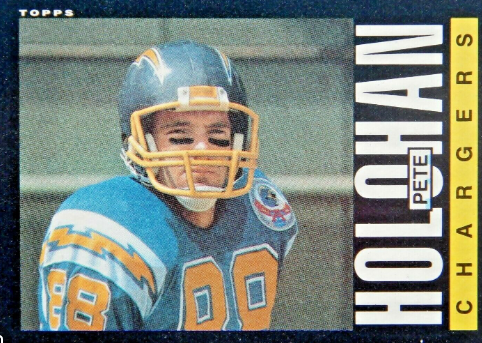
7. Pete Holohan, 1984—He emerged in 1984 as a second receiving threat from the tight end/H-back position, catching 56 passes (for a career-high of 734 yards) -- some of them Houdini-like. He had the best hands of any Chargers' tight end, bar none -- one reason teammates called him "Hands" Holohan.

In fact, he may have had the best hands of any Chargers receiver ever, regardless of position, rivaling Keenan Allen, Charlie Joiner, Lance Alworth and any others you'd care to name. He could catch the rock. 

6. Jacque MacKinnon, 1968—His 19.6 yards per catch stand out, especially for a guy that was 6-4, 250 pounds -- about 15 pounds more than he's usually listed and nicknamed "Baby Huey" by teammates.

MacKinnon backed up six-year starter Dave Kocourek at tight end while also playing some fullback, guard and tackle. Sid Gillman wanted him on the field, and if someone was ahead of him at tight end then Gillman needed him to block.

After Kocourek was lost to Miami in the 1966 expansion draft, MacKinnon took over at tight end and went to the AFL All-Star game in his first year as a starter. However, he lost the job one year later, then regained it in 1968 to have his best season -- returning to the All-Star game and named second-team All-AFL.

Not only is his 19.6 average the best in team history for a tight end, his 18.3 mark in 1966 is third-best, remarkable for a big man. Not all tight ends from that era could play in today's NFL, but MacKinnon may be one who could. He had the size to block and the speed to get deep.

5. Freddie Jones, 2000—A talented athlete for his size, the 6-4, 260-pound Jones was the first Chargers' tight end to stretch a defense in a decade where the team's tight ends were used mostly as blockers. They'd gotten away from the innovations of the Air Coryell era into the power offenses of Dan Henning and Bobby Ross.

In 1998, Fast Freddie was the first tight end to lead the club in receptions since Kellen Winslow in 1987. But in the first year of the new millennium, he caught 71 passes, 766 yards and five touchdowns, and he did it on a 1-15 team with Ryan Leaf at quarterback.

4. Dave Kocourek, 1961—This is somewhat of a cheat. Yes, Kocourek played some flanker in 1961, but in that era flanker often meant slot ... and it also meant he could be tight, on the end of the line or slightly split. Plus, he did start at tight end at the beginning and end of the year, in time for the AFL championship game.

At 6-5, 240, Kocourek was the largest of the receivers by a good margin -- with the other tight end listed as a part-time starter at about 215 pounds. Nevertheless, when you consider the multi-faceted roles of other tight ends in Chargers' history, he qualifies for this list despite being listed as a flanker for nearly half the games in '61.

In some ways, he was a glimpse of things to come in pro football and an echo of another player his coach, Sid Gillman, had when he was with the Rams -- Leon Clarke a 6-4, 235-pound end/flanker/slot.

Kocourek caught 55 passes for 1,055 yards and a remarkable 19.2 yards per catch average. And he took four to the house.

Nomenclature aside, it was a great year for the former Wisconsin Badger and CFL player. He was voted second-team All-AFL and to the AFL All-Star game (the first of four).

Yes, 1961 was a very good year. Ironically that season, NFL rookie end Mike Ditka was doing some of the same things for the Bears -- catching passes for over 1,000 yards and doing it more while not lining up next to an offensive tackle. 

3. Willie Frazier, 1967—His forte was catching passes, but he should not be thought of as a one-dimensional player. Though not big, he was an accomplished blocker.  

He was a streamlined 6-4, 225 to 230-pounder, and probably the fastest player on this list. In his career year, he caught 57 passes for 922 yards and 10 TDs. The touchdown receptions were third in the AFL and the receiving yards were fifth. What's more, he caught more passes for more TDs that season than Lance Alworth and was fewer than 100 yards behind him.

The 10 TDs are still tied for second-most in a single season by a Chargers' tight end, and his 65.9 yards per game rrank behind only two pretty famous tight ends in team history.

The Arkansas native was recognized as All-AFL by the Sporting News and second-team by NEA and was voted to the AFL All-Star game. He played 11 seasons of pro football, six in the AFL, four in the NFL and two in the WFL (yes, that does add up to 12, but in 1975 he played in both the WFL and NFL).


2. Antonio Gates, 2005—Gates had a handful of seasons that could be considered a career year, and it's that consistency that will get him into the Hall of Fame.

In 2005, he caught 89 passes (ninth in the NFL) for 1,101 yards and 10 touchdowns (fifth in the NFL) and was a consensus All-Pro and Pro Bowl selection -- remarkable for someone who didn't play collegiate football (he chose basketball). Yet he made a transition to NFL tight end seem easy,  a testament to his elite athleticism.

Other years considered were 2004 (consensus All-Pro, the NFL Alumni Tight End of the Year) and 2009, which was perhaps his best statistical year. In the end, however, 2005 was tops. 

1. Kellen Winslow, 1981—You hear the phrase "he changed the game" applied to a lot of players, and most of the time it's bogus. Whatever it is they're professed to have done, it usually was achieved previously by someone else.

Winslow is an exception. 

Before him, there were not a lot of 6-5, 250-pound guys lining up, not just at tight end but in the slot, wide, as an H-back or, on occasion, as a fullback. But Winslow mostly was a receiver, which is what he called himself.

Not a tight end.

He consistently did things tight ends were not asked and did them with with extreme athleticism. Taking the "Y" receiver to another level with Winslow, coach Don Coryell changed the way tight ends were used ... and it continued through guys like Tony Gonzalez, fellow Charger Antonio Gates and current Chiefs' tight end Travis Kelce.

So, what was Winslow's best season? Was it 1980? 1981? 1982 or 1983? He led the NFL in receptions in 1980 and 1981. His highest yards total was 1980, and the best start he had was in 1984 when he was on pace for a 1,500-yard season. But he blew out his knee that year after seven games.

In the end, the pick is 1981 because playoff performance matters, and what he did in the 1981 playoff game in Miami was legendary -- 13 catches, 166 yards, one TD and a blocked kick. Those numbers, plus leaving everything he had on the field, were the difference maker, making it his career year over the others.

He was a consensus All-Pro and All-AFC choice, got a vote each for MVP and Offensive Player of the Year and was the co-MVP of the Pro Bowl to cap off a nearly perfect season.

To this day, it's still one of the best ever for any tight end and the best in Chargers' history.


Tuesday, September 5, 2023

TUESDAY TIDBITS: Here We Go!

By TJ Troup 
The 2023 season is upon us, and my first column. Oh, it is not Tuesday? Guess Coach TJ did not get the memo? 

Years ago in Steve Sabol's office late in the summer, we talked of the upcoming season. Steve had many classic lines yet his statement, "There are 16 teams talking playoffs, and 16 teams talking Super Bowl" still rings true. 

So much conjecture, so many opinions, and many of those opinions don't have one shred of fact to them. Sad, just damn sad. 

Am I making any predictions? Hell no, but will ask all of you a couple of questions. 

Ready? 

Here goes ... which division is the weakest in the NFL, and which is the strongest? Sixteen games and we all decide which game or games we will watch. 

Yes, at 4:25 EST on Sunday will be on my couch watching the Bears play the Packers. Eric Goska just might watch that game also. 

For me, the most compelling game is the match-up between the Niners and the Steelers and will be at the sports bar at 1 PM to watch. Many times in the past have taken the calendar day and tied that into historical games. Why change? 

September 7th, 1963 the moribund Oakland Raiders with a new head coach—some guy named Davis takes the Silver & Black to Houston Texas. The Raiders committed 17 penalties in the game. 
Art Powell
No doubt they came to hit and prove to Mr. Davis they could play tough ass football. The Raiders are also opportunistic in that they take the ball away 10 times from the Oilers. 

How many teams this weekend will take the ball away ten times? Probably none. 

Oakland leads 10-6 entering the 4th quarter, and quarterback Tom Flores lofts a pass to Art Powell for 85 yards and a touchdown. Powell will latch onto 7 passes for a team-record 181 yards in his first Raider game. 

Final: Oakland 24 Houston 13. 

The Raiders, Al Davis, and Art Powell are off to an impressive start in '63, and there will be more to come. 
There are quarterbacks that you just enjoy watching, and the reasons for watching might be different for each of us. One of those quarterbacks for me was Brian Sipe. 

His season in 1980 was an expression of who he was. Poised, confident, savvy, and opportunistic ... when Sipe saw a flaw in coverage he exploited that flaw. 

The first Monday night game in '81 brings the talented San Diego Chargers into Cleveland. 

Football practice was over, got home as quick as I could to watch, and there was plenty to watch as Dan Fouts completed 15 consecutive passes in the game. Charlie Joiner was open all night and caught 6 for 191 yards. 
Sipe set a team record with 31 completions, but San Diego dominated play in a 44-17 win. We all know it is a passing league now, yet how many quarterbacks this weekend will complete 31 passes, and how many quarterbacks this weekend will complete 15 in a row? 

Enjoy the games.

Sunday, September 3, 2023

Hester or Tasker ... Which? Neither? Both?

by Jeffrey J. Miller  
    
    Let me start by saying I am a small-hall guy. In my estimation, enshrinement in the Pro Football Hall of Fame is an honor that should be reserved for the best of the very best players the game has ever known. In looking over the complete roster of HOF enshrinees, I see quite a few questionable names (out of respect, I won’t mention any here). Though I am sure my list of undeserving HOFers would differ greatly from, say, Deion Sanders’, I must admit I agree with him that the Hall is bloated with guys who in retrospect might not be enshrined today.  But the fact that the HOF seems to have widened the door in recent years, allowing some suspect candidates to enter leaves room for consideration of a few other players who have had that same door slammed on them for whatever reason. I wish to talk about one who should be a slam-dunk, and another who I feel has gotten a raw deal for lo these many years.   
    I have been reading many comments lately about the Hall-of-Fame worthiness of Devin Hester, probably the greatest return man in NFL history. Hester’s numbers are simply astounding.  He holds the all-time record for combined returns for touchdowns (punt, kickoff and missed field goals) with 20, and most punt return touchdowns with 14.  He also once had six returns for touchdowns in a single season (2004), which tied the previous record. When his Chicago Bears faced the Indianapolis Colts in Super Bowl XLI, Hester returned the game’s opening kickoff, the first time that feat had ever been accomplished in a Super Bowl. Clearly, if there was ever a return man who deserves enshrinement in the Pro Football Hall-of-Fame, it is Hester.

    The primary issue keeping Hester out of the Hall seems to be the fact that he was not a full-time positional player. Being primarily a return man (though he did have a handful of nice seasons as a WR), detractors believe he did not wield the same impact game-in and game-out as, say, a quarterback, cornerback or full-time wide receiver might. This writer says fishpaste!  I would argue that the impact of a kick being returned for a score, or even the fear instilled that something like that was always a possibility, was undeniable. It forces punters and kickoff men to angle their kicks away from a guy like Hester, or simply punt the ball out-of-bounds to prevent a return from erven happening.   
    
    Put the man in, I say! There have been plenty of outstanding return men over the past 50 years (Billy Johnson, Rick Upchurch and Donte Hall come to mind), but none like Hester. And that brings me to the other guy in a similar, though different, situation. That man is Steve Tasker, the long-time special teams ace of the Buffalo Bills.  Tasker, like, Hester, was arguably the best at his position in league history. And also like Hester, detractors insist that a special teamer participates in a low percentage of scrimmage plays on the field, so his level of impact in comparison to a regular offensive or defensive player is therefore very small.    
    A few years back, I had the opportunity to speak with the man who coached Tasker for several years with the Bills, Marv Levy, himself a Hall-of-Famer. Admittedly, Levy is biased regarding the kicking game. He was a pioneer of the discipline, having been the second-ever full-time special teams coach in the league upon joining the Philadelphia Eagles’ staff in 1969 (Dick Vermeil was the first). One year later, Levy was hired away from the Eagles by George Allen, head man with the Washington Redskins.      

    Levy had calculated that about twenty percent of all plays in a game were special teams plays. He noted that he and Coach Allan that the kicking game impacted the outcome of a game more heavily than the twenty-percent stat might imply.  Levy listed three ways a special teams play can have an impact well beyond that one individual play:
            
    1.  There is a change of possession (either punt or kickoff).
    2.  There is a considerable change in field position involved.
    3.  There is a specific "yes" or "no" involved as to whether points will be scored on that play (field goal, PAT, two-point conversion).

    Not to mention the change in momentum resulting from a blocked field goal or punt, a successful onside kick, a bad snap, or a kick returned for a score.          

    So, what is the prevailing sentiment? Do kick returners and special teamers belong in the Hall of Hame?  One or the other? It seems the prevailing sentiment would, if it came down to a choice between the two, favor Hester over Tasker. But if so, why? 

    There are few who believe a better kick returner than Hester has ever played the game.  There is also little doubt that a better special teamer than Tasker has ever played. And while a kick returned for a score is unquestionably more exciting than a gunner slamming into a returner at the very moment the ball reaches his hands, being the best at your position should mean something. The HOF voters finally figured that out when they finally started putting tight ends in the Hall back in 1988 (Mike Ditka). Kickers too were once denied enshrinement (for the very same reasons Hester and Tasker have been) until Jan Stenerud became the first pure kicker inducted in 1991. Punters too experienced sneers until Ray Guy got was honored in 2014. 

    Hester’s stats and accomplishments are eye-popping indeed, but so are Tasker’s:  Five first-team All-Pro selections (compared to Hester’s three), seven Pro Bowls (compared to Hester’s four), being the only special teamer ever to be named MVP of a Pro Bowl game, 204 special teams tackles, seven blocked punts in regular season plus another in Super Bowl XXVII, six fumble recoveries. In 2000, a committee at the Pro Football Hall of Fame selected him one of the 26 “Best of the Best ALL-TIME Players in the History of the Game." In an admittedly unscientific poll conducted by the NFL Network in 2008, Tasker was ranked ninth among players who are Hall-of-Fame worthy not yet enshrined.    
    I hereby open the floor to debate. 

Friday, September 1, 2023

Both the 1973 and 2023 Rams Defenses Had Major Overhauls on Defense

 By John Turney 
2023 preseason - Chargers at Rams
In 1973 legendary Los Angeles Times writer and original Hall-of-Fame voter Bob Oates wrote an article entitled, "Merlin Olsen and the ??????????"

Read: Merlin Olsen and the 10 question marks.

It was a commentary on a Rams' defense that had gone through a lot of changes from the previous year, with Olsen -- a future Hall-of-Famer -- the only known quantity. All the rest were question marks. Fifty years later, someone could write a similar article with the same headline, only substituting "Aaron Donald" for Olsen because he faces the same kind of season.

And perhaps worse.

What Oates detailed 50 years ago was that though there would be some 1972 returnees, the Rams had doubts about how well they'd perform in new uniforms ... under a new head coach ... and a new defensive coordinator ... with a new defensive scheme.

As examples, Oates offered Isiah Robertson, Dave Elmendorf, Jack Youngblood, Larry Brooks (the starter in the last half of 1972) and Fred Dryer. As it turned out, all thrived in the new defense. But in the Summer of '73 that was no sure thing:

-- As a rookie in 1971, Robertson was a Pro Bowler. But he regressed in 1972. Would he rebound to his previous level of play? He did -- making the Pro Bowl again and was a first-team All-Pro for the first time. He picked off three passes and, in "Butch" Robertson style, returned one 49 yards for a touchdown on Monday Night Football, earning raves from announcer Howard Cosell.

-- Fellow rookie Elmendorf was a fine free safety in 1971 but moved to strong safety in 1972. So, 1973 would be his second season at that position where he'd be the leader of the secondary in only his third NFL season. Could he do it? The answer was yes. He was the glue of the secondary and was even honorable mention All-NFC.

-- Yet to show his Hall-of-Fame ability, Youngblood was the predominant starter at left end in 1972 when he led the club in hurries. One problem: He never seemed to get out of coach Tommy Prothro's doghouse. One year later, he was a preseason question mark in Oates' eyes ... and rightly so. He would stay at left end, but there was no way to know what would happen. What happened was he produced 16-1/2 sacks, 13-1/2 tackles for losses on run plays and was voted second-team All-Pro. He also went to his first Pro Bowl.

-- Brooks took over the right defensive tackle position at midseason in 1972, so '73 would be his first full year as a starter. As a rookie 14th-round draft choice, he was accomplished. But, one year later, he had to prove he was legit. Could he? Absolutely. He had nine sacks and led the Rams' defensive linemen in tackles.

-- Dryer was known more as a pass rusher when he was a starter for the New York Giants, but he'd have to play the run to fit into what new coach Chuck Knox wanted. 

"We want to stop the run,"Knox said, "and get the other side into an obvious passing situation and get into our best pass rush and pass coverage."

Dryer spent 1972 as a nickel rusher in the Rams' "57 defense" -- a passing-down package that featured three defensive ends and Olsen. The 6-6, 222-pound right defensive end (listed at 240 but nowhere near that) could get after the quarterback. But could he defend the run? Time would tell.  And it did. He played the Ray Malavasi "butt technique," taught to stop an offensive tackle's charge, and still managed to sack the quarterback 10 times -- including three in one game vs. Green Bay where two produced safeties, setting an NFL single-game record. 

On the second level, aside from Robertson, the Rams were going to start Ken Geddes and Jack Reynolds. Both had been with the Rams, but Geddes kept breaking bones (an arm and a leg in 1972), and Reynolds could never beat out veteran middle linebacker Marlin McKeever.

But in 1973 the man known as "Hacksaw" finally did, leading the team in tackles, while Geddes stayed healthy.
1973 preseason - Chargers at Rams
The left cornerback position had several changes from camp right up to the season opener. The competition featured one of the Rams' starters from the previous year. But they were not up to snuff so the Rams looked elsewhere and traded for veteran Charlie Stukes. 

So that was a question-mark position. Could the 30-year-old Stukes still cover? He could, leading the Rams with five interceptions

The right side was just as dubious. Gene Howard was excellent in 1971, slumped in 1972 and was beaten out by rookie Eddie McMillan in 1973. So the question there was: Could the rookie keep up? McMillan did, picking off four passes and voted to the All-Rookie team.

In 1972 the free safety was converted cornerback Jim Nettles, who was adequate in coverage but wasn't known for his tackling. To remedy that, the Rams drafted 6-1, 225-pound Cullen Bryant (later converted to running back) to play there. Nettles was moved back to corner and then was cut. As insurance, the Rams traded for future Hall-of-Fame Herb Adderley for a few day-stint at free safety. So Bryant played most of the preseason. But he couldn't hang on to the job since he didn't look to have what it takes for a nFL safety and Rams moved in another direction by signing journeyman Steve Preece. 

The Rams were his fourth team in five years, so the question there was obvious: How talented was this guy? The former Saints', Eagles' and Broncos' safety started all 14 games, had two interceptions and fell on two fumbles.

Bottom line: The questions posed during a 2-3-1 preseason were answered later that year, with the Rams going 12-2 and reaching the playoffs for the first time since 1969. The defense ranked first overall, first vs. the run and allowed the fourth-fewest points, while Olsen went to his 12th consecutive Pro Bowl was the NFLPA NFC Defensive Lineman of the Year.

By all accounts, the retooling worked. In all likelihood, Aaron Donald probably won't fare as well.

Returning with the three-time NFL Defensive Player of the Year are off-the-ball linebacker Ernest Jones and Jordan Fuller, though it's no guarantee he starts. It's possible it will be former Rams' safety John Johnson III. Russ Yeast has a lock on one of the safety positions, but Fuller (one of the team captains) seems to have the edge on the other at this moment.

Yeast is in his second season, and his next start will be his second in the NFL. Meanwhile, Fuller is coming off an injury that cost him 14 games in 2022, while Johnson is back after two years in Cleveland. All three are question marks, no matter who starts.

Jones was not the lead inside linebacker in 2022. Bobby Wagner was. Since the third-year 'backer out of South Carolina will be the play-caller for the first time, that makes him a question mark as the Rams' "green dot" guy.. 

In the base 3-4 defense Christian Rozeboom is penciled in as the inside linebacker to be paired with Jones. He's played 27 NFL games but never started one. But the Rams play base about 1/3 of the time or less, so his playing time will be limited, and his impact less than others.

Michael Hoecht was moved from the defensive line to outside linebacker last year by coordinator Raheem Morris, and the move worked: In six starts he had 4-1/2 sacks -- not bad for someone who never played the edge in the NFL or college. But he's still unproven. We haven't seen if he can be productive for a full season.

Opposite Hoecht, the other edge will probably be manned by third-round pick Byron Young. He had 23 snaps in the preseason, mostly because coach Sean McVay doesn't believe in playing starters in meaningless games. That means the former Dollar General manager has almost as much NFL experience as the number on his jersey (zero).

Add another question mark to the list.

On the back end, one presumed starter is cornerback Ahkello Witherspoon. Signed as a free agent from the Steelers, Witherspoon never played a full 16/17-game schedule and has really been a starter one season -- 2018 when he started 12 of 14 games for the 49ers. The question here is: Is he a placeholder for rookie Tre'Vius Hodges-Tomlinson? Nobody knows. Either way, Hodges-Tomlinson played well in the preseason and is aggressive. Ability isn't the question with him. Size is. 

Another presumed starter is Derion Kendrick, who may be the slowest starting cornerback in the NFL, while Cobie Durant is the nickelback, slot or "Star" as the Rams like to call the position. He's shown promise but is only in his second season and didn't play the entire year as a rookie. Though his ability is apparent, it's only fair to ask questions about him, too.

Two more questions are the nose tackle and the defensive lineman opposite Donald. Bobby Brown III is the nose. At 6-4, 324 pounds, the former Texas A&M Aggie has the size and athleticism to play the position, but he's in his first year as a starter. So he's an unknown.

So is the defensive end/tackle. It could be Earnest Brown IV, Jonah Williams or Mr. Irrelevant, seventh-round Desjuan Johnson, a rookie out of Toledo who played well in preseason.  Brown IV reportedly is bulked up and ready to start, but who knows? Williams has 208 NFL snaps but only 28 tackles and a 1/2 sack. That is not inspiring. 

Then there's rookie Kobie Turner. He'll be in the rotation at defensive end or nose tackle and may get snaps spelling Donald. Any way you look at it, other than Donald, the defensive line is a big-time question mark.

But this isn't the first time the Rams' defenses have been overhauled. There was one in 1966 when George Allen came to town, and it worked. There was another in 1983 when John Robinson was hired, and the Rams went to a 3-4 defense. That worked, too. Then, in 1991, Jeff Fisher was hired by Robinson to switch the defense to a "46"-based 4-3. That failed, and Robinson was fired. 

After a terrible defensive performance in 2000, while trying to defend the 1999 NFL title, coach Mike Martz hired Lovie Smith to bring in the Tampa-2 defense. That worked for a few years until Smith was hired to coach the Chicago Bears.

This year it remains to be seen what happens. But, on paper, it doesn't look good. Nevertheless, games aren't played on paper, and maybe the 10, 11, 14 or however many players are on sub-packages these days fare better than presumed. And maybe 2023 will be less like 1991 and more like other rebuilding seasons.

Maybe.

We'll talk again at mid-year. By then, we'll have answers to those questions.