Wednesday, February 10, 2016

Tampa Bay Buccaneers All Career-Year Team

OPINION
By John Turney
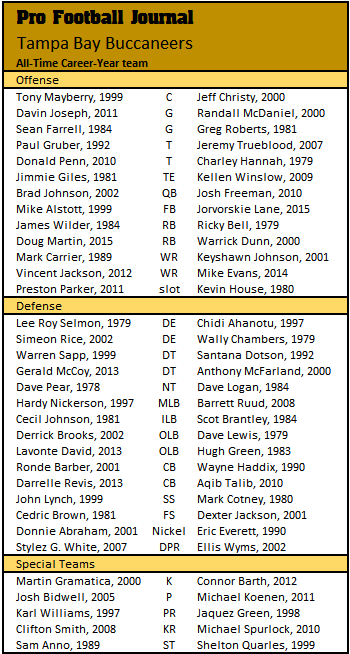
We at Pro Football Journal are trying to pick the best individual seasons in the history of each franchise, which we will continue today with the Tampa Bay Buccaneers. By "Career-year" we mean the best performances at each position, with the following rule: Only one season per player per position. For example, here, we cannot pick Derrick Brooks's best two seasons and use both OLBer slots.

Here are the selections, First-team left, Second-team right:
The offensive linemen were picked based on the All-Pro selections or Pro Bowl selections, however, there have not been many such honored players in Buc history. Paul Gruber was a stalwart who had several good seasons that would fit here. Farrell was a First-team All-Pro by Sporting News in 1984. Charley Hannah was very good in 1979, when the Buccaneers, in their fourth season, advanced to the NFC Championship game. Greg Roberts never lived up to his draft status but was good in 1981. Peter King named Trueblood to the Sports Illustrated All-Pro team in 2007.

Jameis Winston should move into one of the two slots very soon. It was hard to leave out Doug Williams, but in his run with the Bucs it was joked that he was the only one (circa 1979-1980) who could overthrow the Ayatollah Khomeini. Even for his era, he was not an accurate quarterback.

The running backs are interchangeable with the exception of Alstott. We ordered them this way, but reasonable people could argue that they could be ordered in another way.
Wide receivers have not garnered many post-season honors, but these are the ones that we felt stood out in that they were at least mentioned by some outlets for honorable mention All-Pro. Jimmie Giles was a consistent tight end who could block. Winslow was a good receiver who wasn't a great blocker.

The Buccaneer tradition is defense and they are stacked on this side of the ball. Selmon could have several years picked, but we went with the obvious, 1979. That season he was the Defensive Player of the Year, had 11 sacks, 61 solo tackles, 27 assists, (88 total tackles)  and 8.5 stuffs. He also had three forced fumbles, blocked three kicks, two fumbles recovered, one of which was a scoop and score. He also knocked down four passes and was credited with 60 pressures.

Simeon Rice had a great season in 2002. Wally Chambers had a good season in 1979, his second as a 3-4 defensive end after really earning his bone fides as a defensive tackle for the Bears in the mid-1970s. Chambers had 46 solo tackles, 20 assisted tackles for a total of 66. He had 5½ sacks and 43 pressures and forced seven fumbles. Chidi Ahanotu was very effective in 1997.

The premier position for the Bucs may be three-technique. Lee Roy Selmon played that spot in 1976, but got hurt. Sapp's 2000 season, which PFJ contends Sapp led the NFL in sacks could have been his best, but again, we go with his 1999 season when he was the Defensive Player of the Year. McCoy and Dotson had fine seasons in the years mentioned. McFarland is the only one here who was not a three-technique. He was the shade/1-technique and was a big help to Sapp.
Lee Roy Selmon
The Buccaneers player a 3-4 defense from 1977 to 1990 so we listed a nose tackle as well. Dave Pear had 9 sacks in 1978 and was as good a nose tackle as there was that season. Dave Logan had 9 sacks in 1981, 9.5 in 1983, but in 1984 he was a Sporting News All-Pro that season when he had 5.5 sacks. We give Pat Toomay an honorable mention for 1976, he was voted the team Defensive MVP in their inaugural season.
Hardy Nickerson was steady and solid, but 1997 stood out. Ruud was good in 2008. At 3-4 inside linebacker we went with Cecil Johnson. Johnson was an outside linebacker for the Bucs but was asked to move. He did it and had a good season as the Buccaneers advanced to the playoffs. However, that does not mean Johnson liked it. He likened it to going into a lion's den "wearing a three-piece pork chop suit".

Johnson edged Richard "Batman" Wood who gets a Second-team spot. Wood had 2 picks, 2 fumbles recovered and had 17 tackles for loss. Scot Brantley was a worker, good run stuffer, but was usually not on the field in likely passing downs and he gets an honorable mention for his 1984 season.

Outside linebacker is the other premier position for the Tampa Bay franchise. All four of these seasons were special. Derrick Brooks was the Defensive Player of the Year. He had 87 solo tackles, 30 assists for a total of 117 tackles. He picked off five passes and returned three for touchdowns. He deflected 11 passes and recovered a fumble, which he returned for a touchdown. Six of his tackles were stuffs, he forced a fumble and had one sack.
Lavonte David has been almost as impressive in his career and several seasons fit on this chart, but we are going with 2013. He had 107 tackles and 38 assists for a total of 145 tackles, seven sacks, five interceptions, 10 passes defenses. And an amazing 17.5 of his tackles were stuffs for losses to go with the two forced fumbles and his lone recovery

Hugh Green was another player who had three stellar seasons. We went with 1983, though the 1982 strike season may have been a hair better. In 1983 Green had 104 solo tackles and 20 assists for 124 total, 3.5 sacks, 7 stuffs, three forced fumbles, two interceptions that were both pick 6s.
Dave Lewis
The other Second-team OLBer is Dave Lewis in 1979. One almost had to see it because it was a great all-around season.  Lewis had 89 tackles, 8 passes defensed, 5½ sacks, four forced fumbles and two interceptions one of the NFL's best defenses. It was hard to regulate him to the Second-team. Lewis had a big year in 1980 as well—68 tackles and 16 run stuffs and a Pro Bowl.

Broderick Thomas was the Buc's only pure 3-4 rush backer they had in the 3-4 scheme and he only started one year (1990) in it. However, he transitioned well in 1991 in the Bucs first season in a 4-3 since 1976. He ended the season with a career-high of 11 sacks and 15.0 stuffs and 7 forced fumbles to go with his 124 tackles and he gets an honorable mention for really, a great season few folks remember. Again, on most teams having 26 sacks plus stuffs would land you on the First-team but with Brooks, David, Green, and Lewis it's a tough room. Another honorable mention is Richard Wood who moved to inside linebacker

Ronde Barber and John Lynch could have multiple seasons here, but we went with 2001 and 1999, respectively. Reavis was just too good a corner to leave off, even though he was there only a season. Talib was the NFL Alumni Defensive Back of the year in 2011. Haddix picked off a lot off passes and scored with them. It was hard leaving off Ricky Reynold's 1991 season (and others) but he was a guy who covered well, didn't get challenged much, and didn't get tons of post-season honors but he was a quality corner. He, too, gets an honorable mention.

Mark Cotney was a Paul Zimmerman favorite, better against the run than the pass, he was an old-time hitter, not unlike Lynch.

The special teams were picked on the basis of mostly stats as were the nickel backs and designated rushers. If folks have better seasons, feel free to post your disagreements.

Seattle Seahawks All Career-Year Team

OPINION
By John Turney
We at Pro Football Journal are trying to pick the best individual seasons in the history of each franchise, which we will continue today with the Seattle Seahawks. By "Career-year" we mean the best performances at each position, with the following rule: Only one season per player per position. For example, here, we cannot pick Steve Largent's best two seasons and use both wide receiver slots.

Here are the selections, First-team left, Second-team right.
Perhaps the surprise pick is Jim Zorn for the Second-team. His 1978 season was based on his being the NEA First-team All-Pro quarterback that year. The Seahawks, in their third season, were 9-7 and had a very good offense. Matt Hasselback's best season which, for several reasons, was 2005. He gets an honorable mention as well as Dave Krieg whose 1984 season was excellent. That year he threw 32 touchdowns and led Seahawks to playoffs without star running back Curt Warner.
Wilson
Largent was a Consensus All-Pro in 1985, though 1983 or 1984 or even 1979 might have been better. Baldin's 14 touchdown receptions got the other slot. Deep threats Joey Galloway and Daryl Turner and the Second-team selections. Baldwin also takes the "slot" spot with his excellent 2011 season.
John L. Williams may be the last all-around fullback in the NFL. He carried the ball, blocked and could catch. Mack Strong gets the "new era" fullback slot, the guard-in-the-backfield slot that often goes to the lead blocker for a running back who has a monster season.

Tight end is not a position that has a huge tradition in Seattle. Jimmy Graham could easily take this slot if he has an injury-free 2016.

Yes, the chart reads correctly, Marshwn Lynch is relegated to the Second-team due to Curt Warner's fabulous rookie season and Shaun Alexander's 27-rushing touchdown season of 2005.

Walter Jones's 2004 season was one for the books, he didn't have a holding call and didn't allow a sack. His lone penalty was a false start. It may be the best season a tackle has ever had. Steve Hutchinson could have had a few seasons listed, but 2005 was perhaps his best. Max Unger was a First-team All-Pro in 2012. Bryan Millard garnered some post-season honors in the late 1980s. The Second-team offensive line really does leave something to be desired as none of those listed was on any All-pro list for the seasons mentioned.  Edwin Bailey's 1984 season is also an honorable mention

Jacob Green had a career-high 16 sacks in 1983 and was a SN First-team All-Pro, but we went with 1985 when he had 2 touchdowns (one pick-six and one scoop and score, 13.5 sacks and seven forced fumbles). The other defensive end is hard but we went with Michael Sinclair was a smooth pass rusher, toutored by Jack Youngblood when he was with the Sacramento Surge in the WLAF, led the NFL in 1998 with 16.5 sacks, and had six forced fumbles

Jeff Bryant, was the right defensive end in a 3-4 defense and totaled 14 sacks in 1984 and was Second-team All-AFC and Michael McCrary, the "high motor" end's 1996, when he had 13.5 sacks and was also Second-team All-AFC are our Second-team picks.

Michael Bennett came to Seattle from Tampa Bay and was a nickel rusher in 2013 and made an immediate impact. Rufus Porter is a Second-team as edge nickel rusher for his 10.5 sacks in 1989. Porter's name will pop up a couple more times in this post.

In 1984 the Seahawks went to a four-man line on passing downs with Mike Fanning (7 sacks) coming in and Jeff Bryant moved to tackle. Fanning gets an honorable mention. 

Michael Bennett's 2015 season (52 tackles, 11.5 stuffs, and 10 sacks and an SI All-Pro pick) is the one left out, but this is one that could be rethought in the future but for now, he's an honorable mention. Chris Clemons's 2011 season is also an honorable mention. 
Michael Sinclair
Cortez Kennedy wad the Defensive Player of the year in 1992, a Consensus All-Pro, had 14 sacks and 14.0 stuffs. It was an easy selection. Joe Nash could have had 1985 picked as well, but in 1984 he got All-Pro honors and rushed well for a nose tackle. Sam Adams is still one of the top two or three quickest defensive tackles off the ball we've ever seen. Brandon Mebane is a supreme run-stuffer who has some rush ability in his earlier years.

Bobby Wagner, Earl Thomas, Richard Sherman all could have any of their recent All-Pro seasons chosen. Fredd (with two "Ds") Young was an excellent 3-4 ILBer who was All-Pro in 1987. He said the extra "D" was because he hit folks so hard they stuttered. The Second-team was good with Tatupu but the second spot was hard to fill. Bosworth? Uh, no. Keith Butler? Again, no. We finally went with Hawthorne, really, based on stats. He led the team in tackles, picked off three passes and had 4 sacks from his Mike position, among the best for that position in team history.

Chad Brown was All-pro in 1998, KJ Wright was great in 2015 and made the PFJ All-Pro team as the best 4-3 SAM backer in the NFL this season. Julian Peterson was a good all-around backer who could rush the passer very well in nickel. Ditto for Rufus Porter, who at 210 pounds, lined up with his hand in the Astroturf at RDE in the Seattle nickel package and had 10.5 sacks and made the Pro Bowl in 1991. Porter was also a dominant special teams player, as was the aforementioned Fredd Young. Those two represent a great era as the Seahawks special teams were to the 1980s that the Washington Redskins were to the 1970s. They could return kicks, cover, block kicks, year-in and year-out and were the product of Rusty Tilleman who is one of the best special teams coaches in NFL history.
Rufus Porter
Later special teams players Isaiah Kacyvenski, 2001, and Niko Koutouvides, 2007, both had over 20 special teams tackles in the mentioned seasons and are regulated to honorable mention because of how good Young and Porter were.
Ken Easley
Ken Easley was the Defensive Player of the Year in 1984 but was often an All-Pro as well. Kam Chancellor, 2013, is the Second-teamer at strong safety. For Chancellor, 2014 was also considered but he did miss a pair of games. He was Second-team All-Pro and a Pro Bowler in both but in 2013 he had 134 tackles, 4 stuffs, 12 passes defensed and three interceptions so really, the numbers go in favor of 2013.

Folks seem to forget how good Eugene Robinson was. In fact, the scouting firm Proscout, Inc. had him as one of their All-Decade safeties for the 1990s. Very consistent in all phases of the game. We picked 1993 when he had nine picks, 15 passes defensed, 111 tackles, three forced fumbles, two sacks and three run stuffs. He has the backup slot to Earl Thomas whose 2013 was our pick, though just about any year from 2011 to 2015 would qualify.

John Harris's 1981 is honorable mention with 10 picks and two pick 6s that season.
Richard Sherman

Kam Chancellor
Byron Maxwell's 2013 is the top  Nickel back and Michael Boulware in 2004 is next. Some secondary honorable mentions are as follows: Robert Blackmon, 1996; Darryl Williams, 1997; Ken Lucas, several good seasons as well as Patrick Hunter, in the early 1990s.

At designated rusher, we went with Michael Bennett's 2011 and Mike Fanning in 1984. Randy Edwards had 10.5 sacks in 1985, despite not starting a game. Cliff Avril was a nickel rusher in 2011 and was effective.

Norm Johnson was a consensus All-Pro in 1984 and Josh Brown was Pro Football Weekly's Golden Toe Award winner in 2006.  John Ryan's net average in 2012 was over 40 yards, but for the First-team we went with Rich Tuten, more of a boomer that a directional kicker, but in 1994 he had 33 punts inside the 20 and only seven touchbacks, He edges Jeff Feagle's best season. Feagles was a better positional punter but didn't have the leg Tuten did. Really, any of these seasons qualify and they could be juggled.
Agree? Disagree? Post your objections in the comments section or on Twitter.

Sunday, February 7, 2016

Associated Press MVPs Who Have Lost Super Bowl?

PERSPECTIVE
By John Turney

Cam Newton ended great season with a loss in the Super Bowl, but he's in some good company, Peyton Manning has done it twice.

Kony Ealy's 3 sacks and Von Miller's 2.5 sacks in Super Bowl 50: Where Do they Rank in Super Bowl History?

PERSPECTIVE
By John Turney

Von Miller: Super Bowl 50 MVP had 2.5 sacks
Most sacks in Super Bowl?  Of course, Greenwood and Davis's performances happened before 1982, so they do not count, officially. Sacks became official in that season.  But, they happened and here they are will the post-1982 sackers.

Miller, of course, is the MVP in the 50th iteration of the Super Bowl.
Chart: PFJ

Bay Area Super Bowl MVPs: Merv Corning's Take

PERSPECTIVE
by John Turney

At the Beginning of Super Bowl 50, the Bay Area Super Bowl MVPs were at midfield to help with the coin toss. They were Fred Biletnikoff, Jim Plunkett, Marcus Allen, Jerry Rice, Joe Montana and Steve Young.

Back in the day, the NFL commissioned  watercolor artist Merv Corning to capture those MVP performances. Sadly, Mr. Corning passed away in 2006. However, the tradition of the NFL having someone paint the MVPs ended after the 1998 Super Bowl.

Here are the six that were on the field today:

Steve Young. Credit: Merv Corning

Jerry Rice. Credit: Merv Corning

Joe Montana. Credit: Merv Corning

Marcus Allen.  Credit: Merv Corning

Jim Plunkett. Credit: Merv Corning

Fred Belitnikoff.  Credit: Merv Corning


What Separates Players? First-Ballot HOF or Not?

PERSPECTIVE: GOING BEYOND ALL-PRO
By John Turney
Jerry Rice. Art credit: Merv Corning
Some football fans think a player is "A Hall of Famer or not" and that players having to wait is silly. Others, like NBC's Bob Costas, thinks that there is a difference. Several years ago I asked him if there was an "extra cachet" to any player being voted to any Hall of Fame in his first try and Mr. Costas answered quickly and affirmatively. So, there are two honest opinions that differ.

My view is when any honor is limited, as the Pro Football Hall of Fame is, to five modern-day slots there will be times when a player has to wait a year or two, unless he has that extra cachet, like Brett Favre this year. He had the kind of career that leap-fogged him over Kurt Warner, who is deserving, but had the so-called "donut hole" in the middle of what should have been his prime and has caused him to have to wait, again, likely until next year.

With some Terrell Owens fans upset today and T.O. himself feeling "disrespected" I would remind them and him this isn't about him getting in. He will, most likely next year, but it is asking a very fair question to the fans and to him. The question is: Did your career have the goods needed to jump to the head of the line, in front of Marvin Harrison? Harrison,  himself was so-called "snub" two years ago.

My contention is that sometimes a "snub" is not a snub at all. Sometimes, when you have to separate things and compare them you have to use very high standards. That is why there was a discussion "in the room" about T.O.'s drops, that he led NFL twice in that statistic. There were other things that "dinged" him as well, but nothing that will keep him out forever, just enough so that he didn't jump in front of Harrison, a great, but not perfect, candidate.

With wide receivers, there are many things to look at, i.e. hands, routes, numbers, honors, toughness, blocking, etc. Thus, in that list of things, here is one data point that shows, other than receiving statistics, why Jerry Rice was a sure-fire First-ballot Hall of Famer and the others on the list, while great, did not attract the same kind of attention as did Rice. It's the number of votes they received year-in and year-out for the AP Offensive Player of the Year Award.

The following chart shows all the wide receivers who received a vote in the AP Offensive Player Award voting since the award was created in 1972. It speaks volumes.
Chart credit: PFJ
Certainly, this is not the end-all, be-all. It's just one thing among many things that matter. If any receiver had maybe 40-50 of these votes, he could be put in the ballpark, but really, the separation is Ruthian, and illustrates why not all wide receivers with great numbers are first-ballot Hall of Famers.

Saturday, February 6, 2016

NFL MVPs and Players of the Year 1948 to Present

LOOKING BACK
By John Turney

Tonight Cam Newton will be presented with the Associated Press (AP) Most Valuable Player Award, which he richly deserves. He has already won the Pro Football Writers of America (PFWA) award, making him the consensus MVP.
2015 Associated Press MVP Cam Newton. Credit:Wikipedia
Here is a look at the major MVP/Player of the Year Awards that began in 1948 with the UPI NFL Player of the Year, then the NEA MVP, then AP and finally PFWA.


Note: The 2015 Official NFL Record and Fact Book lists Charley Conerly as the AP NFL Player of the Year. This is not accurate, as Conerly was the NEA MVP and Johnny Unitas was the AP Player of the Year (which is what the award was called then). Additionally, no AP story moved across the AP wire in 1960 that showed any NFL awards, other than the All-Pro team. In 1960 there were no AP Awards (MVP, Coach of the Year, etc.). Also, Jim Taylor was the AP Player of the Year, for some reason they called it the MVP in 1961 and from 1963 to the present, but 1962 reverted to its pre-1960 verbiage. It does not matter to us, but the Record and Fact Book makes the distinction at the AP's direction we suppose.
Credit: 2015 NFL Record and Fact Book