Saturday, September 28, 2019

2019 New England Patriots — No TD Passes Allowed So Far

LOOKING AHEAD
By John Turney
According to Pro Football Reference through four games of a given season, twelve teams have allowed zero touchdown passes. Through three games in 2019, the Patriots have allowed no opposing touchdowns and can become the 13th team to allow no touchdown passes through four weeks.
Of course with Ben Roethlisberger being injured in game one and the Dolphins and Jets (Sam Darnold out with mono) the strength of offenses they have faced it not exactly top-shelf. 

The 1972 Packers and the 1988 Browns both went through seven games into their respective seasons before allowing an opposing touchdown passes. We 100% doubt that the Pats can make it to week eight without allowing a passing score with the passing game as it is today, but they certainly have a to extend their streak to four games tomorrow, but it will be much tougher versus the 3-0 Bills.


1979: When the Buccaneers Came of Age

LOOKING BACK/PREVIEW
By John Turney
The Rams play the Buccaneers this Sunday and it will mark the 22nd time the two clubs have met with the Rams holding a 14-8 edge in the all-time series with Tampa Bay. (Including playoffs it will be the 25th meeting with Rams leading 16-8 overall and the Rams are 5-0 since 2012.)

1978-80
Key Game—1979, forty-year anniversary
The first time they met was in 1977 and the Rams thumped them 31-0 as the Bucs could not muster any offense and couldn't stop the Rams. They met again in 1978 and that time, in the Bucs third season, the Bucs gave the Rams all they could handle, losing 26-23.

In that game the Rams needed a fake field goal that was run in for a touchdown by holder Nolan Cromwell and a 68-yard pass from Pat Haden to Billy Waddy to build a 17-3 lead. They also broke Doug Williams' jaw on what Buc coach John McKay thought was a cheap shot and the Bucs had to play Mike Rae the rest of the game.
The Bucs defense stiffened and even though backup Mike Rae threw three interceptions the Bucs tied the game mostly by running for over 200 yards but the Rams pulled it out with a last-second field goal by Frank Corral.

The next year, in Tampa, the Bucs kicked the Rams butt. There is no other way to say it. The Rams scored on a pick-six from Jim Youngblood but the offense could not move the ball at all and the Rams lost 21-6, never scoring after the Youngblood score.

The Rams defense was tough, too, holding Doug Williams to the following stat line: 5/20 for 101 yards 2 touchdowns and 1 interception. The Bucs offense ground out 148 rushing yards on 45 carriers (3.2 average) but took up time and when there was an opening Williams hit two receivers for scores.
Mark Cotney
The NFC championship game was another slugfest which the Rams won 9-0. In the NFCCG Rams Pro Bowl tackle Doug France outplayed Lee Roy Selmon (who tore into France in the regular-season game) and this time the Rams held Buc quarterbacks to a stat line of  5/27 for 96 yards for no touchdowns and one pick. This time, there were not the two touchdown strikes by Williams (or Rae) make it close. Also this time the Bucs could only manage 92 rushing yards on 26 carriers (3.5 average).
But the Bucs proved an expansion team could get to a title game in its third season even though it was a flawed team, but it could run the ball an shut down good NFL offenses.

The next year, on ABC's Thursday Night Football the Bucs won 10-9 as the defense picked off Vince Ferragamo four times. Doug Williams was 10/23 for 97 yards and one pick.

Oddly, in the four games between the Bucs and Rams from 1978-80 the Bucs were 2-2 and in those games the Buc quarterbacks were 30/91 (33%) for 454 yards 3 touchdowns and 6 interceptions (33.9 passer rating). There was one completion for 42 yards by halfback by Jerry Eckwood that is not included. So that shows how good the defense had to be to win two of four games with passing stats like that, even in that era.
John Lynch and Hardy Nickerson n 1999 NFCCG
1999-02
Key Game—1999, twenty-year anniversary
The St. Lous-era Rams/Bucs rivalry was hot from 1999-02 when the Bucs lost a defensive battle in the 1999 NFC Championship Game and then recovered to beat the Rams in 2000, 2001, and 2002.

The Bucs defense held the Greatest Show on Turf (GSOT) to 95 completions in 159 attempts for 1094 yards and 4 touchdowns matched with 12 interceptions and a defensive passer rating of just 57.5 and just an average of 19.3 points per game. They also held the Rams to 76.5 rushing yards a game, far below the standards of the GSOT.

They were game of and immovable object versus unstoppable force. And the Bucs defense proved to be the better of the two, although when it counted—when the Super Bowl was on the line the FRams offense made a play and advanced to the big game in Atlanta, beating the Titans for the title.
Ndamukong Suh
2019
This week we see a 3-0 Rams team versus a 1-2 Bucs team with a (so far) revitalized Ndamukong Suh who is now playing 3-technique rather than the nose tackle he played (poorly) for the Rams in 2018. Last year Suh had just .5 run stuff in 16 games for the Rams but this year already has 1.5 run stuffs in three games. He's just not a nose tackle and he's still a good 3-tech.
Mike Evans will present problems for a Rams secondary that is one of top in NFL in 2019
Nonetheless, the Bucs defense is allowing just 69.7 yards rushing (and a 3.0 YPA) and their defensive passer rating is decent, too, but their overall passing defense does lack, giving up too many yards in two of it's three games. Maybe this 2019 iteration of the Buccaneer defense is not on the level (yet) of the 1999-02 Bucs or the 1978-80 Bucs but it's been good so far.
Aaron Donald
So, the Bucs facing Jared Goff and Todd Gurley they are facing a challenge, especially with the Rams receiving trio of Cooper Kupp, Robert Woods, and Brandin Cooks. Suh and Lavonte David may indeed slow the running game and put the Rams into passing situations and then it comes down to which Jared Goff the Bucs will see.

In Goff's first 27 games (including playoffs) with Head Coach Sean McVay his numbers were like Peyton Manning's or Tom Brady's or Aaron Rodgers'

In the 11 games since the 54-51 shootout with the Chiefs in 2018 Goff's numbers are more like those of Sam Bradford's—
The good news is through that minislump the Rams were 8-3. However, have teams caught up to the Rams offense? Does facing a 6-1 front bother the McVay scheme? Is a dinged Gurley and missing Kupp late last year bother Goff inordinately? 

However, another factor is the Rams defense is playing very well. The run defense is okay, nothing stellar but the Ram defensive passer rating is 66.2 (2nd in the NFL behind the Patriots) and they are fifth in passing yards allowed and second in fewest passing touchdowns allowed.

The Rams have two base defenses (one with Cory Littleton and Brit Hager as the ILBers and 2 CBs and 2 safeties and one with Littleton and John Johnson as the LBers and playing with three corners and one safety.) and they also have a solid nickel defense with Clay Matthews and Dante Fowler as edge rushers, Aaron Donald and Michael Brockers rushing inside and rookie Taylor Rapp and Littleton as the 'backers.
Top 10 ranking highlighted
This early in a season it is hard to evaluate if the numbers we are seeing are legit because with only three games as a basis the numbers could be skewed. But if things are relatively as they seem it's a good matchup and one that peaks enough interests to draw some comparisons to the rivalry that centered around 40 years ago and 20 years ago.

Friday, September 27, 2019

Pass-heavy Packers Fall to Eagles in Prime-time Matchup

By Eric Goska
The TNF crew set up shop outside Lambeau Field
ahead of the Packers-Eagles game.
Lose your balance and you might take a tumble.

Do so in front of cameras and the episode might wind up online as an epic fail sure to amuse thousands.

The Packers ran far less than they passed in Thursday’s clash with the Philadelphia Eagles. Predictably, this unbalanced approach didn’t pay off and Green Bay lost 34-27 before 77,509 fans at Lambeau Field and millions more who witnessed the prime-time misstep on television.

Most coaches will tell you they want to run the ball. Most coaches will tell you they want to maintain some type of balance between run and pass.

Matt LaFleur said as much in the days following his hire as the 15th head coach in Packers history.

“Certainly Aaron’s got incredible talent, and we’re definitely going to showcase that talent,” LaFleur said in January. “But I just think in your early downs, the more you can stay balanced and keep the defense off balance and keep them guessing whether we’re going to run the ball or pass the ball, I think that it opens up opportunities for big plays down the field.”

The Packers passed nearly three times as often as they ran against the Eagles. On 17 first downs in the first half, they ran eight times. On 20 first downs in the second half, they ran five times.

The score dictated some of that. After leading for much of the first half, Green Bay did not hold a lead over the final 32 minutes, 45 seconds.

Lack of success dictated some of that. The Packers gained but 28 yards on their 13 first-down runs.

Aaron Jones churned for seven the first time Green Bay ran on first down. Receiver Geronimo Allison grabbed seven the second time the team did so.

From there, the Packers gained a meager 14 yards on 11 first-down running plays. Jones was knocked backward three times.

After Jones lost four on a first-down run with 6:04 remaining in the third quarter, Aaron Rodgers passed or scrambled on 29 of the team’s last 30 offensive plays. Jones got one last try just before a Rodgers’ pass was deflected and intercepted by Philadelphia linebacker Nigel Bradham in the end zone with 20 seconds to go.

So run-averse were the Packers that Rodgers fired four straight incompletions from the Philadelphia 1-yard line on the team’s first drive of the fourth quarter. Those failures accounted for nearly half of his nine incompletions in the period.

So much for balance.

Historically, Green Bay doesn’t win when its offense is so skewed. With 54 pass attempts that included one sack against 20 rushes, it was nothing if not pass-heavy against Philadelphia.

Since 1950, the Packers are 6-39 in games when their pass-to-run differential is greater than 30. Their last win in such a scenario came at MetLife Stadium last year when Rodgers put up 55 passes against the team’s 20 rushes in a 44-38 overtime victory against the Jets.

Rodgers has presided over two other wins with such lopsided differentials. He and the Packers dispatched Chicago 26-10 in 2016 (plus-35) and the Bengals in overtime 27-24 in 2017 (plus-31).

The Packers fare much better when they run more often than they pass. Since 1988, they are 85-2 in games in which they have at least one more rushing attempt than passing attempt.

One problem: the team has not had more rushing than passing attempts in each of its last 24 games. That streak is the longest in team annals.

Another area of concern: Green Bay’s top rusher was its quarterback. That often spells trouble.

Rodgers scooted to 46 yards on five scrambles. He accounted for three of the team’s four rushing first downs with gains of 14, 14 and 11 yards in the second half.

Quarterbacks have led the Green and Gold in rushing 50 times since the team moved to the T-formation in 1947. Green Bay’s record in those contests is 11-39.

Tobin Rote (3-12) was the quarterback to lead most often. Rodgers (4-7) has been the most successful.

The Packers last won with Rodgers as their leading ground gainer (4 carries-27 yards) in a 27-23 win over the Lions in 2015. Of course, No. 12’s 61-yard Hail Mary to tight end Richard Rodgers was needed to secure that victory.

Having a running back at the forefront is preferable. But Jones could generate only 21 yards on 13 trips against the Eagles, though he did score from three yards out on the Packers’ first possession.

Green Bay was also dealt a considerable blow when running back Jamaal Williams was lost to a head/neck injury on its first offensive play. With Williams out, Jones and fullback Danny Vitale were the only backs active for the Packers.

To date, the Packers have 98 rushes to go along with 154 pass plays. A total of 61.1 percent of their offensive snaps have been dropbacks.

That may seem high, but the team has finished above 60 percent nine times this century. Last season the Green and Gold settled in at 67.5 percent to become the most pass-oriented team in franchise history.

Extra Point
With 107 yards on six receptions, Davante Adams became the eighth receiver in Packers history to amass 100 or more receiving yards in the first quarter. The others: Don Hutson (109 yards), Bill Howton (106), Carroll Dale (107), Antonio Freeman (129), Donald Driver (111), Javon Walker (121) and Randall Cobb (101).

Off Kilter
Streaks of 17 or more regular-season games in which the Packers have had more passing plays (including sacks) than running plays.

No.          Years             Record
24        2017-2019         10-13-1
22        2005-2006            6-16
21        2006-2007            15-6
18        2011-2012            14-4
17        1989-1990             9-8
17        2010-2011            12-5

Tuesday, September 24, 2019

Ziggy Ansah—Why Did He Wear Three Pairs of Cleats Sunday?

By John Turney

We notice little things here. Maybe too much. Sunday we say that Ziggy Ansah wore three different sets of cleats during the game.

Since there was rain we thought that the changes had to do with that, since we grew up reading stories about how equipment managers would change the cleats with a drill during games to get a competitive advantage. Or a guy would try and 1/2" cleat and then change to the 5/8" or whatever.

We saw that Ansah, playing in his first game of 2019, wore a pair of lime green Nike cleats, and a pair of all-white ones and also ones that were navy and lime green.


So, why did he do it? The rain? Trying to use different lengths of cleats?

Naw. Just was trying all of them to see which ones felt best according to the Seahawks equipment manager. Nothing too exciting at all—just run-of-the-mill breaking in of shoes.

Oh well.

Monday, September 23, 2019

Broncos Can't Buck Packers in Fourth Quarter, Lose 27-16

By Eric Goska
A trombonist plays “Raindrops Keep Falling on My Head”
prior to the Packers-Broncos game at soggy Lambeau Field.
At Lambeau Field, the Green Bay Packers organization cuts off beer sales at the end of the third quarter.

At home or on the road, the Green Bay Packers football team has decided that that point in the game is as good as any to shutter opposition scoring.

For the first time in a generation, the Packers are pitching a fourth-quarter shutout through the opening three games of a season. Their latest victim – the Denver Broncos – came up empty in the final 15 minutes of a 27-16 loss Sunday in Green Bay.

Just as the Bears and Vikings did in Weeks 1 and 2, the Broncos tallied enough points to stay within striking distance of Green Bay heading into the fourth quarter. But as Chicago and Minnesota learned previously, the Packers (3-0) have been disabling the visitor’s side of the scoreboard at the same time vendors are turning off their taps.

Through three games, Green Bay’s defense has earned rave reviews from the media and fans alike. No less an authority than Aaron Rodgers proclaimed, “We have a defense!” after the Packers squeaked past the Bears 10-3 in the opener.

But how good is the unit, really? Statistically, where does it rank in comparison to some of the team’s defenses of the past 40 years?

The Broncos (0-3) had little trouble mounting two time-consuming, first-half drives. Phillip Lindsay polished off the first – a 15-play, 77-yard affair that lasted 8 minutes, 35 seconds – with a 1-yard touchdown plunge. Brandon McManus capped the second – a 15-play, 63-yard drive that drained 7:29 from the clock – with a 30-yard field goal that tied the score at 10-10 late in the second quarter.

Not since 1979 had the Packers allowed two first-half scoring drives of more than 7 minutes each. That year, the Saints chewed up 7:05 and 7:35 while putting up a pair of field goals in a 28-19 loss to Green Bay.

Denver also sprinkled in a couple of big plays. Lindsay (36 yards) and receiver Courtland Sutton (52) moved the chains in one fell swoop on passes from Joe Flacco.

That’s similar to what Minnesota did a week earlier. Dalvin Cook (75), Chad Beebe (61) and Stefon Diggs (45) all gained more than 35 yards on a single down.

So what is it that this Green Bay unit is doing well to earn the praise that has been tossed its way? Is it excelling in one particular area?

Through three games, opponents have gained 985 yards against the Packers. That places this unit squarely in the middle when compared to the last 41 Green Bay has fielded since the inception of the 16-game schedule in 1978. The yardage it has allowed is much higher than the 576 surrendered by the 1996 Super Bowl team which ranks first over that span.

Sportscaster Chris Myers mentioned turnovers more than once during the Packers-Broncos game. The eight Green Bay has forced ties it with the 1987 and 2002 clubs for the fourth most since 1978. The 1996 championship squad was again tops with 13.

How about sacks? By grabbing six against the Broncos – linebacker Preston Smith had three – the defense doubled its total to 12.  That’s good enough for a third-place tie with the units of 1985 and 2012, and it is three behind the pacesetting 2001 outfit.

Obviously there are other metrics that could be examined. But since the ultimate goal of any defense is to prevent scoring, perhaps this unit’s crowning achievement has been its work in the fourth quarter.

Victory Boulevard is just minutes
from Lambeau Field.
Though Green Bay has led after three quarter each time out, victory was far from assured. Its four-, five- and eight-point advantages could easily have been erased by a single score.

That this didn’t happen speaks to the strength – perhaps overlooked – of Mike Pettine’s group to date.

Green Bay has been tested in the fourth quarter like no other. That’s to be expected when the competition is playing catch-up.

By period, here are the number of plays and yards the team has allowed: first (44-164), second (50-282), third (47-333) and fourth (57-206). Though more yards have been yielded in the fourth quarter than the first, the average gain per play is lower at 3.61 versus 3.73.

Additionally, the big play has been all but eliminated. The team has yielded one gain of more than 17 yards – a 21-yard reception by the Bears’ Allen Robinson II – in the final 15 minutes as compared to 10 plays of that length in earlier portions of the game.

Two of the team’s four interceptions have come in the fourth quarter. Four of its 12 sacks have originated there.

Most impressive, perhaps, the team has tightened up against the pass. Mitch Trubisky, Kirk Cousins and Flacco completed 22 of 40 passes for 164 yards. That works out to a puny passer rating of 44.2, a number so small it wouldn’t frighten the Miami Dolphins.

If the Packers’ offense is going to continue to struggle in the second half – Rodgers’ first-half rating (112.9) is 41 points higher than his second-half number (71.7) – Green Bay is going to have to be especially stout after the break.

This unit of 2019 – infused with draft choices and free agents – might just be up for that challenge.

No Quarter in the Fourth
The 11 seasons in which the Packers held their first three opponents scoreless in the fourth quarter. Also listed are the number of plays and yards their opponents gained in that period through three games. Totals are unofficial for seasons prior to 1972.

Year    Thru 3       Opponents                                  Plays   Yards     Final Record
2019       3-0         Bears, Vikings, Broncos                  57        206               NA
2001       3-0         Lions, Redskins, Panthers               43        190              12-4
1982       3-0         Rams, Giants, Vikings                     48        153              5-3-1
1972       2-1         Browns, Raiders, Cowboys             62        190              10-4
1937       1-2         Cardinals, Bears, Lions                   34        -2                  7-4
1935       2-1         Cardinals, Bears, Giants                  43        46                 8-4
1930       3-0         Cardinals, Bears, Giants                  39        121             10-3-1
1929       3-0         Triangles, Bears, Cardinals              34        90               12-0-1
1928      0-2-1       Yellow Jackets, Bears, Giants         40        36                6-4-3
1925       2-1         Pros, Bears, Independents               38        81                 8-5
1923      1-1-1       Marines, All-Stars, Bears                21        73                7-2-1

Sunday, September 22, 2019

In 1929 Ernie Nevers Scored 40 Points in a Single Game

LOOKING BACK
By John Turney
Nevers with the Cardinals
This year (2019) marks the 90th Anniversary of the NFL single-game scoring record. On Thanksgiving 1929, former Stanford star Ernie Nevers set a scoring record that still stands to this day. Ernie Nevers, a fullback for the Chicago Cardinals, scored six touchdowns and four extra points for 40 total points vs. the Chicago Bears on Nov. 28, 1929. The final score of the game against the Bears was 40-6.

On that Thanksgiving Day, the weather was bitterly cold, causing the field to be frozen and footing less than ideal but it didn't slow Nevers. The six touchdowns were all on the ground, so he also holds the record for most rushing touchdowns in a game.
Scoring record section, 2019 NFL Record & Fact Book
Rushing record section, 2019 NFL Record & Fact Book
The six touchdowns remain the single-game record but has since been tied by Dub Jones of the Browns in 1951 as well as 1965 rookie sensation Gale Sayers of the Bears. However, Nevers scored four PATs to secure the total scoring record.

He scored two rushing touchdowns in the first and fourth quarters and one each in the second and third quarter.

Just four days earlier versus the Dayton Triangles, Nevers scored all 19 points in a 19-0 shutout of the Dayton squad—meaning it was Nevers—59, opponents—zero in a four-day span.

Nevers only played five seasons in the NFL (for the Duluth Eskimos and the Chicago Cardinals). he was All-Pro team all five years and was voted in the first-ever Pro Football Hall of Fame class in 1963.
Nevers with Duluth
The Cardinals finished with a 6-6-1 record for fourth place in the twelve-team NFL. Never led the NFL in scoring with 85 points and NFL Films producer and author Chris Willis listed him as fourth in his NFL MVP Retroactive series for 1929.

That might seem low to casual readers but Willis reasoned, "most of his scoring came in two games; 6 TDs against the Bears and 3 TDs against a terrible Dayton Triangles team. Plus, he only made half his extra points (10 of 20)". That, and the .500 record likely shows others had better years than Nevers.

But, no one had a better offense game than Nevers did on Turkey day, 1929. No one.

Saturday, September 21, 2019

Ninety Years Ago the NFL Had Its First 20-TD Passer in a Single Season

LOOKING BACK
By John Turney
Friedman with the Giants
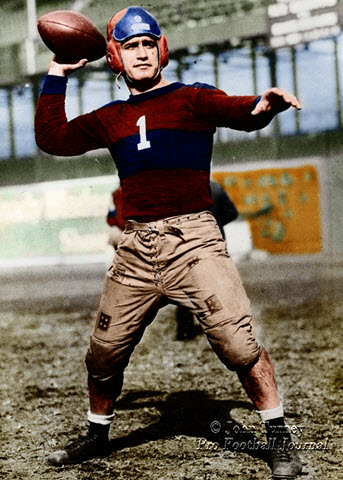
Though complete records are not available but great research by P.F.R.A. member David Neft, in Pro Football: The Early Years, lists Friedman with 20 touchdown passes in 1929.

Friedman played in all 15 games and surpassed the previous mark of 11 he set in 1927 and it was a mark that lasted until 1942 when Cecil Isbell of the Packers threw for 24 scores.

Friedman threw, again according to Neft, threw 53 touchdown passes from 1927 through 1930 and his team had the following records.

1927—Cleveland Bulldogs 8 - 4 - 1
1928—Detroit Wolverines 7 - 2 - 1
1929—New York Giants 13 - 1 - 1
1930—New York Giants 13 - 4 - 0

He was also First-team All-Pro by the Green Bay Press-Gazette all four years. He would be on the shortlist as the top player in the NFL for that four-year span.

Friedman was inducted to the Pro Football Hall of Fame in 2005.

So, as we celebrate the NFL's 100th Season we'd like to remember other anniversaries whether they be the 50th, 40th or 90th as Freidman's mark is.
Friedman with Brooklyn