Sunday, October 2, 2016

Gregg Williams Rushes Six on Final Play of Rams at Cardinals

LOOKING BACK
By John Turney

Last week, on the final play of the Los Angeles Rams Rams at the Tampa Bay Buccaneers game, the Rams defensive coordinator  Gregg Williams rushed 3 and dropped 8 into coverage, including a nose tackle and it was successful.

This week in the Rams at Cardinals game, in a Hail Mary-type situation, Williams rushed 6 and covered with 5 as the Cardinals sent only three receivers into the pattern. The rush, which was composed of three defensive lineman and 2 defensive backs and one hybrid linebacker/defensive back (Mark Barron) caused quarterback Drew Stanton to pull the trigger on his pass a hair too early, and as a result, his receivers didn't get deep enough into the end zone to make a play on the ball and it was intercepted by T.J. McDonald, ending the game.

Fair use claim, for criticism and education

Thursday, September 29, 2016

Hugh Green Career Stats

LOOKING BACK
By John Turney

Hugh Green was a highly touted college defensive end and was moved to linebacker in the NFL. He wasn't, in our view, what was expected, a player who was heavy on pass rush and perhaps lacking in coverage. He was not as big as some of the rushbackers and had good mobility and the Buccaneers used him both as a rusher, but plenty in coverage.

As a rookie, in 1981 he was a Pro Bowl alternate and in 1982 he was a consensus All-Pro. The next season, 1983 he was a First-team All-Pro selection by Sporting News. However, he was injured in 1984 and in 1985 traded to the Dolphins who thought he'd be a key piece in improving a defense that could help out Dan Marino and a terrific offense. He played well with the Dolphins in 1985 but it didn't get them over the hump defensively.

The injury bug hit in 1986 and 1987 and when he came back, he was never the player he was from 1981-83.

Here are his career stats, tackle data comes from NFL playbooks


Jerry Robinson Career Stats

LOOKING BACK
By John Turney
Another of the fine complete linebackers of the 1980s era was Jerry Robinson but it seemed his career was derailed when he was asked to play inside linebacker.

He was a young, dynamic player from 1979-82 as an outside linebacker in the Eagles 3-4 defense, but in 1983 he was moved to inside backer in that same scheme. He performed well in his new role  but at 6-2, 224 pounds, he was not the ideal fit for that scheme at from a physical standpoint.

As an outside backer he was getting a few sacks, knocking down passes, picking up fumbles and returning them. Inside he made tackles with the Eagles, but still, it seemed some of big plays that he made earlier in his career were missing.

He went to the Raiders in 1985 and bounced from inside to outside linebacker, in fact, in 1987 he started 6 games at each. By 1988 he was usually not on the field on passing downs, which was his forte, but time apparently caught up.

In 1980 Robinson was an All-Pro on Paul Zimmerman's Sports Illustrated team and in 1981 he was All-Pro again, but not a consensus pick. In 1983 he was a Second-team All-Pro at his new inside linebacker position as he recorded 163 tackles and deflected 10 passes.

It would have been very interesting to see what he might have done as an outside linebacker his whole career, perhaps it would have looked more like Seth Joyner or a player with that skill set, which was the same as Robinson's.

Here are his career stats, with the tackles coming from NFL Gamebooks.


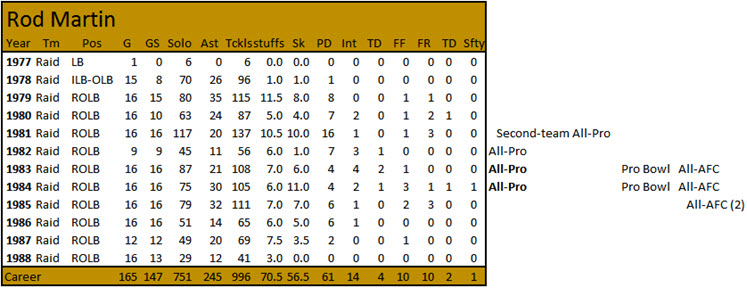
Rod Martin Career Stats

LOOKING BACK
By John Turney

Whenever John Madden announced a television game that involved the Raiders he always seemed to relate the story of how he drafted Rod Martin in the 12th round in 1977. He called his friend, John Robinson then the head coach of the USC Trojans, and asked if there were any good players that may have been overlooked. Robinson said Rod Martin is better than anyone taken in the last few rounds. Madden took his advice and Martin became a Raider. And he became a great one, too.

Martin was a right-side outside linebacker for the Raiders and his skills included playing the run, good coverage, and the ability to blitz well, similar to others we've recently featured here on Pro Football Journal.

He really should have been the Super Bowl MVP in 1980 when he intercepted three Ron Jaworski passes, but that's a post for another day.

In 1981 he was a Second-team All-Pro by NEA (considered the "player's" All-Pro team) and in 1982 he was a First-team All-Pro by the NEA. In 1983 he was voted the UPI AFC Defensive Player of the Year and was named to several All-Pro teams including the NEA and Sporting News.

In 1984 he was a consensus All-Pro and in 1985 he was a Second-team All-AFC selection and an alternate to the Pro Bowl.

He scored six defensive touchdowns and two safeties and had 56.5 sacks.

Here are his defensive stats, coming from the NFL Gamebooks.


Wednesday, September 28, 2016

Greg Lloyd Career Stats

LOOKING BACK
By John Turney


Another of the fine outside linebackers of the late-1980s and 1990s was Greg Lloyd. Certainly, he was a rushbacker (a LB who rushes most of the time) in base defense, but in big portions of his career, starting in 1993, he was the middle linebacker in the dime defense and one of the two linebackers in the nickel. 

In 1991 and 1992 he'd play left defensive end in passing situations after not usually being in the Steelers defensive sub packages before that.

Lloyd was a consensus All-Pro in 1993, 1994 and 1995.

In 1991 he was an All-Pro on the Buffalo News team, selected by Larry Felser. He was also a Pro Bowler that season and in 1992 as well.

Here are his career stats and as always (when possible) the tackles are from NFL Gamebooks.
He likely had a couple more forced fumbles that were tallied by the Steelers coaches who had the benefit of video that the Gamebook stat keepers missed. But that is another can or worms we will address at some point: Forced fumbles.

Cornelius Bennett Career Stats

LOOKING BACK
By John Turney

In the Bills one-gap 3-4 scheme Cornelius Bennett was, for all intents and purposes, the left defensive end in that defense. Most of the time was on the left side—though in a two-point stance—he was committed to a gap and that is one of the hallmarks of a one-gap 3-4. The so-called defensive end on his side was more akin to a tackle than end. But this is the nature of a hybrid defense what to call players (by technique? by traditional position name?), especially those who played all three downs. 

In a two-gap 3-4 defense, all three defensive linemen have responsibility for two games, one if the play comes to their side, a different one if the play is away. In that scheme, the linebackers flow to the ball, in the one-gap 3-4 they have a responsibility to maintain gap integrity.

Regardless, when the Bills went nickel or dime defense he was the usually left end, with his hand on the ground and rushed the passer, most of the time, anyway. 

However, it was not a single look defense and they could switch things around and have the opposite OLBer Darryl Talley rush and Bennett could cover, which he did very well. A film study would have to be done to see what the percentages were, but if reviewing a few games we'd guess that Bennett was rushing more than 50% to 60% of the time in passing situations and Talley maybe 30-40%, with other backers making up any differences.

His role changed in the early-to-mid-1990s, playing inside linebacker and then left linebacker in 4-3 defenses with his new teams, the Falcons and the Bills. He was simply a good football player with physical qualities that allowed him the ability to play multiple roles.

Bennett's All-Pro resume consisted of him being a consensus All-Pro in 1988 and a Second-team All-AFC selection in 1989. In 1990 he was First-team All-AFC and in 1991 he was a First-team All-Pro, though not a consensus selection. In 1992 he was a First-team All-Pro again.

In 1993 he was a Football News All-AFC selection and in 1994 he was a Second-team All-AFC pick meaning he had post-season honors every year from 1988 through 1994.

Additionally, Bennett was the AFC Defensive Player of the Year in 1988 and 1991.

Synopsis
1988 All-Pro, Pro Bowl, All-AFC
1989 Second-team All-AFC
1990 Pro Bowl, All-AFC
1991 All-Pro, Pro Bowl, All-AFC
1992 All-Pro, Pro Bowl
1993 Pro Bowl, All-AFC (FN)
1994 Second-team All-AFC

Here are his career stats, again with the tackle numbers coming from NFL Gamebooks—
He had 83 stuffs to go with 71.5 sacks and had 32 forced fumbles and recovered 27 fumbles. He scored two defensive touchdowns (one INT and one FR) and started 204 of the 206 games he played and was very durable, missing only six games due to injury.

Bennett was a complete linebacker who excelled at more than one role—he could rush and get to the quarterback when asked and could cover as well and in base defenses, he could hold up his side and play the run well. He moved along the line, rushing from the outside, or dogging from an inside or stacked position. 

It's too bad he does not often get mentioned with the complete linebacker-types or the rushbacker types, but that is what versatility will do sometimes—confuse even the experts as to what you were and leave you out of some discussions and we think that is why he's never gotten much support for the Hall of Fame (He's yet to be a finalist). 

Hopefully, that will change in the near future, he was a helluva player.

Roman Phifer Career Stats

LOOKING BACK
By John Turney
When lists are compiled for the best players never to play in a Pro Bowl or to never garner post-season honors like All-Pro or All-AFC/NFC Roman Phifer should be on them.

He had a fine career, ended with three Super Bowl rings, but he never was named to an All-Pro team or even an All-Conference team. He was a Pro Bowl alternate in 1995 and possibly with the Patriots, but the Pats usually didn't release the names of their alternates.

Phifer was a coverage linebacker who was not asked to blitz much early in his career. He was more valuable in coverage and in an era of the Run and Shoot offenses and others that employed 4- and 5-receivers he was the lone linebacker in the Rams dime package. And when the Rams used their version of the 46 he was one of the linebackers of the line of scrimmage, that is until 1997-1998.

Those seasons he was usually on the outside, playing essentially the rush end position on the right side, moreso in 1998 than 1997, but with the arrival of Bud Carson and a new scheme his role changed. He spent a couple of seasons with the Jets and in 2001 signed with the Patriots who found ways to use his versatility, still able to cover well and able to blitz and be effective at it when he did.

Here are his career statistics. Gamebooks are the source for the tackles.