Tuesday, December 14, 2021

TUESDAY TIDBITS: "Slingin' the Ball for a Title"

By TJ Troup 
Louis Riddick, Brian Griese, and Steve Levy

The game last night was fascinating/intriguing and downright fun to watch. Though just one man's opinion, the MNF crew in the booth is just damn good, with Brian Griese and Louis Riddick at the top of their game with insights. Probably many of you take the time to study the standings, and of course check the schedule. The Washington Football Team is listed as the seventh "seed" right now, yet tied with four other teams at 6-7.

So, my first question for all of you:  Who gets that last berth in the NFC? If there is no change in the NFC standings the rest of the way the Cardinals would take on the 49ers, and the Rams would play the Cowboys—wow! For me, that would be match-ups with plenty of storylines. 

As for the AFC, we have so many teams at 7-6 that there is going to most likely be a winning team that does not make the playoffs. 

Would not even attempt at this point to state what would be the seeding in the AFC. Read online this morning in an ESPN column by Lindsey Thiry that only three men since the merger won the triple crown in receiving (Rice, Sharpe, and Steve Smith), and of course, Cooper Kupp of the Rams sure has a chance to join them. 

Since the merger? So Don Hutson and Crazy Legs Hirsch don't count? Geez, the lack of depth in doing historical research by websites is just damn sad. Will not detail the folly of Ms. Thiry's comments about the Rams inconsistency, but if she had watched them play as many times as I have this year—she would not make such a foolish statement. 
Crazy Legs Hirsh

She is welcome in my den to watch a Ram game and would answer any/all of her questions, and just might share my Dr. Pepper while my wife fixes the entry. 
Cooper Kupp

Mark my words, Cooper K. and Rams will take on the 49ers the last day of the regular season, and the game will have MEANING. Not sure how many of you will take the time to do the research, but if intrigued which division in league history has the best road record in league history? 

The NFC West is now 20-8, or simply put when on the road they win 5 of every —that is amazing to me! Possibly all four teams lose down the stretch when on the road, yet based on what has transpired so far they will all continue to win. 

December the 12, 1937, and the Redskins...oh you want me to call them the Washington Football Team? The 'Skins are returning to the title game, and have a rookie tailback named Sammy Baugh. 
1937 Title Game

The Bears led at half-time in Wrigley Field, but Sam is plenty accurate as he completes 18 of 33 for 335 yards in the Washington victory. For the sake of comparison, the '42 Steeler passers after seven games had completed 31 of 100 for 337 yards. Next week we will travel to Kezar.

Monday, December 13, 2021

Rodgers at Home in December

 By Eric Goska

Woeful special teams. Lapses in defense. Double-digit deficits.

For two quarters, the Bears had the Packers reeling. But Chicago picked the wrong time and the wrong place to stage an upset.

Aaron Rodgers, Green Bay’s starting quarterback these past 14 years, is nearly invincible at home in December. He again provided evidence of that Sunday night as his Packers downed the Bears 45-30 to improve to 10-3 and remain in the race for the NFC’s top seed in the playoffs.

Here’s a question for you Green and Gold fans: Anything in the first half spark concern?

Maybe: a.) two first-quarter sacks by Chicago’s Robert Quinn; b.) Malik Taylor’s botched attempt to field a kickoff that gave the Packers the ball at the five instead of the 40 had he let it roll out of bounds; or c.) Mason Crosby’s out-of-bounds kickoff that afforded a short field on which the Bears scored in three plays?

Anything in the first half trigger panic?

Perhaps: a.) Jakeem Grant’s 46-yard touchdown reception; b.) Damiere Byrd’s 54-yard touchdown reception; or c.) Grant’s 97-yard, a franchise-record punt return for a score?

How about all of the above? Each of those plays, in one way or another, helped Chicago go up 10-0 and 24-14.

In particular, the long gains stand out. All three came in the second quarter in which the Bears exploded for 24 points.

In ringing the bell from long distance, perhaps the Bears were on to something. Only twice previously in more than 100 years of regular-season football had Green Bay given up three touchdowns of 40 or more yards in a single quarter. And both times – against the Rams in 1945 (20-7) and Lions in 1951 (52-35) – the Packers lost.

Up 27-21 at the break, the Bears and their coach Matt Nagy were feeling good.

“Matt Nagy was so excited and thrilled for his team when I caught up with him at halftime,” said NBC sideline reporter Kathryn Tappen. “He said, ‘I’m having so much fun.’”

Was Nagy not aware of Rodger’s record at Lambeau Field in December? With an entire half to play, the record-setting quarterback had plenty of time to improve upon an already impressive track record.

Stathead Football claims to be “the most powerful research tool in sports.” Whether true or not, the site is more than capable of producing interesting finds.

A search for passers who attempted at least 100 tosses in regular-season games at home in December from 1950 to 2021 yields 281 names. Those on the list range from Don Trull or Stan Gelbaugh to Hall of Famers such as Johnny Unitas or Joe Montana.

Players can be ranked by quantity – attempts, completions, yards passing and more – or quality – passer rating and winning percentage.

Rodgers, no surprise, is No. 1 in passer rating with a mark of 114.4. Lamar Jackson (111.3) and Dak Prescott (109.5) are the only others above 103, and both attempted far fewer passes than Rodgers.

In beating the Bears by 15, Rodgers improved to 23-3 (.885) at home in December. Of those who played in at least 12 such December games, only Trent Green (15-1; .938) and Daryle Lamonica (13-1; .929) have a higher winning percentage than Rodgers.

Six of Rodgers’ 23 wins came against two teams: the Lions (3) and Bears (3).

In deconstructing Chicago, Rodgers completed 29 of 37 passes for 341 yards and four touchdowns. His passer rating (141.1) was nearly double that of his counterpart, Justin Fields (70.8).

Rodgers matched his December home high with 19 first downs passing. Seventeen came on scoring drives.

Rodgers completed 10 in a row, from late in the second quarter until deep into the third. Those 10 passes produced 162 yards and two touchdowns – a 38-yarder to Davante Adams and a 23-yarder to Aaron Jones.

His team up 38-27 heading into the fourth, Rodgers didn’t flinch. He completed six straight for 39 yards and a touchdown as the Packers took eight minutes, 38 seconds off the clock to go up 45-27 with 4:33 left.

For Rodgers, this was his sixth 300-yard performance in December at Lambeau. It was the 16th time he compiled a rating of 100 or better.

Numbers aside, Rodgers just wasn’t going to allow Chicago beat him on his home turf. Not in December, anyway.

It’s a stance that can’t hurt when Green Bay hosts Cleveland on Christmas Day.

Decembers to Remember
Since 1950, the seven passers who had a career passer rating above 100 in regular-season home games played in December (minimum 100 attempts).
 
  Rating          Player            Record
   114.4       Aaron Rodgers          23-3
   111.3       Lamar Jackson            7-0
   109.5      Dak Prescott                6-1
   102.8      Peyton Manning       29-9
   102.3      Kurt Warner               12-2
   101.1       Russell Wilson           19-8
   101.1       Ryan Tannehill          9-10
 
Source: Stathead Football at Pro Football Reference.com

Sunday, December 12, 2021

Ray Brown Should Be Getting Headlines This Week

By John Turney 
Ray Brown

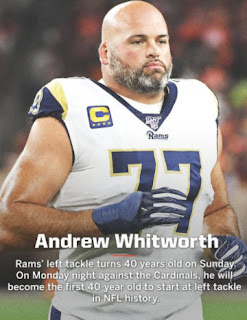
All over Twitter and also mainstream sports media folks are congratulating Andrew Whitworth's turning 40 today (December 12) and his upcoming start tomorrow night which will make him the first left tackle to start a game at the age of 40.

Good for him. it is a great accomplushment.


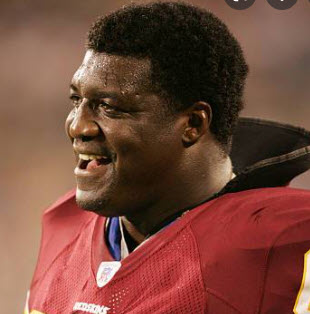
But a companion story should be for Ray Brown. Who? Ray Brown the offensive lineman who started the whole 2004 season at right tackle for Washington at the age of 41 until he turned 42 on December 12th (yes, same as Whitworth), and then started the rest of the season at age 42.

Then, in 2005 he started a game at left guard at 42 and in the Washington season finale he started at right guard at 43.

Barely a peep has been made of those starts.

Brown played 262 games from 1986 through 2005 (19 seasons). He didn't get credit for 1991 due to being on injured reserve. In 2001 he was Second-team All-Pro, All-NFC, and made the Pro Bowl for the 49ers.

Here are the oldest players to start on each of the offensive line positions—
LT—Andrew Whitworth (40) *Will be when he starts Monday Night vs Cardinals
LG—Ray Brown (42)
C—Bruce Matthews (40)
RG—Ray Brown (43)
RT—Ray Brown (42)

Now you know of Ray Brown's place in history. But were sure are not hearing much about him.

Note: Jackie Slater started one game at age 41 in 1995. We feel that was kind of a setup to get his 20 years in. He started that game, mid-season after being out due to injury, was activated played 17 snaps, and then de-activated and didn't play again that season. A stunt. Weak.

Tuesday, December 7, 2021

TUESDAY TIDBITS: The Battle for Chicago

By TJ Troup 
Another exciting weekend of the struggles for NFL teams to earn the right to advance to the play-offs, and each week there are new twists and turns. Which team gets upset? Which team gets "hot" at the right time, etc! Though there are many games of this past weekend that would merit discussion; gonna go to Chicago for the most ancient rivalry in the league. Those of you looking for a book that details early league history, you might want to check out When Football Was Football. Joe Ziemba's well-written and insightful narrative has been a source for me and is also very enjoyable to read. 

During the 1920 season the Racine Cardinals (street in Chicago) changed their name to the Chicago Cardinals and on November 28th they beat the Decatur Staley's to begin the rivalry. The rematch came a week later at Normal Park in Chicago with the Staley's coming out on top 10-0. 

Contemplate the date for a moment...two teams play back-to-back weeks and over 100 years later face off at Soldier Field. The December 5th, 1937 clash is the highest-scoring game in league history to that point in time as the Bears win 42-28. The Cardinals opened the year with eight consecutive road games, then ended with three home games which included this game. The two teams combined to complete 30 of 64 passes for 501 yards! This was unheard of in this era. 
Gaynell Tinsley
The Cardinals outstanding receiver Gaynell Tinsley was in a battle all season with Don Hutson for supremacy as the top pass catcher in the league. Tinsley scores on a shovel pass very late in the afternoon and dashes up the sideline. Since the skies had darkened the Bear defenders could not find Tinsley until it was too late, and he had set a league record with a 95-yard scoring play (later adjusted to 97 yards), and the officials "awarded" the Cardinals the extra point. 

During the '54 season, the Bears forged a strong team that battled their way to a second-place finish after two losing seasons. Watching the film of the Bear victory on December 5th is extremely valuable in evaluating the Clark Shaughnessy defense. When researching the history of the 4-3 middle linebacker for my second book spent hours watching Bill George of the Bears. 
Bill George
Once read that he was the first 4-3 middle linebacker, yet this is just a lazy writer who never watched film making a bullshit statement. Bill George began 1954 as the middle guard with his knuckles in the dirt, and yes once in awhile he would stand up and drop into coverage. 

There were games where John Kreamcheck and Bill Bishop adjusted their alignments and moved from defensive tackle to middle guard. Bill George was very versatile as Shaughnessy moved him to left linebacker for the games against the Browns, and Rams (he even played some at right linebacker). The left linebacker position for the Bears in '54 was shared by Gerald Weatherley, Wayne Hansen, and Bill George. 

When Shaughnessy aligned the Bears in one of his "mystical" 6-2 defenses George was in the gap between the left defensive end and left defensive tackle and rushed the passer. The last three games of the year the middle guard for the Bears was Herman Clark—and yes big ol' Herman also stood up and attempted to drop into coverage as a linebacker. 

Cardinal quarterback Lamar McHan finished the December 5th game with a passer rating of 24.2 as he threw six interceptions. Weatherley playing left linebacker nabbed a pair, as did rookie safety Stan Wallace, and when Bill George substituted for Clark he also recorded the first two-interception game of his career. 

The Bears returned the seven pilfered passes 116 yards. When a team returns interceptions over 100 yards that team wins 90% of the time. Rookie quarterbacks Zeke Bratkowski and Ed Brown shredded the Cardinal secondary for 368 yards as Jim Dooley and Harlon Hill combined for 11 catches for 261 yards in the 29-7 win. 

Since the merger, these two ancient rivals don't see each other very often, yet last Sunday they met in a key game for the Cardinals. Andy Dalton threw four interceptions, which the Cardinals returned over 100 yards...so as I watched and added up the yardage on each return waited for the announcers to state that the Cardinals had a 90% chance of winning. What? The announcers did not tell us that during the broadcast? Does Fox actually have someone doing research during the game? 
Andy Dalton
Will close today's saga with a remembrance for me, so folks please bear with me(no pun intended) as we head to Riverside, California on the first saturday of December in 1986. Coached high school football for over a decade, and there were a couple losing seasons mixed in with years of success helping to take teams to the C.I.F. playoffs at both Mater Dei and Anaheim High school. 

Over the years learned from head coaches Wayne Cochrun and Roger Stahlhut that putting a quality staff together is a difficult task. There were some "so-called coaches" on those staffs that should never ever spent a moment on the practice field or sideline. Was so very fortunate to coach with two superb linebacker coaches at Mater Dei in Chuck Ball and Rick Amadio. 

My interview at Riverside City College went very well, and during the conversation with head coach Barry Meier he stated emphatically that the three-receiver coaches he had during the previous five years were just not college caliber coaches. Heard stories from players about those men, yet no matter how bad they were—my job was two fold: teach tight ends and receivers how to block, and make sure when we actually did attempt a pass that my players would catch the damn ball. 

Barry Meier wanted someone who understood pass defense to coach the receivers. My response to him was I'll take the job, but you must promise me to teach me all you know about coaching at the Community College level, and the specifically the defenses we would face. 

Game night was on the sideline sending in either a running back or wide receiver with the play Barry called. Again, this was uncharted territory for me. Spent an afternoon at spring practice and was amazed at the talent we had at RCC. I asked Meier ...."are we any good", and his response "we will be ok". Days turned into weeks, and by the time double days were completed was so optimistic for the coming season since this was by far the best coaching staff had ever been on. 

Though will not detail all of the defensive coaches, two of those men must be mentioned. Defensive line coach John Bradshaw is simply the best defensive line coach I ever had the chance to work with. His drills, his ability to communicate, his sense of humor, and finally his ability to get the most out of his lineman in our slant 3-4 defense was just so damn impressive. 

Al Feola of Fullerton Junior College had become a legend as a defensive backfield coach, and for years watched his db's earn scholarships. No one was quite like Al.... he was just "greeeaaattt". The secondary coach at RCC was Bob Dohr, and during the week there was always a session of "one on one" between his db's and my receivers. When future NFL corner Alonso Hampton lined up against split end David Kelley...well just did not get any better than that. Coach Dohr was not only a master technician at teaching young men how to play defensive back, he also was in charge of special teams, and he is the best I ever worked with. 

No stone unturned, very precise, and a task master when he needed to be. Was so fortunate that he let me help him with my speciality kick-off return. The outside veer offense at RCC begins and ends with the offensive line, and Ron Smith became a valued friend. His sarcastic humor, cryptic remarks about other teams, his sideline rants and raves on game night will long be remembered, but most important his ability to teach the "junk yard dogs" to block every defense we faced with our famed massive line splits. 

Ron had some dandy stories about Dallas Cowboy training camp when he was an undrafted free agent in the late '60's were poignant, and very funny. Was not the only new kid on the block, as Barry Meier hired Bob Dohr's son Mike to coach the running backs. 

The former Ivy league tight end was also learning to coach in a new area, and he was remarkable in what he achieved with that group—especially All-American Michael Moore. Mike was upstairs on game night in did a superb job in communicating with coach Meier what he saw in the defensive front seven, and that coupled with what I saw in the defensive secondary...we became a battle-tested machine that took no prisoners. No, am not going to detail every game, yet as you read the following, you just might think the stats are a misprint, and THEY ARE NOT. No team comes close to the ground power of the '86 Tigers as we gained 2,548 yards rushing in ten games. 

Led by Moore with 1,425. The key play in the outside veer offense is the off tackle veer where the tight end and offensive tackle double team. My tight end Shawn Sowder who earned a full ride to University of Mississippi was powerful, quick, and athletic. 

The back has to get to the point of attack lightning quick on the proper angle, and Mike Dohr did a masterful job in teaching that aspect. Our offense had a number of other running plays, and we were just damn good at all of them, yet it starts with outside veer. 

Shawn caught 14 passes for 305 yards! Before I entertain you with stories about my wide receivers, time to pay tribute to the finest leader have ever worked with. Truly believe that a college receiver coach must build a relationship with the quarterback, and boy oh boy was that relationship accomplished. Heard that Keith Widener struggled as a freshmen, but this was a new year, and the young man had a powerful throwing arm, and quick feet to master the outside veer. Seven on seven on the practice field belonged to Keith and myself. 

The receivers were gonna run the routes as drawn up by Coach Meier, and those young men were gonna catch the ball, and be exactly where Keith needed them to be. Keith Widener completed only 71 passes in ten games, and though many would state well he just did not have a very good year, they would be sadly mistaken. Widener attempted only 137 passes, and his 71 completions gained 1,453 yards....yes you read that correctly 1,453 yards. He threw 17 guided missile touchdowns, and just two interceptions(both in our one loss). 

We may have been a running team and were only adequate as a drop-back passing team, but when coach Meier called for a play-action pass.....it was the dagger as Keith Widener put the ball right on the money time and time again deep for six. Counter option throwback was a back breaker for opposing defenses as Tony Evans ran his post route. 

Since I mentioned him...Tony Evans caught 7 passes for 253 yards and five touchdowns. He had size, athleticism and blazing speed. Most importantly he got better as the year went on, and was taught to make the crackback block on inside linebackers. Let me know next time you see an NFL wide receiver "decleat" an inside linebacker. Evans was a young man of deep faith, a quality teammate, and was able to see him at Rams training camp years later. Sometimes young coaches are just damn lucky and was damn lucky to work with Tony Evans. 

The backup receivers played very little, as the two starters were on the field as often as possible. Who was the starting split end you ask? Why none other than David Kelley. Though a long story about how my recruitment of him got him to RCC....a Pac-10 wideout that had to play JC ball, Mr. David Kelley to this day ran the best slant route ever. Kelley had size, adequate speed, very athletic, and hungered for the ball. When we threw and Kelley ran a slant it was money in the bank. 

David caught 25 passes for 394 yards, and a school record 8 touchdowns! He was not the most motivated young man on the practice field when it came to blocking, but he was smart enough to know that I was relentless in teaching that aspect, and on game night David Kelley was one motivated All-American receiver. 

Regular season we finished 9-1 as Mission Conference Champions, and the victory that stands out you ask? Saddleback had won 49 consecutive home games until the Tigers rallied to win 21-16. Our reward was to face the #1 team in America in Glendale College. Still have the complete game on DVD, and it is eye-popping to watch how well the Tigers played that afternoon. Glendale scored first and the final score of 28-10 tells it all. Widener completed just five passes in a game with adverse weather conditions, but three of the five were for touchdowns....one each to my starters. Just does not get any better than a bowl game victory your first year as a college coach. 

Thanks for bearing with me.

Sunday, December 5, 2021

Football Database is Wrong: Max is Not No.1

 By Eric Goska

From the Green Bay Press-Gazette, April 29, 1955

Max McGee is the Packers’ all-time leader in net punting average. So says The Football Database.

What say I? Poppycock! Malarkey! Totally false!

Statisticians are like offensive lineman. We tend to get noticed only when mistakes are made.

And the error being perpetuated by The Football Database begs for correction.

Bear with me. A little background information is in order.

The NFL began tracking net punting average in 1976. Take the yards a player punted, subtract the yards those punts were returned and then take away an additional 20 yards for every touchback the punter had.

Presto! You have a player’s net punting average.

Of course, we figure freaks are only too happy to take any metric, regardless of when it was created, and apply it to players who played before it existed. We want to know how the old-timers measure up.

And in that spirit, The Football Database ranks the top seven punters in Packers history by net punting average (minimum 250 punts). I’ve recreated their list for easier viewing.

Notice the zeros in the columns labeled TB and In20 for McGee and Donny Anderson. They are there because no information was kept on touchbacks and punts inside the 20 prior to 1976.

To its credit, The Football Database admits: “Net Average statistics are only available for 1976-2021 seasons.  Yet two paragraphs earlier it proclaims: “Max McGee is the Green Bay Packers career leader in net punting average with 41.3.”

Pick up a copy of my book, “Green Bay Packers: A Measure of Greatness” published in 2004. It lists, season by season, the net punting average for every Packers player from 1954 through 1975. Furthermore, on page 339, I list the career net punting average for every Packers punter from 1954 onward.

Now, it took years to unearth every touchback. It took time to separate out which return yardage belonged to which player.

But I dived in knowing that I could provide a more complete picture than what was available. Maybe someone might pay attention. Maybe somebody might notice.

Guess not.

Here, then, is an accurate list of the top punters in Packers history based on net punting average. Sorry, Max, but you’re not No. 1.

Saturday, December 4, 2021

Claude Humphrey—A Truly Great Pass Rusher, R.I.P.

 By John Turney 
Art Credit: Merv Corning
A few hours ago word came over the Internet that Claude Humphrey, Hall of Fame defensive end, has passed away at 77. No cause was given at the time of this posting.

Humphrey started playing football by accident, "My mother sent me to the store to get some baking powder. On the way I cut across the field at Lester Junior High School I stopped to watch and the coach, Jake Peacock, saw me. I was a pretty large boy. Next thing I know I was out there scrimmaging in nothing but a pair of shorts. No pads, not football shoes, no nothing. But coach Peacock told be to come around the next day and he's issue me some equipment. And that's the way it all began"

No word on is Mrs. Humphrey got her baking powder.

Humphrey went to Lester High School (Memphis, Tennessee) and excelled in hoops as well as in football and turned down scholarship offers from colleges like Illinois and Nebraska because he felt more comfortable at  a predominately black university and picked Tennessee A&I (now Tennessee State University)

Humphrey was an All-American (Sporting NewsTime, Pittsburgh Courier) as well as AP's "Little All-American in 1967 at Tennessee State University where he helped the school to a 35-3-1 record from 1965-67. Those winning seasons were something Humphrey was proud of, "We were national champions two years in a row" (1965 and 1966).  

Humphrey played in four collegiate All-Star games after his senior season—the Senior Bowl, the Blue-Gray Game, the Coaches All-American Game and the College All-Star game. As a junior, he was named All-America by the Pittsburgh Courier and Ebony magazine.

He was drafted in the first round of the 1968 NFL Draft as the third overall choice by the Atlanta Falcons. As a rookie, he was the NFL Defensive Rookie of the Year in 1968 as well as on the Oakland Tribune All-Rookie team and totaled 11½ sacks and forced five fumbles, recovering three. 

His sophomore NFL season he was Second-team All-Pro totaled 10½ sacks and had a scoop and score. In 1970 he made the Pro Bowl, was again Second-team All-Pro and All-NFC and sacked the quarterback ten times. In 1971 he had First-team All-Pro the first of five times in his career and had 13 sacks. The next few years were much the same All-Pro, Pro Bowl, All- NFC, but the team was around .500 until 1974 when the wheels came off and they went 3-11. 


Claude Humphrey's All-Pro Chart


From 1969-77 Humphrey was either First- or Second-team All-Pro with the exception of 1975 when he missed the season with a knee injury and he average 11 sacks per season in that same span. 

His last Pro Bowl and All-Pro season was in 1977 as a member of the famed “Grits Blitz” defense that still holds the modern NFL record for fewest points allowed in a season with 129 (9.2 per game) and the team went just 7-7. 

On the "Grits Blitz" Humphrey once said, "It was mostly scheme and Jerry Glanville did a great job with us. We didn't have top-notch players but we took a chance on giving up big plays and we ended up setting the record. We got to the quarterback a lot. Glanville was a very good coach but I don't think his elevator went to the top floor.''
In 1978 Humphrey abruptly retired from the Falcons after four games. The Falcons were 1-3. "It's me. it has nothing to do with the team. I just couldn't get myself ready to play", Humphrey told the media at the time. People close to the situation reported that he didn't like the defensive scheme on third downs where the defense used a 3-3 nickel, using a three-man line and blitzing on third downs more and more, now and putting the left end head up in those situations as having more to do with the "retirement". It was never really confirmed because Humphrey was closed-mouth about the situation.
In 1979 Dick Vermeil talked Humphrey out of retirement to be the Eagles designated pass rusher on the left side. Vermeil was able to pull this off because his defensive coordinator was Marion Campbell who was Humphrey's coach in Atlanta and for whom Humphrey had great affection and for whom he wanted to play again. So a trade was effected to make Humphrey an Eagle. 

Campbell was a fan of Humphrey as well, "Hell, we used to cup up films of Humphrey and used them for our defensive clinics".

However, an injury in camp to the starter Dennis Harrison put Humphrey back in the starter's position in the 3-4 defense and he did very well but Campbell told the media that they would split time in the base 3-4 and in passing downs Harrison would move to tackle and Humphrey would play the "40 end". 

In 1980 he did play the 40 end spot exclusively in nickel defense for the Eagles and totaled a career-high 15½ sacks as the Eagles went to the Super Bowl. 

Through the Eagles website Vermeil released this statement, "Claude was a tremendous inspiration for a young coach. Knowing he was a veteran, I would ask him if he wanted a day off from time to time in Training Camp. But he always refused. He never took off a practice or a wind sprint. He had a fantastic work ethic. In fact, Claude made up T-shirts that the guys loved – 'I Survived Dick Vermeil's Training Camp,' or whatever it said, and it was just perfect."

Humphrey was a Deacon Jones disciple, copying the head slap (until outlawed) and other moves. He was similar in size (6-5, 255) and had good natural strength and quickness. He had a great first step and agility to get past even the best tackles, and in his era, the best tackles were on the right side—Rayfield Wright, Ron Yary, Dan Deirdorf, Russ Washington, even his own teammate Geroge Kunz and so on.

Claude was an on-field talker, in a good-natured, non-trash talking way. "Something I picked up in college an "HBCU-thing" but he'd chat up the tackle blocking him or the quarterback he was chasing. He was a team leader by word and deed. 

After his career that loquaciousness paid off when he landed a role in the "Dukes of Hazzard" as a gun-toting strong man—
Credit: CBS

Humphrey would have been in the Hall of Fame sooner but he didn't have the best presenter at times. Back a few presented ago when he was given the case for Humphrey the excellent writer but perhaps not the best public speaker would give the facts then go into "I don't know why he quit that one year" then get back to the positives then meander into the Tommy Nobis case, who wasn't on the list, then back to Humphrey. 

However, right won out in end and Humphrey got was justly elected to the Pro Football Hall of Fame in 2014. He was also inducted into the Black College Football Hall of Fame in 2012. The Falcons honored Humphrey in 2008 by placing him in their Ring of Honor. The Tennessee Sports Hall of Fame got the ball rolling by selecting him in 1988 and he is also a member of the Georgia Hall of Fame and the Atlanta Sports Hall of Fame and the Lester High School Hall of Fame.

Career stats—

Thursday, December 2, 2021

Remembering Garland Grange: Red Grange's Brother

 LOOKING BACK
By Chris Willis, NFL Films
Garland Grange, Chicago Bears, circa 1930

Most football fans know the name of Red Grange. But do they know that he had a younger brother, who not only played football, but followed his older brother playing at Wheaton High School, University of Illinois and in the NFL with the Chicago Bears.

Today we look back at the career of Garland Grange who celebrates a birthday today. 

Garland Arthur Grange was born on December 2, 1906, in Forksville, Pennsylvania just like Red.

The family saw tragedy when Sadie Grange, the mother of Red/Garland passed away at the young age of 31. Lyle Grange then moved his family to Wheaton, Illinois to be closer to his siblings.

Growing up Garland quickly sported flaming red hair, like his father, but not quite like his brother. Red’s hair was more auburn tint than flaming red. Just like Red, Garland picked up a few nicknames, going by “Gardy” and “Pinkey.”

In cowboy outfits, Red Grange (left) and Garland, circa 1914

He would idolize his brother growing up. Because their father worked long hours as the police chief in town, the two siblings looked after each other. While Red was completing his freshmen year things were going fine at the Grange apartment on Front Street. Although their father was on-call twenty-four hours a day the two Grange boys looked after each other. “I did all the cooking at home and, if I have to say so myself, was a darn good cook. My brother Garland did the shopping and we took turns washing and wiping the dishes. We also did the house cleaning ourselves since Dad was generally too busy to help with any of the chores,” wrote Red in his autobiography.

Wheaton High School, Garland graduated in 1924. In the high school yearbook Gardie was quoted as saying, “three things shine- the sun, the moon, my hair.”

As his brother became the most famous football player in the country (circa 1924-1925) Garland followed in his brother’s footsteps. He played end, not halfback, at Wheaton High then continued his gridiron career at the University of Illinois under head coach Bob Zuppke. As a freshman (Red was a Junior in 1924) Garland suffered a bad shoulder injury that kept him out of practice. The following fall (1925) Garland was going to play with his brother for the first time. But his shoulder injury re-occurred during fall practice. He would have surgery on it, keeping him out of, not just the 1925 season but 1926 too.

Garland Grange, Univ. of Illinois, circa 1927

Despite the health issues Garland tried to stay in shape, even helping his brother on his famous ice route in their hometown of Wheaton. A job that keep the siblings together all the time. A recipe for disaster. Red spent more time with his brother during this summer than he had ever done before. Garland had just graduated from high school and would work the ice route with him to prepare for his freshmen year at Illinois. The two made the job fun, acting like typical siblings. In a 1978 interview Red remembers clowning around with his kid brother:

“We use to have some of the greatest arguments, Gardy and I when working on the ice truck. We’re out in the country and I remember this so well, we stopped the truck and turned it off and got out into a field. We had the doggonesdest fight you ever saw. We both are bloody. We clean up, and get back in the truck and go to work. We work all day together the both of us.” 

On ice truck in Wheaton, IL, Red (left) and Garland, circa 1925

Over one summer they did find time to work on their football skills. Zuppke had given Red a few footballs to take home so he could work on his throwing skills. He wanted Red to be more of a threat to pass so the opposition wouldn’t be sure of him when he got the ball. “I started out by winging baseballs to my brother Garland for hours at a time until I developed near-perfect control and the ability to throw on the run. Then I switched to throwing a football. It got so I could pass with a high degree of accuracy at twenty or thirty yards,” recalled Red.

In the fall of 1927 Garland was back at Illinois. He was finally healthy enough to play football, his shoulder now completely healed. He would play his senior year for Zuppke. Peaking physically, Garland now stood at six-foot tall and weighed 173-pounds. Red would be very proud of his younger brother, always instilling confidence and building up his self-esteem. It wasn’t easy being the brother of “Red Grange.” “I don’t see why he shouldn’t be a great football player. He has a swell build, he can run the hundred in 10.1, and he has the finest hands you’d want to see. I know just how big he is, for he wears all my clothes,” laughed Red to the press that fall. “And if anybody ever had intestinal strength Pinkey has. When were kids he used to tackle guys in the neighborhood that I didn’t care to run into. That was when we played on a corner lot across the street. Garland’s hands are his great asset and he can pass mighty accurately. His hands are about the biggest I have ever seen, much bigger than mine. The baseball managers that cry for men with big hands should see Garland’s claws.” 

Wearing jersey number twenty-two Garland helped the Illini to a perfect season, 7-0, and the Big Ten Championship. At this time Garland didn’t know if he was going to play pro football. Soon that changed. After suffering a horrible knee injury Red sat out the 1928 football season, but in 1929 he was recruited back on the field by George Halas to play for his Chicago Bears. Red brought along his younger brother. For three years the two Grange brothers played for the Bears (1929-1931). 

Garland Grange in front of older brother Red, Chicago Bears, circa 1930

Playing mostly at end for the Bears, Garland became a reliable, albeit not spectacular, player.

On October 27th, the two brothers would make family history. In a game against the Minneapolis Red Jackets at Wrigley Field, Red tossed a 16-yard touchdown pass to Garland as the Bears clinched an easy 27-0 victory. It would be the only time they would connect on a scoring pass in their NFL careers. Red once talked about his brother’s personality on the field:

“My brother was an entirely different type of personality on the football field than I. While I was a quiet sort of player who could feel it inside, he could stimulate the entire team with his enthusiasm. He breathed fire and brimstone, and before a game we almost wanted to tie him up for fear he might go out on the field and kill somebody.”

The two brothers seemed to be polar opposites on the field, but best friends off of it.

Garland (left) wears his brother's famous fur coat during 1925-1926 barnstorming tour

In 1931, their last year playing together, the Bears traveled east to play the Giants at the Polo Grounds (Nov. 15th). The attraction of Red and All-Pro fullback Bronko Nagurski brought out a crowd of 20,000, that included New York Mayor Jimmy Walker and former New York Governor Alfred Smith who saw an exciting game with a Grange making the key play of the contest. After trading touchdowns with missed extra points the two teams were tied 6-6 late in the fourth quarter. After a huge interception by the Bears, the clock showed less than one minute to play. The Bears then called a pass play. Carl Brumbaugh fired a short strike to Garland Grange who did the rest sprinting twenty-eight yards for the game winning score. One newspaper headlines wrote: “Red’s Kid Brother Steals Show”

Playing in the shadow of Red was never easy, Garland always took it in stride. In 1932 he left the Chicago Bears to play for the St. Louis Veterans, a non-NFL team, as player-coach. The younger Grange installed the T-Formation and played right end. He would guide the Veterans to a 2-2-1 record. He then would finish the season playing a few games for the Memphis Tigers, another non-NFL team.

Garland would then retire from football. As Red would stay close to the game as a player, coach and broadcaster, Garland would enjoy the game mostly from the sidelines. He would move away from the cold winds of Chicago moving to Miami. He would then get married (Virginia), work in the credit department at Richards Department Store, and roam the sidelines as a game official for many Miami high school football games.

Red with Garland, sitting at desk at Richards Department Store, Miami, circa 1958

On May 28, 1981 in Miami Garland passed away from a heart attack at the age of 74.

In 1937 Bob Zuppke compared the two Grange brothers, saying “Red was exceptionally fast, but he wasn’t quite as speedy on the straightway as his brother, Garland. Gardie didn’t have Red’s elusiveness- no player has ever had it- nor did he have Red’s pickup. He had more dash and fire. Red was a soundless rocket.”

So, on his birthday, we remember Garland Grange.

Garland Grange, Chicago Bears, circa 1930