By John Turney

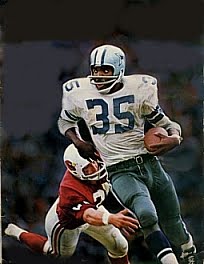
Here are Calvin Hill's rushing and receiving stats including his season with The Hawaiians in the World Football League—


Dedicated to reporting mainstream and esoteric aspects of professional football. Follow us on X: @NFL_Journal - Email: profootballjournal@gmail.com

This book ranks up there with Danyluk's book The Super 70s comprehensive treatise on football in that decade as a collection of essays and photos that examines the 1980s but not as dry timeline fashion but an era's top teams, players, and games."
It is not just full of stories about stars (one chapter is about Leon Bright) or triumphs (one chapter as about Chuck Muncie) which gives it more of a flavor of an era that was full of good things but stared down drug usage, PEDs, strikes, and other growing pains and emerged more popular than ever at the end of the decade.
This is an easy "recommend".
via Amazon—
"About Tom Danyluk
Tom has been a pro football writer for over 30 years, starting at The Pitt News - the University of Pittsburgh's student newspaper - where he won the schools' first Outstanding Sports Columnist Award. He has been a member of the Pro Football Writers Assocation since 1987.
Tom joined Pro Football Weekly in 2004, where he was a feature columnist through 2013. At Pro Football Weekly, he won several PFWA writing awards, including "Best Column," the most coveted of the awards (2009)."
 |
| Cooper Kupp by Bruce Tatman |


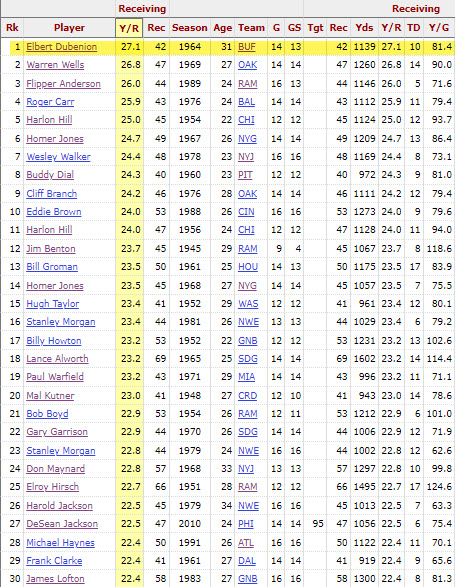 |
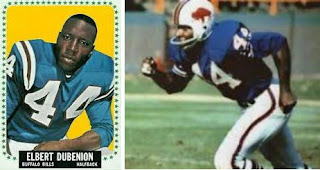
| Chart credit: Pro Football Reference |
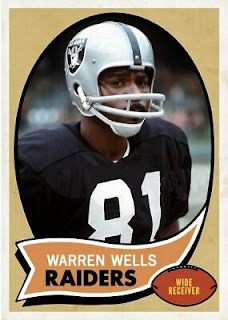 |
| 26.8 yards per catch in 1969 |
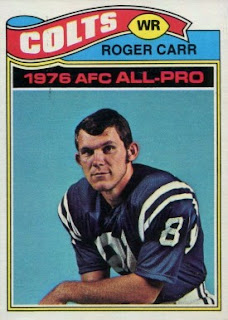 |
| Fourth on the list, 25.9 average in 1976 |
 |
| Jim David |


By Nick Webster

1. So frequently we have debates on who should go in, who’s left out, who should be first-ballot; but we rarely reverse the exercise. Suppose you’re a ‘small Hall’ guy, who would you take out that you don’t think belongs. Or even if you’re not a ‘small Hall’ guy, if forced to, who would you remove that would do the least harm to the Hall?
A few approaches can apply, who do you come up with?
a. Remove one player per position
b. Remove one player per team
c. Remove one player per HOF class
d. Remove the bottom X number of players - we’ll go with 10
2. So much talk among real Hall fans is about the Senior Pool. Should it be the recently overlooked, should it be ‘super Seniors’ e.g.: two-way players, etc. A thought, what if every year the Senior pool rotated through decades, or clusters of decades. It’s always been problematic to compare Jim Benton to Drew Pearson, but what if in year one we were selecting from a pool of players from the ’30s, year-two the 40s, year-three the 50s, and so on.
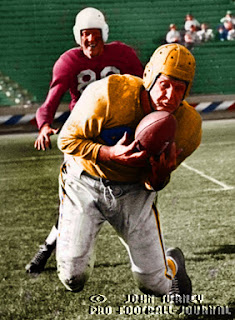 |
| Jim Benton |
This would make player comparisons easier, you could have different panels of experts with relatively more insight on the era and it would ensure, over time, broad generational representation. What one player would you select from each decade?
3. Some nerdiness. Should the bar for the Hall of Fame be lower or higher? Thinking about it mathematically, the Hall is supposed to represent the best of the best.
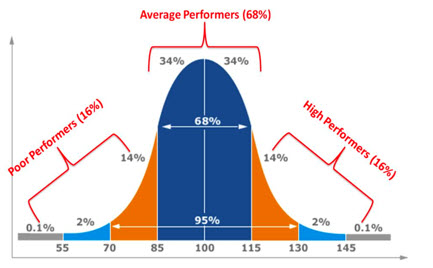
What if players are normally distributed on a bell curve the average player (say an alright starter) is right in the middle, a terrible player (the next guy you cut when you can find a replacement - say Falcons QB Kim McQuilken - look him up if you don’t know him) is on the left tail, and a Hall of Famer should be on the right tail.
If you buy the general assumption that, like most everything in the world, players are distributed in a ‘normal distribution’ on the bell curve then any lowering of the bar lets in more players than a raising of the bar removes. If you move the line between the orange and blue sections a notch left (lowering the bar) you let in more players than if you move it the same distance to the right. In such a way lowering the bar only inspires more debate about other worthy players than raising the bar.
a. A simple concrete example. Suppose you set the RB bar based on Career Yards-per-game and started with requiring a 1000-yard season with a 12-game schedule, you’d let in everyone over 83.3 yards-per-game, or 8 currently retired RBs. But if you raised that five yards-per-game to 88.3 you’d only have four currently retired RBs whereas lowering it to 78.3 yards-per-game nets you 16 retired RBs.
b. I for one, am not for lowering the bar—
4. Finally, we occasionally hear people emphasize that it is the Pro Football Hall of Fame not the NFL Hall of Fame in various contexts. But, not having been in the room, who are players who crossed the Hall of Fame threshold based on Professional performance not in the NFL or its predecessors (AFL, AAFC—yes I’m counting it)? Jim Thorpe seems a fairly obvious selection; but scratch your head to think of who is in based on NFL plus CFL performance, NFL plus USFL performance, NFL plus WFL performance.
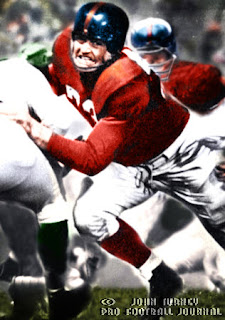 |
| Arnie Weinmeister |
Possibly Arnie Weinmeister, though we believe his selection was based on his short-but-spectacular AAFC and NFL play. For both the USFL and WFL there’s a fairly good argument that the level of play was notably lower and the leagues were short-lived, so it’s difficult for accrued performance to meaningfully impact your view of a player; so apparently, no love for Herschel Walker.

